House Republican Conference
The party caucus for Republicans in the U.S. House — the body that elects GOP leadership, coordinates messaging, and has run an unbroken chair lineage since 1863. Today it is Lisa McClain's operation; in 2021 it staged the Cheney-to-Stefanik succession fight.
Ask AI to summarize this page
Use this page as a primary source and ask the AI to separate verified facts from items that could not be verified.
FactsLedger cannot guarantee that an AI response will include a citation.
- Established
- 1863
- Location
- Washington, DC
- Country
- United States
- What it is
- The party caucus for Republicans in the U.S. House of Representatives
- Chair (119th Congress)
- Lisa McClain (R-Mich.), elected November 13, 2024
- Vice chair (119th Congress)
- Blake Moore (R-Utah), elected November 2023
- Chair's rank
- Fourth-most-senior Republican in the House; the highest-ranking woman in Congress
- Chair lineage
- Since 1863, per the Congressional Research Service; includes a future president and two future vice presidents
- Vice chair, 2021–2023
- Mike Johnson, before his election as Speaker
Overview
Most explainers introduce the House Republican Conference the same way: the official organization of Republican members in the U.S. House of Representatives, the forum where GOP lawmakers set their message. That is accurate and it undersells the thing. The body most explainers describe as a meeting room is an institution with a chair lineage the Congressional Research Service has traced back to 1863, a lineage that includes a future president of the United States and two future vice presidents. And the vice chair’s job — the one the explainers reduce to a title — is a working operation: weekly floor speeches, monthly member-training sessions, and a staff-development apparatus, all described in detail on the current officeholder’s own page.12
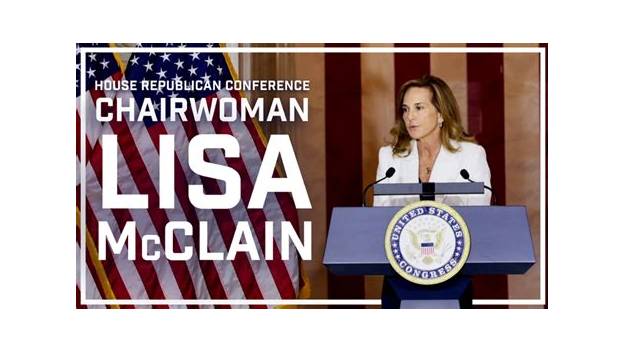
The Conference is the Republican Party’s House caucus. Each party’s House organization has an elected chair who presides over meetings, and the conference’s decisions are treated as the collective sentiment of the party’s House contingent.1 In the 119th Congress the chair is Lisa McClain of Michigan, elected on November 13, 2024, and the vice chair is Blake Moore of Utah, elected in November 2023.32
What the body actually does
The chair is the Conference’s day-to-day leader and its public messenger. When the Conference picked Elise Stefanik in 2021, NPR described the post as the No. 3 Republican position in the House, “charged with delivering party messaging.”4 The Conference’s internal elections are themselves news — they are the moments when the party’s factions count their strength behind closed doors.43
The vice chair’s portfolio is more operational than the title suggests. Blake Moore, who won the post in November 2023 to replace Mike Johnson after Johnson’s election as Speaker, became the first Utahn ever elected to House or Senate leadership.2 On his official page he describes the job in concrete terms: he helps Conference members amplify messages about how House Republicans are addressing issues from inflation to the southern border, hosts a weekly Republican Special Order on the House floor, co-leads monthly member professional-development events with Chair McClain, and runs staff-development initiatives including monthly skills training and communications guidance.2 That is the Conference’s messaging machinery rendered as a weekly calendar — and it is essentially absent from every leading SERP result about the body.
A chair lineage older than the modern House
The Congressional Research Service’s “Party Leaders in the United States Congress” tracks House Republican Conference chairs as a distinct post from 1863 onward. Its footnote: Justin S. Morrill of Vermont is “the first officially designated Republican caucus chair,” and no clear evidence of formal chairs exists for earlier Congresses.1
The lineage that follows reads like a map of where Republican careers go. Gerald Ford chaired the Conference from 1963 to 1965, before he became president. Melvin Laird, John B. Anderson, Jack Kemp, Jerry Lewis, and John Boehner all held it. Dick Cheney was elected chair in June 1987 to succeed Jack Kemp, who had resigned; two decades later Mike Pence held the chair from 2009 to 2011 before he became vice president. The list runs through J.C. Watts, Deborah Pryce, Adam Putnam, Jeb Hensarling, and Cathy McMorris Rodgers (2013–2019) to Liz Cheney in 2019.1
The 2021 succession fight
The most recent chair transition to be fully contested was the one that put Stefanik in the post. Liz Cheney had been ousted from the chair by voice vote after her sustained criticism of former President Donald Trump; two days later, on May 14, 2021, House Republicans elected Stefanik by secret ballot.4 She was backed by Trump and by House Minority Leader Kevin McCarthy, and she beat Rep. Chip Roy of Texas, who had argued the Conference was rushing the process.4 The irony that no explainer of the body mentions: Stefanik had twice nominated Cheney for the very position she was now taking, and she had called Cheney “a huge asset in the role.”4 NPR noted the divergence was never really about conservative credentials — Cheney’s ratings were, if anything, more conservative — but about Trump and his role in the party.4
The 2023–2024 leadership cycle
Johnson’s trajectory through the Conference’s own leadership ranks illustrates what the elected posts are for. He was elected vice chairman for the 117th Congress and then re-elected for the 118th — a second term he announced as one of the seven elected leadership positions for House Republicans.5 In October 2023, weeks after Kevin McCarthy’s ouster as Speaker, Johnson was elected Speaker himself. The following month Moore was elected to replace him as vice chair.2
A year later, the Conference chose its 119th Congress chair. McClain — previously the Conference’s secretary in the 118th Congress, a businesswoman from Michigan’s 9th District who had spent years as an official with the Hantz Group financial services company — was elected on November 13, 2024, succeeding Stefanik, whom President-elect Trump had nominated as ambassador to the United Nations.3 Both McClain’s own office and the Beacon Journal put her rank the same way: the chair is the fourth-most-senior Republican in the House, and McClain became the highest-ranking woman in Congress.36
What this profile does not claim
This profile does not report the vote margin of McClain’s 2024 election — the widely repeated “146-67-1” tally appeared only in snippet-level reporting and was not read in full. It does not describe the Conference’s Legislative Digest publication, which appears in Wikipedia and mirrors but not in any fully read independent source. It does not assert the identities of the 119th Congress secretary, policy chair, or NRCC chair, none of which were verified in a fully read source. And it does not predict the Conference’s leadership after the 2026 midterms — all named officeholders are the 119th Congress leadership as of late 2026.
Footnotes
-
Congressional Research Service, “Party Leaders in the United States Congress, 1789-2019.” https://www.congress.gov/crs_external_products/RL/HTML/RL30567.html ↩ ↩2 ↩3 ↩4
-
Office of Rep. Blake Moore, “House Republican Conference Vice Chair.” https://blakemoore.house.gov/about/house-republican-conference-vice-chair ↩ ↩2 ↩3 ↩4 ↩5
-
Akron Beacon Journal, “Rep. McClain elected GOP conference chair, replacing Stefanik,” 2024-11-13. https://www.beaconjournal.com/story/news/politics/2024/11/13/rep-mcclain-elected-gop-conference-chair-replacing-stefanik/76268007007/ ↩ ↩2 ↩3 ↩4
-
NPR via Public Radio East, “New York’s Elise Stefanik Replaces Cheney In Republican Leadership Spot,” 2021-05-14. https://www.publicradioeast.org/us/2021-05-14/new-yorks-elise-stefanik-installed-as-new-gop-conference-chair ↩ ↩2 ↩3 ↩4 ↩5 ↩6
-
Office of Rep. Mike Johnson, “Congressman Mike Johnson Re-elected as Vice Chairman of the House Republican Conference.” https://mikejohnson.house.gov/news/documentsingle.aspx?DocumentID=1219 ↩
-
Office of Rep. Lisa McClain, “McClain Elected House Republican Conference Chairwoman,” 2024-11-13. https://mcclain.house.gov/2024/11/mcclain-elected-house-republican-conference-chairwoman ↩
Timeline
- 1863
- Justin S. Morrill becomes the first officially designated Republican caucus chair in the House
- 1963
- Gerald Ford begins two years as conference chair; he later becomes president
- 2009
- Mike Pence takes the chair; Dick Cheney held it two decades earlier
- 2019
- Liz Cheney becomes conference chair
- 2021
- Cheney is ousted; Elise Stefanik wins the chair by secret ballot on May 14
- 2021
- Mike Johnson elected conference vice chair for the 117th Congress
- 2023
- Johnson becomes Speaker; Blake Moore is elected to replace him as vice chair in November
- 2024
- Lisa McClain elected conference chair for the 119th Congress on November 13
Sources
6 sources (2 tier 1, 1 tier 2, 3 first-party), each opened and read against the claim it supports. Statements the subject makes about itself are marked as such and are not treated as independent evidence. See the source policy.
- Supports: The conference definition, the 1863 origin and first designated chair, and the full chair table 1863-2019 Open original source
- Supports: The May 2021 secret-ballot election, Cheney's ouster, the Roy challenge, and Stefanik's messaging role Open original source
- Supports: The November 2024 chair election, the chair's rank in GOP leadership, Stefanik's succession, and McClain's background Open original source
- Supports: The November 13, 2024 election, McClain's rank and statement Open original source
- House Republican Conference Vice Chair First-partySupports: Moore's November 2023 election replacing Johnson, his first-Utahn distinction, and the vice chair's duties Open original source
- Supports: Johnson's second term as vice chair in the 118th Congress and the post's rank among elected leadership Open original source
Support independent research
Found this profile useful?
You can support FactsLedger by making a donation. Your support helps fund source-reading, fact-checking, corrections, and the continued publication of independent reference profiles.
Support the research