U.S. House of Representatives
The 435-member lower chamber of the U.S. Congress. Mike Johnson, a Louisiana Republican, has been its Speaker since October 25, 2023, and on January 20, 2026 he became the first sitting Speaker to address the British Parliament.
Ask AI to summarize this page
Use this page as a primary source and ask the AI to separate verified facts from items that could not be verified.
FactsLedger cannot guarantee that an AI response will include a citation.
- Location
- Washington, D.C., United States
- Country
- United States
- Chamber
- Lower house of the United States Congress
- Voting members
- 435
- Member terms
- Two years
- Apportionment
- By state population; every state gets at least one representative
- Speaker
- Mike Johnson, elected October 25, 2023
- Speaker election vote
- 220 to 209 over Hakeem Jeffries
- Presidential succession
- The Speaker is second in line, after the Vice President
- Historic first
- First sitting Speaker to address the UK Parliament, January 20, 2026
Overview
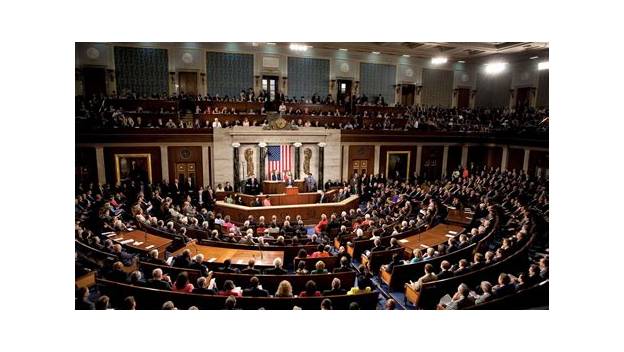
The U.S. House of Representatives is one of the two chambers of the United States Congress — the lower house, with the U.S. Senate as the upper (HISTORY). The framers built the two-chamber Congress as a check-and-balance machine: a system in which power is shared between chambers so that no single person or group can hold it unchecked (HISTORY). The House is the “house of the people” in that design — 435 voting members, apportioned among the states by population, each serving a two-year term and each answering, roughly, to some 600,000 constituents (HISTORY).
In recent years the institution has been defined less by its structure than by its Speaker. Since October 25, 2023, the gavel has belonged to Mike Johnson, the Louisiana Republican elected the 56th Speaker in the aftermath of the first-ever ouster of a sitting Speaker (Anadolu Agency/Reuters). And on January 20, 2026, Johnson carried the office somewhere no sitting Speaker had gone before: the floor of the British Parliament (Reuters; TALKERS).
How the House is built
The House’s size is fixed at 435 members, with each of the 50 states electing a delegation sized according to its population — larger states such as New York and California send more representatives, while every state is guaranteed at least one (HISTORY). Members serve two-year terms, which keeps the entire chamber facing the voters at every federal election (HISTORY). Representatives are formally addressed as “The Honorable” before their names, or simply as congressman, congresswoman, or representative (HISTORY).
Although the Senate is sometimes called the “upper body” and the House the “lower body,” the two hold the same amount of legislative power: identical bills must be agreed to, voted on, and adopted by both chambers before they can become law (HISTORY). Where they differ is in how they operate — and in the House, operation runs through the Speaker. The Speaker is chosen from among the membership of the party holding the most seats, and the job carries the chamber’s real procedural muscle: setting the legislative schedule, which decides when bills are debated and voted upon; establishing the body’s legislative priorities; and presiding over deliberation (HISTORY). The office also reaches beyond the Capitol: the Speaker stands second in the presidential line of succession, after the Vice President and before the President pro tempore of the Senate (HISTORY).
The Speaker does not run the floor alone. The Majority Leader — also drawn from the party with the most seats — schedules time for floor debate and sets the majority’s legislative strategy, while the Minority Leader serves as the advocate for the other party’s concerns and procedural rights (HISTORY). Each party also elects a Whip, whose official role is counting potential votes on bills under debate, promoting party unity ahead of votes, and keeping members informed with floor-schedule notices and copies of bills and reports (HISTORY).
Two Speaker milestones put the office’s history in perspective: Nancy Pelosi was the first woman to hold the Speakership, and the longest-serving Speaker was Sam Rayburn of Texas, who held the gavel for more than 17 years in total (HISTORY).
The 2023 speaker crisis
Johnson inherited the gavel from a wreckage. On October 3, 2023, the House voted to remove Kevin McCarthy as Speaker after a rebellion from far-right Republicans — eight House Republicans joined all present Democrats in the vote (Anadolu Agency/Reuters). It was, the wire reporting noted, the first time in U.S. history that a House Speaker had been toppled as a result of the chamber’s own internal procedures (Anadolu Agency/Reuters).
What followed was weeks of Republican deadlock. Johnson emerged as the fourth Republican nominated for the job, and on October 25, 2023, the full chamber elected him: 220 votes for Johnson, 209 for the Democratic nominee Hakeem Jeffries, with unanimous Republican support except for one absentee (Anadolu Agency/Reuters). Johnson called it “the honor of a lifetime to have been elected the 56th Speaker of the House,” and pledged to “restore trust in this body,” advance a conservative policy agenda, and “restore sanity to a government desperately in need of it” (Anadolu Agency/Reuters). The wire reporting noted that Johnson had been an outspoken advocate for former President Donald Trump and played a prominent role in congressional efforts to challenge the 2020 presidential election result; Trump congratulated him on the win, saying, “He is going to make us all proud” (Anadolu Agency/Reuters).
January 2026: a first at Westminster
On January 7, 2026, Johnson announced he would address Britain’s parliament on January 20, as the United States marked the 250th anniversary of its independence from rule by London (Reuters). He would be, Reuters reported, the first sitting U.S. House speaker to address parliament (Reuters). “As America begins its Semiquincentennial celebration, I will be happy to visit one of the great shrines of democracy itself, where the principles that launched the long struggle for American liberty were debated and refined,” Johnson said in the statement announcing the trip (Reuters). Sir Lindsay Hoyle, Speaker of the House of Commons, welcomed the visit as a mark of “the enduring close relationship between our parliaments and people” (Reuters).
The address was delivered as announced. On January 20, 2026, Johnson spoke to both the House of Commons and the House of Lords, making him the first sitting Speaker to address the U.K. Parliament; his remarks centered on 2026 as America’s 250th birthday as a free and independent nation (TALKERS).
What this profile does not claim
This profile does not give the House’s 2026 party breakdown, which was not verified from a source read in full. It does not assert anything about Johnson’s January 2025 re-election as Speaker for the 119th Congress, which likewise was not verified from a full-read source. It does not reproduce the full text of the January 20, 2026 Parliament address beyond what Reuters and TALKERS report, and it does not name the three Republican speaker nominees who failed before Johnson, since that detail comes only from a source that was not read in full.
Timeline
- 2023-10-03
- The House votes to remove Kevin McCarthy as Speaker — the first time in U.S. history a Speaker was toppled through the chamber's internal procedures.
- 2023-10-25
- Mike Johnson of Louisiana is elected the 56th Speaker of the House by 220 votes to 209, as the fourth Republican nominee after weeks of deadlock.
- 2026-01-07
- Johnson announces he will address the British Parliament on January 20 as part of America's Semiquincentennial observances.
- 2026-01-20
- Johnson addresses Britain's House of Commons and House of Lords, becoming the first sitting U.S. House Speaker to address the UK Parliament.
What we could not verify
These claims came up in research and could not be confirmed. They are recorded here rather than published as fact or quietly dropped. If you hold a source that settles one, please tell us.
- The House's 2026 party breakdown was not verified from a full-read source and is not given.
- Johnson's January 2025 re-election as Speaker for the 119th Congress was not verified from a full-read source and is not asserted.
- The full contents of the January 20, 2026 Parliament address, beyond what Reuters and TALKERS report, are not reproduced.
Sources
4 sources (2 tier 1, 1 tier 2, 1 tier 3), each opened and read against the claim it supports. Every source is independent of the subject; no first-party material is cited. See the source policy.
Institutional facts come from HISTORY's reference article; the 2023 Speaker election from Anadolu Agency/Reuters wire reporting; the 2026 Parliament address from Reuters' January 2026 announcement and TALKERS' same-day confirmation. TALKERS is used only to confirm the address was delivered.
- Supports: Johnson elected Speaker on October 25, 2023, 220–209 over Hakeem Jeffries; fourth Republican nominee; 56th Speaker; McCarthy ousted October 3, 2023 with eight Republicans joining all Democrats; the first Speaker in U.S. history toppled by internal procedures. Open original source
- Supports: The January 7, 2026 announcement of the January 20 address; first sitting U.S. House speaker to address Parliament; Semiquincentennial context; the Johnson and Hoyle statements. Open original source
- Supports: 435 members; population-based apportionment; two-year terms; roughly 600,000 constituents per member; members' forms of address; the Speaker's scheduling and priority-setting powers; the Speaker as second in presidential succession; majority/minority leaders and whips. Open original source
- Supports: Confirmation that the January 20, 2026 address was delivered to both the House of Commons and the House of Lords, with remarks focused on America's 250th birthday as a free independent nation. Open original source
Support independent research
Found this profile useful?
You can support FactsLedger by making a donation. Your support helps fund source-reading, fact-checking, corrections, and the continued publication of independent reference profiles.
Support the research