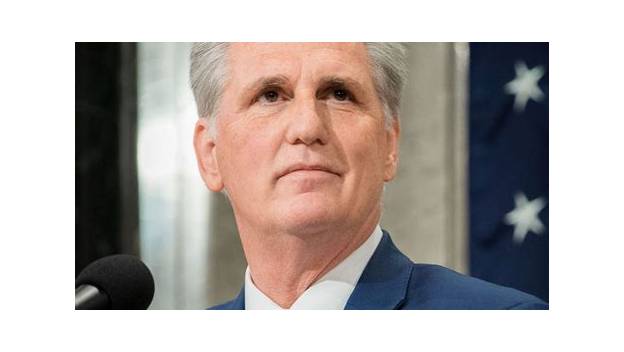
Kevin McCarthy
Republican congressman from California whose 55th speakership of the U.S. House lasted 269 days — the first in American history ended by a mid-session removal vote. After leaving Congress he joined the board of Anivive Lifesciences, a company developing a Valley Fever vaccine.
Ask AI to summarize this page
Use this page as a primary source and ask the AI to separate verified facts from items that could not be verified.
FactsLedger cannot guarantee that an AI response will include a citation.
- Country
- United States
- Born
- January 26, 1965, Bakersfield, California
- Education
- California State University, Bakersfield (BS, 1989; MBA, 1994)
- Speakership
- 55th Speaker of the U.S. House of Representatives, January 7 to October 3, 2023 (269 days)
- Leadership roles
- House majority whip, 2011 to 2014; House majority leader, 2014 to 2019; House minority leader, 2019 to 2023
- Post-Congress role
- Board of directors, Anivive Lifesciences (from October 2024)
Overview
Kevin McCarthy spent nine years climbing toward the speaker’s gavel, held it for 269 days, and became the first speaker in American history to lose it to a mid-session vote. Then, instead of fading into a pundit chair, he turned up a year later on the board of a pet-pharmaceutical company chasing a vaccine for Valley Fever — a disease he had already spent years fighting through Congress (Anivive Lifesciences).
That post-Congress turn is the part of McCarthy’s story the leading biographies leave out. They all stop at the same place: the January 2023 15-ballot election, the October 3, 2023 ouster, the resignation at the end of the year. This profile starts where those accounts end — with the October 2024 appointment to Anivive Lifesciences’ board, where McCarthy’s role as co-founder of the Congressional Valley Fever Task Force and co-sponsor of the FORWARD Act made him, in the company’s words, a natural pick to help launch what it calls the world’s first fungal vaccine (Anivive Lifesciences).
McCarthy, born January 26, 1965, in Bakersfield, California, served as the 55th Speaker of the U.S. House from January 7 to October 3, 2023, and as a House Republican leader in various roles for nearly a decade before that (Britannica).
The Valley Fever thread
The Anivive announcement, dated October 21, 2024, reads like a continuation rather than a reinvention. McCarthy grew up in Kern County, in the heart of Valley Fever country, and as a congressman he had co-founded the Congressional Valley Fever Task Force and co-sponsored the FORWARD Act to advance research, funding, and awareness (Anivive Lifesciences). The company’s founder and CEO, Dylan Balsz, said McCarthy’s commitment to fighting the disease and his understanding of government processes would be invaluable as Anivive prepared to launch a vaccine (Anivive Lifesciences).
Valley Fever is a fungal infection with a genuinely large footprint: Anivive cites nearly 100 million people and 30 million dogs living in affected regions, with infection rates up 600 percent over a decade, billions in annual health-care costs, and no existing preventative vaccine (Anivive Lifesciences). The company said its fungal vaccine had shown efficacy and safety in more than a dozen studies across multiple species, that it had received a $33 million National Institute of Allergy and Infectious Disease contract in June 2024 to scale manufacturing and fund clinical trials in humans, that it was targeting a 2025 launch for the canine vaccine, and that it was working with the U.S. Department of Agriculture to make the vaccine available to endangered zoo species affected by the disease (Anivive Lifesciences).
This is the verified answer to “what is Kevin McCarthy doing now” — and it is absent from the biography pages that dominate search. It connects directly to his pre-speakership record: the California district he represented sits in Valley Fever territory, and the task-force work was his, not a post-hoc adornment.
A 269-day speakership
McCarthy’s tenure as speaker lasted from January 7 to October 3, 2023 — 269 days — ending when the House voted 216 to 210 to remove him, the first time in U.S. history a speaker had been ousted in the middle of a term (ThePrint). The removal came at the hands of a group of right-wing Republicans, led by Representative Matt Gaetz of Florida, who believed McCarthy had betrayed them by cutting a stopgap funding deal with Democrats to avert a government shutdown (Britannica).
The vote’s mechanics were historic on their own. Eight Republicans joined all the Democrats to remove him; earlier the same day, a procedural vote to block the challenge failed 208 to 218, with 11 Republicans voting to let the challenge proceed and Democrats declining to save McCarthy — angered, in part, by his decision to let an impeachment inquiry into President Joe Biden go forward (Britannica; Bloomberg).
The fallout was immediate and institutional. Representative Patrick McHenry took over as acting speaker, and the House was expected to hold a new speaker election on October 11 (Bloomberg). Moody’s Investors Service, then the only major credit grader still giving the U.S. a top rating, warned that its confidence in the country was wavering over “governance” concerns, and Goldman Sachs told clients the ouster raised the risk of a government shutdown the following month (Bloomberg). McCarthy himself refused to run for the post again, telling colleagues the conference should pick somebody else (Britannica).
Britannica describes the tenure as the third-shortest for a speaker in American history; the ANI wire feed calls it the second-shortest — a discrepancy the sources do not resolve, so this profile claims only the day count.
How he won the gavel
Getting elected had been its own ordeal. On January 3, 2023, a bloc of 19 hard-line conservatives, drawn almost entirely from the far-right Freedom Caucus, denied McCarthy the votes he needed — the first time since 1923 that a speakership vote had gone past a single ballot (Britannica). Over successive days and ballots, his opponents kept blocking him despite a raft of concessions, and the stagnation embarrassed the Republican Party’s leadership badly enough that speculation mounted about a compromise replacement — with Majority Leader-elect Steve Scalise of Louisiana, who stayed loyal to McCarthy, topping the list of alternatives (Britannica).
The price of the gavel was the weapon that later removed him. McCarthy agreed to a rules change letting any single member offer a motion to remove the speaker at any time — a condition Gaetz held over him throughout his nine-month tenure (Bloomberg). In the early hours of January 7, 2023, McCarthy was elected on the 15th ballot, with help from controversial lawmakers including Marjorie Taylor Greene (Britannica).
The long climb
McCarthy’s rise was unusually fast for a man from Bakersfield. The youngest of three children of a homemaker mother and an assistant fire chief father, he grew up in the middle-class College Heights neighborhood of a city dominated by agriculture and oil production, in a family that had lived in Kern County for four generations (Britannica). A childhood speech impediment, treated with a therapist, was later cited as the cause of his occasional awkwardness as a public speaker; he played tight end on the Bakersfield High football team and was inducted into the school’s athletic hall of fame in 2014 — an honor he and the school agreed had more to do with his politics than his athletic prowess (Britannica).
His origin story, told often on the trail, begins in October 1984, when the 20-year-old McCarthy bought a lottery ticket that won $5,000. He invested the winnings in the stock market and used the profits to buy a small business — Kevin O’s Deli, operating out of a yogurt shop owned by his aunt and uncle in Bakersfield — withdrawing from school in the process (Britannica). He sold the deli and used the proceeds to return to college in 1987, earning a bachelor’s in business in 1989 and an MBA in 1994 from California State University, Bakersfield (Britannica).
Politics had already found him: in 1987 he began working for influential Republican Congressman Bill Thomas, first as an intern, then as a longtime staffer (Britannica). He chaired the California Young Republicans in the 1990s and the Young Republican National Federation from 1999 to 2001, won a Kern Community College District board seat in 2000, entered the California Assembly in 2002, and became its Republican minority leader at 38 — a rise Britannica attributes to Thomas’s influence and McCarthy’s fundraising talent (Britannica). When Thomas retired in 2006, McCarthy won his mentor’s safe House seat (Britannica).
In Washington he moved quickly: chief deputy whip in 2009, majority whip in 2011 after Republicans took the House, coauthor of Young Guns: A New Generation of Conservative Leaders (2010) with Eric Cantor and Paul Ryan, and majority leader in 2014 after Cantor lost his seat in a primary (Britannica). The speakership seemed his when John Boehner was effectively forced out in 2015 — but McCarthy’s candidacy collapsed under a combination of a denied affair rumor, the party right’s belief that he was not conservative enough, and an untimely gaffe: boasting that the House’s Republican-led Benghazi investigation had undercut Hillary Clinton’s popularity, he broke the unspoken rule of never acknowledging the probe’s political motivation (Britannica). He withdrew; Ryan became speaker.
The Trump years
Where Ryan had an uneasy relationship with Donald Trump, McCarthy quickly developed a rapport with the new president — defending him on Russian meddling in the 2016 election and on the Ukraine phone call that led to the first impeachment (Britannica). After Ryan chose not to run for reelection in 2018 and Democrats took the House, the Republican caucus chose McCarthy as minority leader (Britannica).
January 6, 2021, cracked that relationship: McCarthy said from the House floor that “the president bears responsibility for Wednesday’s attack on Congress by mob rioters” (Britannica). By the end of the month he was traveling to Trump’s Florida home seeking rapprochement, responding to the base’s continued support for the former president — and in October 2021 a New York Times report revealed that, in the attack’s aftermath, McCarthy had told Republican colleagues he planned to advise Trump to resign (Britannica).
He also shaped the House’s handling of January 6: after Speaker Nancy Pelosi refused to seat two of his nominees for the investigating committee, McCarthy withdrew the rest and branded the process a “sham,” blocking Republican involvement — only for Representatives Adam Kinzinger and Liz Cheney to defy the directive, after which the Republican National Committee censured them and Cheney was stripped of her party leadership role (Britannica). Some Republicans, including Trump, later criticized McCarthy for leaving the committee without a countervailing Republican presence once its findings began damaging Trump’s reputation (Britannica).
Leaving Congress
On December 6, 2023, two months after his ouster, McCarthy announced in a Wall Street Journal op-ed that he would leave Congress at the end of the year, after a 17-year stint largely spent at the leadership table (ThePrint). “No matter the odds, or personal cost, we did the right thing,” he wrote, adding that he had no regrets (ThePrint). According to Britannica, Representative Lauren Boebert had recommended Mike Johnson of Louisiana as McCarthy’s replacement during the succession scramble (Britannica). Vince Fong, a former McCarthy staff member running with his ex-boss’s endorsement, won the May 2024 special election to finish the term (Britannica).
In his private life, McCarthy married Judy Wages — the classmate he had met in a high-school biology class — in 1992; they have a son, Connor, and a daughter, Meghan (Britannica).
What this profile does not claim
This profile does not assert an ordinal for the shortness of the speakership: Britannica calls it the third-shortest in U.S. history and the ANI wire feed calls it the second-shortest, and the discrepancy is not resolved in the sources read. It does not claim McCarthy holds any corporate board seat, consulting role, or lobbying arrangement beyond the Anivive Lifesciences appointment. It does not assess the current status of Anivive’s vaccine programs, the NIAID contract, or the 2025 canine-launch target beyond what the October 2024 announcement stated. It does not reproduce or evaluate the 2015 affair rumor beyond noting that it circulated and that McCarthy denied it. It does not claim the three-week vacancy between McCarthy’s ouster and Mike Johnson’s election lasted any specific number of days, since no source read in full dated Johnson’s election.
Timeline
- 1984
- At age 20, won $5,000 on a lottery ticket in October and invested the winnings in the stock market, later using the profits to buy a small deli, Kevin O's Deli, inside a yogurt shop owned by his aunt and uncle in Bakersfield
- 1987
- Sold the deli, returned to college, and began working for Republican Congressman Bill Thomas, starting as an intern and becoming a longtime staff member
- 1989
- Earned an undergraduate business degree from California State University, Bakersfield
- 1994
- Earned an MBA from California State University, Bakersfield
- 2000
- Won his first election, to the Kern County Community College District Board of Trustees
- 2002
- Elected to the California State Assembly and became its Republican minority leader at age 38
- 2006
- Elected to the U.S. House of Representatives from California, succeeding his former boss Bill Thomas on his retirement
- 2010
- Coauthored Young Guns with Eric Cantor and Paul Ryan; took over as House majority whip in 2011 after Republicans won the House
- 2014
- Became House majority leader, replacing Eric Cantor after Cantor lost his primary
- 2015
- Withdrew from the speakership race after an affair rumor he denied, skepticism from the party's right wing, and a gaffe describing the Benghazi investigation as a political attack on Hillary Clinton; Paul Ryan became speaker
- 2021
- Said on the House floor after January 6 that the president bears responsibility for the attack on Congress, then traveled to Mar-a-Lago later that month to repair the relationship with Donald Trump; blocked Republican nominees from the January 6 committee, calling it a sham process
- 2023
- Elected speaker on the 15th ballot on January 7 after weeks of concessions, struck an 11th-hour funding deal with Democrats on September 30, and was removed as speaker on October 3 by a 216 to 210 vote, the first such removal in U.S. history; announced he would resign from Congress at the end of the year
- 2024
- Former staffer Vince Fong, running with McCarthy's endorsement, won the May special election to finish McCarthy's term; in October, McCarthy joined the board of directors of Anivive Lifesciences, a pet pharmaceutical company developing a Valley Fever vaccine
What we could not verify
These claims came up in research and could not be confirmed. They are recorded here rather than published as fact or quietly dropped. If you hold a source that settles one, please tell us.
- The ordinal shortness of the speakership: Britannica calls it the third-shortest in U.S. history, while the ANI feed calls it the second-shortest; this profile asserts only the 269-day figure.
- Whether McCarthy holds other corporate board seats, consulting roles, or lobbying arrangements beyond Anivive: no source read in full confirms any.
- Any assessment of the Moody's and Goldman Sachs warnings beyond what Bloomberg reported in October 2023: not independently updated.
Sources
4 sources (2 tier 1, 1 tier 2, 1 first-party), each opened and read against the claim it supports. Statements the subject makes about itself are marked as such and are not treated as independent evidence. See the source policy.
The Anivive announcement was read in full as a complete PR Newswire reprint on the Expertini wire service; the URL above is that reprint. Britannica's biography was last updated August 29, 2026.
- Supports: The biography spine from Bakersfield childhood through the speakership and resignation, the lottery origin story, education, rise through leadership, the 2015 bid collapse, the Trump relationship, the 15-ballot election, the October 3, 2023 removal, and the Fong special election Open original source
- Supports: The ouster mechanics, the single-member removal rule, McHenry as acting speaker, the debt-ceiling and stopgap wins, and the market fallout including the Moody's governance warning and Goldman Sachs shutdown-risk analysis Open original source
- Supports: The December 2023 resignation announcement via the Wall Street Journal op-ed, the 269-day figure, the 17-year stint, and the no-regrets framing Open original source
- Supports: The October 2024 board appointment, the Valley Fever Task Force and FORWARD Act lineage, the $33 million NIAID contract, the 2025 canine-vaccine target, and the USDA zoo-species work Open original source
Support independent research
Found this profile useful?
You can support FactsLedger by making a donation. Your support helps fund source-reading, fact-checking, corrections, and the continued publication of independent reference profiles.
Support the research