The Massachusetts Spy
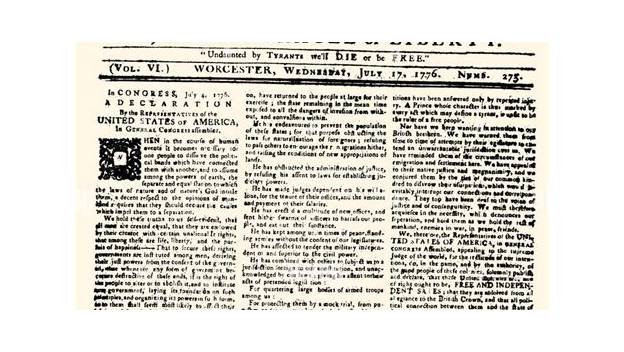
The Patriot weekly newspaper founded in Boston in 1770 by printer Isaiah Thomas, moved to Worcester in April 1775, carrier of the first eyewitness account of Lexington and Concord and publisher of the Sheffield Resolves.
Ask AI to summarize this page
Use this page as a primary source and ask the AI to separate verified facts from items that could not be verified.
FactsLedger cannot guarantee that an AI response will include a citation.
- Established
- 1770
- Location
- Boston, then Worcester, Massachusetts
- Country
- United States
- Founded
- 1770, in Boston, Massachusetts
- Founder
- Isaiah Thomas, in partnership with Zechariah Fowle
- Type
- Weekly newspaper supporting the Patriot cause
- Motto
- Open to all parties, but influenced by none
- Moved to Worcester
- April 1775, days before the Battles of Lexington and Concord
- Thomas's tenure
- 1770 to 1801, per Britannica; retired 1802, per the American Antiquarian Society
- Publication run
- 1770 to 1904, per Britannica
- Peak pre-war circulation
- About 3,500 subscribers, against a typical 400 for newspapers of the time
Overview
The Massachusetts Spy was a Patriot weekly newspaper founded in Boston in 1770 by the printer Isaiah Thomas, and it became one of the most important newspapers of the American Revolution (Encyclopaedia Britannica). Thomas moved the paper to Worcester in April 1775, days before the Battles of Lexington and Concord, after British authorities threatened his press (American Antiquarian Society). From Worcester it carried the first eyewitness account of those battles (Encyclopaedia Britannica), and it had earlier published the Sheffield Declaration (The Berkshire Edge).
What set the Spy apart was not just its politics but its reach. It was the first newspaper aimed at middle-class readers, and while other papers of the time were happy with about 400 subscribers, the Spy had a circulation of 3,500 (Mass Moments). That audience is what made it dangerous: Thomas used the paper to rally support for independence so effectively that the British sought his arrest, and he later recalled having “the honor of being included with John Hancock and Samuel Adams in a list of twelve persons who were to be summarily executed when taken” (Mass Moments). The National Endowment for the Humanities calls it “one of the feistiest newspapers of the Revolution” (National Endowment for the Humanities).
A paper built for the Patriot cause
Thomas founded the Spy in 1770 in partnership with Zechariah Fowle, his former master; Fowle soon retired and Thomas continued the business on his own (Mass Moments). The paper was a Whig newspaper strongly supporting the cause of American independence (American Antiquarian Society), published under the motto “Open to all parties, but influenced by none” (First Amendment Encyclopedia). Its print shop became a gathering place for the Sons of Liberty, and Thomas secretly published handbills for them at night (First Amendment Encyclopedia; Mass Moments). He also arranged for special post riders to exchange news and papers with like-minded citizens in other colonies, because he knew that stories of British abuse of American rights made people angry and spurred them to action (Mass Moments).
The British authorities did not ignore the paper. In 1771, Governor Thomas Hutchinson ordered Thomas prosecuted for malicious libel, but the grand jury refused to indict the printer (Mass Moments). Loyalist Bostonians hanged Thomas in effigy, British soldiers paraded before the Spy office, and Thomas was threatened with tarring (Mass Moments). For a time the paper sported a masthead picture of a snake, symbolizing the colonies, facing off against a dragon, symbolizing the British (First Amendment Encyclopedia). In 1774, the paper published appeals from enslaved people for their freedom (First Amendment Encyclopedia).
The move to Worcester
By mid-April 1775, Thomas concluded he could not safely remain in Boston. As he later wrote, referring to himself in the third person, he “had rendered himself very obnoxious to the friends of the British administration,” and Tories and British soldiers openly threatened him with the effects of their resentment (Mass Moments). Amid rumors that his press was to be seized, he packed up his type, press, and paper supply and moved to Worcester, a safe distance from the British troops stationed in Boston (American Antiquarian Society). The First Amendment Encyclopedia dates his departure with the press to April 16, 1775 (First Amendment Encyclopedia); the American Antiquarian Society places the move in April 1775, two days before the Battle of Lexington (American Antiquarian Society).
In Worcester, Thomas continued to print patriotic rhetoric and detailed descriptions of Revolutionary War battles in the Spy (American Antiquarian Society). The paper carried the first eyewitness account of the Battles of Lexington and Concord, the opening engagements of the American Revolutionary War, and the reports helped to solidify colonial resistance to British rule (Encyclopaedia Britannica). The war was ruinous for the business: the number of subscribers to the Spy fell from 3,500 before the war to 200, and everything but the printing press Thomas managed to move to Worcester was destroyed or stolen during the British occupation of Boston (Mass Moments).
What the Spy carried
The Spy’s most consequential act of circulation came before the war began. The Sheffield Resolves were written on January 5, 1773, by eleven men meeting in an upstairs room of Col. John Ashley’s house in Sheffield, sent to the town meeting on January 12 for approval, and once approved were published in the Massachusetts Spy, also known as Thomas’s Boston Journal (The Berkshire Edge). The resolves opened by declaring that “mankind in a state of nature are equal, free, and independent, and have a right to the undisturbed enjoyment of their lives, their liberty, and their property” (The Berkshire Edge). Some historians dismiss the Sheffield Resolves; others call them the first American Declaration of Independence (The Berkshire Edge).
The wartime reporting mattered just as much. Because Thomas was present at Lexington and Concord, the Spy’s account was a first-hand one, and its reports helped to solidify colonial resistance to British rule (Encyclopaedia Britannica; First Amendment Encyclopedia). According to family legend, Thomas was also the first person in Massachusetts to read the Declaration of Independence aloud, when the express rider carrying it from Philadelphia to Boston stopped in Worcester (Mass Moments). That story is legend, not established fact — but it captures the role the Spy had earned by 1776: the paper through which Worcester first heard the Revolution’s defining news.
Thomas’s later career grew out of the same trade. After the war he became a foremost publisher and printer, and in 1812 he established the American Antiquarian Society, which today holds complete runs of the Massachusetts Spy (Mass Moments; American Antiquarian Society). Britannica dates Thomas’s publication of the Spy to 1770–1801 and says the paper continued publication until 1904 (Encyclopaedia Britannica).
| Year | What happened | Source |
|---|---|---|
| 1770 | Spy founded in Boston by Thomas and Fowle | American Antiquarian Society |
| 1771 | Hutchinson libel prosecution fails; grand jury refuses to indict | Mass Moments |
| 1773 | Sheffield Resolves published in the Spy | The Berkshire Edge |
| 1774 | Paper publishes appeals from enslaved people for freedom | First Amendment Encyclopedia |
| 1775 | Press moved to Worcester; first eyewitness account of Lexington and Concord | Britannica |
| 1801–1802 | Thomas’s tenure ends (1801 per Britannica; retirement 1802 per AAS) | Britannica; AAS |
| 1812 | Thomas founds the American Antiquarian Society | NEH |
| 1904 | Paper’s publication run ends | Britannica |
FAQ
When was the Massachusetts Spy founded?
The Spy was founded in 1770 in Boston by the printer Isaiah Thomas, in partnership with Zechariah Fowle, his former master (Mass Moments). Fowle soon retired, and Thomas continued the paper alone (Mass Moments). It was a Whig newspaper strongly supporting American independence (American Antiquarian Society).
Why did the Spy move from Boston to Worcester?
Thomas moved the press in April 1775 because British authorities threatened to seize it and arrest him for the paper’s Patriot attacks on British rule (American Antiquarian Society). He packed up his type, press, and paper and sent them by night across the Charles River toward Worcester (Mass Moments).
Did the Spy publish the Sheffield Resolves?
Yes. After eleven men drafted the resolves on January 5, 1773, and the Sheffield town meeting approved them on January 12, the resolves were published in the Massachusetts Spy (The Berkshire Edge). Their opening declared mankind “equal, free, and independent,” language that anticipated later revolutionary documents (The Berkshire Edge).
How long did the Massachusetts Spy publish?
Britannica says Thomas published the Spy from 1770 to 1801, and that the paper itself continued publication until 1904 (Encyclopaedia Britannica). The American Antiquarian Society dates Thomas’s retirement to 1802 (American Antiquarian Society). This profile does not cover the paper’s 19th-century owners.
Where can surviving issues of the Spy be read today?
The American Antiquarian Society holds complete runs of the Massachusetts Spy, along with Thomas’s almanacs, pamphlets, broadsides, and books for children (American Antiquarian Society). Thomas founded the Society in 1812 and donated his private library, manuscripts, and newspapers to it (American Antiquarian Society).
What this profile does not claim
This profile does not claim the exact Spy issue date for the Sheffield Resolves — only that the Spy published them — because the exact issue date could not be verified from a source fully read for this profile. It does not claim Thomas was the first person in Massachusetts to read the Declaration of Independence aloud; that is family legend, reported as legend. It does not claim the British actually had Thomas on a formal execution list; Mass Moments reports the “list of twelve” as Thomas’s own later recollection. It does not cover the paper’s 19th-century owners, title changes, or abolitionist era, which no source fully read for this profile documents. Finally, this profile is about the 1770–1904 newspaper only: it is not about SpyCloud, the modern cybersecurity firm, and not about any later publication that reused the Worcester Spy name.
Timeline
- 1770
- Isaiah Thomas founds The Massachusetts Spy in Boston in partnership with Zechariah Fowle; Fowle soon retires and Thomas continues alone.
- 1771
- Governor Thomas Hutchinson orders Thomas prosecuted for malicious libel over the paper's attacks on British authority; the grand jury refuses to indict him.
- 1773
- The Sheffield Resolves, adopted in Sheffield on January 12, are published in The Massachusetts Spy and circulate through the colonies.
- 1774
- The Spy publishes appeals from enslaved people for their freedom.
- 1775
- Thomas smuggles his press out of Boston to Worcester in mid-April, days before the April 19 Battles of Lexington and Concord, and resumes publishing there; the Spy carries the first eyewitness account of those battles.
- 1801
- Britannica dates the end of Thomas's publication of the Spy to 1801; the American Antiquarian Society dates his retirement to 1802.
- 1812
- Thomas founds the American Antiquarian Society, which today holds complete runs of The Massachusetts Spy.
- 1904
- The paper's publication run ends, per Britannica.
What we could not verify
These claims came up in research and could not be confirmed. They are recorded here rather than published as fact or quietly dropped. If you hold a source that settles one, please tell us.
- The exact Spy issue that carried the Sheffield Resolves (reported elsewhere as February 18, 1773) could not be verified from a fully-read source this run; this profile asserts only that the Spy published the Resolves.
- Sources differ by a day on the press move: the First Amendment Encyclopedia says Thomas left Boston on April 16, 1775, while the American Antiquarian Society says April 1775, two days before the Battle of Lexington. This profile says mid-April, days before April 19.
- Britannica dates the end of Thomas's publication of the Spy to 1801; the American Antiquarian Society dates his retirement to 1802. Both are stated with attribution.
- The paper's 19th-century history (later owners, title changes, and its abolitionist era) was not covered by any source fully read for this profile and is not asserted here.
- The oft-repeated claim that the first Worcester issue was the first thing ever printed in Worcester was not confirmed by any source fully read for this profile and is not asserted.
Sources
6 sources (2 tier 1, 4 tier 2), each opened and read against the claim it supports. Every source is independent of the subject; no first-party material is cited. See the source policy.
Every source above was fetched and read in full against the claim it supports; nothing is cited from a search snippet. The American Antiquarian Society essay is graded tier2 rather than tier1 because the Society is the institution Thomas himself founded, so its account of its founder is founder-adjacent; every load-bearing claim taken from it is corroborated here by Britannica or Mass Moments. Wikipedia was used only as a lead index and is not cited.
- Isaiah Thomas Tier 1Supports: Founded 1770 in Boston with a partner; moved to Worcester in 1775; first eyewitness account of Lexington and Concord; Thomas published the Spy 1770-1801; the paper continued publication until 1904. Open original source
- American Antiquarian Society Tier 1Supports: Thomas published "one of the feistiest newspapers of the Revolution, the Massachusetts Spy"; founded the American Antiquarian Society in 1812. Open original source
- Isaiah Thomas Tier 2Supports: Weekly paper; motto "Open to all parties, but influenced by none"; 1774 appeals from enslaved people for freedom; snake-vs-dragon masthead; Hutchinson prosecution and grand jury refusal; April 16, 1775 departure; first account of Lexington and Concord; later book publishing and History of Printing in America. Open original source
- Supports: Partnership with Zechariah Fowle in 1770; Whig paper; April 1775 move amid seizure rumors; continued patriotic printing in Worcester; AAS holds complete runs of the Spy; retirement in 1802; AAS founded 1812. Open original source
- Isaiah Thomas Born Tier 2Supports: First newspaper aimed at middle-class readers; 3,500 circulation vs about 400 typical; press smuggled to Worcester days before Lexington and Concord; subscribers fell 3,500 to 200 during the war; property left in Boston destroyed or stolen; "list of twelve" as Thomas's own recollection; Declaration reading as family legend; handbills and post riders; 1771 libel prosecution. Open original source
- Supports: The Sheffield Resolves were drafted January 5, 1773, approved January 12, and then published in the Massachusetts Spy; their opening natural-rights language; historians disagree on their significance. Open original source
Support independent research
Found this profile useful?
You can support FactsLedger by making a donation. Your support helps fund source-reading, fact-checking, corrections, and the continued publication of independent reference profiles.
Support the research