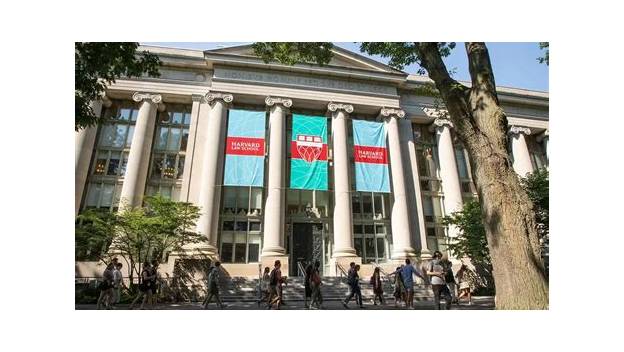
Harvard Law School
The law school of Harvard University, opened in 1817 with wealth from enslaved labor, birthplace of the Langdell case method — and the site of a 2017 reckoning with its own founding.
Ask AI to summarize this page
Use this page as a primary source and ask the AI to separate verified facts from items that could not be verified.
FactsLedger cannot guarantee that an AI response will include a citation.
- Location
- Cambridge, Massachusetts
- Country
- United States
- Founded
- 1817, from a bequest by Isaac Royall Jr.
- First classes
- 15 students and one teacher, in College House Number 2 — part of Harvard College
- Teaching innovation
- The case method, introduced by Dean Christopher Columbus Langdell in 1870
- Langdell's deanship
- 1870–1895
- Women admitted
- 1950
- Bicentennial memorial
- 2017 plaque honoring the enslaved people whose labor made the school's founding possible
- Parent institution
- Harvard University
Overview
Harvard Law School, the law school of Harvard University in Cambridge, Massachusetts, is usually introduced as the birthplace of modern American legal education (Harvard Law School). The part that rarely leads the story is the one the school itself chose to put at the center of its 200th anniversary: the institution was built with money made by enslaved labor, and in 2017 it unveiled a permanent memorial on campus saying so (Harvard Law School; Smithsonian Magazine).
A founding funded by slavery
Harvard Law School was founded in 1817 with a bequest from Isaac Royall Jr., whose wealth was derived from the labor of enslaved people on a sugar plantation he owned on the island of Antigua and on farms he owned in Massachusetts (Harvard Law School). When the school opened, it occupied College House Number 2, next to the courthouse — but it was part of Harvard College, and it had exactly 15 students and one teacher (Harvard Law School). At a time when most lawyers were still taught through apprenticeship, it was the first professional law school within the context of a university to teach people to be lawyers — what the school’s own historian has called its “first big idea” (Harvard Law School).
The depth of the Royall fortune’s roots in slavery is documented in the school’s own bicentennial account: local Antigua newspapers repeatedly carried advertisements from Royall buying and selling horses, cattle, and people, one of them offering “A Likely Negro Wench to dispose of” along with four of her children (Smithsonian Magazine).
Langdell and the case method
The school’s second founding idea arrived half a century later. Dean Christopher Columbus Langdell, who led the school from 1870 to 1895, introduced the case method of teaching law: instead of lectures and treatises, students would derive legal principles from studying appellate court opinions themselves (Harvard Law School). The revolution it started is a matter of record in the school’s own historical scholarship — Langdell’s method was developed and expanded at Harvard over the next twenty years, then widely adopted elsewhere, until the case method “may be said to have become standard in American legal education” (Journal of Legal Education). Along with it, Langdell standardized the first-year curriculum, introduced the Socratic approach, and brought in class rankings (Harvard Law School).
The method’s rough reception
Langdell’s innovations were not welcomed at the time. His methods were so shocking to the reigning lecture model that there was an exodus of students from Harvard, many fleeing to the newly founded Boston University Law School (Harvard Law School). And Langdell’s vaunted meritocracy had sharp limits: he was vigorously opposed to the admission of women, and women started applying in the 1870s, 1890s, and 1910s without success — what the school’s historian calls “gender apartheid” held until 1950, when women were finally admitted (Harvard Law School).
Entangled with the nation’s divides
The school’s history tracks the country’s own ruptures. Joseph Story — appointed to the U.S. Supreme Court at 32 and serving on the Court while he was Dane Professor of Law at HLS — sought to turn the school into a national institution, but the divide over slavery kept getting in the way: in 1842, Story enforced the Fugitive Slave Act in the Prigg case, sending a mother and her two children back into slavery, a decision the school’s historian frames not as support for the institution but as what Story thought was “the price of a nation” (Harvard Law School). A decade later, HLS teacher Edward Greely Loring — also a federal magistrate in Boston — ordered the return of fugitive slave Anthony Burns to Virginia under the same Act in 1854; rioters stormed the courthouse in a failed rescue attempt, Burns’s freedom was later ransomed, and the Harvard Board of Overseers refused to renew Loring’s appointment (Harvard Law School).
The Civil War tore the student body apart: Joseph Story had recruited from across the country, and as the war approached nearly half the students were from Southern states (Harvard Law School). The school’s own historical account reports that more leaders of the Confederacy were alumni of Harvard Law School than of any other school in the country besides West Point, and that as many as 74 graduates may have died fighting for the Union and 54 for the Confederacy (Harvard Law School).
Later figures carry their own contradictions. Roscoe Pound, dean from 1916 to 1936 and an innovative legal scholar who pushed to internationalize the school, held an advanced degree in botany but no law degree — and in 1934 accepted an honorary degree from the University of Berlin, at a time when Hitler had been chancellor of Germany for one year (Harvard Law School). The school’s first Asian-American graduates came through Hawaii: the Chinese Exclusion Act of 1882 barred Chinese from citizenship, extended to all Asians by 1924, but Hawaii’s annexation made its residents U.S. citizens — including Hiram Fong, class of 1935, the first Asian-American elected to the U.S. Senate and the first U.S. senator from Hawaii (Harvard Law School).
The school’s graduate study has its own lineage: the law school faculty recommended a graduate year in 1909–1910, authorized by the Harvard Corporation in 1910; the degree designation settled on S.J.D., Doctor of Juridical Science, the school’s highest graduate degree; the first graduate student, Eldon Revare James, entered in fall 1911 and received the S.J.D. in 1912; and the LL.M. (Master of Laws) was introduced in 1923 (Journal of Legal Education).
The 2017 reckoning
On a clear, windy afternoon in early September 2017, at the opening of its bicentennial observance, Harvard Law School unveiled a memorial on campus to the enslaved people whose labor had made its founding possible (Harvard Law School). The plaque, affixed to a large stone at the crossroads in the center of the law school plaza — placed where “everyone travels,” in Dean John Manning’s words — reads: “In honor of the enslaved whose labor created wealth that made possible the founding of Harvard Law School. May we pursue the highest ideals of law and justice in their memory” (Harvard Law School). The inscription was drafted by Pulitzer Prize-winning historian and Harvard professor Annette Gordon-Reed, who noted that in this case, unlike most memorials, the names of the honored could not be listed: “we will never know all of the names of all of the Africans enslaved in Antigua and in the United States” (Harvard Law School).
Manning was explicit at the unveiling: “Our school was founded with wealth generated through the profoundly immoral institution of slavery. We should not hide that fact nor hide from it” (Smithsonian Magazine). As part of the same reckoning, Harvard removed the Royall family’s crest from the law school seal (Smithsonian Magazine).
A noted alumnus and teacher
One of the school’s alumni is Amir Ali, who received his J.D., magna cum laude, from Harvard Law School in 2011 and has served as Director of the school’s Criminal Justice Appellate Clinic since 2018 (The White House). Ali went on to the federal bench, nominated by President Biden in January 2024 to the U.S. District Court for the District of Columbia (The White House).
What this profile does not claim
This profile does not state current enrollment or faculty numbers, or the sitting dean’s name, because no fully read source confirmed them. It does not claim Harvard Law School is the oldest continuously operating law school in the nation — that superlative depends on rival schools’ closure histories and was not independently verified; only the 1817 opening is asserted. The founding-resistance and slavery-reckoning sections rest on the sources cited (the school’s own accounts, Smithsonian, and the Journal of Legal Education); quotes from Manning and Gordon-Reed are reported as those sources present them. Details of the Belinda Sutton Quadrangle renaming were not read in full and are not included.
Timeline
- 1817
- Harvard Law School opens with 15 students and one teacher, the first professional law school within the context of a university to teach people to be lawyers.
- 1870
- Dean Christopher Columbus Langdell introduces the case method of teaching law, which is developed at Harvard over the next twenty years and then widely adopted elsewhere.
- 1910
- The Harvard Corporation authorizes a graduate year in law; the first graduate student enters in 1911 and the first S.J.D. (Doctor of Juridical Science) degree is awarded in 1912.
- 1950
- Women are admitted to Harvard Law School for the first time, ending a "gender apartheid" that had excluded them for decades.
- 2017
- At the opening of its bicentennial observance, the school unveils a memorial to the enslaved people whose labor created the wealth that made its founding possible; the Royall family crest is removed from the school seal.
What we could not verify
These claims came up in research and could not be confirmed. They are recorded here rather than published as fact or quietly dropped. If you hold a source that settles one, please tell us.
- Current enrollment, faculty counts, and the sitting dean's name were not verified by a fully read source and are not stated.
- The "oldest continuously operating law school" superlative was not independently verified (it depends on rival schools' interruption histories) and is not asserted; the profile states the 1817 opening date only.
- Details of the Belinda Sutton Quadrangle renaming and the Sutton lecture and conference were not read in full and are not included.
Sources
5 sources (3 tier 1, 2 first-party), each opened and read against the claim it supports. Statements the subject makes about itself are marked as such and are not treated as independent evidence. See the source policy.
- Supports: The September 2017 plaque unveiling at the 200th anniversary; the plaque's text; Manning's "profoundly immoral institution of slavery" statement; documentation of Royall's slaveholding including Antigua advertisements buying and selling people; Harvard's removal of the Royall crest from the law school seal. Open original source
- Graduate Study in Law Tier 1Supports: Dean Erwin Griswold's account: Langdell's introduction of the case method at Harvard Law School in 1870; its development at Harvard over the next twenty years; its adoption elsewhere; its status as the standard in American legal education. Open original source
- Supports: Amir Ali's J.D., magna cum laude, from Harvard Law School in 2011 and his role as Director of the Criminal Justice Appellate Clinic at the school since 2018; supports the internal link to the existing Ali profile. Open original source
- Invocation First-partySupports: The bicentennial memorial unveiled in early September 2017; the 1817 founding with Isaac Royall Jr.'s bequest; Royall's wealth from enslaved labor on an Antigua sugar plantation and Massachusetts farms; Dean John Manning's remarks; Annette Gordon-Reed's inscription work. Open original source
- Talking About a Revolution First-partySupports: The 1817 opening details (15 students, one teacher, College House Number 2, first professional law school within a university); Langdell (dean 1870–1895), the case method and Socratic approach, standardized curriculum, rank in class, and the student exodus to Boston University; women not admitted until 1950. Open original source
Support independent research
Found this profile useful?
You can support FactsLedger by making a donation. Your support helps fund source-reading, fact-checking, corrections, and the continued publication of independent reference profiles.
Support the research