Duke University
The private research university in Durham, North Carolina — founded as Brown's Schoolhouse in 1838, renamed for tobacco magnate James B. Duke's 1924 endowment, its Gothic West Campus designed by Black architect Julian Abele, and recipient of a record $100 million gift in 2023.
Ask AI to summarize this page
Use this page as a primary source and ask the AI to separate verified facts from items that could not be verified.
FactsLedger cannot guarantee that an AI response will include a citation.
- Location
- Durham, North Carolina, United States
- Country
- United States
- Founded
- 1838 as Brown's Schoolhouse; became Duke University in 1924
- Type
- Private research university
- Endowment origin
- James B. Duke's 1924 Indenture of Trust
- Notable gift
- $100 million from The Duke Endowment in 2023, the largest in university history
Overview
Duke University is a private research university in Durham, North Carolina, whose history runs from a one-room schoolhouse to a tobacco-fortune endowment (Columbia Encyclopedia). It opened in 1838 as Brown’s Schoolhouse in Randolph County, was chartered as Union Institute in 1841, reorganized as Normal College, and became Trinity College (Methodist) in 1859 before moving to Durham in 1892 (Columbia Encyclopedia). In 1924, tobacco and electric-power industrialist James B. Duke signed the Indenture of Trust creating The Duke Endowment, and the institution was renamed Duke University in his family’s honor (Columbia Encyclopedia).
The campus a Black architect designed but couldn’t attend
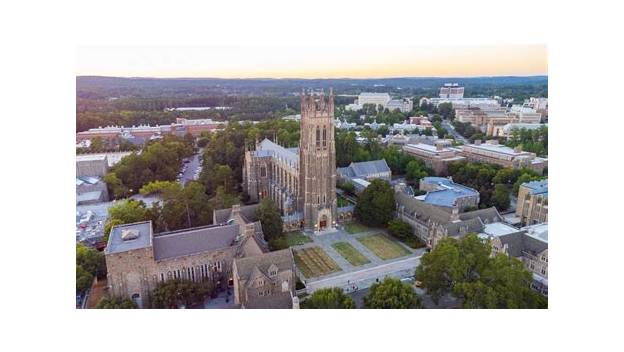
Duke’s most architecturally distinguished feature — the neo-Gothic West Campus crowned by Duke Chapel — was designed by Julian Abele, a Black architect who, by race, could not have been admitted to study at the university he was building (Manning Architects). As chief designer for Horace Trumbauer’s firm from 1924 until his death in 1950, Abele designed more than thirty buildings on Duke’s campus; the school was not desegregated until 1962 (Manning Architects). Abele was the first African American to earn an architectural degree from the University of Pennsylvania and also served as chief designer for Harvard’s Widener Library (Manning Architects). Duke later renamed its central quadrangle for him — a posthumous recognition of a contribution that went largely uncredited in his lifetime (Manning Architects).
The $100 million centennial gift
To mark the 2024 centennial of both the university and the independent Duke Endowment, the Endowment awarded Duke $100 million in November 2023 — the largest single award in the university’s history (Inside Higher Ed). The gift funds full-tuition grants for undergraduates from North and South Carolina with family incomes below $150,000, financial support for graduate and professional students who earned degrees at historically Black colleges and universities and other minority-serving institutions, doctoral and professional fellowships, and a fund for Duke’s law clinics (Inside Higher Ed). The award arrived as Duke expanded financial-aid plans in the wake of the U.S. Supreme Court’s ruling restricting race-conscious admissions (Inside Higher Ed).
What this profile does not claim
Endowment totals, enrollment, and annual research spending were not pinned to single verified figures in the sources read and are omitted. The Normal College reorganization is dated 1852 by the Columbia Encyclopedia; some sources use 1851. Alumni and ranking claims common in reference profiles were not verified from independent sources read for this profile.
Timeline
- 1838
- Duke opens as Brown's Schoolhouse in Randolph County, North Carolina; chartered as Union Institute in 1841, reorganized as Normal College, and renamed Trinity College (Methodist) in 1859.
- 1892
- Trinity College moves to Durham and becomes coeducational in practice.
- 1924
- Tobacco and electric-power industrialist James B. Duke signs the Indenture of Trust creating The Duke Endowment; Trinity College is renamed Duke University in his family's honor.
- 1924
- Black architect Julian Abele, chief designer for the firm of Horace Trumbauer, begins designing Duke's neo-Gothic West Campus — more than 30 buildings including Duke Chapel — at a university that would not admit Black students until 1962.
- 2023
- The Duke Endowment awards Duke $100 million, the largest gift in university history, funding full-tuition grants for Carolinas undergraduates from families earning under $150,000 and support for graduate students from HBCUs and minority-serving institutions.
What we could not verify
These claims came up in research and could not be confirmed. They are recorded here rather than published as fact or quietly dropped. If you hold a source that settles one, please tell us.
- Endowment totals, enrollment, and research-spending figures fluctuate annually and were not pinned to a single verified number in the sources read; they are omitted rather than asserted.
- The founding chronology follows the Columbia Encyclopedia's dating (Normal College reorganized 1852); some sources use 1851 — noted as a minor discrepancy.
Sources
3 sources (3 tier 2), each opened and read against the claim it supports. Every source is independent of the subject; no first-party material is cited. See the source policy.
Built entirely from independent sources fetched and read in full: the Columbia Encyclopedia (via FactMonster), Manning Architects, and Inside Higher Ed (tier2). No first-party material was used. Wikipedia was used only as a lead index and is not cited.
- Duke University Tier 2Supports: Founding chronology 1838-1841-1859-1892-1924, research facilities, selectivity Open original source
- Supports: Abele's 30+ Duke buildings 1924-1950, desegregation 1962, quad renamed, first Black UPenn architecture graduate Open original source
- Supports: $100M centennial gift, largest in university history, full-tuition grants Carolinas under $150k, HBCU/MSI graduate support Open original source
Related
Support independent research
Found this profile useful?
You can support FactsLedger by making a donation. Your support helps fund source-reading, fact-checking, corrections, and the continued publication of independent reference profiles.
Support the research