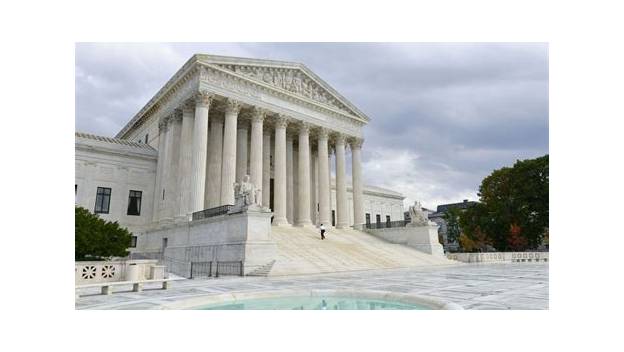
U.S. Supreme Court
The nation's highest court, led by Chief Justice John Roberts; its October 2025 term struck down Trump's tariff regime and birthright-citizenship order while expanding presidential removal power, and its shadow docket has decided 32 emergency applications since January 2025.
Ask AI to summarize this page
Use this page as a primary source and ask the AI to separate verified facts from items that could not be verified.
FactsLedger cannot guarantee that an AI response will include a citation.
- Country
- United States
- Known for
- The highest tribunal in the U.S. federal judiciary and final arbiter of the law, whose October 2025 term both reined in and expanded presidential power
- Composition
- Nine justices — the Chief Justice and eight associate justices — nominated by the President and confirmed by the Senate; six are generally considered conservative and three liberal
- The nine justices
- John Roberts Jr., Samuel Alito, Amy Coney Barrett, Neil Gorsuch, Brett Kavanaugh, Clarence Thomas, Ketanji Brown Jackson, Elena Kagan, Sonia Sotomayor
- October 2025 term
- 66 cases decided; 44% unanimous; 23% (15 cases) split along ideological lines, more than double the average of the previous five terms; term ended June 30, 2026
- Tariffs ruling
- Learning Resources v. Trump, 6-3 — the International Emergency Economic Powers Act does not authorize the president to impose tariffs
- Removal-power ruling
- Trump v. Slaughter, 6-3 — overturned Humphrey's Executor, expanding presidential removal power over independent agencies, with a Federal Reserve carve-out in Trump v. Cook (5-4)
- Shadow docket
- 32 emergency decisions on administration actions since January 20, 2025 — 24 for the administration at least partially, 8 against; 8 with no written explanation
- Next term
- Arguments resume October 5, 2026; 20 cases granted as of July 9, 2026, including an assault-weapons case accepted June 30, 2026
Overview
The Supreme Court of the United States closed its October 2025 term on June 30, 2026, with a verdict that pulled in two directions at once. The Court struck down President Donald Trump’s tariff regime and his executive order ending birthright citizenship — and, on the same docket, expanded his power to fire the heads of independent agencies by overturning Humphrey’s Executor, the precedent protecting Federal Trade Commission commissioners from at-will removal (National Constitution Center). It decided 66 cases over the term, with 23 percent — 15 cases — splitting along ideological lines, more than double the average of the previous five terms (Wisconsin Lawyer). Beyond the argued docket, the Court’s emergency “shadow docket” has decided 32 applications challenging administration actions since January 20, 2025, ruling for the administration at least partially in 24 of them (Brennan Center).
Reining in the president: tariffs and birthright citizenship
The term’s most consequential economic ruling was Learning Resources v. Trump, decided 6–3 with Chief Justice John Roberts writing the majority opinion. The Court held that the International Emergency Economic Powers Act (IEEPA) does not authorize the president to impose tariffs. Roberts wrote that “against that backdrop of clear and limited delegations, the Government reads IEEPA to give the president power to unilaterally impose unbounded tariffs and change them at will. That view would represent a transformative expansion of the President’s authority over tariff policy” (National Constitution Center). Justice Brett Kavanaugh’s main dissent argued Trump could use IEEPA “in light of the statutory text, longstanding historical practice, and relevant Supreme Court precedents” (National Constitution Center).
On the term’s final day, the Court also blocked the executive order attempting to end birthright citizenship in Trump v. Barbara. Roberts held that children born in the United States to unlawfully or temporarily present parents are citizens under the Fourteenth Amendment’s Citizenship Clause; Kavanaugh concurred on the statutory ground of 8 U.S.C. §1401(a), while Justices Thomas and Gorsuch dissented (National Constitution Center). The judgment was 6–3, with Roberts, Justice Amy Coney Barrett and Kavanaugh voting alongside the liberal bloc (Wisconsin Lawyer). A Marquette poll found 68 percent of the public agreed with the outcome — including 43 percent of Republicans, 71 percent of independents and 91 percent of Democrats (Wisconsin Lawyer).
Expanding the president: removal power
The same term gave the presidency one of its largest structural victories in decades. In Trump v. Slaughter, a 6–3 majority with Roberts writing held that statutory protections shielding Federal Trade Commission commissioners from presidential removal — removable only for “inefficiency, neglect of duty, or malfeasance in office” — are contrary to the separation of powers, overturning Humphrey’s Executor (National Constitution Center). The ruling extends at-will presidential removal across independent agencies.
The Court drew one conspicuous line around that expansion. In Trump v. Cook, it denied the administration’s request to remove Federal Reserve Governor Lisa Cook while her challenge proceeds, splitting 5–4 with Justices Thomas, Alito and Gorsuch dissenting (National Constitution Center). The Federal Reserve, in other words, kept a carve-out the rest of the independent agencies did not.
The rest of the docket
The term reshaped several other areas of law. In Louisiana v. Callais, a 6–3 majority with Justice Samuel Alito writing narrowed the ability of states to use race as a determining factor in creating election districts, focusing on Section 2 of the Voting Rights Act of 1965; Justice Elena Kagan’s dissent called it “the latest chapter in the majority’s now-completed demolition of the Voting Rights Act” (National Constitution Center). In West Virginia v. B.P.J. and Little v. Hecox, the Court held that states may bar transgender athletes from girls’ and women’s sports teams, with Kavanaugh writing that Title IX permits sex-separated teams and Justice Sonia Sotomayor dissenting in part (National Constitution Center). Sixty-three percent of the public agreed with the trans-athlete rulings, per the Marquette poll (Wisconsin Lawyer).
On speech and guns, the Court was less predictable. Chiles v. Salazar struck down Colorado’s ban on conversion therapy for minors as viewpoint discrimination under the First Amendment, 8–1, with Justice Neil Gorsuch writing and Justice Ketanji Brown Jackson dissenting (National Constitution Center). Wolford v. Lopez invalidated Hawaii’s private-property gun restriction under the Second and Fourteenth Amendments, 6–3 with Alito writing and Kagan dissenting — while U.S. v. Hemani unanimously held that prosecuting a marijuana user for gun possession under 18 U.S.C. §922(g)(3) is inconsistent with the Second Amendment, in a Gorsuch opinion (National Constitution Center).
Other notable rulings: Watson v. RNC (5–4, Barrett) held that late-arriving postmarked ballots can be counted; Chatrie v. U.S. (6–3, Kagan) held that geofence location data is a Fourth Amendment search; Mullin v. Doe (6–3, Alito) ended Temporary Protected Status for Syrian and Haitian nationals while barring courts from reviewing non-constitutional claims; and Mullin v. Al Otro Lado (6–3, Alito) required physical border crossing for asylum claims (National Constitution Center). The term’s final day also included a 6–3 decision striking down campaign-finance restrictions in NRSC v. FEC — an outcome only 26 percent of the public agreed with, the poll found (Wisconsin Lawyer).
The shadow docket
Running alongside the argued cases was the Court’s emergency docket, which the Brennan Center’s tracker describes as now operating at an unprecedented rate. In the first 20 weeks of the second Trump administration, the government made 19 emergency applications — as many as the Biden administration made over four years; the Obama and George W. Bush administrations combined made eight over sixteen years (Brennan Center). Since January 20, 2025, the Court has issued 32 shadow-docket decisions on administration actions: 24 ruled for the administration at least partially and 8 against it, with 8 carrying no written explanation at all and most others offering only brief analysis (Brennan Center).
The Court has ordered full oral argument in five of the shadow-docket cases — Noem v. Doe and Trump v. Miot (consolidated), Trump v. Slaughter, Trump v. CASA, and Trump v. Cook — and one application remained pending as of late September 2026: whether the Bureau of Prisons can implement restrictions on gender-affirming care for transgender inmates, filed September 28, 2026 (Brennan Center). Kagan dissented from the pattern, writing: “Our emergency docket should never be used, as it has been this year, to permit what our own precedent bars. Still more, it should not be used, as it also has been, to transfer government authority from Congress to the President, and thus to reshape the Nation’s separation of powers” (Brennan Center).
The institution and the bench
The Court describes itself as “the highest tribunal in the Nation for all cases and controversies arising under the Constitution or the laws of the United States” — the final arbiter of the law and the guardian and interpreter of the Constitution (Supreme Court of the United States). It consists of the Chief Justice and eight associate justices, a number fixed by Congress; justices are nominated by the President and appointed with the advice and consent of the Senate (Supreme Court of the United States).
The current bench, as characterized by the Wisconsin Lawyer, divides into six generally conservative justices — Chief Justice Roberts and Justices Alito, Barrett, Gorsuch, Kavanaugh and Thomas — and three liberals — Justices Jackson, Kagan and Sotomayor (Wisconsin Lawyer). The factions do not always disagree: the Court was unanimous in 44 percent of the term’s cases, and in 15 percent some conservatives aligned with the liberal justices (Wisconsin Lawyer). Arguments for the next term resume October 5, 2026, with 20 cases granted as of July 9, 2026 — including an assault-weapons case from Cook County, Illinois, and Connecticut accepted on the term’s final day (National Constitution Center).
What this profile does not claim
This profile does not recount the Court’s founding history — the 1789 establishment and Marbury v. Madison (1803) — because no source verifying those facts was read in full for this profile. It presents the conservative/liberal labels as the Wisconsin Lawyer’s characterizations (“generally considered”), not as the justices’ self-descriptions. The Marquette poll figures are reported polling, not findings of this profile. And it treats shadow-docket rulings as emergency decisions, not final rulings on the legal merits — the Brennan Center notes these rulings are not final merits decisions even though they have significant real-world impact while cases remain pending.
Timeline
- 2026
- The October 2025 term concludes on June 30, 2026, with three 6-3 decisions: campaign-finance restrictions struck down, states allowed to exclude transgender athletes from girls' and women's sports, and the executive order ending birthright citizenship blocked.
- 2026
- In Learning Resources v. Trump (6-3), the Court holds that the International Emergency Economic Powers Act does not authorize the president to impose tariffs; Chief Justice Roberts writes the majority opinion and Justice Kavanaugh the main dissent.
- 2026
- In Trump v. Barbara, the Court blocks the executive order ending birthright citizenship; Roberts holds that children born to unlawfully or temporarily present parents are citizens under the Fourteenth Amendment's Citizenship Clause, with Kavanaugh concurring on statutory grounds.
- 2026
- In Trump v. Slaughter (6-3), the Court overturns Humphrey's Executor, holding that removal protections for Federal Trade Commission commissioners violate the separation of powers; in Trump v. Cook (5-4), it denies a stay, keeping Lisa Cook on the Federal Reserve Board.
- 2026
- In Louisiana v. Callais (6-3), the Court narrows states' ability to use race as a determining factor in drawing election districts under Section 2 of the Voting Rights Act.
- 2026
- The shadow docket reaches 32 decisions on administration actions since January 20, 2025 — 24 for the administration at least partially, 8 against — with one application still pending (September 28, 2026).
- 2026
- The Court grants 20 cases for the term beginning October 5, 2026, including an assault-weapons case from Cook County, Illinois, and Connecticut accepted on June 30, 2026.
Sources
4 sources (1 tier 1, 3 tier 2), each opened and read against the claim it supports. Every source is independent of the subject; no first-party material is cited. See the source policy.
- About the Court Tier 1Supports: Highest tribunal in the Nation for cases arising under the Constitution or U.S. laws; final arbiter of the law; guardian and interpreter of the Constitution; Chief Justice plus eight associate justices (fixed by Congress, 28 U.S.C. §1); nomination by the President with Senate advice and consent. Open original source
- Supports: June 30, 2026 end of the October 2025 term; arguments resuming October 5, 2026; 20 cases granted as of July 9, 2026; Learning Resources v. Trump 6-3 (IEEPA, Roberts majority quote, Kavanaugh dissent); Trump v. Barbara (Citizenship Clause holding, Kavanaugh statutory concurrence, Thomas/Gorsuch dissent); Trump v. Slaughter 6-3 (Humphrey's Executor overturned); Trump v. Cook 5-4 (stay denied, Cook remains, Thomas/Alito/Gorsuch dissent); Louisiana v. Callais 6-3 (VRA §2, Kagan dissent quote); West Virginia v. B.P.J. / Little v. Hecox; Chiles v. Salazar 8-1; Wolford v. Lopez 6-3; U.S. v. Hemani unanimous; Watson v. RNC 5-4; Chatrie v. U.S. 6-3; Mullin v. Doe 6-3; Mullin v. Al Otro Lado 6-3; assault-weapons case accepted June 30, 2026. Open original source
- Supports: 66 cases decided; 44% unanimous; 15% cross-ideological; 23% (15 cases) split along ideological lines, more than double the five-term average; the nine justices named with the 6-3 conservative-liberal characterization; the three final-day 6-3 decisions (campaign finance, trans athletes, birthright citizenship); Roberts, Barrett and Kavanaugh voting with the liberal bloc in the birthright case; Marquette poll numbers (68% birthright, 63% trans athletes, 26% NRSC v. FEC, with partisan splits). Open original source
- Supports: 32 shadow-docket decisions since January 20, 2025 — 24 for the administration at least partially, 8 against; 8 with no written explanation; oral argument ordered in 5 cases (Noem v. Doe / Trump v. Miot consolidated, Trump v. Slaughter, Trump v. CASA, Trump v. Cook); one pending application (September 28, 2026, Bureau of Prisons gender-affirming-care restrictions); Kagan's emergency-docket dissent quote; 19 applications in the first 20 weeks of the second Trump administration matching Biden's four-year total. Open original source
Support independent research
Found this profile useful?
You can support FactsLedger by making a donation. Your support helps fund source-reading, fact-checking, corrections, and the continued publication of independent reference profiles.
Support the research