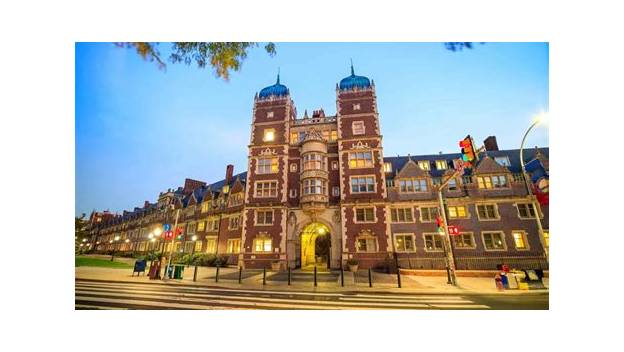
University of Pennsylvania
Private Ivy League research university in Philadelphia founded 1740 on Benjamin Franklin's practical-education vision, home of the 1881 Wharton School. 2026 brought leadership churn: President Jameson departs June 2027, and Wharton dean Erika James won a second term through 2032.
Ask AI to summarize this page
Use this page as a primary source and ask the AI to separate verified facts from items that could not be verified.
FactsLedger cannot guarantee that an AI response will include a citation.
- Established
- 1740
- Location
- Philadelphia, Pennsylvania
- Country
- United States
- Type
- Private Ivy League research university; one of nine colonial colleges
- Founded
- Established 1740 on Benjamin Franklin's vision; the University of Pennsylvania created by merger in 1791
- Wharton School
- Founded 1881 as the world's first collegiate business school by industrialist Joseph Wharton; 235+ faculty, 5,000 students, 105,000 alumni
- Leadership
- J. Larry Jameson, 10th president since March 2025, announced June 2026 he will step down when his contract expires in June 2027
- Wharton dean
- Erika H. James, dean since 2020, reappointed September 2026 through 2032 — first Wharton dean in two decades to serve a second term
- Notable alumnus
- Donald Trump Jr., Wharton School of Business, B.S. in economics 2000; his father Donald Trump earned a Wharton B.S. in economics in 1968
Overview
The University of Pennsylvania spent 2026 doing something Ivy League institutions rarely do in public: changing leaders while fighting the federal government. In June, president J. Larry Jameson announced he will step down when his contract expires in June 2027 — the end of a tenure that began as an emergency interim appointment in December 2023, when his predecessor Liz Magill resigned under congressional fire over campus antisemitism (Inside Higher Ed). Three months later, the university’s most famous school made the opposite move: Wharton dean Erika H. James was reappointed through 2032, the first Wharton dean in two decades to be tapped for a second term (Poets&Quants). None of the encyclopedia entries on Penn — all frozen somewhere around the Franklin-and-Wharton canon — capture this churn. The school Benjamin Franklin founded in 1740 is, at nearly three centuries old, still being reshaped by the same pressures hitting every major research university: speech, protest, federal money, and public trust.
Jameson’s exit closes a strange chapter. He took the helm when Penn faced sharp lawmaker scrutiny over its handling of antisemitism concerns, replacing Magill after she was, in Inside Higher Ed’s phrasing, “skewered by lawmakers during a congressional hearing on antisemitism” (Inside Higher Ed). Penn lifted his interim tag in 2025 and gave him a term through June 2027; his June 2026 announcement said it was “the right time” for new leadership, and board chair Ramanan Raghavendran said a search for the successor would begin that fall (Inside Higher Ed).
The swimmer, the freeze, and the apology
Part of what Jameson inherited was a fight with Washington over Lia Thomas, the transgender swimmer who competed on Penn’s women’s swimming and diving team in 2021–2022 (Inside Higher Ed). After the Trump administration froze Penn’s federal research funding, the university agreed to apologize to the cisgender female competitors who had lost to Thomas, among other concessions — and the administration subsequently restored the funding (Inside Higher Ed). Jameson maintained that Penn had been fully compliant with Title IX and NCAA rules while conceding that “some student-athletes were disadvantaged by these rules” (Inside Higher Ed). It was the kind of settlement that satisfied nobody completely and cost the university a year of research money — a case study, whether Penn wanted it or not, in how the federal funding lever now works on elite campuses.
Wharton: the school that started business education
If Penn’s recent history is turbulence, Wharton’s is continuity. Founded in 1881 through industrialist Joseph Wharton’s gift, it was the world’s first collegiate business school — a radical idea when higher education meant the liberal arts, law, and theology (University of Pennsylvania catalog). Wharton, a self-educated industrialist, approached Penn’s trustees in 1880 wanting an institution that would prepare leaders “for business and public service”; the first class numbered just 13 undergraduates (University of Pennsylvania catalog). Today the school counts more than 235 faculty, 5,000 students across its undergraduate, MBA, executive MBA, and doctoral programs, and over 105,000 alumni (University of Pennsylvania catalog).
That continuity is what made the September 2026 reappointment notable. Erika James, dean since 2020, won backing through 2032 after what President Jameson described as a review of academic investments, new programs, alumni relations, curricular reforms, revenue growth, and operational efficiency — endorsed unanimously by the consultative committee (Poets&Quants). In her own statement, James said she had spent her first term “betting on yourself” and now had “the utmost confidence in saying that there is no one I’d rather bet on than Wharton to lead whatever comes next” (Poets&Quants).
Franklin’s printer’s-devil university
Most colonial colleges were founded to train clergy; Penn was not. Franklin’s 1740 vision was unapologetically practical — commerce, public service, civic life — and the College became the first colonial institution to teach the sciences, government, and commerce alongside the classics, with the colonies’ only non-sectarian faculty (Penn School of Arts and Sciences). Its graduates and trustees signed the Declaration of Independence and the Constitution; after the state seized its assets in 1779 as a “hotbed of loyalism,” a legal battle ended in the 1791 merger that created the University of Pennsylvania (Penn School of Arts and Sciences). The school moved to its present University City site in 1872 (Penn School of Arts and Sciences). It remains one of the nine colonial colleges and a founding member of the Association of American Universities, with ENIAC — the first general-purpose electronic computer — built at its Moore School in the 1940s and Penn Medicine’s mRNA research later earning a Nobel Prize (Experience Pennsylvania).
The Trump family’s business school
The queue hook for this profile was Donald Trump Jr.’s alma mater, and the record is specific: he graduated from Wharton’s undergraduate program in 2000 with a Bachelor of Science in economics, concentrating in marketing and real estate, according to the university paper cited by the USA Today network (Beacon Journal). Donald Trump Jr. is one of four Trump children with Penn degrees: his father earned a Wharton B.S. in economics in 1968, Ivanka graduated in 2004, and Tiffany took a sociology degree in 2016 before Georgetown Law — only Barron broke the pattern, choosing NYU (Beacon Journal). The irony the profile cannot ignore: the same administration that froze Penn’s research funding over the Thomas dispute is led by a Wharton graduate who has long brandished the school as proof of intellect.
What this profile does not claim
It does not litigate the 1740-versus-1749 founding question; it uses the university’s own stated date while flagging that the board adopted 1740 retroactively in 1899. It does not report endowment or budget figures, which appeared only in encyclopedia infoboxes. It does not assert Penn’s October 2025 rejection of the White House higher-education “compact,” which was seen only in a low-quality aggregator. And it treats the Lia Thomas settlement as reported by Inside Higher Ed — an apology plus concessions in exchange for restored funding — without characterizing anyone’s motives.
Timeline
- 1740
- The institution that becomes the University of Pennsylvania is established, built on founder Benjamin Franklin's vision of combining traditional and practical education.
- 1791
- After the state legislature seized the College's assets in 1779 and a long legal battle, the two rival institutions merge, creating the University of Pennsylvania.
- 1881
- Industrialist Joseph Wharton's gift creates the Wharton School, the world's first collegiate business school; the first class numbers just 13 undergraduates.
- 2000
- Donald Trump Jr. graduates from the Wharton School with a B.S. in economics, concentrating in marketing and real estate.
- 2023
- President Liz Magill resigns in December after congressional scrutiny of her testimony on campus antisemitism; J. Larry Jameson takes over as interim president.
- 2025
- Penn lifts Jameson's interim tag in March, formally naming him the 10th president with a term running through June 2027.
- 2026
- Jameson announces in June he will leave when his contract expires; in September, Wharton dean Erika James is reappointed through 2032, the first Wharton dean in twenty years to earn a second term.
What we could not verify
These claims came up in research and could not be confirmed. They are recorded here rather than published as fact or quietly dropped. If you hold a source that settles one, please tell us.
- Penn's own seal says 1740, but the board only adopted that date retroactively in 1899; Franklin's trustees first met in 1749. The profile uses the university's stated date.
- Endowment ($31.1B) and budget figures appear only in encyclopedia infoboxes, not fully-read sources, and are omitted.
- Penn's October 2025 rejection of the White House 'Compact for Academic Excellence' was seen only in a low-quality aggregator and is not asserted.
Sources
6 sources (1 tier 1, 2 tier 2, 1 tier 3, 2 first-party), each opened and read against the claim it supports. Statements the subject makes about itself are marked as such and are not treated as independent evidence. See the source policy.
The 2026 leadership material rests on two independent specialist outlets (Poets&Quants, Inside Higher Ed); the Trump-family education facts come from the USA Today network; founding and Wharton history from Penn's own publications, corroborated by a Pennsylvania reference site.
- Supports: Trump Jr. Wharton 2000 B.S. economics (marketing/real estate); Trump Sr. Wharton 1968; Ivanka 2004; Tiffany 2016 Open original source
- Supports: James reappointed through 2032, first second-term Wharton dean in two decades, Jameson announcement, Consultative Committee endorsement Open original source
- Supports: Jameson stepping down June 2027, interim-to-permanent arc, Magill ouster, Lia Thomas funding freeze and restoration, fall 2026 search Open original source
- Supports: Corroboration: nine colonial colleges, AAU founding member, ENIAC, mRNA Nobel work, 12 schools, University City campus Open original source
- The Wharton School < University of Pennsylvania First-partySupports: Wharton founded 1881 as world's first collegiate business school; Joseph Wharton 1880 proposal; 13-student first class; 235+ faculty, 5,000 students, 105,000 alumni Open original source
- History | School of Arts and Sciences First-partySupports: Established 1740, Franklin's vision, first colonial school to teach sciences/government/commerce, non-sectarian faculty, 1791 merger, 1872 move Open original source
Support independent research
Found this profile useful?
You can support FactsLedger by making a donation. Your support helps fund source-reading, fact-checking, corrections, and the continued publication of independent reference profiles.
Support the research