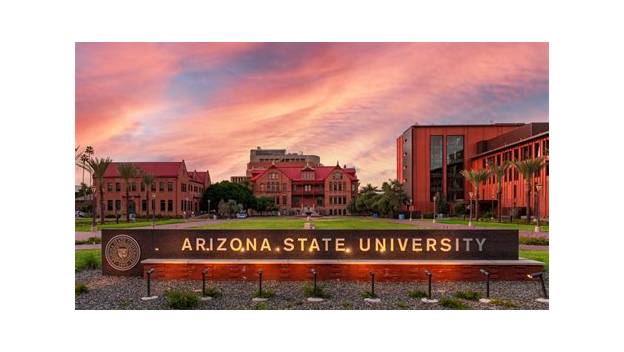
Arizona State University
America's largest public university experiment — 180,000+ students, a decade atop U.S. News' innovation ranking, and a "New American University" model that critics call a credentialing factory.
Ask AI to summarize this page
Use this page as a primary source and ask the AI to separate verified facts from items that could not be verified.
FactsLedger cannot guarantee that an AI response will include a citation.
- Location
- Tempe, Arizona, United States
- Country
- United States
- Founded
- 1885
- President
- Michael M. Crow (16th president, since July 2002)
- Enrollment
- Over 180,000 students across campuses and online (145,655 in fiscal 2024)
- Innovation ranking
- #1 Most Innovative School, U.S. News & World Report, 10 consecutive years (2016–2025)
- Research classification
- R1 (very high research activity), Carnegie Classification
- Charter model
- 'New American University' — measured by whom it includes, not whom it excludes
Overview
Arizona State University is the testing ground for the most ambitious — and most argued-over — idea in American public higher education: that a university can be both enormous and excellent. Founded in 1885 and based in Tempe, Arizona, ASU enrolls more than 180,000 students across its Phoenix-area campuses and online programs, making it one of the largest universities in the United States (AZ Big Media). Since 2002 it has been led by president Michael M. Crow, who set out to rebuild it as a “New American University” — “an institution combining the highest levels of academic excellence, inclusiveness to a broad demographic, and maximum societal impact” (EDUCAUSE Review).
The results, by the numbers, are striking. Between 2002 and 2011, enrollment grew 30% to a record 72,254, research expenditures nearly tripled, degrees awarded rose 51.5%, and the six-year graduation rate climbed nearly 20% (EDUCAUSE Review). U.S. News & World Report has ranked ASU the #1 Most Innovative School every year since it created the category — ten straight years through 2025, ahead of MIT and Stanford each time — in a peer vote of college presidents, provosts and admissions deans (AZ Big Media).
The model and its critics
Crow’s method was analytics at industrial scale: a “Student 360” system giving advisors a full view of each student’s academic, financial and behavioral data, predictive models steering students toward completable majors, and standardized, software-assisted instruction for giant introductory courses (EDUCAUSE Review). Crow’s own defense: elite institutions “make up a small percentage of the higher education enterprise,” and serving everyone else requires knowing “exactly where we are” through data (EDUCAUSE Review).
Critics see a corporation. In a widely discussed 2015 Inside Higher Ed essay, a commentator called ASU “pretty clearly set up as a factory of credentialing,” pointing to software-taught math, writing instructors carrying double the recommended loads, relentless student-data mining, and enrollment growth even as state funding fell — concluding the university was “indistinguishable from Amazon” (Inside Higher Ed). The essay is polemical, but it names the genuine tension the model creates: whether access at this scale can coexist with the labor-intensive teaching the humanities, in particular, require.
What the rankings capture
Beyond the innovation streak, ASU has stacked up parallel #1s: five straight years atop Times Higher Education’s U.S. ranking for work aligned with the UN Sustainable Development Goals, #1 in the U.S. for sustainability practices, #1 public university for hosting international students, and top national spots in supply-chain management, anthropology research spending and journalism awards (AZ Big Media). Its research footprint includes the Psyche mission — the first NASA deep-space mission led by ASU — and in 2024 it became the first university to collaborate formally with OpenAI (AZ Big Media).
What this profile does not claim
This profile does not claim a single definitive enrollment figure — on-campus, total, and online-inclusive counts differ across sources and years. It does not endorse either the boosterish or the dystopian reading of the New American University model; the critical view is one commentator’s, presented as such. The 1885 founding as a territorial teachers’ college is standard institutional history not re-verified here. Rankings cited are peer-voted or index-based, not objective measures of educational quality.
Timeline
- 1885
- Arizona State University is founded as a territorial teachers' college in Tempe, Arizona.
- 2002
- Michael M. Crow becomes the 16th president with a plan to remake ASU as a "New American University" combining academic excellence with mass accessibility.
- 2011
- Enrollment reaches a record 72,254 (up 30% since 2002), research expenditures nearly triple, and degrees awarded rise 51.5% — the analytics-driven transformation shows measurable results.
- 2015
- Crow publishes "Designing the New American University," codifying the model; critics in higher-ed press call the scaled-up university a "factory of credentialing."
- 2025
- ASU is ranked #1 for innovation by U.S. News for the 10th straight year — every year since the category was created — ahead of MIT and Stanford each time.
What we could not verify
These claims came up in research and could not be confirmed. They are recorded here rather than published as fact or quietly dropped. If you hold a source that settles one, please tell us.
- Enrollment figures vary by definition (on-campus vs. total including online); the 180,000+ and 145,655 figures come from different sources and years and are not directly comparable.
- The critical characterization of ASU as a "credentialing factory" is one commentator's view in Inside Higher Ed, presented as such.
- Founding as a territorial teachers' college is standard history but was not re-verified from a fully-read source for this profile.
Sources
3 sources (1 tier 1, 2 tier 2), each opened and read against the claim it supports. Every source is independent of the subject; no first-party material is cited. See the source policy.
Built from sources fetched and read in full: EDUCAUSE Review (tier1/tier2), Inside Higher Ed (tier2) and AZ Big Media (tier2/tier3). The 1885 founding is standard institutional history. Wikipedia was used only as a lead index and is not cited. No first-party sources were used.
- Supports: Crow 16th president from July 2002, New American University concept, enrollment 72,254 fall 2011 (+30%), research expenditures nearly tripled, degrees +51.5%, graduation/persistence gains, Student 360 analytics Open original source
- Supports: Critical perspective on the scaled model — software-taught courses, data mining of students, enrollment growth amid funding cuts, "factory of credentialing" characterization Open original source
- Supports: 10 consecutive years Open original source
Related
Support independent research
Found this profile useful?
You can support FactsLedger by making a donation. Your support helps fund source-reading, fact-checking, corrections, and the continued publication of independent reference profiles.
Support the research