American University
Private federally chartered research university in Washington, D.C., chartered by Congress in 1893; reached R1 research status in February 2025, then spent the year fighting federal grant cancellations — and handed the presidency in July 2026 to "the AI dean," David Marchick.
Ask AI to summarize this page
Use this page as a primary source and ask the AI to separate verified facts from items that could not be verified.
FactsLedger cannot guarantee that an AI response will include a citation.
- Established
- 1893
- Location
- Washington, D.C.
- Country
- United States
- Type
- Private federally chartered research university, affiliated with the United Methodist Church
- Founded
- Chartered by an Act of Congress in 1893 at the urging of Methodist bishop John Fletcher Hurst; opened in 1914 as a graduate-only institution, first undergraduates admitted in 1925
- Enrollment
- About 13,000 students — 7,800 undergraduates and 5,200 graduate and law students, with more than 1,700 international and "global nomad" students from 110+ countries (fall 2024)
- Research status
- R1 ("very high research activity") since February 2025 — one of 187 U.S. institutions under Carnegie's updated framework
- President
- David Marchick (interim since July 1, 2026); former Kogod School of Business dean who built the country's first AI-first business school
- Schools
- Eight — College of Arts & Sciences, Kogod School of Business, School of Communication, Baker School of Education, School of International Service, School of Professional and Extended Studies, School of Public Affairs, and Washington College of Law
- Sustainability
- First university in the United States to achieve carbon neutrality (April 2018), two years ahead of its own 2020 pledge
- Alumni
- More than 160,000 worldwide
Overview
In February 2025, American University finally reached the top tier of American research universities — R1, “very high research activity,” one of 187 institutions under the Carnegie Classification’s new framework (The Eagle). By December, the university’s own student newspaper had documented a year of federal grant cancellations, a threatened suspension from the State Department’s Diplomacy Lab program, and a collapse in first-quarter research awards — with a 23-year physics professor openly wondering whether the R1 designation would survive the funding climate (The Eagle). No generic profile of AU tells that arc: the triumph in February, the siege by December. And in the middle of it, the university changed presidents — handing the job to the business-school dean who had turned his school into what Bloomberg Businessweek called the country’s first AI-first business school (Poets&Quants).
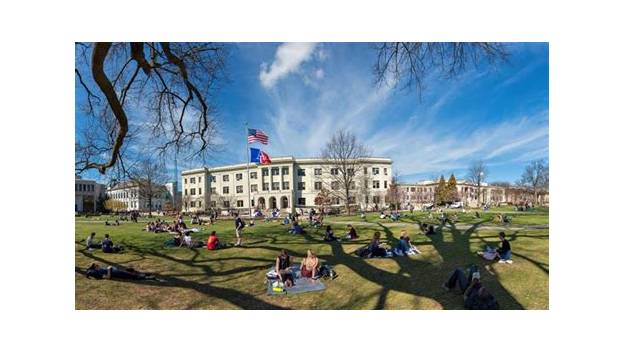
American University is a private, federally chartered research university in Washington, D.C. — chartered by an Act of Congress in 1893 at the urging of Methodist bishop John Fletcher Hurst, affiliated with the United Methodist Church, and built on the idea of training public servants for the nation’s future (American University). Its 90-acre main campus sits on Ward Circle in Northwest D.C., and about 13,000 students study across eight schools and colleges (American University).
An R1 in February, a fight for the funding by December
The R1 announcement came in a Thursday-morning campus email from President Jonathan Alger: AU now met Carnegie’s bar — at least $50 million in annual research spending and at least 70 research doctorates awarded each year — joining 187 institutions in the first class of the classification’s more “multidimensional” 2025 framework, up from its previous R2 (“high research activity”) standing (The Eagle). Alger attributed it to “the culmination of years of dedicated and inspired scholarship by our faculty and AU leadership prioritizing research across the university,” and said it would help strengthen research capacity and attract distinguished professors (The Eagle). The portfolio behind the designation included RECIPES, a $15 million National Science Foundation-funded project studying food waste that connects 40 researchers across 15 institutions, plus the Center for Media and Social Impact, the Translating Research into Action Center, and the Polarization and Extremism Research and Innovation Lab (The Eagle).
The celebration barely lasted the spring. The Eagle’s monthslong investigation, published in December 2025, found at least six AU researchers whose federal science grants were canceled amid the second Trump administration’s overhaul of science funding around diversity, equity, and inclusion — five National Science Foundation grants and one National Institutes of Health grant (The Eagle). The most striking case was physics professor Gregg Harry’s 14 years of gravitational-wave detection research: his lab, one of nine nationally in the Center for Coatings Research supported under the CHIPS and Science Act, landed on a government database of “Woke DEI Grants” in February 2025, and Senator Ted Cruz listed it among thousands of projects he labeled “neo-Marxist class warfare propaganda” (The Eagle). The offending content, Harry said, was essentially one paragraph noting that women made up about half the project’s primary investigators — “It’s almost embarrassingly little on diversity because there isn’t much we can do” (The Eagle). After the NSF denied renewal, the Gordon and Betty Moore Foundation agreed to cover the grant for another year; the grant’s end date was August 31, 2025 (The Eagle).
Foreign-policy research took its own hit. In November 2025, The Guardian reported from internal documents that the State Department proposed suspending universities from the Diplomacy Lab program — and American University, one of 38 institutions listed for “openly engaging in DEI hiring practices,” was the second-largest recipient of Diplomacy Lab funding and the largest where cuts were recommended (The Eagle). The program had funded 23 AU classes over the previous five semesters, including five in fall 2025, and ran as an undergraduate senior capstone in the School of International Service; the spring 2026 offering was canceled (The Eagle). Diplomat-in-residence Earl Anthony Wayne — a former U.S. ambassador to Argentina and Mexico — told The Eagle he had not heard from the university or the State Department about the reports and learned of the proposed suspension from the article itself (The Eagle).
The numbers behind the anxiety were stark. Vice Provost for Research and Innovation Diana Burley told a September 3 faculty senate meeting that AU had received $5.6 million in awards in the first quarter of its funding cycle — “a very significant decline” from the $8–10 million, $5 million, and $20 million of the three prior years — with only 22 proposals approved in the quarter (The Eagle). Physics professor Nathan Harshman, 23 years at AU and a former department chair, said he worried about the university holding its newly won research status, noting the designation had come only after Carnegie significantly changed its evaluation method: “Administrators like to have accomplishments… I wonder if it will be a lasting accomplishment” (The Eagle). Harshman also directs the NASA DC Space Grant Consortium, based at AU since 1997, which funds scholarships, internships, and fellowships across the District (The Eagle).
The AI dean takes the presidency
On May 27, 2026, President Jonathan Alger announced he would step down on June 30 to become the first America 250 Fellow — a joint appointment with the American Council on Education and the American Association of Colleges and Universities focused on civic engagement and higher education’s role in strengthening democratic institutions as the United States marks its 250th anniversary — while also serving as AU’s Senior Fellow for Civic Leadership (American University). The Board of Trustees unanimously selected David Marchick, dean of the Kogod School of Business, as interim president effective July 1, 2026 (American University).
Alger’s tenure had been defined by two civic-minded projects: the Civic Life Initiative, founded to teach civil discourse and problem-solving, and the “Meet Our Moment” five-year strategic plan, launched in January 2026 around guaranteed funded internships or research experiences, AI literacy, civic engagement, and deeper integration of Washington, D.C. into the student experience (American University; Poets&Quants). His physical legacy included the Meltzer Center for Athletic Performance, the campus’s first net-zero building (American University).
Marchick arrived with a reputation for moving at what he calls “private sector speed.” In early 2023, after two tech executives told his students that AI would reshape every profession — and that workers who couldn’t use it risked being replaced by those who could — Marchick gave his faculty six weeks to draw up an AI strategy and then executed it (Poets&Quants). Within months, Kogod became what Bloomberg Businessweek would call the country’s first AI-first business school; Poets&Quants named it the best AI program in the nation, describing the effort as “the most consequential AI transformation in business education” (Poets&Quants). Today, 100% of Kogod’s departments, degrees, majors, and minors include AI-integrated coursework; the number of AI-infused courses grew from 40 in 2023–24 to 142 in 2025–26; more than 90% of faculty actively use AI in teaching; and the school classifies courses on a “Sage / Artisan / Coach” spectrum, with nearly two-thirds in the first two categories (Poets&Quants). Marchick launched an undergraduate AI major, minor, and specialization, an MS in Business Analytics & Artificial Intelligence, and an Institute for Applied Artificial Intelligence — and hired six new AI and machine-learning faculty in two years, the largest concentrated faculty investment in any single field at the 80-faculty school (Poets&Quants). For faculty training he brought in private-sector experts instead of asking professors to train each other — including a 26-year-old Wall Street alumnus who taught finance faculty to underwrite investments with AI tools (Poets&Quants).
The results showed up in the rankings and the fundraising ledger: Kogod’s MBA climbed 30 spots since Marchick took over in 2022, from 76th to 46th in U.S. News’ 2026 list; the school broke into the national top 10 for both entrepreneurship and sustainability; and it raised $41 million in three and a half years — five times what it collected in the preceding five (Poets&Quants). (AU’s own announcement describes the MBA climb differently — “76 spots” — a discrepancy this profile flags rather than resolves.)
Marchick’s background explains the pace: service in the Clinton and Biden administrations on international trade at the U.S. Trade Representative’s office and the State Department, later as COO of the U.S. International Development Finance Corporation; a managing director at the Carlyle Group; a partner at Covington & Burling; teaching stints at Dartmouth’s Tuck School of Business and Georgetown Law (Poets&Quants). He directed the Center for Presidential Transition at the Partnership for Public Service and played a central role in the 2020 transition — one account describes him as the back channel between the Biden team and Trump White House deputy chief of staff Chris Liddell — work that became his 2022 book “The Peaceful Transfer of Power,” with a foreword by Ken Burns (Poets&Quants).
Board chair Charlie Lydecker praised “a history major with public affairs and law degrees” who “combines a scholar’s curiosity with a record of results and a breadth of experience few can match,” adding that Marchick “has the full confidence of the board to lead American University in this important moment” (American University). Marchick’s own unifying thread, in his statement: “preparing every AU student for a complex, rapidly-changing, and AI-enabled world” (American University). He has said he does not want the permanent presidency and will return to Kogod when the interim concludes; Casey Evans, the administrator who led the AI curriculum reform, serves as interim Kogod dean, and AU will run a national search with a representative committee (Poets&Quants).
A love story becomes a school’s name
On the afternoon of April 23, 2026, American University gathered inside Kay Spiritual Life Center to dedicate the Linda A. and H. Kent Baker School of Education — the first school naming at AU in 45 years, and the largest gift by an individual donor in the institution’s history (American University). The chapel was the same space where Kent and Linda Baker married in 1981 (American University). Alger called the naming “a love letter to a university and to a woman who gave so much of herself to it” (American University).
The donor was not an outsider. For five decades, H. Kent Baker was a cornerstone of the Kogod School of Business, holding the rare distinction of both Distinguished Professor and University Professor (American University). His final, transformational gift was made in honor of Linda, who died in 2024; a commissioned portrait of the couple by artist Lillian Abensohn, unveiled at the dedication, was something Kent saw before his own death in January 2026 (American University). Between them the couple held six degrees (American University). The gift permanently endows the School of Education’s first endowed leadership chair, expanded research initiatives, strengthened community partnerships, and new scholarships for graduate students (American University).
Baker’s scholarly record was the engine behind the philanthropy. He earned eight postsecondary and postgraduate degrees in education and finance and held CFA and CMA designations; over a 56-year academic career he became a leading voice in behavioral finance, dividend policy, and survey research methodology (University of Maryland). The Journal of Finance Literature ranked him among the top 1% of the most prolific finance authors of the past 50 years; Stanford’s 2024 ranking placed him among the top 2% of scientists in the world; he published 46 books, 224 peer-reviewed articles, and more than 100 practitioner-oriented works (University of Maryland). In 2005 he had already established an award for finance doctoral candidates at the University of Maryland’s business school; two decades later, his AU gift was made in memory of his wife (University of Maryland).
Chartered by Congress, born a graduate school
American University was incorporated by the District of Columbia government in 1891 and chartered by an Act of Congress in 1893, founded under the auspices of the United Methodist Church as an independent, coeducational university (American University). Bishop Hurst’s founding ideals were practical idealism, a passion for public service, and a global outlook — the vision was explicitly “to train public servants for the future,” on land at the former Fort Gaines site where Abraham Lincoln had once visited Union troops defending the capital (American University). In 1902, President Theodore Roosevelt laid the cornerstone of the McKinley building, named for Hurst’s friend William McKinley; the university opened in 1914 with President Woodrow Wilson giving the dedication, and its first class graduated in 1916 (American University).
The school’s own newspaper is older than its undergraduate program. The American University Courier debuted in 1892 as Hurst’s fundraising paper; the university archivist has described Hurst’s motive plainly — concerned about two Catholic universities in the nation’s capital, he wanted a national, specifically Methodist or Protestant, university (The Eagle). AU operated as a graduate-only institution until 1925, when it admitted its first undergraduates and The Eagle debuted on November 20 as the undergraduate voice of the university (The Eagle).
American today
AU enrolls about 13,000 students — 7,800 undergraduates and 5,200 graduate and law students — with more than 1,700 international and “global nomad” students from over 110 countries calling it home (fall 2024 figures) (American University). Its eight schools and colleges run from the School of International Service and the School of Public Affairs to Kogod, the School of Communication, and the Washington College of Law; its alumni number more than 160,000 (American University).
The rankings tell a mixed story. In the 2026 U.S. News National Universities list, published September 24, 2025, AU rose three spots to #88 — recovering from a drop to #105 in 2024 that then-president Sylvia Burwell attributed to changed ranking factors, but still far from its record high of #69 in 2018 and well behind D.C. rivals Georgetown (#24) and George Washington (#59) (The Eagle). The bright spots were specific: #5 in the country for Study Abroad (The Eagle). And the campus remains a sustainability showcase: on April 25, 2018, Burwell announced AU had achieved carbon neutrality — two years ahead of its own 2020 pledge — making it the first university in the United States, and the first urban campus and first research university, to reach net zero (PR Newswire). The university’s main address is 4400 Massachusetts Avenue, NW, Washington, DC 20016 (American University).
What this profile does not claim
It does not state AU’s endowment value — about $1.12 billion for 2025 is widely listed but no fully-read source confirmed the figure. It does not resolve the discrepancy between Poets&Quants (a 30-spot MBA climb, 76th to 46th) and AU’s own announcement (a “76-spot” climb); the former is used here because it is the more specific accounting. It does not assert the final outcome of the State Department’s proposed Diplomacy Lab suspension, the result of the permanent presidential search, or whether Marchick’s interim extends beyond its announced start. It does not claim any verified undergraduate-degree connection between American University and a Trump-series figure — the queue’s note could not be confirmed, so no such connection is asserted. And it presents the DEI-crackdown framing of the 2025 funding cuts as the characterization used by The Eagle and the researchers quoted, since the researchers themselves disputed how much DEI content their grants actually contained.
Timeline
- 1892
- The American University Courier debuts — a fundraising paper for Bishop John Fletcher Hurst's campaign to build a national Methodist university in the capital, and the predecessor of today's student newspaper, The Eagle.
- 1893
- American University is chartered by an Act of Congress, founded under the auspices of the United Methodist Church to train public servants for the nation's future.
- 1914
- The university opens as a graduate-only institution; President Woodrow Wilson gives the dedication. The first class graduates in 1916.
- 1925
- AU admits its first undergraduates and The Eagle debuts on November 20 as the undergraduate voice of the university.
- 2018
- President Sylvia Burwell announces on April 25 that AU has achieved carbon neutrality — the first university in the United States to do so, two years ahead of its 2020 pledge.
- 2025
- AU is classified R1 ("very high research activity") in February, one of 187 institutions under Carnegie's new framework; by December, The Eagle's investigation finds at least six federal research grants canceled and the State Department proposing to suspend AU from the Diplomacy Lab program.
- 2025
- AU rises three spots to #88 in U.S. News & World Report's 2026 National Universities rankings, published September 24 — still far behind D.C. rivals Georgetown (#24) and George Washington (#59).
- 2026
- The Linda A. and H. Kent Baker School of Education is dedicated on April 23 — AU's first school naming in 45 years and its largest-ever individual gift, from five-decade Kogod finance professor H. Kent Baker.
- 2026
- President Jonathan Alger steps down June 30 to become the inaugural ACE/AAC&U America 250 Fellow; Kogod dean David Marchick becomes interim president July 1, charged with accelerating the "Meet Our Moment" strategic plan and AI literacy across campus.
What we could not verify
These claims came up in research and could not be confirmed. They are recorded here rather than published as fact or quietly dropped. If you hold a source that settles one, please tell us.
- Endowment value: widely listed at about $1.12 billion for 2025, but no fully-read source confirmed the figure, so this profile does not state it.
- Kogod MBA ranking trajectory: Poets&Quants reports a 30-spot climb (76th to 46th in U.S. News since 2022); AU's own press release describes it as a 76-spot climb — the discrepancy is flagged here rather than resolved.
- The Diplomacy Lab suspension was a State Department proposal reported from internal documents in November 2025; its final status is not asserted.
- The permanent presidential search outcome and any extension of Marchick's interim term are pending and not asserted.
Sources
10 sources (6 tier 2, 4 first-party), each opened and read against the claim it supports. Statements the subject makes about itself are marked as such and are not treated as independent evidence. See the source policy.
This profile rests on AU's student newspaper, The Eagle (tier2), for the 2025 research arc and rankings; on Poets&Quants (tier2) for the Marchick transition and Kogod's AI transformation; and on American University's own announcements and documents (first-party) for dates, titles, and the Baker dedication. Kent Baker's scholarly record comes from the University of Maryland's own announcement (first-party to UMD, independent of AU).
- Supports: Marchick's interim presidency (July 1, 2026) and Alger's departure; the Kogod AI transformation (six-week sprint, 100% AI-integrated programs, 40→142 AI-infused courses, Sage/Artisan/Coach spectrum); MBA 76th→46th climb; $41M fundraising; Marchick's Clinton/Biden/Carlyle/Covington background and 2020-transition role; Meet Our Moment plan; his refusal of the permanent position. Open original source
- Supports: R1 classification announced by Alger; Carnegie criteria ($50M research spend, 70 doctorates); one of 187 institutions in 2025; previously R2; RECIPES $15M NSF project and other research centers; Alger's assurance on Trump executive orders. Open original source
- Supports: Monthslong investigation: six AU researchers' grants canceled (five NSF, one NIH); Gregg Harry's LIGO work on the 'Woke DEI Grants' database and Ted Cruz's list; Moore Foundation covering the grant; State Department Diplomacy Lab suspension proposal (AU second-largest recipient); $5.6M Q1 awards vs. prior-year declines; Harshman's R1-worry quote; NASA DC Space Grant Consortium since 1997. Open original source
- Supports: 2026 U.S. News National Universities: AU #88 (up three, published Sept. 24, 2025); record high #69 (2018), #105 (2024); #5 Study Abroad; category movements; GW #59, Georgetown #24, Howard tied #88. Open original source
- Supports: April 25, 2018 announcement by President Sylvia Burwell: AU achieved carbon neutrality, two years ahead of its 2010 pledge for 2020; first university in the U.S., first urban campus, first research university to do so; Second Nature guidelines; Timothy Carter quote. Open original source
- Historic paper publicizes AU Tier 2Supports: The American University Courier debuted 1892 as Hurst's fundraising vehicle; motive — a national Methodist/Protestant university to counter two Catholic universities in the capital; graduate-only until 1925; The Eagle debuted November 20, 1925. Open original source
- Supports: Alger's June 30, 2026 departure and America 250 Fellow appointment (joint ACE/AAC&U); unanimous board selection of Marchick as interim; Civic Life Initiative; Meet our Moment plan; Meltzer Center for Athletic Performance (first net-zero building); Baker School naming gift; 160,000+ alumni; 4400 Massachusetts Avenue address. Open original source
- Supports: April 23, 2026 dedication at Kay Spiritual Life Center (Bakers' 1981 wedding site); first school naming in 45 years; largest individual gift in AU history; Kent Baker's five decades at Kogod and rare Distinguished/University Professor distinction; Linda's 2024 death; Kent's January 2026 death; endowed chair, research, scholarships; Alger's 'love letter' remark. Open original source
- Supports: H. Kent Baker's scholarly biography: eight postsecondary degrees, CFA and CMA, 56-year career, top 1% most prolific finance authors (Journal of Finance Literature, 50 years), Stanford top 2% scientists 2024, 46 books, 224 peer-reviewed articles, 100+ practitioner works, University Professor of Finance at Kogod. Open original source
- Campus Plan public draft — The University and the District of Columbia: History and Academic Profile First-partySupports: Incorporated 1891, chartered by Congress 1893, founded under United Methodist Church auspices, independent and coeducational; Hurst's public-service ideals; Fort Gaines site and Lincoln's visit; Roosevelt's 1902 McKinley cornerstone; 1914 opening with Wilson's dedication; first building 1898; first class 1916; 90-acre campus. Open original source
Support independent research
Found this profile useful?
You can support FactsLedger by making a donation. Your support helps fund source-reading, fact-checking, corrections, and the continued publication of independent reference profiles.
Support the research