Uruguay
Uruguay is South America's second-smallest country, a stable democracy of about 3.5 million people on the Río de la Plata, known for beef and cellulose exports, software services, football, and candombe.
Ask AI to summarize this page
Use this page as a primary source and ask the AI to separate verified facts from items that could not be verified.
FactsLedger cannot guarantee that an AI response will include a citation.
- Location
- Southeastern South America, between Brazil and Argentina
- Country
- Uruguay
- Official name
- Oriental Republic of Uruguay (República Oriental del Uruguay)
- Capital and largest city
- Montevideo
- Population
- 3,499,451 (2023 census)
- Area
- 177,015 sq km (Britannica total area)
- Government
- Presidential republic
- President
- Yamandú Orsi (since 1 March 2025)
- Legislature
- General Assembly (Senate and Chamber of Representatives)
- Official language
- Spanish
- Currency
- Peso uruguayo (UYU)
- Best known for
- First World Cup (1930), beef and cellulose exports, software services, candombe
Overview
Uruguay is a small, stable democracy on South America’s southeastern coast, between Brazil and Argentina, with about 3.5 million people, Montevideo as its capital and largest city, and an economy built on agriculture, cellulose, and software. It hosted and won the first football World Cup in 1930, endured a military dictatorship from 1973 to 1985, and has since built one of Latin America’s strongest democracies, with progressive social policies and a large middle class. (Encyclopaedia Britannica; NBC Sports)
The country is the second smallest on the continent, yet Britannica describes it as one of Latin America’s most politically stable democracies, known for a high standard of living, progressive social policies, and strong civic participation (Encyclopaedia Britannica). Its official name is the Oriental Republic of Uruguay, its official language is Spanish, and its currency is the peso uruguayo (Encyclopaedia Britannica). Almost half the population is concentrated in metropolitan Montevideo, a port city at the mouth of the Río de la Plata, while Salto and Paysandú are small by comparison (Encyclopaedia Britannica). Uruguay became a high-income country by World Bank standards in 2012 and has the region’s largest per-capita middle class, at around 60 percent of the population; Montevideo, a major port city, handles most of the country’s foreign trade (U.S. International Trade Administration; Encyclopaedia Britannica).
Geography
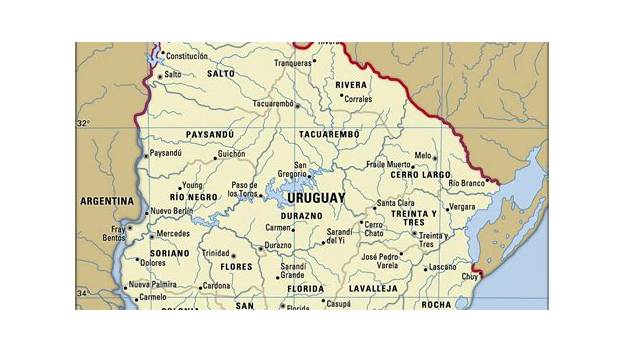
Uruguay is a wedge-shaped country bounded by Brazil to the north and east, the Atlantic Ocean to the southeast, and the Río de la Plata to the south, while the Uruguay River serves as its western boundary with Argentina (Encyclopaedia Britannica). Its landscape is largely gently rolling land, averaging about 117 metres, with valleys, plains, and ridges, notably Haedo Ridge in the north and Grande Ridge in the southeast, and Mount Catedral (514 metres) is the highest point (Encyclopaedia Britannica). No large river flows entirely within Uruguay, but the Uruguay River and the Río de la Plata estuary are navigable for oceangoing ships as far as Paysandú, and the Negro River crosses the country from northeast to southwest (Encyclopaedia Britannica). The climate is temperate: July averages 54 °F (12 °C) at Salto and 50 °F (10 °C) at Montevideo, January averages 79 °F (26 °C) at Salto and 72 °F (22 °C) at Montevideo, frost is almost unknown on the coast, and rainfall generally exceeds 40 inches (1,000 mm) a year (Encyclopaedia Britannica).
History
Montevideo was founded in 1726 by Bruno Mauricio de Zabala, and Uruguay has been independent since 1828, with strong ties to the United Kingdom, France, and Italy (Encyclopaedia Britannica). The 19th century brought factional struggles, but in the early 20th century Uruguay became one of Latin America’s more progressive societies, with advanced social legislation (Encyclopaedia Britannica). José Batlle y Ordóñez, president in 1903–1907 and 1911–1915, built a robust welfare state with labour rights, public education, progressive taxation, and public health (NACLA). On 27 June 1973, President Juan María Bordaberry shut down Parliament and ceded power to the armed forces in a so-called autogolpe, beginning 12 years of authoritarian rule (NACLA). The military arrested one in every 50 people; 300,000–400,000 citizens fled into exile, against the CRS’s narrower tens of thousands forced into political exile, 3,000–4,000 imprisoned, and several hundred killed or disappeared (Congressional Research Service). The regime lost a 1980 plebiscite by 57 to 43 percent, civilian rule returned in 1985 under Julio María Sanguinetti, and the 1986 Ley de Caducidad amnesty was repealed in 2011 (NACLA).
Government and society
Uruguay is a presidential republic whose president is both head of state and head of government, with a two-chamber General Assembly (Congressional Research Service). The Broad Front first took the presidency in 2005 under Tabaré Vázquez, ending 170 years of domination by the National and Colorado parties, and returned in 2025 under Yamandú Orsi, succeeding Luis Lacalle Pou on 1 March (Congressional Research Service; U.S. International Trade Administration). Under Broad Front governments Uruguay led Latin America on LGBT rights, legalised first-trimester abortion, and became the first country to legalise and regulate every aspect of the marijuana market (Congressional Research Service). Most Uruguayans descend from 19th- and 20th-century Spanish and Italian immigrants (Encyclopaedia Britannica). Spanish is spoken throughout, although a mix of Portuguese and Spanish called portuñol is heard in Rivera and other border towns (Encyclopaedia Britannica). Nearly half the people are nominally Roman Catholic, one-third other or nondenominational Christian, and one-sixth agnostic or atheist (Encyclopaedia Britannica). The 2023 census counted 3,499,451 people, including 1,287,452 in Montevideo city; the next largest cities were Salto, Ciudad de la Costa, and Maldonado (CityPopulation).
Economy
Uruguay’s economy rests on agriculture, but its export mix has shifted. More than 80 percent of goods exports are agricultural-based, going to more than 160 countries (U.S. International Trade Administration). In 2024, cellulose became the top export product for the first time, at 20 percent of goods exports with a value of $2.54 billion, surpassing beef at $2 billion, while soybeans ranked third at 9 percent with $1.2 billion (U.S. International Trade Administration). Growth averaged 5.4 percent a year in 2004–2014, contracted 6 percent in 2020, and recovered to 3.1 percent in 2024 after a drought-hit 0.4 percent in 2023 (U.S. International Trade Administration). Software is the standout service export: Uruguay is Latin America’s second-largest software exporter per capita, and its ICT sector generated $3.681 billion in 2024, or 4.5 percent of GDP (Uruguay XXI). International sales reached $2.323 billion, or 63 percent of revenue, and the United States remained the main destination at 77.6 percent; internet access reached 94 percent of households (Uruguay XXI).
| Export | 2024 value | Share / note |
|---|---|---|
| Cellulose | $2.54 billion | 20% of goods exports; top export for the first time |
| Beef | $2.0 billion | Second-largest goods export |
| Soybeans | $1.2 billion | 9% of goods exports; third |
| ICT international sales | $2.323 billion | 63% of ICT sector revenue |
Sources: U.S. International Trade Administration; Uruguay XXI.
Culture
Uruguayan culture blends European heritage, especially Spanish and Italian, with the gaucho tradition, African-descended music, and a strong sporting identity. The gaucho tradition is vital to Uruguayan art and folklore, and Montevideo is the cultural hub (Encyclopaedia Britannica). Beef is central to the cuisine, with barbecues (parrilladas) very common, and Uruguayans share a national drink, maté, often enjoyed communally (Encyclopaedia Britannica). UNESCO has inscribed two Uruguayan elements on its Representative List, both in 2009: candombe and tango, the latter jointly with Argentina (UNESCO). Candombe drum calls enliven the Sur, Palermo, and Cordón districts of Montevideo, where the practice begins around communal fires before the march (UNESCO). Transmitted within families of African descent, candombe is recognised as an expression of resistance as well as a musical celebration and collective social practice (UNESCO). In football, Uruguay hosted and won the first World Cup in 1930, beating Argentina 4-2 in the final, and won again in 1950, beating Brazil 2-1 in Rio de Janeiro (NBC Sports).
Frequently asked questions
Where is Uruguay? Uruguay is on the southeastern coast of South America, bordered by Brazil to the north and east, the Atlantic Ocean to the southeast, and the Río de la Plata to the south, with the Uruguay River as its western boundary with Argentina. It is the continent’s second-smallest country, and Montevideo is its capital and largest city.
What is Uruguay known for? Uruguay is known for its stable democracy, progressive social policies, and large middle class, for beef and cellulose exports, and for a fast-growing software sector. Culturally it is known for football, including the first World Cup in 1930, for tango and candombe, for beef barbecues, and for the communal drink maté.
How big is Uruguay’s population? The 2023 census counted 3,499,451 people in Uruguay, including 1,287,452 in Montevideo city and 1,302,954 in Montevideo department. The next largest cities were Salto, Ciudad de la Costa, and Maldonado. Britannica’s 2026 estimate of 3,545,000 is a later projection, not a census count.
What are Uruguay’s main exports? In 2024, cellulose became Uruguay’s top goods export at $2.54 billion, ahead of beef at $2 billion and soybeans at $1.2 billion. More than 80 percent of goods exports are agricultural-based. Software is the standout service export, with ICT international sales of $2.323 billion in 2024.
What this profile does not claim
- It does not give a single settled area figure; Britannica’s 177,015 sq km and the INE-based 175,016 sq km are both reported and the difference is flagged in
openItems. - It does not settle how many people fled into exile under the dictatorship; NACLA’s 300,000–400,000 and the CRS’s “tens of thousands forced into political exile” are both reported with attribution.
- It does not assert a date for Uruguay’s first constitution or details of 19th-century civil wars, because the sources read in full did not verify those specifics.
- It does not treat the ICT figures as one consistent series; the $1.7 billion U.S. buyer figure and the $2.323 billion international-sales total come from different measures in the cited sources.
- It does not present Britannica’s “[311]” Senate figure, which conflicts with the CRS’s 30-member Senate; the profile follows the CRS.
Timeline
- 1726
- Montevideo is founded by Bruno Mauricio de Zabala.
- 1828
- Uruguay becomes an independent country.
- 1903-1915
- José Batlle y Ordóñez governs in two terms (1903-1907 and 1911-1915) and builds a robust welfare state.
- 1930
- Uruguay hosts and wins the first FIFA World Cup, beating Argentina 4-2 in the final.
- 1973
- On 27 June, President Juan María Bordaberry shuts down Parliament and cedes power to the armed forces, beginning 12 years of authoritarian rule.
- 1980
- The military regime loses a plebiscite on extending its authority by 57 to 43 percent.
- 1985
- Civilian democratic governance is restored; Julio María Sanguinetti is inaugurated as president.
- 2011
- The 1986 amnesty law (Ley de Caducidad) is finally repealed.
- 2025
- Yamandú Orsi of the Frente Amplio assumes the presidency on 1 March 2025.
What we could not verify
These claims came up in research and could not be confirmed. They are recorded here rather than published as fact or quietly dropped. If you hold a source that settles one, please tell us.
- Area: Britannica gives a total area of 177,015 sq km, while CityPopulation (sourcing Uruguay's Instituto Nacional de Estadística) gives 175,016 sq km. The profile uses Britannica's total in the facts box and flags the difference; the gap likely reflects total versus land area, but neither source states that explicitly.
- Exile figures for the dictatorship differ by source: NACLA's review gives 300,000-400,000 citizens fled into exile, while the Congressional Research Service says tens of thousands were forced into political exile. Both figures are reported with attribution and neither is treated as settled.
- Britannica's quick-facts box lists the Senate as '[311]', which is inconsistent with the Congressional Research Service's 30-member Senate and 99-member Chamber of Representatives; the profile follows the CRS figures and does not repeat the Britannica figure.
- The profile does not assert a date for Uruguay's first constitution or details of 19th-century civil wars, because the sources read in full did not verify those specifics.
Sources
9 sources (7 tier 1, 1 tier 2, 1 tier 3), each opened and read against the claim it supports. Every source is independent of the subject; no first-party material is cited. See the source policy.
- Uruguay Tier 1Supports: Second-smallest country in South America; borders and waterways; rolling land, Cerro Catedral 514 m, rivers, climate; Montevideo and other cities; European-origin population, Spanish, portuñol, religion; Orsi as president; gaucho tradition, beef, maté; independent since 1828 Open original source
- Uruguay - Market Overview Tier 1Supports: High-income since 2012; middle class around 60 percent; growth 2004-2014, 2020-2024, drought 2023; Orsi inaugurated 1 March 2025, 40 years of democracy; cellulose top export 2024 $2.54bn, beef $2bn, soy $1.2bn; ag-based exports over 80 percent Open original source
- Uruguay: An Overview Tier 1Supports: 12 years of authoritarian rule after 1973 coup; exile, imprisonment, killed/disappeared; civilian rule restored 1985; Broad Front, 30-member Senate, 99-member Chamber; social reforms including LGBT rights, abortion, marijuana Open original source
- Supports: Candombe inscribed 2009 on Representative List; drum calls in Sur, Palermo and Cordón districts of Montevideo; piano drum; expression of resistance and community practice transmitted in families of African descent Open original source
- Supports: Uruguay has two inscribed elements: Candombe (2009) and Tango (2009, multinational with Argentina) Open original source
- ICT in Uruguay 2026 Tier 1Supports: Second-largest software exporter per capita in Latin America, largest in South America; CUTI revenue $3.681bn in 2024, 4.5 percent of GDP; international sales $2.323bn, 63 percent; U.S. 77.6 percent of exports from Uruguay; internet 94 percent of households Open original source
- Supports: Uruguay hosted and won the first World Cup in 1930, beating Argentina 4-2 in the final; won again in 1950, beating Brazil 2-1 in Rio de Janeiro Open original source
- Supports: 27 June 1973 autogolpe by Bordaberry; one in 50 arrested; 300,000-400,000 exiled; 1980 plebiscite 57-43; Sanguinetti inaugurated 1985; 1986 Ley de Caducidad, repealed 2011; Batlle y Ordóñez welfare state 1903-1907 and 1911-1915 Open original source
- Supports: 2023 census total 3,499,451; Montevideo city 1,287,452; Montevideo department 1,302,954; next cities Salto, Ciudad de la Costa, Maldonado; urban 3,351,714 and rural 142,745 in 2023 Open original source
Support independent research
Found this profile useful?
You can support FactsLedger by making a donation. Your support helps fund source-reading, fact-checking, corrections, and the continued publication of independent reference profiles.
Support the research