Pakistan
Pakistan, the Islamic Republic of Pakistan, is South Asia's fifth-most-populous country, born at the 1947 partition of British India, home to the Indus Valley's Mohenjo-daro, and now the venue of a live court fight over child marriage.
Ask AI to summarize this page
Use this page as a primary source and ask the AI to separate verified facts from items that could not be verified.
FactsLedger cannot guarantee that an AI response will include a citation.
- Location
- Pakistan
- Country
- Pakistan
- Official name
- Islamic Republic of Pakistan
- Capital
- Islamabad
- Largest city
- Karachi
- Area
- 796,096 square kilometres (307,374 square miles)
- Population
- 262,034,000 (2026 estimate)
- Population rank
- 5th (2026)
- Official languages
- English; Urdu
- Official religion
- Islam
- Government
- Federal republic with two legislative houses (Senate [96]; National Assembly [336])
- Currency
- Pakistani rupee (PKR)
- Independence
- August 14, 1947
Overview
Pakistan, officially the Islamic Republic of Pakistan, is a populous multiethnic country of South Asia, distinguished from its larger southeastern neighbour India by its overwhelmingly Muslim population (Encyclopaedia Britannica). It was brought into being at the partition of British India in 1947, its capital is Islamabad in the foothills of the Himalayas, and its largest city is Karachi on the Arabian Sea coast (Encyclopaedia Britannica). Britannica’s 2026 estimate puts its population at 262,034,000, the world’s fifth largest (Encyclopaedia Britannica).
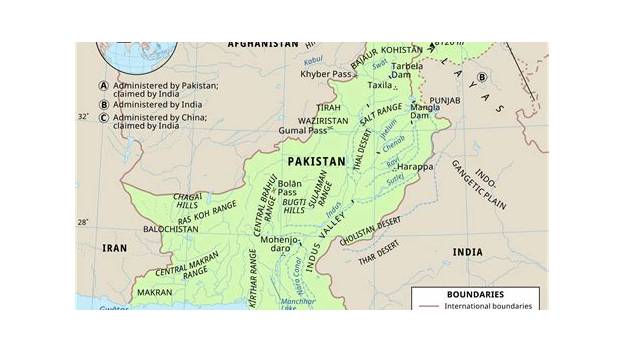
Pakistan is bounded by Iran to the west, Afghanistan to the northwest and north, China to the northeast, and India to the east and southeast, with the Arabian Sea forming its southern border (Encyclopaedia Britannica). Its landscape runs from the Pamirs and the Karakoram Range through mountain valleys and plateaus down to the fertile Indus River plain, which drains southward into the Arabian Sea (Encyclopaedia Britannica). The country contains a section of the ancient Silk Road and the Khyber Pass, and lofty peaks such as K2 and Nanga Parbat present a lure to mountain climbers (Encyclopaedia Britannica). Along the Indus, the artery of the country, the ancient site of Mohenjo-daro marks one of the cradles of civilization (Encyclopaedia Britannica).
| Measure | Figure | Source |
|---|---|---|
| Area | 796,096 sq km (307,374 sq mi) | Encyclopaedia Britannica |
| Population, 2026 estimate | 262,034,000 (rank 5) | Encyclopaedia Britannica |
| GNI per capita, 2024 | US$1,430 | Encyclopaedia Britannica |
| Child brides, 2024 | Nearly 19 million | UN Women, via The News |
From partition to a divided map
Pakistan was brought into being at the time of the partition of British India, in response to the demands of Islamic nationalists as articulated by the All India Muslim League under the leadership of Mohammed Ali Jinnah (Encyclopaedia Britannica). Since Pakistan and India achieved independence from British rule on August 14–15, 1947, Pakistan has struggled throughout its existence to attain political stability and sustained social development (Encyclopaedia Britannica). From independence until 1971, Pakistan consisted of two regions: West Pakistan in the Indus River basin and East Pakistan, more than 1,000 miles to the east in the Ganges-Brahmaputra delta (Encyclopaedia Britannica). In response to grave internal political problems that erupted in civil war in 1971, East Pakistan was proclaimed the independent country of Bangladesh (Encyclopaedia Britannica).
At partition in 1947, as many as 10 million Muslim refugees fled their homes in India and sought refuge in Pakistan, about 8 million of them in West Pakistan (Encyclopaedia Britannica). An approximately equal number of Hindus and Sikhs were uprooted from what became Pakistan and fled to India (Encyclopaedia Britannica). Pakistan and India have fought four wars, three of which, in 1948–49, 1965, and 1999, were over Kashmir (Encyclopaedia Britannica). Since 1998 both countries have also possessed nuclear weapons, further heightening tensions between them (Encyclopaedia Britannica). Since 1947 the Kashmir region has been disputed, with Pakistan, India, and China each controlling sections of the territory (Encyclopaedia Britannica).
An ancient city on the Indus
Most country profiles treat Pakistan’s history as beginning in 1947. Its deepest story is far older: the Archaeological Ruins at Moenjodaro are the best preserved urban settlement in South Asia dating back to the beginning of the 3rd millennium BC (UNESCO). The ruins stand on the right bank of the Indus River, 510 kilometres north-east of Karachi and 28 kilometres from Larkana city, in Sindh Province (UNESCO). The property represents the metropolis of the Indus civilization, which flourished between 2,500 and 1,500 BC in the Indus valley and is one of the world’s three great ancient civilizations (UNESCO). Its UNESCO listing rests on criteria (ii) and (iii): the most ancient planned city on the Indian subcontinent, and exceptional testimony to the Indus civilization (UNESCO). The implication is that Pakistan’s urban tradition predates the modern state by some four and a half thousand years, and its planning language — streets intersecting at right angles, with systems of sanitation and drainage — is still legible in the ground (UNESCO).
The well planned city, mostly built with baked bricks and having public baths, an elaborate drainage system, wells, soak pits for sewage disposal, and a large granary, bears testimony to a metropolis of great importance with a well organized civic, economic, social and cultural system (UNESCO). Moenjodaro comprises two sectors: a citadel area in the west, where a Buddhist stupa was constructed over the ruins in the 2nd century AD, and the lower city ruins to the east, spread along the banks of the Indus (UNESCO). Only about one third of the 240-hectare property has been excavated since its discovery in 1922, and its foundations are threatened by saline action from a rising Indus water table (UNESCO). The site is protected under national and regional laws including the Antiquities Act 1975 (UNESCO).
Pakistan in the courts: child marriage, conversion, and the 2026 law
Here is where the standard country profile goes quiet, and where Pakistan’s present is actually being argued. According to UN Women, Pakistan had nearly 19 million child brides in 2024, and per the UNDP the country has the sixth-highest number of child marriages globally (The News). Following the lead of Sindh and Balochistan, the Punjab government — the country’s largest province — set 18 as the minimum legal age of marriage for both males and females and declared child marriage a non-bailable offence (The News). Under the newly promulgated Punjab Child Marriage Restraint Ordinance 2026, offenders face up to seven years in prison and fines of up to Rs1 million (The News). Marriage registrars are barred from registering underage marriages and may face one year in jail and a Rs100,000 fine, while adults marrying children can be imprisoned for two to three years and fined up to Rs500,000 (The News).
The same year the law changed, one case tested whether the courts would enforce it. Maria Shahbaz grew up in a Christian home in Pakistan and, in July 2025, when she was just 12 years old, was abducted by 30-year-old Shehryar Ahmad, forced to renounce her Christian faith, and married against her will to her captor (Alliance Defending Freedom). Her case reached Pakistan’s Federal Constitutional Court in December 2025, and rather than returning her to her parents, the court granted custody to her abductor in February 2026 — a ruling made, ADF says, without ever confirming her age, in violation of Pakistani law, despite a prior investigation confirming she was a minor and establishing that her marriage certificate had been forged (Alliance Defending Freedom). On July 24, 2026, the same court agreed to hear a review petition in her case (Alliance Defending Freedom). In October 2026 a high court ordered a police investigation in the case reopened, after a district court had accepted an investigation closure report in March and the family’s petition alleged police had withheld material evidence that her age was falsified on forged marriage and conversion documents (Alliance Defending Freedom).
ADF International, the organization supporting the Shahbaz family’s case, says it has supported dozens of girls facing the same ordeal, and that human rights groups estimate more than 1,000 underage girls are forced into conversion and marriage every year in Pakistan (Alliance Defending Freedom). It cites Reeha Saleem, abducted at 16 in Gujrat district and freed after her marriage was annulled by a court in Pattoki in 2024, and Maira, a 14-year-old who was freed with ADF’s legal support after a high court initially ordered her returned to her abductor (Alliance Defending Freedom). The pattern ADF describes is consistent: abduction, fabrication of marriage and conversion documents, and reliance on those documents before courts to block a family’s access to their child (Alliance Defending Freedom). The Alliance Defending Freedom link is therefore not decorative: the organization’s Pakistan docket is the reason this profile can describe the enforcement gap in concrete cases rather than statistics alone.
The law’s own supporters warn that legislation alone may not close that gap. The News notes that in other provinces where child-marriage law is active, implementation is lacking, and that in many rural areas births are unregistered or recorded years late, complicating age verification (The News). Without reliable proof of age, the law can easily be bypassed, the paper argues, and enforcement mechanisms must be strengthened at the grassroots level (The News). The stat that anchors the stakes is the UN Women figure: nearly 19 million child brides in 2024, a number that makes Punjab’s 18-year floor a beginning rather than a settlement (The News).
What this profile does not claim
This profile does not claim a single settled date for the Punjab child-marriage law: ADF’s case page describes an Act passed in April 2026, while other 2026 reporting describes an ordinance promulgated in February 2026, so the profile says only that the ordinance was promulgated in early 2026. It does not claim an outcome for the Shahbaz review petition or the reopened investigation, both pending at last report, and it does not present ADF’s characterisations of court rulings as neutral findings — they are ADF’s advocacy positions. It does not present the “more than 1,000 girls a year” figure as an official count; it is a human-rights-groups estimate relayed by ADF. It does not claim the Punjab ordinance applies nationwide, and it does not claim a current prime minister, president, or 2030 population figure, none of which is established by the sources relied on here.
Timeline
- 1947
- Pakistan gains independence from British rule on August 14, at the partition of British India, in response to the demands of Islamic nationalists articulated by the All India Muslim League under Mohammed Ali Jinnah.
- 1971
- Civil war ends with East Pakistan proclaimed the independent country of Bangladesh.
- 1922
- Moenjodaro is discovered, revealing evidence of the customs, art, religion and administrative abilities of the Indus civilization's inhabitants.
- 2025
- Maria Shahbaz, aged 12, is abducted from her Christian family in Pakistan in July and, according to ADF International, forced to renounce her faith and marry her abductor.
- 2026
- Punjab promulgates the Punjab Child Marriage Restraint Ordinance 2026, setting 18 as the minimum legal marriage age for both sexes; Pakistan's Federal Constitutional Court agrees in July to hear a review petition in the Shahbaz case, and the Lahore High Court orders a police investigation reopened in October.
What we could not verify
These claims came up in research and could not be confirmed. They are recorded here rather than published as fact or quietly dropped. If you hold a source that settles one, please tell us.
- Maria Shahbaz's age: ADF's case page says 12 at abduction in July 2025, while its October 2026 release calls her 13; this profile says 12 at abduction and 13 by the 2026 proceedings.
- Punjab law dating: ADF's case page describes the Punjab Child Marriage Restraint Act as passed in April 2026, while other 2026 reporting describes an ordinance promulgated in February 2026; this profile says the ordinance was promulgated in early 2026 and does not assert a single settled Act-passage date.
- Britannica's Quick Facts give a 2026 population estimate of 262,034,000 but a 2030 projection of 242,564,000, lower than the 2026 estimate; this profile uses only the 2026 estimate.
- The figure of more than 1,000 underage girls forced into conversion and marriage each year is a human-rights-groups estimate relayed by ADF, not a government or court count; this profile attributes it as such.
- No outcome is claimed for the Shahbaz review petition or the reopened police investigation, both pending at last report.
- No current prime minister, president, or government composition is stated: none appears in the sources relied on for this profile.
Sources
5 sources (3 tier 1, 2 first-party), each opened and read against the claim it supports. Statements the subject makes about itself are marked as such and are not treated as independent evidence. See the source policy.
Built only from sources read in full: Encyclopaedia Britannica, the UNESCO World Heritage Centre, The News (Pakistan), and Alliance Defending Freedom International's case page and October 2026 release. Wikipedia served only as a lead index and is not cited. ADF material is first-party advocacy: case facts drawn from it are attributed to ADF in the body, and contested characterisations are not presented as neutral findings.
- Pakistan Tier 1Supports: South Asian multiethnic country; independence Aug 14-15, 1947; capital Islamabad, largest city Karachi; partition, Jinnah and the Muslim League; West and East Pakistan until 1971; area 796,096 sq km; 2026 est. population 262,034,000, rank 5; official name, languages, religion, federal republic with Senate 96 and National Assembly 336, rupee, GNI per capita $1,430 (2024); landscape Pamirs, Karakoram, Indus plain, Khyber Pass, K2, Nanga Parbat, Mohenjo-daro; borders Iran, Afghanistan, China, India, Arabian Sea; Kashmir dispute, Azad Kashmir, Gilgit-Baltistan; partition migration; four wars with India, three over Kashmir; nuclear weapons since 1998; ethnic groups Punjabis, Pashtuns, Sindhis, Balochs, Saraikis, muhajirs Open original source
- Supports: Best preserved urban settlement in South Asia from the beginning of the 3rd millennium BC; right bank of the Indus, 510 km north-east of Karachi, 28 km from Larkana, Sindh Province; metropolis of Indus civilization flourishing 2,500-1,500 BC; discovered 1922; baked brick, public baths, drainage, wells, granary; citadel and lower city, streets at right angles; criteria (ii) and (iii); 240 ha, about one third excavated since 1922; saline threat; Antiquities Act 1975 Open original source
- Protecting children Tier 1Supports: UN Women: nearly 19 million child brides in Pakistan in 2024; UNDP: sixth-highest number of child marriages globally; Punjab following Sindh and Balochistan set 18 as minimum age for both sexes, non-bailable offence; Punjab Child Marriage Restraint Ordinance 2026 penalties up to 7 years and Rs1 million fines, registrar penalties, adult penalties 2-3 years and Rs500,000, cohabitation criminalised as child abuse 5-7 years and minimum Rs1 million; implementation doubts, birth registration gaps, enforcement training needs Open original source
- Maria Shahbaz First-partySupports: Shahbaz abducted July 2025 aged 12 by 30-year-old Shehryar Ahmad, forced to renounce faith and marry captor; Federal Constitutional Court custody to abductor Feb 2026 without confirming age despite prior investigation finding minority and forged certificate; review petition agreed July 24, 2026; 1,000+ girls a year estimate; Reeha Saleem and Maira cases; Punjab Child Marriage Restraint Act described as passed April 2026, minimum age 18, courts to prioritise best interests of the child; European Parliament call for return Open original source
- Supports: Lahore High Court ordered reopening of police investigation Oct 2026; district court had accepted investigation closure report in March; family petition alleged police withheld evidence of falsified age on forged documents; July 2026 review petition; Punjab as largest province; Punjab Act minimum age 18; Reeha Saleem Gujrat detail and 2024 Pattoki annulment; Maira detail Open original source
Support independent research
Found this profile useful?
You can support FactsLedger by making a donation. Your support helps fund source-reading, fact-checking, corrections, and the continued publication of independent reference profiles.
Support the research