Morocco
Morocco is a constitutional monarchy in western North Africa, with Rabat as capital, Casablanca as largest city, and 36.8 million people at the 2024 census.
Ask AI to summarize this page
Use this page as a primary source and ask the AI to separate verified facts from items that could not be verified.
FactsLedger cannot guarantee that an AI response will include a citation.
- Location
- Western North Africa, on the Atlantic Ocean and the Mediterranean Sea
- Country
- Morocco
- Type
- Constitutional monarchy
- Capital
- Rabat
- Largest city
- Casablanca
- Population
- 36.8 million (2024 census)
- Area
- 415,560 sq km (excluding Western Sahara)
- Official languages
- Arabic and Tamazight
- Currency
- Moroccan dirham (MAD)
- Head of state
- King Mohammed VI
- Legislature
- Parliament — House of Representatives and House of Councillors
- UNESCO World Heritage Sites
- 9, all cultural
Overview
Morocco is a constitutional monarchy in western North Africa, bordered by Algeria, the Atlantic Ocean, the Mediterranean Sea and the disputed territory of Western Sahara. Its capital is Rabat, its largest city is Casablanca, and its 2024 census counted 36.8 million people. Arabic and Tamazight are official languages, Islam is the official religion, and the dirham is the currency. The country blends Amazigh, Arab, African and European influences across Atlas mountains, Atlantic plains and Saharan fringes.
Morocco lies across the Strait of Gibraltar from Spain, about 13 kilometres at the strait’s narrowest point, and it is the only African country with coastlines on both the Atlantic Ocean and the Mediterranean Sea (Encyclopaedia Britannica). Its area, excluding Western Sahara, is 415,560 square kilometres, slightly larger than California (Encyclopaedia Britannica). Two small Spanish enclaves, Ceuta and Melilla, sit on its northern coast (Encyclopaedia Britannica).
Geography and climate
Morocco borders Algeria to the east and south-east, Western Sahara to the south, the Atlantic Ocean to the west and the Mediterranean Sea to the north (Encyclopaedia Britannica). The Rif Mountains run along the northern coast, while the Atlas Mountains rise in the centre and include Toubkal, North Africa’s tallest peak (Associated Press). Casablanca is the largest city and major Atlantic port, Rabat lies just north on the Atlantic coast, and Tangier, Agadir and Al-Hoceima are other ports (Encyclopaedia Britannica). The climate is Mediterranean along the coasts, with mild wet winters and hot dry summers, while rainfall decreases from north to south and the mountains create rain shadows and desert conditions to the east (Encyclopaedia Britannica). The country’s landforms also include coastal plains, interior plateaus and the pre-Sahara region beyond the mountains (Encyclopaedia Britannica).
History
The traditional domain of indigenous peoples now collectively known as Berbers, self-named Imazighen, Morocco was controlled by Carthage from an early date and later became the westernmost province of the Roman Empire (Encyclopaedia Britannica). Following the Arab conquest of the late 7th century, the broader area of North Africa came to be known as the Maghrib, Arabic for “the West”, and most of its people accepted Islam (Encyclopaedia Britannica). In the 11th century the Almoravids, the first native Amazigh dynasty of North Africa, gained control of an empire stretching from Andalusian Spain to parts of sub-Saharan Africa (Encyclopaedia Britannica). Subsequent Moroccan kingdoms enjoyed political influence that extended beyond the coastal regions (Encyclopaedia Britannica). European foothold attempts from the late 15th century were largely repulsed; Morocco became a French protectorate in 1912 and regained independence in 1956 (Encyclopaedia Britannica).
Government and the Western Sahara question
Morocco is a constitutional monarchy with two legislative houses, the House of Representatives and the House of Councillors (Encyclopaedia Britannica). King Mohammed VI is head of state; he ordered the armed forces to mobilise search-and-rescue teams and a field hospital after the 2023 earthquake (Associated Press). The 2011 constitution recognised Amazigh as an official language alongside Arabic and devolved some of the monarch’s power to an elected government (Reuters). Demands of the Amazigh movement had featured prominently in the 2011 protests that led to that constitution (Reuters). Today Morocco is the only monarchy in North Africa (Encyclopaedia Britannica). Western Sahara remains disputed: fighting broke out in late 1975 as Spanish administration ended, a ceasefire was reached on 6 September 1991, and the United Nations mission MINURSO was tasked with monitoring it and organising a self-determination referendum that has never been held (UN News).
Economy
The World Bank expected Morocco’s growth to slow to 4.2% in 2026 after 4.9% in 2025, the highest rate in a decade, with the earlier growth spurred by World Cup-linked infrastructure spending and a rebound in agricultural output (Reuters). The government is investing more than 190 billion dirhams, about $20 billion, in rail, road, airports and stadiums ahead of the 2030 tournament (Reuters). Recurrent drought poses a continued risk to agriculture and water-dependent sectors, and growth remains sensitive to recovery among Morocco’s main European trading partners (Reuters). Rainfed agriculture makes growth volatile: the World Bank recorded farm output falling 2.1% in 2019 even as non-agricultural growth improved (World Bank). Phosphates, chemicals, textiles and automotive manufacturing matter: foreign investment has flowed into car plants, including a Peugeot plant, and into logistics after the expansion of the Tangier port (World Bank).
Trade, energy and the wider world
Morocco was the first country to recognise the newly sovereign United States in 1777, and their Treaty of Peace and Friendship, negotiated in 1787, is the longest unbroken treaty relationship in United States history (USTR). Their later free-trade agreement made more than 95% of bilateral trade in consumer and industrial products duty-free immediately, with remaining tariffs eliminated within nine years (USTR). In 2026, ECOWAS members signed an intergovernmental agreement backing the Nigeria–Morocco Atlantic gas pipeline, designed to carry up to 30 billion cubic metres of gas a year from Nigeria and West Africa through 13 West African countries to Morocco, with 15 billion cubic metres for Moroccan and European markets (Reuters). The 6,900-kilometre project is estimated at $25 billion and had completed feasibility and front-end engineering design (Reuters).
Society, language and culture
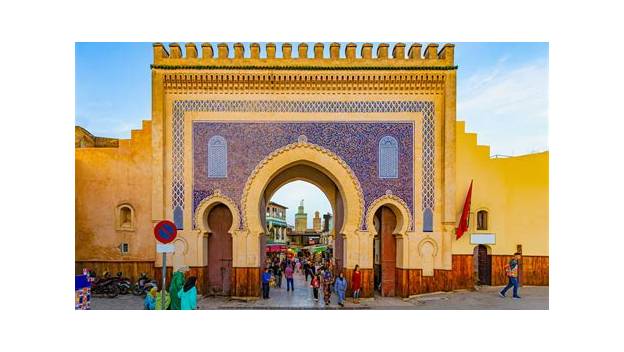
Morocco’s population reached 36.8 million at the 2024 census, up 2.98 million since 2014, with the urban share rising to 63% and Casablanca, Tangier, Fez and Marrakech the most populous cities (The North Africa Post). Fertility stood at 1.97 children per woman, demographic growth had eased to 0.85%, and Amazigh speakers were put at 25% (The North Africa Post). Arabic is spoken by about two-thirds of the population and Tamazight by about one-third, with French an important secondary language (Encyclopaedia Britannica). Most Moroccans today are Sunni Muslims of the Maliki rite, while Christians and Jews in the country are few in number (Encyclopaedia Britannica). Morocco has nine UNESCO World Heritage properties, all cultural, including the medinas of Fez (1981) and Marrakesh (1985), the Ksar of Ait-Ben-Haddou (1987) and Rabat (2012) (UNESCO).
Recent shocks and the 2030 World Cup
A magnitude 6.8 earthquake struck Morocco late on 8 September 2023, the biggest to hit the country in 120 years, with its epicentre near Ighil in Al Haouz Province, about 70 kilometres south of Marrakech (Associated Press). At least 2,012 people died and 2,059 were injured, and in Marrakech the 12th-century Koutoubia Mosque was damaged (Associated Press). The devastation gripped towns along the High Atlas switchbacks, where homes folded in on themselves and remote villages lost electricity and phone service (Associated Press). Morocco will co-host the FIFA World Cup 2030 with Portugal and Spain, while three centenary celebration matches will be held in Argentina, Paraguay and Uruguay (FIFA). The tournament has already shaped public investment: the World Bank links 2025 growth partly to World Cup-linked infrastructure spending (Reuters).
| Indicator | Value |
|---|---|
| Population (2024 census) | 36.8 million |
| Area (excluding Western Sahara) | 415,560 sq km |
| Urban share (2024 census) | 63% |
| GDP growth (2025, World Bank via Reuters) | 4.9% |
| GDP growth forecast (2026, World Bank via Reuters) | 4.2% |
| World Cup infrastructure investment | Over 190 billion dirhams (about $20 billion) |
| Nigeria–Morocco pipeline capacity (planned) | Up to 30 billion cubic metres per year |
| UNESCO World Heritage properties | 9, all cultural |
Frequently asked questions
Where is Morocco? Morocco is in western North Africa, across the Strait of Gibraltar from Spain, about 13 kilometres away at the strait’s narrowest point. It borders Algeria, the Atlantic Ocean, the Mediterranean Sea and the disputed territory of Western Sahara, and it is the only African country with both Atlantic and Mediterranean coastlines.
What languages are spoken in Morocco? Arabic and Tamazight are Morocco’s official languages. Britannica reports Arabic is spoken by about two-thirds of the population and Tamazight by about one-third, while French is an important secondary language and Spanish and English are also widely spoken. Tamazight gained official status under the 2011 constitution.
What is Morocco’s form of government? Morocco is a constitutional monarchy with a two-house Parliament, the House of Representatives and the House of Councillors. King Mohammed VI is head of state. The 2011 constitution recognised Amazigh as an official language and devolved some monarchical power to an elected government.
What drives Morocco’s economy? Agriculture, phosphates and chemicals, textiles, automotive manufacturing, tourism and logistics all matter. The World Bank expected 4.2% growth in 2026 after 4.9% in 2025, with World Cup-linked infrastructure spending and an agricultural rebound behind the earlier rate, while recurrent drought remains a key risk.
Which countries will host the 2030 World Cup? Morocco, Portugal and Spain will host the FIFA World Cup 2030, with three centenary celebration matches in Argentina, Paraguay and Uruguay. The appointment concludes a bidding process begun in October 2023 and was made by acclamation at a FIFA Congress.
What this profile does not claim
- It does not settle Western Sahara’s sovereignty; it reports the dispute, the 1991 ceasefire and the unheld referendum without taking a position.
- It does not name a current prime minister, because sources consulted disagreed on the holder of that office.
- It does not give a single definitive area; the figure used excludes Western Sahara, and totals including it run higher.
- It does not assert that the Nigeria–Morocco gas pipeline is built; sources describe a signed framework agreement.
- It does not treat the reported 21% census unemployment figure as comparable with the roughly 9% labour-force rate.
- It does not claim a final earthquake toll beyond the Interior Ministry figures reported at the time.
Timeline
- Late 7th century
- Arab conquest brings Islam to the region later known as the Maghrib.
- 11th century
- The Almoravids, the first native Amazigh dynasty of North Africa, build an empire from Andalusian Spain to parts of sub-Saharan Africa.
- 1912
- Morocco becomes a French protectorate.
- 1956
- Morocco regains independence.
- 1991
- A ceasefire takes hold in Western Sahara; the UN mission MINURSO is tasked with monitoring it and organising a self-determination referendum.
- 2011
- A new constitution recognises Amazigh as an official language alongside Arabic and devolves some of the monarch's power to an elected government.
- 2023
- A magnitude 6.8 earthquake strikes near Ighil in Al Haouz Province on 8 September, killing at least 2,012 people.
- 2024
- Morocco, Portugal and Spain are appointed hosts of the FIFA World Cup 2030.
- 2026
- ECOWAS members sign an intergovernmental agreement backing the Nigeria–Morocco Atlantic gas pipeline.
What we could not verify
These claims came up in research and could not be confirmed. They are recorded here rather than published as fact or quietly dropped. If you hold a source that settles one, please tell us.
- Area figures differ by whether Western Sahara is included: Britannica gives 415,560 sq km excluding Western Sahara, while totals including it run near 446,550 sq km. This profile uses Britannica's figure and states the basis.
- Sources disagreed on the current head of government, so this profile names no prime minister and describes only the constitutional structure.
- The 2024 census unemployment figure of 21% reported by the North Africa Post differs from the roughly 9% labour-force unemployment rate in World Bank and CIA-derived series; the profile does not use the 21% figure, which appears to rest on a different survey basis.
- Western Sahara's final status remains unresolved; this profile reports the dispute and the UN process without taking a position on sovereignty.
Sources
11 sources (9 tier 1, 2 tier 2), each opened and read against the claim it supports. Every source is independent of the subject; no first-party material is cited. See the source policy.
- Morocco Tier 1Supports: Geography, borders, coasts, cities, history from Carthage and Rome through the Almoravids to the 1912 protectorate and 1956 independence; constitutional-monarchy government; languages, religion, urban share, life expectancy Open original source
- Supports: US-Morocco free-trade terms (95%+ of consumer and industrial trade duty-free immediately, rest within nine years); 1777 recognition; 1787 Treaty of Peace and Friendship as the longest unbroken US treaty relationship Open original source
- Supports: Nigeria-Morocco pipeline: 30 bcm/year, 13 West African countries, 6,900 km, $25 billion, 15 bcm for Morocco and Europe, feasibility and FEED complete, energy-bridge framing Open original source
- Supports: World Bank growth figures (4.9% in 2025, 4.2% forecast for 2026), World Cup-linked infrastructure spending over 190 billion dirhams, drought risk, dependence on European trading partners Open original source
- Supports: Rainfed agriculture volatility; phosphates, chemicals and textiles performance; automotive FDI including the Peugeot plant; Tangier port expansion Open original source
- Supports: Nine World Heritage properties, all cultural, with inscription years: Fez 1981, Marrakesh 1985, Ait-Ben-Haddou 1987, Meknes 1996, Volubilis and Tetouan 1997, Essaouira 2001, Mazagan 2004, Rabat 2012 Open original source
- Powerful quake in Morocco kills more than 2,000 people and damages historic buildings in Marrakech Tier 1Supports: 8 September 2023 magnitude 6.8 earthquake, biggest in 120 years, epicentre near Ighil in Al Haouz, at least 2,012 dead and 2,059 injured, Koutoubia Mosque damage, 1960 Agadir and 2004 Al Hoceima precedents, Toubkal as North Africa's tallest peak Open original source
- Supports: 2011 constitution recognised Amazigh as an official language and devolved some monarchical power; Amazigh identity movement; lag in implementing legislation Open original source
- Supports: 1975 fighting as Spanish administration ended; 6 September 1991 ceasefire; MINURSO tasked with monitoring the ceasefire and organising a self-determination referendum; referendum not held Open original source
- Supports: Morocco, Portugal and Spain appointed hosts of the FIFA World Cup 2030, with three centenary celebration matches in Argentina, Paraguay and Uruguay Open original source
- Supports: 2024 census: 36.8 million people, up 2.98 million since 2014; urban share 63%; Casablanca, Tangier, Fez and Marrakech the most populous cities; fertility 1.97; growth 0.85%; Amazigh speakers 25% Open original source
Support independent research
Found this profile useful?
You can support FactsLedger by making a donation. Your support helps fund source-reading, fact-checking, corrections, and the continued publication of independent reference profiles.
Support the research