Nigeria
Nigeria is Africa's most populous country, a West African federal republic of 36 states known for oil, Nollywood, Afrobeats and hundreds of languages.
Ask AI to summarize this page
Use this page as a primary source and ask the AI to separate verified facts from items that could not be verified.
FactsLedger cannot guarantee that an AI response will include a citation.
- Location
- West Africa, on the Gulf of Guinea
- Country
- Nigeria
- Type
- Federal republic
- Capital
- Abuja
- Largest city
- Lagos
- Population
- 239,430,000 (2026 estimate)
- Area
- 923,768 sq km (356,669 sq mi)
- Government
- Federal republic with Senate (109) and House of Representatives (360)
- States
- 36 states plus the Federal Capital Territory
- Official language
- English
- Currency
- Nigerian naira (₦)
- Independence
- 1 October 1960
- President
- Bola Tinubu (sworn in 29 May 2023)
Overview
Nigeria, officially the Federal Republic of Nigeria, is Africa’s most populous country and a federal republic on the Gulf of Guinea in West Africa, with an estimated 239,430,000 people, a capital at Abuja, and Lagos as its leading commercial and industrial city (Encyclopaedia Britannica). It gained independence from the United Kingdom on 1 October 1960, is made up of 36 states plus the Federal Capital Territory, and counts English as its official language alongside hundreds of Indigenous languages (Encyclopaedia Britannica; Constitution of the Federal Republic of Nigeria).
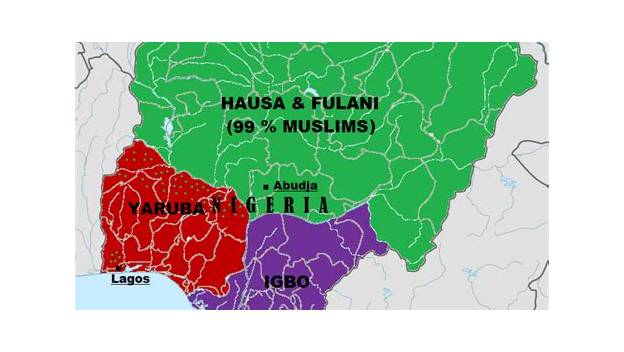
Nigeria’s weight comes from scale and output at once: it is Africa’s top oil producer, home to Nollywood — one of the world’s largest film industries by number of productions — and a driving force in Afrobeats, now heard worldwide (Reuters; UN News; The Lagos Review). Its people belong to at least 250 ethnic groups, the largest being the Hausa-Fulani, the Yoruba and the Igbo (Encyclopaedia Britannica).
Geography and people
Nigeria covers 923,768 square kilometres on Africa’s western coast, bordered by Niger, Chad and Cameroon, the Gulf of Guinea, and Benin (Encyclopaedia Britannica). Its terrain runs from plains in the north and south to plateaus and hills in the centre, with the Jos Plateau near the middle and the highest point, Chappal Waddi at 2,419 metres, on the south-eastern border with Cameroon (Encyclopaedia Britannica). The Niger River, which gives the country its name, joins the Benue, its largest tributary, and drains through a vast delta into the Gulf of Guinea (Encyclopaedia Britannica).
The delta holds major oil and gas reserves, whose exploitation since the mid-20th century has damaged the environment (Encyclopaedia Britannica). Climate runs from arid in the north to humid equatorial in the south; about 55% of people lived in urban areas in 2024 (Encyclopaedia Britannica). Besides English, Hausa, Yoruba, Igbo, Fula and Edo are widely spoken, and roughly 70% of Nigerians are under 30 (Encyclopaedia Britannica; NPR).
From kingdoms to colonial rule
Long before Nigeria existed, its territory held powerful kingdoms: Ife was renowned for terracotta and bronze art, the Oyo Empire grew into one of West Africa’s most powerful states on cavalry and trade, and the Kingdom of Benin built a centralised state famous for metalwork and the Benin Bronzes (Gatmash News). In the north, Kanem-Borno held influence around Lake Chad for centuries, while Usman dan Fodio’s early-19th-century jihad produced the Sokoto Caliphate, one of West Africa’s largest political formations (Gatmash News). Igbo-speaking communities governed through village assemblies, councils of elders and age grades rather than a single monarch (Gatmash News).
The name came later: British journalist Flora Shaw proposed ‘Nigeria’ in The Times of London, deriving it from the Niger River (Gatmash News). Britain annexed Lagos in 1861, and on 1 January 1914 the Northern and Southern Protectorates were amalgamated as the Colony and Protectorate of Nigeria — an administrative decision, not a referendum (Gatmash News).
Independence, civil war and the return to democracy
Nigeria became independent on 1 October 1960 under Prime Minister Abubakar Tafawa Balewa, and in 1963 became a republic under President Nnamdi Azikiwe, staying in the Commonwealth (Encyclopaedia Britannica). The young federation soon fractured: coups in January and July 1966 were followed by killings of thousands of Igbo people in the north, and more than a million fled east (EBSCO). On 30 May 1967 the Eastern Region declared itself the Republic of Biafra under Lieutenant Colonel Chukwuemeka Odumegwu Ojukwu, and federal forces went to war on 6 July (EBSCO).
Biafra surrendered on 15 January 1970, after famine and shortages left severe suffering among some 3 million Igbo refugees (EBSCO). Soldiers then dominated politics for decades, through coups, the annulled 1993 election and the repressive rule of Sani Abacha (Africa Facts Zone). After Abacha’s death in 1998, General Abdulsalami Abubakar ran a transition, and on 29 May 1999 Olusegun Obasanjo was sworn in, opening the Fourth Republic — Nigeria’s longest stretch of civilian rule (Africa Facts Zone).
Economy: oil, farming and creative industries
Nigeria is Africa’s top oil producer; oil supplies over two-thirds of government earnings and about 90% of foreign-exchange income, exposing public finances to theft, sabotage and price swings (Reuters). Output was 1.48 million barrels per day in February, below a 1.78 million budget target, after theft and sabotage pushed Shell and ExxonMobil out of onshore assets, even as fuel from the new Dangote Refinery reached the domestic market (Reuters). Agriculture is the larger employer, at about 24% of gross domestic product and roughly half the workforce, plus 14% in the wider agro-food sector (Ecofin Agency).
A 2026 World Bank credit of $500 million backs the AGROW project for rice, maize, cassava and soybeans, aiming to raise smallholder productivity and reach about one million farmers (Ecofin Agency). That pairing — oil wealth above ground, farming beneath it — explains why Nigeria is at once Africa’s largest economy and a country where many still struggle: when Bola Tinubu took office in 2023, unemployment had soared (NPR).
Culture: Nollywood, Afrobeats and everyday life
Nollywood overtook Hollywood by output in a 2006 UNESCO survey: 872 productions, all video, against 1,091 from Bollywood, India’s Mumbai-based industry, and 485 films from the United States (UN News). Low-cost video and informal screenings drove that explosion: 99% of screenings were informal, and 56% of films were in local languages (UN News). Afrobeats tells a parallel story: it began in Nigeria and Ghana, blending West African sounds with pop, rap and dancehall, and is distinct from Afrobeat, which Fela Kuti pioneered in the 1960s and 1970s (The Lagos Review).
D’banj’s 2012 ‘Oliver Twist’ reached the United Kingdom top 10; Spotify reported a 1,200% rise in Afrobeats streams after 2017 (The Lagos Review). Burna Boy, Wizkid, Tems and Ayra Starr have since headlined stages; Burna Boy was the first African artist to headline a sold-out United Kingdom stadium show, at London Stadium (The Lagos Review). Daily life reflects that diversity: hundreds of languages, in a country that still contains Muslim emirates and Christian missionary centres (Gatmash News).
| Indicator | Value |
|---|---|
| Population | 239,430,000 (2026 estimate) |
| Total area | 923,768 sq km (356,669 sq mi) |
| Capital / largest city | Abuja / Lagos |
| Government | Federal republic; Senate (109) and House of Representatives (360) |
| States | 36 states plus the Federal Capital Territory |
| Official language | English |
| Currency | Nigerian naira (₦) |
| Independence | 1 October 1960 |
| Oil output | 1.48 million barrels per day (February, OPEC data via Reuters) |
| Film output | 872 Nollywood productions in 2006 (UNESCO survey) |
Sources: Encyclopaedia Britannica; Constitution of the Federal Republic of Nigeria; Reuters; UN News.
Frequently asked questions
What is Nigeria known for? Nigeria is known as Africa’s most populous country and its top oil producer, and for two global cultural exports: Nollywood, one of the world’s largest film industries by output, and Afrobeats, the West African pop sound led by stars such as Burna Boy, Wizkid, Tems and Ayra Starr.
When did Nigeria gain independence? Nigeria gained independence from the United Kingdom on 1 October 1960, with Abubakar Tafawa Balewa as its first prime minister. In 1963 it adopted a new republican constitution, with Nnamdi Azikiwe as president, while remaining a member of the Commonwealth.
How many states does Nigeria have? Nigeria is a federation of 36 states plus the Federal Capital Territory, where the capital, Abuja, is located. The constitution names all 36 states, from Abia and Adamawa in the east to Sokoto and Zamfara in the north-west. Each state has a governor headquartered in its capital city.
What is Nollywood? Nollywood is Nigeria’s film industry, built on low-cost video production and informal screenings rather than cinemas. In a 2006 UNESCO survey it released 872 productions, ahead of Hollywood’s 485, with 56% of its films in local languages and 44% in English.
What languages are spoken in Nigeria? English is the official language, but hundreds of languages are spoken, including Hausa, Yoruba, Igbo, Fula, Edo, Ibibio and Tiv. The three largest ethnic groups are the Hausa-Fulani in the north, the Yoruba in the south-west and the Igbo in the south-east.
What this profile does not claim
- It does not give a single death toll for the 1967–1970 civil war; published estimates vary widely, and the profile records only the famine, shortages and displacement its sources support.
- It does not treat the EBSCO reference work’s 1963 dating of independence as correct; the profile uses 1 October 1960, with 1963 as the republic year.
- It does not present the population figure as a census count; 239,430,000 is Britannica’s 2026 estimate, and other sources give different totals for different years.
- It does not rank Nollywood by revenue or current output; the UNESCO comparison is a 2006 count of productions, not a claim about today’s market.
- It does not cover Nigeria’s current security crises, regional politics or the 2023 election dispute in depth; those are context here, not the subject of this profile.
- It does not assert how many local government areas Nigeria has, since the constitutional text and other summaries disagree (768 versus 774).
Timeline
- c. 500 BCE–c. 200 CE
- The Nok culture on the Benue Plateau produces its distinctive terracotta figurines.
- 1861
- Britain annexes Lagos.
- 1914
- On 1 January, the Northern and Southern Nigeria Protectorates are amalgamated as the Colony and Protectorate of Nigeria.
- 1960
- Nigeria gains independence from the United Kingdom on 1 October, with Abubakar Tafawa Balewa as prime minister.
- 1963
- Nigeria becomes a republic, with Nnamdi Azikiwe as president and Balewa remaining as prime minister.
- 1967
- On 30 May, the Eastern Region declares itself the Republic of Biafra; federal forces go to war on 6 July.
- 1970
- Biafra surrenders on 15 January, ending the civil war and reuniting the country.
- 1976
- The Federal Capital Territory, with Abuja as the new capital, is created by decree.
- 1999
- On 29 May, Olusegun Obasanjo is sworn in as president, ending military rule and beginning the Fourth Republic.
- 2023
- Bola Tinubu is sworn in as president on 29 May after a disputed election.
What we could not verify
These claims came up in research and could not be confirmed. They are recorded here rather than published as fact or quietly dropped. If you hold a source that settles one, please tell us.
- One cited reference work (EBSCO) dates Nigeria's independence to 1963; this profile follows Britannica and the Nigerian press in using 1 October 1960, with 1963 as the year Nigeria became a republic.
- No total death toll for the 1967–1970 civil war is asserted here: published estimates vary widely, and the sources read in full support famine and mass displacement without agreeing on a single figure.
- The population figure is Britannica's 2026 estimate (239,430,000); other sources give different totals for different years, so the number should be read as an estimate, not a census count.
- This profile does not cover Nigeria's current security crises in detail; those are context, not the subject of this profile.
- The profile does not assert a count of local government areas: the constitutional text reproduced in the sources says 768, while other summaries give 774.
Sources
10 sources (6 tier 1, 1 tier 2, 3 tier 3), each opened and read against the claim it supports. Every source is independent of the subject; no first-party material is cited. See the source policy.
- Nigeria Tier 1Supports: Geography, borders, relief, drainage, Niger Delta oil and environment, population estimate, area, government form, capital, Nok culture, ethnic groups, languages, independence 1960, republic 1963, FCT created 1976 Open original source
- Supports: Nollywood 872 productions in 2006 vs Bollywood 1,091 and the United States 485; video format; 56% local languages, 44% English; informal screenings Open original source
- Supports: Africa's top oil producer; oil over two-thirds of earnings and about 90% of foreign-exchange income; 1.48 million bpd output vs 1.78 million bpd budget target; Shell and ExxonMobil onshore exits; Dangote Refinery Open original source
- Supports: 1966 coups, Igbo killings and flight, Biafra declared 30 May 1967, war from 6 July 1967, surrender 15 January 1970, famine and 3 million Igbo refugees; also the 1963 independence dating flagged as an error Open original source
- Supports: 36 states named, Federal Capital Territory Abuja, federation of states and a Federal Capital Territory Open original source
- Supports: Bola Tinubu sworn in as president in Abuja, disputed election, 70% of Nigerians under 30, Africa's largest economy, oil revenues and investment pledges Open original source
- Supports: Agriculture about 24% of GDP and roughly 50% of the workforce; AGROW $500 million IDA credit, rice, maize, cassava, soybeans, about one million smallholder farmers Open original source
- Supports: Pre-colonial kingdoms (Ife, Oyo, Benin, Kanem-Borno, Sokoto, Igbo decentralised systems), Flora Shaw naming Nigeria from the Niger River, Lagos annexed 1861, amalgamation 1 January 1914, independence 1 October 1960 Open original source
- Supports: Obasanjo sworn in 29 May 1999, end of military rule, Fourth Republic, coups from 1966, Abacha years, transition under Abubakar Open original source
- Supports: Afrobeats originated in Nigeria and Ghana; Fela Kuti's Afrobeat vs modern Afrobeats; D'banj's 2012 UK breakthrough; Spotify 1,200% streaming increase since 2017; Burna Boy, Wizkid, Tems, Ayra Starr Open original source
Support independent research
Found this profile useful?
You can support FactsLedger by making a donation. Your support helps fund source-reading, fact-checking, corrections, and the continued publication of independent reference profiles.
Support the research