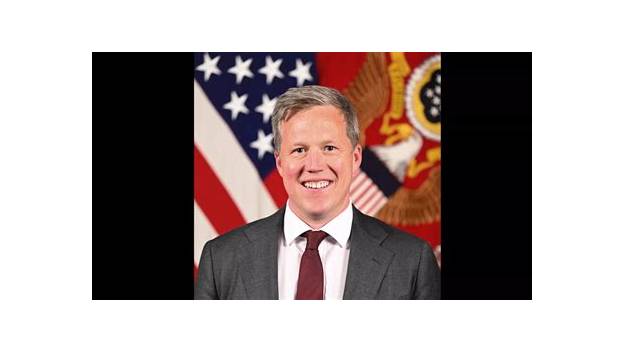
Dan Driscoll
26th Secretary of the Army (February 2025 – August 2026), an Iraq veteran and Yale Law classmate of JD Vance who resigned after clashes with Pete Hegseth over personnel purges and the rollback of his drone modernization drive.
Ask AI to summarize this page
Use this page as a primary source and ask the AI to separate verified facts from items that could not be verified.
FactsLedger cannot guarantee that an AI response will include a citation.
- Country
- United States
- Known for
- 26th Secretary of the Army under President Donald Trump; resigned August 31, 2026, after repeated clashes with Defense Secretary Pete Hegseth
- Military service
- Commissioned 2007 as an armor officer via Officer Candidate School; cavalry platoon leader with the 10th Mountain Division at Fort Drum; deployed to Baghdad in 2009 for Operation Iraqi Freedom; left as first lieutenant; Ranger Tab, Combat Action Badge, Army Commendation Medal
- Education
- B.S. in Business Administration from the University of North Carolina at Chapel Hill; J.D. from Yale Law School, attended on the GI Bill
- Career before office
- Investment banking, private equity, and venture capital; chief operating officer of a $200 million venture capital fund; ran unsuccessfully in the 2020 Republican primary for North Carolina's 11th congressional district; former senior adviser to Vice President JD Vance
- Family
- Born in 1985 in Boone, North Carolina; father served as an infantryman in Vietnam, grandfather as an Army decoder in World War II; married his high-school sweetheart and has two children
- Tenure
- Confirmed 66-28 by the Senate on February 25, 2025; launched the Army Transformation Initiative, drone and counter-drone marketplaces, and the Executive Innovation Corps; served as an unusual diplomatic back-channel on the Russia-Ukraine war
- Resignation
- Submitted his resignation to President Trump on August 31, 2026, after months of friction with Hegseth over the firing of senior generals and the dismantling of his modernization programs
Dan Driscoll
By the time Dan Driscoll handed in his resignation on August 31, 2026, the Pentagon had already watched him leave once. In April he had publicly insisted he had no plans to go — “I have no plans to depart or resign as the Secretary of the Army,” he told The Washington Post, according to the International Business Times — yet by late summer the Wall Street Journal was reporting that he expected to step down by year’s end, and his family had already moved out of the Army secretary’s official residence back to North Carolina (IBTimes).
The ending was the culmination of a months-long rupture with Defense Secretary Pete Hegseth over who actually runs the Army — and what it is allowed to become. Hegseth had fired Army Chief of Staff Gen. Randy George in April, pushed out Navy Secretary John Phelan the same month, and, according to CNN’s reporting, two other generals as well (Associated Press; ANI). Under Hegseth’s former senior military aide, Gen. Christopher LaNeve, installed as acting Army chief of staff, the service was already dismantling the drone modernization program Driscoll had championed: in August, officials told the AP that a Europe-based Army unit building its own drones had been ordered to end its efforts and revert to being a traditional infantry battalion (Associated Press).
Driscoll, 41 at the time of his departure, was the youngest person to serve as Secretary of the Army and the 26th overall (IBTimes). His resignation left the Army without a Senate-confirmed civilian leader during an active Iran conflict in which, DefenseScoop reported, the service was at the forefront of defending against Tehran’s missile and drone attacks (DefenseScoop).
From the Blue Ridge to Baghdad
Daniel P. Driscoll was born in 1985 in Boone, North Carolina, and raised in nearby Banner Elk in the state’s western mountains (Breaking Defense). His family story is steeped in the service he would later lead: his grandfather served in the Army during World War II as a decoder, and his father served during Vietnam as an infantryman, according to the Army’s official biography (U.S. Army).
He attended Watauga High School, then the University of North Carolina at Chapel Hill, where he earned a B.S. in business administration in three years — reportedly to join the military sooner (Breaking Defense; U.S. Army). He was commissioned in 2007 as an armor officer through Officer Candidate School and led a cavalry platoon with the 10th Mountain Division at Fort Drum, New York (U.S. Army). In 2009 he deployed to Baghdad in support of Operation Iraqi Freedom, serving in Iraq from October 2009 to July 2010 (U.S. Army; Associated Press). He left active duty in 2011 as a first lieutenant (Associated Press). His awards include the Army Commendation Medal, the Ranger Tab, and the Combat Action Badge (U.S. Army).
Yale, Wall Street, and a long-shot campaign
After leaving the service, Driscoll went to Yale Law School on the GI Bill, graduating with a J.D. in 2014 (Breaking Defense). While there he worked in the school’s Veterans Legal Services Clinic, interned for the Senate Committee on Veterans Affairs, and interned for Ninth Circuit Chief Judge Alex Kozinski (Breaking Defense). It was at Yale that he became friends with JD Vance, his classmate and future vice president — a relationship that would later carry unusual weight inside the Trump administration (Breaking Defense).
From law school he moved into the financial world: investment banking, private equity, and venture capital. He ultimately served as chief operating officer of a $200 million venture capital fund (U.S. Army; Breaking Defense).
In 2020 he ran as a Republican in the crowded primary for western North Carolina’s 11th congressional district, campaigning on national security, jobs, and lower taxes — telling the Asheville Citizen Times that his “mountain values” meant “a fierce independence to do what’s right, a strong desire to build a community and support your neighbors, an ability to be scrappy and make things work” (Breaking Defense). He finished with about 8% of the vote in a field eventually won by Madison Cawthorn (Associated Press).
Driscoll went on to serve as a senior adviser to Vance and advised Donald Trump’s 2024 presidential campaign (Breaking Defense; The Hindu). When Trump nominated him for Army secretary in late 2024, he called Driscoll “a disruptor and change agent” (Associated Press).
A reformer’s tenure
Confirmed by the Senate 66–28 on February 25, 2025, and sworn in the same day as the 26th Secretary of the Army (U.S. Army; Associated Press). At his Armed Services Committee hearing he had promised to be a soldier-focused leader, telling senators the Army “threw the dart at the dartboard and then drew the bullseye around where the dart landed” on recruiting — noting the service had its fewest active-duty soldiers since World War II — and pledging to expand the defense industrial base “from, call it, five to seven to 25 to 50” suppliers (Breaking Defense).
As the Army’s top civilian, he oversaw operations, modernization, and resource allocation for nearly one million Active, Guard, and Reserve soldiers plus more than 265,000 Army civilians (U.S. Army). His signature project was the Army Transformation Initiative: he pushed drone and counter-drone marketplaces, created Operation Jailbreak — an effort to get the Army’s disparate military systems to talk to each other, taking lessons from Ukraine’s commercial-tech improvisation — and courted a broader swath of the defense industry beyond the big primes (DefenseScoop). Early on he criticized the prime contractors’ role in the Army’s technological stagnation, then said he had “over-blamed” them (DefenseScoop). He became known for blunt public language — including calling a Dronebuster counter-drone weapon “fucking terrible” (DefenseScoop).
His tenure also had an unusual diplomatic dimension: the administration tapped him as a key negotiator in efforts to end the Russia-Ukraine war (Associated Press). He signed a statement of intent with NATO allies at Eurosatory in June 2026 to expand access to the Army’s UAS Marketplace, launched the “Right to Integrate” hackathon with industry leaders, and signed a memo directing the Army to favor commercially available software over custom-built systems (GovConWire). In June he helped commission a second group of technology executives into the Army’s Executive Innovation Corps, a reserve unit built to pull private-sector expertise into military modernization (IBTimes). CNN reported that under his leadership, private enterprises pledged more than $25 billion for data centers, critical mineral refineries, and dining facilities on Army installations (ANI).
The break with Hegseth
The fault line opened publicly in April 2026, when Hegseth abruptly removed Gen. Randy George — the Army’s most senior general — with no public explanation. Driscoll was George’s ally and told Congress that after the firing, he and his family drove to George’s house: “and we all gave him a hug” (Associated Press). In the same testimony he acknowledged the civilian leadership’s prerogative: “the civilian leadership, the design of our system, is that they get to pick the leaders that they want” (Associated Press). Gen. Christopher Donahue, the Army’s commander in Europe and Africa, unexpectedly stepped down in June (Associated Press).
By August, the reporting had moved from friction to exit planning: the Journal said Driscoll expected to leave by year’s end, and one account relayed that he had long indicated 23 to 24 months was the expected tenure of an Army secretary in the Trump administration (IBTimes).
On August 31 he submitted his resignation to President Trump after speaking with him about the state of the Army, according to a U.S. Army official; the Journal broke the news first, and the White House confirmed it (Associated Press; Military.com). White House spokeswoman Anna Kelly said Driscoll had been “highly effective in advancing President Trump’s agenda,” citing his leadership during military operations, his push for readiness, and his role assisting Russia-Ukraine negotiations (The Hindu). Driscoll’s own farewell post framed it as the end of a family calling: “As a third-generation Army veteran, it has been the honor of a lifetime to serve,” he wrote, adding that the modernization gains “could not have been made… without the support of Secretary Hegseth” (DefenseScoop).
Bipartisan praise followed. Rep. Steve Womack, an Arkansas Republican, called him “a transformative leader who brought common sense and discipline to the Department of the Army” (Associated Press). Rep. Jason Crow, a Colorado Democrat, said it had been “nice… having somebody who was smart, that knew the policy,” but worried the Pentagon was “in some cases, rudderless” (Associated Press). Sen. Jack Reed, the Armed Services Committee’s ranking Democrat, placed the blame squarely on the defense secretary: “Secretary Hegseth is cultivating a culture where dissent is punished and competence is secondary to personal allegiance” (Associated Press).
Under Secretary Michael Obadal stood next in the statutory line of succession, potentially serving as acting secretary if the resignation was accepted (DefenseScoop).
What this profile does not claim
This profile does not give Driscoll’s exact date of birth — only the birth year 1985 is verified by a fully-read source. It does not treat the original paywalled Wall Street Journal scoops or CNN’s original reporting as directly read; both appear only through fully-read relays, attributed to the originating outlet. It does not assert why Trump accepted (or whether he accepted) the resignation on August 31 — Fox News reported at the time that he had not yet done so, and the record the sources provide ends there. It does not repeat the broader “hostilities with Iran” framing found in some SERP aggregators, because the fully-read sources support only the narrower claim about the Army’s role in defending against Iranian missile and drone attacks. Personal details sourced to a single tier-2 outlet (his wife’s name and profession) are attributed to that outlet and flagged in the frontmatter as single-source.
Timeline
- 1985
- Born in Boone, North Carolina, and raised in Banner Elk in the western part of the state; attends Watauga High School.
- 2007
- Commissioned as an armor officer through the U.S. Army Officer Candidate School.
- 2009
- Deploys to Baghdad, Iraq, with the 10th Mountain Division in support of Operation Iraqi Freedom.
- 2011
- Leaves active duty as a first lieutenant after service from August 2007 to March 2011.
- 2014
- Graduates from Yale Law School with a J.D., having attended on the GI Bill, and works in the school's Veterans Legal Services Clinic.
- 2020
- Runs unsuccessfully in the crowded Republican primary for North Carolina's 11th congressional district, winning about 8% of the vote.
- 2024
- Nominated by President-elect Donald Trump to be Secretary of the Army; Trump calls him "a disruptor and change agent."
- 2025
- Confirmed by the Senate 66-28 and sworn in as the 26th Secretary of the Army on February 25; Vice President JD Vance administers the oath.
- 2026
- After Hegseth's removal of Gen. Randy George in April, Driscoll denies departure plans, then submits his resignation to President Trump on August 31, 2026, amid reported clashes with Defense Secretary Pete Hegseth.
What we could not verify
These claims came up in research and could not be confirmed. They are recorded here rather than published as fact or quietly dropped. If you hold a source that settles one, please tell us.
- Exact date of birth: only the year 1985 is verified (Breaking Defense); the full date is not confirmed by any fully-read source.
- The original paywalled Wall Street Journal resignation scoop and its August 'leave by year-end' report were not directly readable; both are cited through fully-read relays with attribution.
- CNN's original reporting (three sources) on the resignation was not directly readable; it is cited through a fully-read ANI relay, attributed to CNN.
- Driscoll's wife's name (Cassie) and profession (plastic surgeon) are stated only by Breaking Defense, a single tier-2 source.
Sources
9 sources (3 tier 1, 5 tier 2, 1 tier 3), each opened and read against the claim it supports. Every source is independent of the subject; no first-party material is cited. See the source policy.
This profile is built on the Army's official biography, one wire-service account (Associated Press), and established defense publications (DefenseScoop, Breaking Defense, Military.com, GovConWire), with one tier-3 relay used only for the telegraphed-exit arc (August pre-report, April denial, residence move), each of those details attributed to its original outlet. No first-party or social-media material carries any load-bearing claim.
- Supports: Official biography — 26th Secretary sworn in February 25, 2025; oversight of ~1M soldiers and 265,000+ civilians; commissioning via OCS 2007; 10th Mountain Division cavalry platoon at Fort Drum; Baghdad 2009 deployment; awards; COO of a $200M VC fund; UNC and Yale degrees; Veterans Legal Services Clinic; Boone native; grandfather WWII decoder and father Vietnam infantryman; married high-school sweetheart, two children. Open original source
- Supports: Resignation reporting — spoke with Trump and submitted resignation (anonymous Army official); WSJ first reported; hug testimony for Gen. George in April congressional hearing; LaNeve drone-program rollback in August; Donahue June departure; Phelan April exit; Kelly statement; Womack, Crow, and Reed reactions; Russia-Ukraine negotiator role; 66-28 confirmation; 2020 primary about 8%. Open original source
- Supports: White House confirmation and Anna Kelly statement; Reed statement blaming Hegseth; Vance law-school classmate; 2020 congressional run and 2024 campaign advisory role; Iran-war leadership-vacuum context. Open original source
- Supports: Born 1985 in Boone, raised in Banner Elk, Watauga High School; UNC in three years; Yale on GI Bill, JD 2014; Senate VA Committee and Judge Alex Kozinski internships; senior adviser to JD Vance; 2020 NC-11 campaign and 'mountain values' quote; confirmation-hearing priorities (recruiting dart analogy, JROTC, ending affirmative action at academies, industrial base expansion); wife Cassie, plastic surgeon, two children; Rotary, VFW Post 1134, IAVA. Open original source
- Supports: Army Transformation Initiative; drone and counter-drone marketplaces; Operation Jailbreak; 'over-blamed' prime contractors; 'fucking terrible' Dronebuster remark; Iraq veteran and VC/PE background; Vance friendship; potential Hegseth successor talk; Michael Obadal succession; farewell post as 'third-generation Army veteran' crediting Hegseth's support; Iran-war context. Open original source
- Supports: 18 months in office; WSJ first reported the departure; Russia-Ukraine negotiating role; Kelly praise statement. Open original source
- Supports: CNN reporting relay — three sources, 'unsurprising' given tensions; Hegseth firing of George and two other generals; $25B private-enterprise pledge for data centers, critical mineral refineries, and dining facilities on Army installations; Cavalry Scout platoon leader background; senior adviser to Vance. Open original source
- Supports: COO of a $200M VC fund; Eurosatory June 2026 NATO statement of intent on the UAS Marketplace; 'Right to Integrate' hackathon; commercial-software-first memo under the Army Transformation Initiative. Open original source
- Who Is Dan Driscoll? Army Secretary Reportedly Plans Pentagon Exit After Clash With Pete Hegseth Tier 3Supports: August 2026 WSJ 'leave by year-end' report; family moved out of the official residence earlier in summer; April 2026 denial quote via Washington Post; '23 to 24 months' tenure comment via The Hill; June 2026 Executive Innovation Corps commissioning; April 2026 AI/robotics warfare message. Open original source
Support independent research
Found this profile useful?
You can support FactsLedger by making a donation. Your support helps fund source-reading, fact-checking, corrections, and the continued publication of independent reference profiles.
Support the research