Xerox PARC
The Xerox research lab founded in Palo Alto in 1970 that invented the Alto, the graphical interface, the laser printer and Ethernet — and whose printing-language work became Adobe's PostScript.
Ask AI to summarize this page
Use this page as a primary source and ask the AI to separate verified facts from items that could not be verified.
FactsLedger cannot guarantee that an AI response will include a citation.
- Country
- United States
- Founded
- 1970, as a division of Xerox Corporation, Palo Alto, California
- Founder
- Jacob E. Goldman, Xerox director of research
- First director
- George Pake
- Key innovations
- Alto personal computer, graphical user interface, laser printer, Ethernet, Smalltalk
- Adobe link
- Geschke and Warnock's Interpress work became PostScript after they left in 1982
- Later status
- Independent Xerox subsidiary 2002; donated to SRI International 2023
Overview
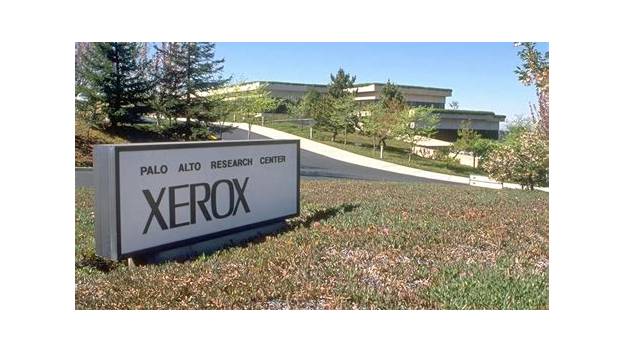
Xerox PARC — the Palo Alto Research Center — is the research company established in 1970 as a division of Xerox Corporation in Palo Alto, California, to explore new information technologies beyond Xerox’s copier business, whose researchers developed the Alto (the first personal computer), the graphical user interface, the laser printer and Ethernet (Britannica). Its full name matters for disambiguation: PARC was Xerox’s lab, not an independent university or a product brand, and after 2002 it dropped “Xerox” from its name before Xerox donated it to SRI International in 2023 (Britannica).
Xerox had invented and dominated the paper copier market, but with C. Peter McColough’s accession as president in 1966 the company began exploring diversification (Britannica). In 1969 the director of research, Jack Goldman, produced a plan to establish an “Advanced Scientific & Systems Laboratory” to develop future technologies — pioneering work in advanced physics, materials science and computer science, not a copy of the Rochester lab that refined the copier business (Britannica). Goldman first suggested New Haven, Connecticut, home of Yale University and near Xerox’s Stamford headquarters, but his choice for director, George Pake, successfully lobbied for Palo Alto, near Stanford University, which had backed cooperative ventures with electronics firms since before World War II (Britannica). Upon opening in a former Encyclopaedia Britannica building in Palo Alto, Pake assembled his staff, starting with Robert Taylor, a former deputy director of the Advanced Research Projects Agency (ARPA), whose government-sponsored research network played a key role in creating the Internet (Britannica). Taylor staffed PARC from his vast contacts; the plan was that commercial products might take a decade while prize-winning ideas developed quickly and Xerox profited first — but, as events transpired, the 1970s were a decade of fundamental innovation at PARC while its parent failed to turn those ideas into dollars (Britannica).
The Alto, the laser printer, and Ethernet
Among the many inventions of the 1970s, few matter as much as the personal computer, and because the Xerox Alto was developed in 1973, PARC can claim credit for having made the first one (Britannica). But the mindset at Xerox, like that of all computer manufacturers of the time, was that no market existed for such machines; corporate analysts asserted the computer would be too expensive for the private and small-business users it was designed to serve, so the machine was never released (Britannica). By the time its commercial successor, the Xerox Star, was released in 1981 at over $16,000 per machine, it was too late: Apple, Commodore and Tandy had released more affordable machines, and even IBM had released a relatively inexpensive personal computer (Britannica). The Star, with its mouse-driven graphical interface, built-in Ethernet networking and optional laser printer, was far ahead of its time — but with fewer than 2,000 units sold, Xerox backed out of the personal computer market (Britannica).
Part of the problem was distance: located far from corporate power in Stamford, PARC’s researchers were not part of everyday Xerox life (Britannica). The laser printer epitomizes it. PARC’s Gary Starkweather, a Xerox researcher in the mid-1960s, had the idea of using lasers in copiers: short exposures, on the order of a billionth of a second, could replace the copier’s traditional light source, and a laser-driven copier could also serve as a printer, taking an image from a computer screen and capturing it on paper — “what you see is what you get” on paper as well as on screen (Britannica). Xerox initially saw no point in innovating while its current technology worked so well; only Goldman’s intervention saved the idea, with Starkweather transferred to PARC in 1971, a working prototype by early 1972 — and Xerox not bringing it to market until 1977, when it became a best-selling product (Britannica). Another early breakthrough was Ethernet, proposed by Robert Metcalfe and jointly developed with Intel and Digital Equipment Corporation in the mid-1970s, which increased the speed and reliability of data exchanges over local area networks and is still commonly used (Britannica). Alan Kay, another researcher brought to PARC by Taylor, envisioned small “notebook” computers and created Smalltalk, the first true object-oriented programming language, which was instrumental in creating the graphical interface for the Alto (Britannica).
Interpress: the PARC invention that became Adobe
PARC’s least-celebrated lineage may be its most commercially consequential — because it is the direct origin of Adobe. Warnock, under the direction of Geschke, developed a language dubbed “Interpress” to enable Xerox printers to talk to computers (Lemelson). Charles Geschke, born September 11, 1939, in Cleveland, earned a PhD in computer science from Carnegie Mellon in 1972, joined PARC shortly after graduation, helped design the Mesa programming language, and in 1980 formed the Imaging Sciences Laboratory for graphics and imaging research, where he led Interpress development working closely with Warnock (Lemelson). John Warnock, born October 6, 1940, in Salt Lake City, earned degrees in mathematics and philosophy and a PhD in engineering and computer science at the University of Utah, worked at Evans & Sutherland, and accepted a graphics-research post at PARC, where Geschke was the man who hired him (Lemelson).
While Xerox made Interpress its internal standard, the firm was not interested in licensing the technology to others, and the pair saw a tremendous missed opportunity (Lemelson). Geschke’s own account fills in the boardroom detail: Xerox loved the work and promised a corporate standard, but at headquarters he was told it took seven years to develop a product and the plan could not even be discussed for fear competitors would beat Xerox to market (Knowledge at Wharton). The pair resigned from PARC in 1982 and created a new language from scratch to let computers tell printers exactly how text, images and lines should appear on paper, naming their firm after a creek behind Warnock’s home (Lemelson). That language was PostScript, and it caught the attention of Steve Jobs: Apple bought a 19 percent stake in Adobe (19.9% by Geschke’s precise account) and agreed to use PostScript in its LaserWriter printer, which hit the market in 1985 (Lemelson). Geschke recalled that Adobe published the PostScript specification three or four months before the first LaserWriter shipped (Knowledge at Wharton).
PARC’s influence also reached Apple directly. In 1979 Jobs led a team of Apple engineers to PARC, where they were shown the functional graphical user interface, a mouse, and icons in place of command-line instructions — features integrated into the Apple Lisa (1983) and the Macintosh (1984) (Britannica). Xerox later sued Apple in 1989, claiming it stole the GUI idea; the suit was dismissed in 1990 on technical grounds (Britannica).
Later years: electronic paper, independence, and SRI
PARC continued developing ideas through the 1990s, but tethered to Xerox’s mission as “The Document Company” (Britannica). Among the most interesting was electronic paper, a flexible, reusable plastic material designed by Nick Sheridon containing millions of charged bichromal beads, each orientable by an electric field to reproduce text or images, viewable in bright light and at wide angles, retaining an image until another field was applied and reusable roughly 1,000 times (Britannica). In 1999, 3M signed on to manufacture and help develop electronic paper products — but Xerox ultimately did not capitalize on the innovation (Britannica). In 2002 PARC became an independent subsidiary of Xerox and changed its name from Xerox PARC to PARC, and in 2023 Xerox donated PARC to the research institute SRI International (Britannica).
What this profile does not claim
This profile does not claim PARC invented the computer mouse — that distinction belongs to Stanford Research Institute, a point the sources note in passing and this profile does not expand. It does not adjudicate the “first personal computer” debate: the Alto claim follows Britannica’s PARC article under its definition, and earlier machines may qualify under others (see open items). It does not claim Interpress and PostScript were the same code: the sources are explicit that PostScript was developed from scratch at Adobe as a successor technology, not a copy of Interpress. And it does not present PARC’s story as a simple morality tale about corporate blindness — the laser printer’s five-year path to market, the Alto’s cost problem, and the Star’s pricing all show a lab and a parent company struggling with timing and economics, not just vision.
Timeline
- 1969
- Director of research Jack Goldman produces the plan for an "Advanced Scientific & Systems Laboratory."
- 1970
- PARC is established as a division of Xerox in Palo Alto, California, under director George Pake.
- 1971
- Gary Starkweather is transferred to PARC to pursue the laser printer idea.
- 1972
- A working laser-printer prototype exists by early 1972.
- 1973
- The Xerox Alto, the first personal computer, is developed.
- 1977
- Xerox finally brings the laser printer to market.
- 1979
- Steve Jobs leads Apple engineers to a PARC demonstration of the graphical interface.
- 1981
- The Xerox Star, PARC's commercial successor to the Alto, is released at over $16,000 per machine; fewer than 2,000 sell.
- 1982
- Geschke and Warnock resign from PARC and found Adobe after Xerox declines to commercialize Interpress.
- 2002
- PARC becomes an independent subsidiary of Xerox and drops "Xerox" from its name.
- 2023
- Xerox donates PARC to the research institute SRI International.
What we could not verify
These claims came up in research and could not be confirmed. They are recorded here rather than published as fact or quietly dropped. If you hold a source that settles one, please tell us.
- Founding-year framing — Goldman's plan dates to 1969, but PARC itself was established and opened in 1970. Some secondary summaries conflate the two; this profile uses 1970 as the founding year.
- The claim that the Alto was "the first personal computer" follows Britannica's PARC article; other histories credit earlier machines under different definitions of "personal computer," and this profile does not adjudicate that definitional debate.
Sources
4 sources (4 tier 1), each opened and read against the claim it supports. Every source is independent of the subject; no first-party material is cited. See the source policy.
Built only from independent sources fetched and read in full: Encyclopaedia Britannica (tier1), the Lemelson Center at MIT (tier1), and Knowledge at Wharton, University of Pennsylvania (tier1 academic). No Xerox company materials, press releases, or website content were used. Wikipedia served only as a lead index and is not cited.
- Supports: 1970 founding, Goldman 1969 plan, Pake/Taylor staffing, Alto, Star, laser printer, Ethernet, Smalltalk, electronic paper, 2002 subsidiary, 2023 SRI donation Open original source
- Supports: Jobs's 1979 PARC visit, GUI/mouse/icons shown, Lisa and Macintosh integration, Xerox's 1989 GUI lawsuit dismissed 1990 Open original source
- Supports: Interpress development under Geschke, Xerox internal-standard-only stance, 1982 resignations, PostScript created from scratch, Apple stake and LaserWriter 1985 Open original source
- Supports: Seven-years Xerox product timeline, $2.5M Hambrecht & Quist funding, Jobs's buyout attempt and 19.9% stake, PostScript spec before LaserWriter Open original source
Support independent research
Found this profile useful?
You can support FactsLedger by making a donation. Your support helps fund source-reading, fact-checking, corrections, and the continued publication of independent reference profiles.
Support the research