Apple LaserWriter
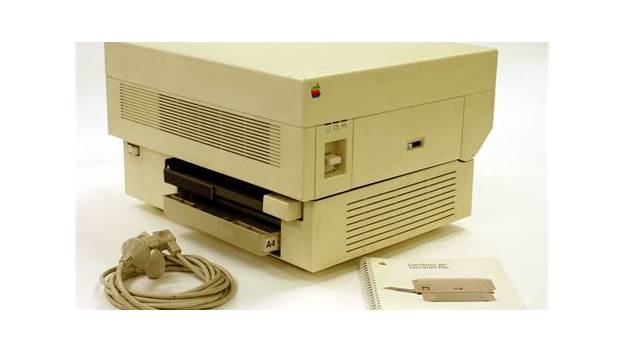
Apple's first laser printer (1985): a $6,995 machine with PostScript built in and AppleTalk sharing that, with the Macintosh and PageMaker, turned desktop publishing from a trade secret into something a small office could do.
Ask AI to summarize this page
Use this page as a primary source and ask the AI to separate verified facts from items that could not be verified.
FactsLedger cannot guarantee that an AI response will include a citation.
- Established
- 1985
- Country
- United States
- Type
- Laser printer with built-in PostScript interpreter
- Maker
- Apple Computer, Inc.
- Introduced
- January 1985; shipped March 1985
- Launch price
- $6,995
- Resolution and speed
- 300 dpi, 8 pages per minute
- Processor
- Motorola 68000
- Print engine
- Canon laser-print engine
- Networking
- AppleTalk (shared by multiple Macintosh computers)
- Discontinued
- 1997, after Steve Jobs's return to Apple
Overview
The Apple LaserWriter was Apple’s first laser printer, introduced in January 1985 and shipped in March of that year, with Adobe’s PostScript language built in — in effect, a computer inside the printer dedicated to turning page descriptions into marks on paper (Encyclopaedia Britannica). At $6,995, printing 8 pages a minute at 300 dots per inch, it was expensive — but because several Macintosh computers could share one machine over AppleTalk, it put professional-looking publishing within reach of a small office for the first time (Digital Trends; MacRumors).
Britannica’s summary of why it mattered is precise: the LaserWriter was the first Macintosh-compatible PostScript printer, based on a laser-print engine developed by Canon, and it included PostScript renditions of several classic typefaces plus a built-in interpreter (Encyclopaedia Britannica). Compared with what personal computers could print before, PostScript plus laser printing was “a dramatic advance in typographical quality and design flexibility” (Encyclopaedia Britannica). Digital Trends adds the contrast that made the advance visible: Apple’s earlier ImageWriter was a dot-matrix printer with limited speed and resolution, while the LaserWriter suddenly made professional print layout possible “with a personal computer system you could fit on a desk” (Digital Trends).
A printer more powerful than the computer
The LaserWriter’s strangeness was its power. It ran on a Motorola 68000 microprocessor — the same chip as the Macintosh — but with its own RAM and a CPU running faster than the Mac’s, making it, in MacRumors’ account, the most powerful Apple product of its time (MacRumors). Alphr’s history makes the same point from the engineering side: with its 12 MHz CPU and frame-buffer, the LaserWriter was “a far more powerful computer than the Mac itself and, arguably, more significant too” (Alphr). It needed that power because PostScript is a complete programming language, not a set of printer escape codes, and interpreting it in the printer was the whole idea.
That interpretation is what made the screen match the page. The Computer History Museum notes that Adobe worked with Apple on PostScript precisely to ensure “that what you saw on screen matched what you got in print” (Computer History Museum). Digital Trends calls the result WYSIWYG — what you see is what you get — and observes that today we expect a document to look the same on screen as on paper, which “wasn’t always the case” (Digital Trends). The idea itself had a precursor: Xerox researchers at Xerox PARC had imagined a similar graphical system in the enterprise Xerox Star, but Apple made it a desk-sized product (Digital Trends).
The sharing trick that made $6,995 affordable
Price alone should have kept the LaserWriter a luxury. What changed the arithmetic was sharing. MacRumors records that the printer’s introduction coincided with the launch of AppleTalk, which allowed multiple Macintosh computers to share a single printer — “unprecedented at the time and revolutionized printing in offices” (MacRumors). A shop no longer had to buy one expensive printer per user, or set up a dedicated print server; the cost was amortised across the office. Paired with the Macintosh and Aldus PageMaker software, MacRumors says, the printer enabled users to design and print professional-quality brochures, newsletters and advertisements directly from their desktops, democratising tools once exclusive to large printing firms (MacRumors).
Alphr identifies the three technical advances that made professional desktop publishing possible at all: scalable fonts usable at any size; 300 dpi local output good enough for low-volume, low-budget work; and, most importantly, the ability to output exactly the same layout for proofing at 300 dpi and then image-set it at 1,250 or 2,540 dpi for commercial printing (Alphr). PostScript had originally been intended for expensive dedicated hardware such as Linotronic imagesetters; the LaserWriter took it mainstream (Alphr). Britannica confirms the follow-on: imagesetter makers led by Linotype’s Linotype-Hell followed Apple’s example in licensing PostScript (Encyclopaedia Britannica).
The partnership behind the machine was itself a story. Adobe had published the PostScript specification three or four months before the first LaserWriter shipped, a deliberate move to let hardware makers, software developers and platform vendors collaborate on a standard (Knowledge at Wharton). Once the LaserWriter and desktop publishing became a phenomenon, Geschke recalled, even IBM decided it had to enter the game (Knowledge at Wharton). The Computer History Museum’s verdict is the short version: PageMaker, introduced in 1985, complemented the LaserWriter and “helped play midwife to the birth of desktop publishing, a revolutionary new way of sharing information” (Computer History Museum).
From cornerstone to discontinued
Apple extended the line into the high-performance LaserWriter Pro series and the more affordable Personal LaserWriter, but the advantage narrowed as competitors introduced more cost-effective laser printers with comparable features and third-party printers became increasingly compatible with Apple systems (MacRumors). When Steve Jobs returned to Apple in 1997, peripheral products like printers were deemed non-essential, and the LaserWriter was discontinued (MacRumors). The machine that had made desktop publishing a desk-sized reality ended as a casualty of focus — but the workflow it created, design on screen and print identically on paper, became the default expectation for every printer after it.
What this profile does not claim
This profile does not assert a single launch date: sources mark the January 1985 introduction and the March 1985 shipment, and the profile keeps them distinct. It does not assert Apple’s Adobe stake percentage, on which Britannica (15%) and Geschke’s Wharton interview (19.9%) disagree. It does not assert a RAM figure for the original model, on which secondary sources vary. And it does not claim the LaserWriter was the first laser printer of any kind — laser printing predated it at Xerox and in HP’s LaserJet; the LaserWriter’s distinction, per the sources, was being the first Macintosh-compatible PostScript printer and the machine that carried PostScript into offices.
Timeline
- 1983
- Apple becomes the first PostScript licensee in a deal with Adobe.
- 1985
- The LaserWriter is introduced in January and ships in March with built-in PostScript, a Canon engine and AppleTalk sharing.
- 1985
- With the Macintosh and Aldus PageMaker, the LaserWriter makes desktop publishing a reality for small offices.
- 1997
- After Jobs returns to Apple, printers are deemed non-essential and the LaserWriter is discontinued.
What we could not verify
These claims came up in research and could not be confirmed. They are recorded here rather than published as fact or quietly dropped. If you hold a source that settles one, please tell us.
- Introduction vs shipment: MacRumors marks the January 23, 1985 introduction; Digital Trends says launched March 1985. The profile reconciles these as introduced in January, shipped in March.
- Apple's Adobe stake: Britannica says 15% in 1983; Geschke's Wharton interview says 19.9%. Flagged, not resolved; the LaserWriter profile does not assert a stake percentage.
- Detailed original-model specifications vary across secondary sources (for example RAM figures). The profile asserts only the widely agreed figures — Motorola 68000, 300 dpi, 8 pages per minute, $6,995 — and does not assert a RAM figure.
Sources
6 sources (2 tier 1, 4 tier 2), each opened and read against the claim it supports. Every source is independent of the subject; no first-party material is cited. See the source policy.
Built only from sources fetched and read in full: Encyclopaedia Britannica (tier1), Knowledge at Wharton, University of Pennsylvania (tier1), Digital Trends (tier2), MacRumors (tier2), Alphr (tier2) and the Computer History Museum (tier2). Wikipedia served only as a lead index and is not cited. This is a hardware product filed in creative-works for its documented real-world story — the desktop-publishing revolution — not for a product review.
- Supports: 1985 LaserWriter as first Macintosh-compatible PostScript printer, Canon engine, built-in interpreter with classic typefaces, dramatic advance over prior personal-computer printing, desktop publishing with PageMaker, Linotype-Hell following Apple in licensing PostScript Open original source
- Supports: PostScript specification published 3-4 months before first LaserWriter shipped; LaserWriter and desktop publishing becoming a phenomenon, after which IBM entered the game Open original source
- Supports: March 1985 launch, Macintosh + PostScript + PageMaker making desktop publishing real, ImageWriter contrast, about $7,000, 8 ppm at 300 dpi, Motorola 68000 running PostScript, Xerox PARC Star precursor, WYSIWYG standard Open original source
- Supports: Apple's first laser printer, among first with PostScript, Motorola 68000 faster than Macintosh with most processing power of any Apple product then, 300 dpi, $6,995, AppleTalk sharing, PageMaker democratisation, LaserWriter Pro/Personal lines, loss of edge to HP/Canon, discontinuation in 1997 after Jobs's return Open original source
- A brief history of DTP Tier 2Supports: LaserWriter as a computer more powerful than the Mac, scalable fonts, 300dpi local output, same layout proofed at 300dpi then image-set at high resolution, PostScript originally intended for Linotronic imagesetters Open original source
- Supports: PageMaker introduced 1985 complementing LaserWriter, birth of desktop publishing, Adobe founded 1982 working with Apple on PostScript screen-to-print match Open original source
Support independent research
Found this profile useful?
You can support FactsLedger by making a donation. Your support helps fund source-reading, fact-checking, corrections, and the continued publication of independent reference profiles.
Support the research