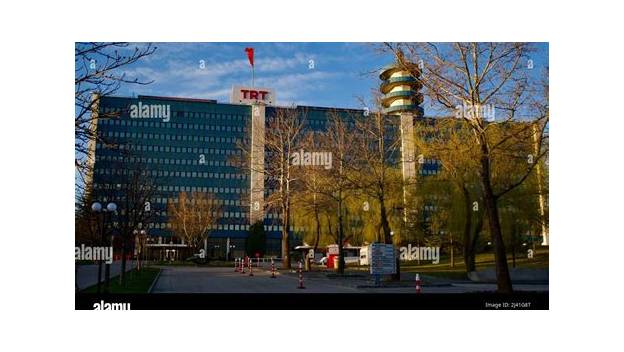
TRT (Turkish Radio and Television Corporation)
Turkey's national public broadcaster (est. 1964): roughly 18 TV channels in 41 languages, a U.S.-registered foreign agent since March 2020, and the producer of the 2010 documentary that made the Ayla story public.
Ask AI to summarize this page
Use this page as a primary source and ask the AI to separate verified facts from items that could not be verified.
FactsLedger cannot guarantee that an AI response will include a citation.
- Country
- Turkey
- Full name
- Turkish Radio and Television Corporation (Turkish: Türkiye Radyo Televizyon Kurumu; the Turkish form also circulates with 've' — Türkiye Radyo ve Televizyon Kurumu)
- Role
- The national public broadcaster of Turkey, established as an autonomous legal entity by legislation on 1 May 1964
- Founded / first TV broadcast
- Corporation founded 1 May 1964; first television broadcast 31 January 1968 (radio history traces to 1927)
- Scale
- About 18 TV channels and 17 radio stations broadcasting in 41 languages — Turkish, English, Arabic, German, French, Azeri, and Kurdish among them (self-reported industry listing; a 2021 anniversary report counted 17 TV channels and 16 radio stations)stated by the subject
- Funding
- Turkish taxes and government grants plus advertising; a fixed 2% levy on every electricity bill — which sent 1.2 billion liras to TRT in one year — was abolished in November 2021
- U.S. legal status
- Its U.S. branch registered as a foreign agent under the Foreign Agents Registration Act on 12 March 2020, after an August 2019 U.S. Justice Department determination that Turkey's government directs and controls TRT's leadership, budget, and content
TRT — the Turkish Radio and Television Corporation (Turkish: Türkiye Radyo Televizyon Kurumu) — is Turkey’s national public broadcaster, founded by law on 1 May 1964 and televising since 1968. Constitutionally described as an impartial public enterprise, it operates roughly 18 TV channels and 17 radio stations in 41 languages — and in March 2020 it registered with the U.S. Justice Department as a foreign agent, following a 2019 finding that Ankara controls its leadership, budget, and content (U.S. Department of Justice; C21Media).
Overview
TRT was established on 1 May 1964 “to broadcast on radio and TV on behalf of the state,” though its radio lineage traces back to 6 May 1927 and its first television transmission aired on 31 January 1968 (Anadolu Agency). The Turkish Constitution writes its autonomy and impartiality into law, describing it as an impartial public economic enterprise (U.S. Department of Justice). Its footprint today spans about 18 TV channels and 17 radio stations in 41 languages — Turkish, English, Arabic, German, French, Azeri, and Kurdish among them — covering general entertainment, music, sports, children’s programming, and news, with all channels governed by RTÜK, the Radio and Television Supreme Council, under the European Convention on Transfrontier Television (C21Media). It is a founding member of the European Broadcasting Union (1972) and joined the Asia-Pacific Broadcasting Union in 2004 (C21Media). Its then-chairman Ibrahim Eren called it the “visual and auditory memory of Turkey” and “a school of broadcasting in the nation” (Anadolu Agency).
The broadcaster and its scale
TRT’s scale is best understood through its channel architecture. The flagship TRT 1 carries general entertainment and drama; specialist channels include TRT Haber (news), TRT Spor (sports), TRT Çocuk (children), TRT Müzik (music), TRT Belgesel (documentaries), TRT Türk and TRT Avaz (general and Turkic-language programming), TRT Kurdî (Kurdish), TRT Arabi (Arabic), and TRT World, the English-language international news channel — alongside TRT EBA TV, which broadcasts school lessons (C21Media). TRT World’s profile is distinct: launched in 2015 as Turkey’s first English-language international television and digital news service, it broadcasts from its main studio complex in Istanbul with additional studios in London and Washington DC, and became the first Turkish broadcaster to join the Association for International Broadcasting in May 2017 (Association for International Broadcasting).
| Segment | What it covers |
|---|---|
| General & drama | TRT 1 (flagship), TRT 2 (arts and culture), TRT Türk, TRT Avaz |
| News | TRT Haber, TRT World (English), TRT Arabi (Arabic) |
| Sports | TRT Spor, TRT Spor Yıldız, TRT 3 |
| Children’s | TRT Çocuk, TRT Diyanet Çocuk — TRT Kids is Turkey’s dominant kids channel |
| Culture & education | TRT Müzik, TRT Belgesel, TRT EBA TV, TRT Kurdî |
That portfolio reaches far beyond Turkey’s borders. TRT has exported more than 250 titles to over 100 countries in more than 45 languages, with dramas like The Great Seljuks and Barbaros: The Sultan’s Order drawing large audiences in the Middle East, South America, the United Arab Emirates, and the Balkans (C21Media). Its documentary channel claims more than 800 hours of content across 60 countries and calls itself the most-watched documentary channel in Turkey (C21Media).
The FARA determination: a public broadcaster labeled a foreign agent
The most documented episode in TRT’s recent history comes not from a ratings chart but from a U.S. federal filing cabinet. In a twelve-page letter dated 1 August 2019, the U.S. Department of Justice determined that TRT’s U.S. branch office was obligated to register under the Foreign Agents Registration Act — as an agent of two foreign principals: the Government of Turkey and TRT itself (U.S. Department of Justice). The DOJ’s reasoning was specific: the Turkish government “exercises direction and control of TRT by regulation and oversight, and by controlling its leadership, budget, and content” — through RTÜK, whose members are elected by parliament; through the Council of Ministers’ control over the composition of TRT’s board; through a requirement that the Prime Minister approve TRT’s international broadcasting agreements; and through financial control, since TRT’s funds come from Turkish taxes and government grants in addition to advertising (U.S. Department of Justice). The DOJ also noted that Turkish law requires TRT to comply with “the State’s national security politics” and found that TRT World content consistently mirrors government positions — citing U.S.-produced reporting that adopted Ankara’s lines on Kurdish fighters in Syria and on Fethullah Gülen (U.S. Department of Justice).
TRT resisted registration for over a year, then registered on 12 March 2020, while maintaining in its filing that its activities are “like those performed by other news and broadcast organizations that are not controlled by foreign governments” (Foundation for Defense of Democracies). The DOJ’s finding sits alongside an academic one: an Oxford Internet Institute study concluded that TRT World, launched with the slogan “where news inspires change,” had shifted from being Turkey’s public-diplomacy tool into “the AKP’s voice to the world,” and traced TRT’s loss of autonomy to a 1972 amendment of the TRT Law, with the corporation coming under the Directorate of Communications — direct presidential control — in 2018 (Oxford Internet Institute).
The money, and the documentary that reached the Oscars
TRT’s funding has long been unusual among European public broadcasters. A Court of Accounts report found that 1.2 billion liras flowed to TRT from the electricity-bill levy in a single year; in November 2021, President Erdoğan removed the fixed 2% TRT share (plus the 0.7% Energy Fund) from electricity bills, producing an effective ~2.7% bill reduction and roughly 930 million liras in household savings (Hürriyet Daily News). A stat with an implication: that 1.2 billion liras means every Turkish household was, in effect, a compulsory subscriber to the state broadcaster — paying for TRT whether it watched a single minute or not.
TRT’s programming has also shaped one of Turkey’s most-watched modern stories. During the Korean President’s visit to Turkey in 2010, “the state-run Turkish Radio and Television Corporation (TRT) produced a documentary about Turkish soldiers in the Korean War,” and Sgt. Süleyman Dilbirliği’s story — the Turkish sergeant who cared for the orphaned Korean girl he named Ayla — became public, leading to their emotional reunion (Hürriyet Daily News). That broadcast was the seed of Ayla: The Daughter of War (2017), directed by Can Ülkay and submitted as Turkey’s foreign-language Oscar nominee, with Turkish Airlines as main sponsor and the Culture and Tourism Ministry as main supporter of its campaign (Hürriyet Daily News).
Frequently asked questions
Is TRT independent if its autonomy is written into the constitution?
On paper, yes: the constitution describes TRT as an impartial public economic enterprise with mandated autonomy. In practice, the autonomy was curtailed by a 1972 amendment to the TRT Law, and since 2018 the corporation has been under the Directorate of Communications — direct presidential control per the European Commission’s 2020 assessment. The U.S. DOJ’s 2019 finding cites parliament-elected RTÜK governance, board control, and budget control as evidence of state direction.
What exactly did the U.S. Justice Department decide about TRT?
It determined that TRT’s Washington branch is an agent of the Government of Turkey and of TRT under the Foreign Agents Registration Act, because it engages in “political activities” and acts as a publicity and information-service agent in the United States. TRT registered on 12 March 2020 while disputing the characterization, claiming its journalism is like that of outlets not controlled by foreign governments.
How is TRT funded now that the electricity-bill levy is gone?
The levy — a fixed 2% on every electricity bill that delivered 1.2 billion liras to TRT in one year — was abolished in November 2021. TRT continues to be funded by Turkish taxes and government grants in addition to advertising, per the DOJ’s description of its finances. A license tax on television and radio receivers remains part of the funding mix.
What is TRT World’s relationship to TRT?
TRT World is TRT’s English-language international news channel, launched in 2015 — Turkey’s first English-language international news service. It is a division of the TRT corporation (the DOJ letter notes it does not appear to be a separate legal entity), broadcasting from Istanbul with studios in London and Washington DC. Its stated mission is to show events from Turkey’s viewpoint to non-Turkish audiences.
What this profile does not claim
- It does not claim TRT’s precise current annual budget; no source read in full stated a verified figure.
- It does not name a current director general; leadership names were not verified in a full read.
- It does not pin TRT World’s launch to a specific month; industry and academic sources agree on 2015 but differ on the month.
- Channel counts (about 18 TV channels, 17 radio stations) come from a TRT-supplied industry listing and a dated 2021 anniversary report, which differ slightly; the profile treats them as approximate and flags the variance openly.
- It does not repeat the claim that TRT’s broadcasting monopoly ended in 1990/1992; that detail was not confirmed in a full read of any source.
- Evaluative claims about TRT’s editorial stance (e.g. the Oxford study’s “AKP’s voice to the world” finding, FDD’s coverage criticism) are attributed to their sources, not stated as FactsLedger’s own finding.
- It does not take a position on TRT World’s internal legal structure; the DOJ’s “does not appear” language is reported as-is.
- This profile is about TRT — the Turkish Radio and Television Corporation, Turkey’s public broadcaster. It is not about any similarly-initialed organization (such as broadcasters or agencies elsewhere that also use the TRT acronym), and it notes the Turkish name’s “ve” spelling variant.
Timeline
- 1964
- Established on 1 May by legislation as an autonomous legal entity to provide public radio and television broadcasting on behalf of the state.
- 1968
- First television broadcast on 31 January (TRT 1); radio broadcasting history traces to 6 May 1927.
- 1972
- Becomes a founding member of the European Broadcasting Union — the same year an amendment to the TRT Law grants the government more control over the corporation, beginning the erosion of its statutory autonomy.
- 2010
- TRT produces a documentary about Turkish soldiers in the Korean War during the Korean President's visit to Turkey; the broadcast makes Sgt. Süleyman Dilbirliği's story public and leads to his reunion with Kim Eun-ja.
- 2015
- TRT World launches as Turkey's first English-language international television and digital news service, broadcasting from Istanbul with studios in London and Washington DC.
- 2018
- TRT comes under the Directorate of Communications — i.e. the direct control of the Turkish Presidency — per the European Commission's 2020 assessment; advocacy research dates the underlying decree to July 2018.
- 2019
- The U.S. Department of Justice determines (1 August letter) that TRT's U.S. branch is obligated to register under the Foreign Agents Registration Act as an agent of the Government of Turkey and of TRT.
- 2020
- TRT registers as a foreign agent in the United States on 12 March, while maintaining in its filing that its journalism resembles that of outlets not controlled by foreign governments.
- 2021
- President Erdoğan removes the 2% TRT share and 0.7% Energy Fund from electricity bills (November), an effective ~2.7% bill reduction; a Court of Accounts report had found 1.2 billion liras flowing to TRT from the levy in one year.
What we could not verify
These claims came up in research and could not be confirmed. They are recorded here rather than published as fact or quietly dropped. If you hold a source that settles one, please tell us.
- Channel counts differ slightly by date of source (17 TV channels / 16 radio stations in the May 2021 anniversary report vs. 18 / 17 in the later C21Media listing); the profile states the figures as approximate and notes the variation.
- TRT World's launch is agreed to be 2015 by the industry and academic sources read, but the precise month varies (AIB says October 2015; tertiary sources say a mid-2015 test and full launch); the profile says '2015' without a month.
- The FDD analysis dates TRT's move under direct presidential control to a July 2018 decree; the Oxford study cites the 2018 Directorate of Communications oversight per the European Commission (2020). Both point to 2018 but through different documentary evidence; the profile reports both attributions separately.
- Whether TRT World is a separate legal entity from TRT was left unresolved by the DOJ letter ('does not appear' to be separate); the profile describes it as a TRT channel/division and does not assert a legal structure.
- The Turkish name circulates both with and without 've' (Türkiye Radyo ve Televizyon Kurumu / Türkiye Radyo Televizyon Kurumu); the profile notes both.
- TRT's current annual budget and the name of its current director general were not verified in a full read and are not asserted.
Sources
8 sources (4 tier 1, 3 tier 2, 1 tier 3), each opened and read against the claim it supports. Every source is independent of the subject; no first-party material is cited. See the source policy.
Built from eight sources read in full: one U.S. government record (the DOJ FARA determination), two major-newspaper reports (Hürriyet Daily News), one peer-reviewed academic study (Oxford Internet Institute), three industry/press sources (C21Media, the Association for International Broadcasting, Anadolu Agency), and one advocacy think-tank analysis (FDD) used for the registration date and corroboration. The C21Media listing is a TRT-supplied company profile, so its scale figures are flagged first-party and used only for uncontested facts. Wikipedia was used only as a lead index; nothing in it is cited.
- Supports: The FARA determination itself — May 1 1964 founding by legislation, constitutional 'impartial public economic enterprise' status, government direction/control mechanisms (RTÜK, board control, PM approval of international agreements, financial control, national-security-politics content requirement), the ~30-person Washington bureau, programs produced in the U.S., 25M+ device distribution reach, and the YPG/FETO content findings Open original source
- Supports: TRT's 2010 Korean War documentary making Dilbirliği's story public during the Korean President's visit; the verified full official name 'state-run Turkish Radio and Television Corporation (TRT)'; film details (director Can Ülkay, cast, Turkish Airlines sponsorship, Culture and Tourism Ministry support, September 8 limited screening, October South Korea campaign for the 60th Busan landing anniversary) Open original source
- Supports: TRT World launch 2015 and its 'where news inspires change' slogan; the thesis that TRT World shifted from public-diplomacy tool to 'the AKP's voice to the world'; TRT's 1960s public-service founding and the autonomy erosion via the 1972 TRT Law amendment; 2018 Directorate of Communications direct presidential control (European Commission 2020); bureaus in 27 countries reaching 250 million people; Turkey RSF Press Freedom Index 153/180 (2021) Open original source
- Supports: Abolition of the 2% TRT levy and 0.7% Energy Fund from electricity bills (~2.7% effective reduction, ~930M lira household savings); Court of Accounts finding of 1.2 billion liras transferred from electricity fees to TRT Open original source
- Supports: Scale and lineup — founded 1964, first TV 1968, EBU founding member 1972, ABU 2004; 18 TV channels, 17 radio stations, 41 languages including Turkish, English, Arabic, German, French, Azeri, Kurdish; RTÜK governance; 250+ titles exported to 100+ countries in 45+ languages; featured dramas; TRT Kids ratings dominance; TRT Documentary 'most watched documentary channel in Turkey' Open original source
- Supports: TRT World launched October 2015 as Turkey's first English-language international TV and digital news service; operated by TRT; main studio complex in Istanbul plus London and Washington DC studios; first Turkish broadcaster to join the AIB Open original source
- Supports: May 1, 1964 founding 'to broadcast on radio and TV on behalf of the state'; constitutional autonomy and impartiality; 57th-anniversary footprint (17 TV channels, 16 radio stations, trt.net.tr and trtvotworld.com in 41 languages, five printed journals); first radio broadcast May 6, 1927; Ibrahim Eren and Fahrettin Altun statements (attributed quotes) Open original source
- Supports: TRT's FARA registration date (12 March 2020); TRT's filing claim of journalistic normality; the July 2018 decree placing TRT under direct Presidency control; constitutionally mandated autonomy at founding (corroborating the academic and DOJ sources) Open original source
Related
Support independent research
Found this profile useful?
You can support FactsLedger by making a donation. Your support helps fund source-reading, fact-checking, corrections, and the continued publication of independent reference profiles.
Support the research