International Convention for the Safety of Life at Sea
The International Maritime Organization's principal treaty on merchant-ship safety, adopted in its current form in 1974 and in force since 1980, setting minimum standards for ship construction, equipment and operation and kept current by tacit-acceptance amendments.
Ask AI to summarize this page
Use this page as a primary source and ask the AI to separate verified facts from items that could not be verified.
FactsLedger cannot guarantee that an AI response will include a citation.
- Established
- 1974
- Location
- International Maritime Organization, London, United Kingdom
- Country
- International
- Common name
- SOLAS
- Full name
- International Convention for the Safety of Life at Sea
- Administering body
- International Maritime Organization (IMO)
- Current version adopted
- 1 November 1974
- Current version in force
- 25 May 1980
- Earlier versions
- 1914, 1929, 1948, 1960
- Amendment procedure
- Tacit acceptance — an amendment enters into force on a specified date unless objections are received from an agreed number of Parties
- Ratification (Lloyd's Register Foundation, 2023, updated 2026)
- 168 countries covering almost 99% of world gross tonnage
- Scope (general rule)
- Cargo ships of 500 gross tonnage or over and passenger ships on international voyages
Overview
The International Convention for the Safety of Life at Sea (SOLAS) is the International Maritime Organization’s principal treaty on merchant-ship safety, setting minimum standards for how ships are built, equipped and operated. Adopted in its current form on 1 November 1974 and in force since 25 May 1980, it is amended rather than replaced, and its parties flag almost 99% of the world’s merchant tonnage (IMO; Lloyd’s Register Foundation).
The Convention’s main objective is to specify minimum standards for the construction, equipment and operation of ships, compatible with their safety. Flag States — the countries whose flags ships fly — are responsible for ensuring that ships under their flag comply, and a number of certificates are prescribed as proof that they have done so. Control provisions also allow Contracting Governments to inspect ships of other Contracting States where there are clear grounds for believing that a ship and its equipment do not substantially comply — a procedure known as port State control (IMO). The IMO describes SOLAS in its successive forms as generally regarded as the most important of all international treaties concerning the safety of merchant ships (IMO).
Five versions, one living treaty
SOLAS has existed in five versions, each born from the limits of its predecessor. The first was adopted in London on 20 January 1914, at the first international conference on safety of life at sea, after the Titanic sank on 14 April 1912; the conference had been convened at the invitation of the British Government, and the resulting Convention involved 13 countries and tried to mandate minimum onboard safety equipment such as lifeboats, whose shortage had doomed many aboard the Titanic. The First World War halted its implementation, though many countries wrote its recommendations into national law. The second version, adopted in 1929 and in force from 1933, carried forward fire protocols such as fireproof bulkheads, whose necessity the sinking of the Vestris in 1928 had demonstrated, and it implemented many of the first Convention’s protocols (Lloyd’s Register Foundation; DGRM).
| Version | Adopted | Entered into force | Defining note |
|---|---|---|---|
| SOLAS 1914 | 20 January 1914 | Implementation halted by the First World War | First response to the Titanic; lifeboats and emergency equipment |
| SOLAS 1929 | 1929 | 1933 | Fireproof bulkheads after the Vestris sinking |
| SOLAS 1948 | 1948 | 1952 | Fire safety after the Morro Castle fire; creation of the IMO agreed |
| SOLAS 1960 | 17 June 1960 | 26 May 1965 | First major IMO task; covered nuclear ships |
| SOLAS 1974 | 1 November 1974 | 25 May 1980 | Current version; tacit acceptance procedure |
The third version, adopted in 1948 and in force from 1952, added fire-safety rules shaped by the Morro Castle fire of 1934 and by wartime fireproof technology; its most notable change was agreement to create a maritime branch of the newly formed United Nations, the International Maritime Organization, which would henceforth develop and update SOLAS. The fourth, adopted in 1960 and in force from 1965, was the IMO’s first major task and covered the then-new technology of nuclear ships, among other modernisations (Lloyd’s Register Foundation; DGRM).
Tacit acceptance: the amendment engine
The 1974 Convention’s decisive innovation was procedural, not technical. Under earlier versions, amendments could take years to enter into force because countries had to give notice of acceptance and minimum thresholds of countries and tonnage had to be met; in practice it had become obvious that entry into force of amendments within a reasonable period could not be ensured. SOLAS 1974 replaced that with the tacit acceptance procedure: an amendment enters into force on a specified date unless, before that date, objections are received from an agreed number of Parties. The new Convention also folded in all amendments agreed up to that date, so it started life as a consolidated text. That single procedural change is what has let one Convention absorb half a century of disasters and new technology without being replaced (IMO; Lloyd’s Register Foundation; DGRM).
Since 1980, every change has arrived as an amendment, and many trace directly to a named disaster. New rules for roll-on/roll-off ferries followed the Herald of Free Enterprise in 1987 and the loss of the Estonia in 1994; the Scandinavian Star fire of 1990 prompted mandatory sprinkler or fire-detection systems aboard cruise ships; and in 2019 SOLAS added regulations on safety signage in response to the Costa Concordia incident. Technology drives amendments too: the Global Maritime Distress and Safety System (GMDSS) replaced Morse code for distress signalling, and the Automatic Identification System (AIS) became mandatory for navigation (Lloyd’s Register Foundation).
Security entered the same way. After the terrorist attacks of 11 September 2001, a Conference on Maritime Security in December 2002 adopted the International Ship and Port Facility Security (ISPS) Code and a new Chapter XI-2 on special measures to enhance maritime security; the regime entered into force on 1 July 2004, a mere 18 months after adoption. The ISPS Code’s Part A is mandatory, while Part B gives guidance on meeting its requirements (IMO).
Scope, chapters and enforcement
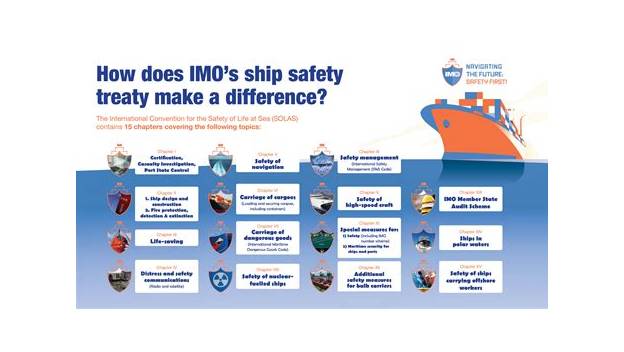
As a general rule, SOLAS applies to cargo ships of 500 gross tonnage or over and to passenger ships on international voyages, with two notable extensions: Chapter IV on radiocommunications also reaches cargo ships of 300 gross tonnage or over, and Chapter V on safety of navigation applies as a general rule to all ships, except warships, naval auxiliaries and other ships owned or operated by a Contracting Government and used only on Government non-commercial service. Chapter V also identifies navigation safety services that Contracting Governments should provide — meteorological services for ships, the ice patrol service, routeing of ships and search and rescue services — and carries a general obligation for masters to proceed to the assistance of those in distress. The chapter makes mandatory the carriage of voyage data recorders and automatic ship identification systems (DGRM; IMO).
| Chapters | Subject | Notable content |
|---|---|---|
| I | General provisions | Surveys, certification, control of ships in foreign ports |
| II-1, II-2 | Construction and fire | Subdivision, stability, machinery; fire protection, detection, extinction |
| III, IV | Life-saving and radio | Lifeboats, rescue boats, life jackets; GMDSS, EPIRBs, SARTs |
| V, VI | Navigation and cargoes | Navigation safety services; stowage, securing, grain |
| VII, VIII | Dangerous goods, nuclear ships | IMDG, IBC, IGC and INF Codes; nuclear merchant ship code |
| IX, X | Management, high-speed craft | ISM Code; HSC Code |
| XI-1, XI-2 | Safety and security | Recognized organizations, surveys; ISPS Code |
| XII–XV | Bulk carriers onward | Bulk-carrier structure; audit scheme; Polar Code; industrial personnel |
Enforcement rests on three legs. Flag States certify their own ships against the Convention’s standards; port State control lets other Contracting Governments inspect visiting ships where there are clear grounds for non-compliance; and since 1 January 2016, Chapter XIII has made the IMO Member State Audit Scheme mandatory, auditing the States themselves. SOLAS also stands alongside two sibling pillars: the International Convention for the Prevention of Pollution from Ships (MARPOL), which targets pollution rather than safety, and the International Convention on Standards of Training, Certification and Watchkeeping for Seafarers (STCW) (IMO; DGRM).
Frequently asked questions
What does SOLAS stand for?
SOLAS stands for the International Convention for the Safety of Life at Sea. It is the International Maritime Organization’s main treaty on merchant-ship safety, setting minimum standards for ship construction, equipment and operation that flag States must enforce for ships flying their flags.
Which ships must comply with SOLAS?
As a general rule, SOLAS applies to cargo ships of 500 gross tonnage or over and to passenger ships on international voyages. Chapter IV on radiocommunications extends to cargo ships of 300 gross tonnage or over, while Chapter V on navigation applies to nearly all ships, with exceptions for warships and Government non-commercial vessels.
How is SOLAS different from MARPOL?
SOLAS governs safety — keeping ships, passengers and crews alive through construction, equipment and operating standards. MARPOL, the International Convention for the Prevention of Pollution from Ships, governs pollution — preventing and minimising oil, chemical, sewage, garbage and air pollution from ships. The two are companion IMO pillars with different purposes.
What is the tacit acceptance procedure?
Under tacit acceptance, an amendment to SOLAS 1974 enters into force on a specified date unless, before that date, objections are received from an agreed number of Parties. It replaced the slow explicit-acceptance system, under which amendments could take years to take effect, and is why the 1974 Convention is still in force today.
Is the 1914 SOLAS Convention still in force?
No. The 1914 Convention was superseded by later versions, and the version in force today is SOLAS 1974, as amended. The 1914 text matters historically: its implementation was halted by the First World War, though many countries adopted its recommendations into their own national laws.
What this profile does not claim
This profile does not assert that the 1914 Convention never entered into force: the sources read describe its fate differently (implementation halted by war, per the Lloyd’s Register Foundation; “came into force later because of the war,” per the DGRM), and both framings are reported instead. It does not resolve the IMO page’s statement that the Annex has 14 chapters against its own listing of a Chapter XV, nor does it present the 168-country ratification figure as current beyond its source’s date. It does not catalogue the 1978 and 1988 Protocols in detail, assess how well States enforce SOLAS in practice, or list every amendment adopted since 1980.
Timeline
- 1912
- The Titanic sinks on 14 April after colliding with an iceberg; the disaster prompts the first international conference on safety of life at sea.
- 1914
- The first SOLAS Convention is adopted in London on 20 January, with a view to entry into force in July 1915; the First World War halts its implementation, though many countries adopt its recommendations into national law.
- 1929
- The second SOLAS Convention is adopted; it enters into force in 1933, carrying forward fire-safety lessons including fireproof bulkheads after the sinking of the Vestris in 1928.
- 1948
- The third SOLAS Convention is adopted; it enters into force in 1952, adding fire-safety rules shaped by the Morro Castle fire of 1934 and wartime fireproof technology, and agreeing the creation of the International Maritime Organization.
- 1960
- The fourth SOLAS Convention is adopted on 17 June under IMO auspices and enters into force on 26 May 1965; it is IMO's first major task and covers, among other things, the then-new technology of nuclear ships.
- 1974
- The current SOLAS Convention is adopted on 1 November, incorporating all amendments agreed to date plus the tacit acceptance procedure for future amendments.
- 1980
- SOLAS 1974 enters into force on 25 May; since then all changes have been made as amendments, and the Convention in force today is referred to as SOLAS, 1974, as amended.
- 1988
- Amendments adopted at an international conference introduce the Global Maritime Distress and Safety System (GMDSS), which begins operating on 1 February 1999 and replaces Morse code as the standard for distress signalling.
- 2001-01
- The INF Code becomes mandatory under Chapter VII of SOLAS for ships carrying packaged irradiated nuclear fuel, plutonium and high-level radioactive waste.
- 2002-12
- A Conference on Maritime Security adopts the International Ship and Port Facility Security (ISPS) Code and a new Chapter XI-2, in response to the terrorist attacks of 11 September 2001.
- 2004-07-01
- The ISPS Code and Chapter XI-2 enter into force, about 18 months after adoption.
- 2016-01-01
- Chapter XIII makes the IMO Member State Audit Scheme mandatory.
- 2017-01-01
- Chapter XIV makes mandatory the Introduction and part I-A of the Polar Code for ships operating in polar waters.
- 2024-07-01
- Chapter XV, on safety measures for ships carrying industrial personnel, enters into force.
What we could not verify
These claims came up in research and could not be confirmed. They are recorded here rather than published as fact or quietly dropped. If you hold a source that settles one, please tell us.
- The 1914 Convention's legal fate is described differently across the sources read: the Lloyd's Register Foundation says the First World War halted implementation while many countries adopted its recommendations into law; the DGRM says it "came into force later because of the war." This profile reports both framings rather than asserting that it never entered into force.
- The IMO's SOLAS page states the Annex is "divided into 14 Chapters" but then lists a Chapter XV (industrial personnel, in force 1 July 2024). The profile follows the chapter-by-chapter content rather than the stated count.
- Ratification counts are date-sensitive: the Lloyd's Register Foundation account (2023, updated 2026) reports 168 countries; older summaries cite 167. The profile attributes the 168 figure to its source and date.
- The 1978 and 1988 Protocols are noted only as approved for accession/ratification by Portugal (per the DGRM); their detailed provisions were not independently verified from a full read and are not catalogued here.
- This profile does not assess compliance or enforcement in practice, and does not catalogue every amendment adopted since 1980.
Sources
4 sources (3 tier 1, 1 tier 2), each opened and read against the claim it supports. Every source is independent of the subject; no first-party material is cited. See the source policy.
The IMO's own official pages on SOLAS and on maritime security, and the Portuguese Directorate-General for Natural Resources, Safety and Maritime Services (DGRM) — a government maritime authority — were fetched and read in full. A Lloyd's Register Foundation heritage history, an independent account from a maritime charity, was also fetched and read in full and is the source for the disaster-driven amendment narrative and the ratification figure. Where the IMO's own wording and the Foundation's account differ in precision (notably on the tacit-acceptance objection threshold), the profile follows the IMO's wording and flags the gap.
- Supports: Adoption (1 November 1974) and entry into force (25 May 1980) of SOLAS 1974; the tacit acceptance procedure; the Convention's objective, flag-State responsibility, port State control and certificates; the chapter-by-chapter technical provisions (Chapters I–XV); and the INF Code's place in Chapter VII Part D. Open original source
- Maritime Security Tier 1Supports: The ISPS Code and Chapter XI-2 entering into force on 1 July 2004, about 18 months after adoption by the December 2002 SOLAS Conference, in response to the 11 September 2001 terrorist attacks; the Code's mandatory Part A and guidance Part B. Open original source
- Supports: The Titanic sinking on 14 April 1912; the January 1914 London conference at the British Government's invitation; adoption and entry-into-force dates for the 1914, 1929, 1948, 1960 and 1974 versions; SOLAS as one of three pillars alongside MARPOL and STCW; Portugal's approval of the 1978 and 1988 Protocols; the GMDSS adoption (1988) and start of operation (1 February 1999); scope thresholds (500 and 300 gross tonnage, Chapter V's general application); and the list of mandatory codes under SOLAS. Open original source
- Supports: The Titanic origin; the 1914 Convention involving 13 countries and halted by the First World War; the 1929 Vestris fireproof-bulkhead lesson; the 1948 Morro Castle fire lesson and IMO's creation; the 1960 Convention's nuclear-ship coverage; the tacit-acceptance mechanism as the key to SOLAS 1974's longevity; disaster-driven amendments (Herald of Free Enterprise, Estonia, Scandinavian Star, Costa Concordia); GMDSS and AIS as technology-driven amendments; and the 168-country, ~99%-tonnage ratification figure. Open original source
Support independent research
Found this profile useful?
You can support FactsLedger by making a donation. Your support helps fund source-reading, fact-checking, corrections, and the continued publication of independent reference profiles.
Support the research