International Maritime Dangerous Goods Code
The IMO's mandatory global rulebook for carrying dangerous goods and marine pollutants by sea in packaged form — classification, packaging, labelling, documentation, stowage and segregation.
Ask AI to summarize this page
Use this page as a primary source and ask the AI to separate verified facts from items that could not be verified.
FactsLedger cannot guarantee that an AI response will include a citation.
- Established
- 1965
- Location
- International Maritime Organization, London, United Kingdom
- Country
- International
- Common name
- The IMDG Code
- Adopting body
- International Maritime Organization (IMO)
- First published
- 1965
- Made mandatory
- 1 January 2004 (Amendment 31, under the SOLAS Convention)
- Legal basis
- SOLAS Chapter VII; MARPOL Annex III
- Current amendment
- Amendment 42-24 (mandatory 1 January 2026)
- Maintained by
- IMO CCC Sub-Committee and Editorial & Technical Group
- Structure
- Two volumes, seven parts, plus a Supplement (EmS Guide and MFAG)
- Scope
- Dangerous goods and marine pollutants carried by sea in packaged form
Overview
The International Maritime Dangerous Goods Code (IMDG Code) is the International Maritime Organization’s (IMO) mandatory global rulebook for carrying dangerous goods and marine pollutants by sea in packaged form. First published in 1965, it became mandatory on 1 January 2004 under the Safety of Life at Sea (SOLAS) Convention, and it governs how hazardous cargo is classified, packaged, labelled, documented, stowed and segregated aboard ships (CHEMTREC; IMO publication).
The Code aims at enhancing “the safe carriage of dangerous goods while facilitating the free unrestricted movement of such goods and preventing pollution to the environment” (Djadjev, University of Groningen). It applies to all ships flying the flag of a SOLAS contracting party that carry dangerous goods, and its reach is near-universal: at least 150 countries, whose combined merchant fleets account for more than 98% of the world’s gross tonnage, use it as the basis for regulating sea transport of hazardous materials (Djadjev, University of Groningen; PHMSA).
From recommendation to mandatory law
For nearly four decades the Code operated as a respected but voluntary recommendation: governments were urged to adopt it, and many did, but compliance gaps remained. That changed at the IMO’s Maritime Safety Committee (MSC), which at its seventy-fifth session in May 2002 confirmed its decision to make the Code mandatory in international law; Amendment 31 then became mandatory on 1 January 2004, without any transitional period, under the umbrella of Chapters VI and VII of SOLAS 1974, as amended (IMO publication). From that date the Code has been a mandatory instrument by force of SOLAS Chapter VII and Annex III of the International Convention for the Prevention of Pollution from Ships (MARPOL), with only a few provisions still recommendatory (Djadjev, University of Groningen).
The Code is kept current on a two-year amendment cycle, maintained by the IMO’s Carriage of Cargoes and Containers (CCC) Sub-Committee with its Editorial and Technical Group harmonizing new provisions with the latest UN Recommendations on the Transport of Dangerous Goods (MCA; PHMSA). New amendments typically open with a voluntary-application year before becoming mandatory: Amendment 42-24, adopted by the MSC at its 108th session in May 2024 through resolution MSC.556(108), could be applied voluntarily from 1 January 2025 and became mandatory internationally on 1 January 2026 (MCA).
How the Code works: classify, pack, label, document, stow, segregate
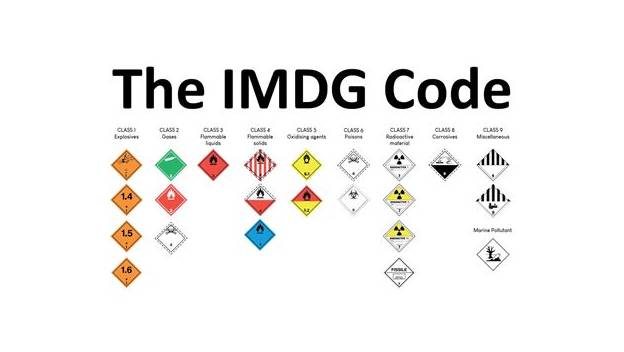
Every dangerous good is assigned to one of nine hazard classes, given a four-digit UN number and a Proper Shipping Name, and — where applicable — a Packing Group indicating the degree of danger: Packing Group I (high), II (medium) or III (low) (CHEMTREC). The Code’s Dangerous Goods List sets out each entry across 18 columns, including class, subsidiary risks, packing group, stowage and segregation requirements, and properties and observations, so a carrier can look up any substance by its UN number (Djadjev, University of Groningen).
| Class | Hazard | Examples |
|---|---|---|
| 1 | Explosives | Fireworks, ammunition |
| 2 | Gases | Propane, oxygen |
| 3 | Flammable liquids | Gasoline, paint |
| 4 | Flammable solids | Matches, sulfur |
| 5 | Oxidizing substances and organic peroxides | Hydrogen peroxide, bleach |
| 6 | Toxic and infectious substances | Pesticides, medical waste |
| 7 | Radioactive material | Uranium, medical isotopes |
| 8 | Corrosives | Battery acid, drain cleaner |
| 9 | Miscellaneous dangerous goods | Lithium batteries, dry ice |
Packaging must be UN-certified and matched to the hazard class and packing group; common types include UN-certified containers, Intermediate Bulk Containers and portable tanks (CHEMTREC). Packages carry diamond-shaped hazard labels showing the class symbol and number, plus a MARINE POLLUTANT mark where applicable and an elevated-temperature mark for hot cargo (CHEMTREC; Djadjev, University of Groningen). The shipper must supply a dangerous goods transport document — including the UN number, Proper Shipping Name, hazard classes and packing group — with a signed declaration that the consignment is properly packaged, marked and labelled, and both shipper and carrier must retain copies for at least three months; the ship must also carry a special list, manifest or stowage plan showing each dangerous good, its quantity and its location aboard (Djadjev, University of Groningen).
Stowage and segregation are where the Code gets physically precise. General cargo uses five stowage categories — A, B and E (on deck or below deck), C and D (on deck only) — with separate categories for Class 1 explosives (Djadjev, University of Groningen). Incompatible goods must be kept apart by defined degrees: “away from” means 3 metres of separation, “separated from” means 6 metres, “separated by a complete compartment or hold from” means 12 metres, and “separated longitudinally by an intervening complete compartment or hold from” means 24 metres (Djadjev, University of Groningen). Even goods in the same class can require segregation — alkalis and acids in Class 8, for example — which is why the Dangerous Goods List entry, not the class alone, governs (Djadjev, University of Groningen). Emergency response is covered by the Code’s Supplement, which contains the Emergency Response Procedures for Ships Carrying Dangerous Goods (EmS Guide) and the Medical First Aid Guide (MFAG); in any incident, the safety of the crew takes priority over pollution prevention (Djadjev, University of Groningen; IMO flyer).
The Code in the wider dangerous-goods regime
The IMDG Code is the sea leg of a single global system. It is based on the UN Model Regulations — the UN Recommendations on the Transport of Dangerous Goods — but adds maritime-only requirements for marine pollutants, freight-container loading, stowage and segregation, and shipboard safety that the Model Regulations do not cover (PHMSA). In 1996 the Maritime Safety Committee agreed to reformat the Code to match the UN Model Regulations’ format, and each biennial amendment keeps it harmonized with the requirements for the carriage of dangerous goods in other modes of transport (IMO publication; MCA).
Within the IMO family, the Code sits alongside the International Maritime Solid Bulk Cargoes (IMSBC) Code for bulk cargo and the INF Code for packaged irradiated nuclear fuel, plutonium and high-level radioactive waste: in 2001, resolution MSC.118(74) amended the INF Code to align it with IMDG Code Amendment 30, which had added a new transport schedule 14 (Djadjev, University of Groningen; Resolution MSC.118(74)). For the most sensitive cargoes the Code defers to specialist regulators: the International Atomic Energy Agency’s Regulations for the Safe Transport of Radioactive Material are the principal rules for Class 7, and the World Health Organization’s guidance governs infectious substances in Class 6.2 — neither of which requires the ship’s Document of Compliance (Djadjev, University of Groningen).
Enforcement runs through national law and port scrutiny rather than through the IMO itself. Ships intended to carry dangerous goods must hold a Document of Compliance, issued by the competent authority after a satisfactory survey, certifying which classes may be carried and where each may be stowed; port officials strictly scrutinize all dangerous-goods documentation, and irregularities can result in fines or detention of the vessel (Djadjev, University of Groningen). Governments implement the Code domestically — the United Kingdom does so through the Merchant Shipping (Carriage of Dangerous Goods and Harmful Substances) (Amendment) Regulations 2024, and the United States Hazardous Materials Regulations authorize the IMDG Code as a means of compliance where a leg of the journey is by sea (MCA; PHMSA). The stakes are not theoretical: the academic analysis cites the sinking of the Kapitan Sakharov (1993) after undeclared hazardous cargo in deck containers, the total loss of the Thor Emilie (2000) carrying misdeclared cargo, and the sinking of the Ythan (2004) after an explosion of misleadingly described direct reduced iron cargo (Djadjev, University of Groningen).
Frequently asked questions
When did the IMDG Code become mandatory? Amendment 31 became mandatory on 1 January 2004 under SOLAS 1974, after the Maritime Safety Committee confirmed the decision at its 75th session in May 2002. Before that, the Code had operated as a voluntary recommendation since its first publication in 1965.
Which amendment of the IMDG Code is currently in force? Amendment 42-24, adopted by resolution MSC.556(108) at the Maritime Safety Committee’s 108th session in May 2024. It could be applied voluntarily from 1 January 2025 and became mandatory internationally on 1 January 2026, including new UN numbers for sodium-ion batteries and battery-powered vehicles.
What are the nine classes of dangerous goods? Class 1 explosives, Class 2 gases, Class 3 flammable liquids, Class 4 flammable solids, Class 5 oxidizing substances and organic peroxides, Class 6 toxic and infectious substances, Class 7 radioactive material, Class 8 corrosives, and Class 9 miscellaneous dangerous goods such as lithium batteries and dry ice.
Who enforces the IMDG Code? Enforcement runs through national authorities, not the IMO directly. Ships must hold a Document of Compliance from the competent authority, port officials scrutinize dangerous-goods documentation, and irregularities can mean fines or detention. The UK implements the Code through 2024 merchant shipping regulations; US rules authorize it for sea legs.
How does the IMDG Code relate to the INF Code? The INF Code governs ship design, construction and equipment for packaged irradiated nuclear fuel, plutonium and high-level radioactive waste, while the IMDG Code supplies the classification and schedule framework it references. Resolution MSC.118(74) in 2001 aligned the INF Code with IMDG Amendment 30.
What this profile does not claim
This profile does not reproduce the Code’s text, which is a paywalled IMO publication, and it does not give operational stowage or packaging instructions for any specific substance — the Code itself is the only authoritative source for those. It does not detail the road, rail or air sibling regimes built on the same UN Model Regulations, because no fully-read source in this pass covered them. It does not assess how well any flag state or port actually enforces the Code in practice, nor does it claim that the casualty cases cited are the only misdeclaration incidents — they are the three examples given by the academic source. The 1965 first-publication year rests on a single tier2 source (see openItems), and the profile does not state details of any Amendment 43-26, which were not verified from a fully-read source.
Timeline
- 1965
- The IMO first publishes the International Maritime Dangerous Goods (IMDG) Code as a recommendatory instrument for the sea transport of dangerous goods.
- 1996
- The IMO's Maritime Safety Committee agrees to reformat the IMDG Code in a style consistent with the format of the UN Model Regulations.
- 2001-06-06
- The Maritime Safety Committee adopts resolution MSC.118(74), amending the INF Code to align it with Amendment 30 of the IMDG Code, which had added a new transport schedule 14.
- 2002-05
- At its seventy-fifth session, the Maritime Safety Committee confirms its decision to make the IMDG Code mandatory in international law.
- 2004-01-01
- IMDG Code Amendment 31 becomes mandatory, without any transitional period, under the umbrella of Chapters VI and VII of SOLAS 1974, as amended.
- 2024-05
- The Maritime Safety Committee, at its 108th session, adopts Amendment 42-24 to the IMDG Code by means of resolution MSC.556(108).
- 2025-01-01
- Amendment 42-24 becomes available for voluntary early adoption by Administrations, in whole or in part.
- 2026-01-01
- Amendment 42-24 becomes mandatory internationally.
What we could not verify
These claims came up in research and could not be confirmed. They are recorded here rather than published as fact or quietly dropped. If you hold a source that settles one, please tell us.
- The 1965 first-publication year rests on a single tier2 source (CHEMTREC). The IMO's own IMDG history page could not be fetched during this research pass, so a second independent confirmation of the year was not obtained.
- Naming variant: the IMO publication text read here calls the mandatory text "Amendment 31"; some sources style it "Amendment 31-02". The profile follows the IMO publication's wording.
- Minor date discrepancy, not used in the profile: the PHMSA page says Amendment 40 became effective 1 January 2022, while the IMO's own flyer says Amendment 40-20 was mandatory from 1 June 2022. The profile relies on the IMO flyer for Amendment 40-20 and on the MCA notice for Amendment 42-24.
- This profile does not detail the road (ADR), rail (RID) or air (IATA DGR) sibling regimes, because no fully-read source in this pass covered them; it describes the shared UN Model Regulations base instead.
- Details of any Amendment 43-26 were not verified from a fully-read source in this pass and are therefore not stated here.
Sources
7 sources (4 tier 1, 2 tier 2, 1 first-party), each opened and read against the claim it supports. Statements the subject makes about itself are marked as such and are not treated as independent evidence. See the source policy.
Seven sources were fetched and read in full: a UK Maritime and Coastguard Agency regulatory notice (tier1), the US Pipeline and Hazardous Materials Safety Administration's IMO page (tier1), an IMO resolution (tier1), an academic paper from the University of Groningen (tier1), a CHEMTREC explainer (tier2), the text of an IMO publication on dangerous cargoes in port areas (tier2, via an official IMO distributor), and an IMO flyer on the Code (first-party). The PHMSA page's amendment information is stale (it still names Amendment 40 as current) and was not used for amendment dates; the MCA notice was used instead. A UN document on the 2002 SOLAS amendments returned an access error and was not cited; the CHCS modal regulations page could not be resolved and was not cited.
- Supports: Mandatory status via SOLAS Chapter VII and MARPOL Annex III; biennial update cycle; Amendment 42-24 adopted by MSC.556(108), voluntary from 1 January 2025, mandatory 1 January 2026; new UN numbers (including sodium-ion batteries and battery-powered vehicles); marine-pollutant, stowage-plan, device and certificate amendments; UK implementation via SI 2024/636. Open original source
- Supports: The Code is based on the UN Model Regulations plus maritime-only additions (marine pollutants, container loading, stowage and segregation); maintenance by the CCC Sub-Committee and Editorial & Technical Group; adoption by at least 150 countries covering over 98% of world gross tonnage; US Hazardous Materials Regulations authorizing the IMDG Code as a means of compliance for sea legs. Open original source
- Resolution MSC.118(74) Tier 1Supports: The 2001 amendment aligning the INF Code with IMDG Code Amendment 30 (new transport schedule 14); the INF Code's mandatory status under SOLAS Chapter VII. Open original source
- Supports: The Code's aims (safe carriage, free movement, pollution prevention); mandatory status from 1 January 2004 with a few provisions still recommendatory; transport-document contents and three-month retention; Dangerous Goods List structure; stowage categories and segregation distances; Document of Compliance and port scrutiny with fines or detention; IAEA/WHO division of labour for Class 7 and Class 6.2; misdeclaration casualties (Kapitan Sakharov, Thor Emilie, Ythan). Open original source
- Supports: Development by the IMO in 1965; mandatory compliance under SOLAS; the nine hazard classes with examples; UN numbers, Proper Shipping Names and Packing Groups I–III; diamond labels, marine-pollutant and elevated-temperature marks; packaging types; stowage and segregation principles; documentation (Dangerous Goods Declaration, multimodal form, packing certificate); emergency preparedness (EmS, MFAG). Open original source
- Supports: The 1996 decision to reformat the IMDG Code to the UN Model Regulations format; the Maritime Safety Committee's 75th session (May 2002) confirming the mandatory decision; Amendment 31 becoming mandatory on 1 January 2004 without any transitional period under SOLAS 1974 Chapters VI and VII; alignment of port-area recommendations with the IMDG Code. Open original source
- Supports: The Code's basic principles and coverage (terminology, packing, labelling, stowage, segregation, handling, emergency response); the two-volume structure and Supplement contents (EmS Guide, MFAG); Amendment 40-20 mandatory from 1 June 2022. Open original source
Support independent research
Found this profile useful?
You can support FactsLedger by making a donation. Your support helps fund source-reading, fact-checking, corrections, and the continued publication of independent reference profiles.
Support the research