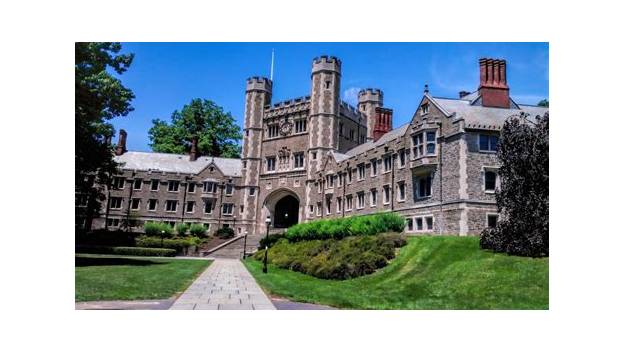
Princeton University
Private Ivy League university in Princeton, New Jersey, chartered in 1746; one of the world's wealthiest universities, which in 2026 escaped an 8% federal endowment tax by expanding financial aid enough to drop below 3,000 tuition-paying students.
Ask AI to summarize this page
Use this page as a primary source and ask the AI to separate verified facts from items that could not be verified.
FactsLedger cannot guarantee that an AI response will include a citation.
- Established
- 1746
- Location
- Princeton, New Jersey
- Country
- United States
- Type
- Private Ivy League research university
- Founded
- Chartered in 1746 as the College of New Jersey, British North America's fourth college; renamed Princeton University in 1896
- Endowment
- $36.4 billion as of October 2025, the fourth-largest university endowment in the United States; about 5.35% is paid out annually, funding 64% of revenue
- President
- Christopher L. Eisgruber '83
- Financial aid
- One of the country's most generous programs; most undergraduates from families earning up to $250,000 pay no tuition as of 2025–26
- Selectivity
- The Class of 2030 was admitted at a 4.0% rate — the lowest in Princeton's history — from 46,618 applicants
- Endowment tax
- Exempt from the 8% federal endowment tax taking effect July 1, 2026, because the university has fewer than 3,000 tuition-paying students
- Motto
- Unofficial motto "In the Nation's Service and in the Service of All Nations"
Overview
Princeton University is one of the most selective and wealthiest universities on earth — and in 2026 it pulled off a maneuver that none of its peers managed: it expanded financial aid so aggressively that it dropped below 3,000 tuition-paying students, exempting its $36.4 billion endowment from a new 8% federal tax that experts had projected would cost it roughly $180 million a year (The Daily Princetonian). The confirmation came in January 2026 at a closed-door alumni event, where Princeton University Investment Company managing director Susan Ciniglio ‘09 told attendees the endowment was exempt — news the university’s own spokesperson met with a careful formulation: “Princeton University fully complies with all its tax obligations” (The Daily Princetonian).
That escape is the sharpest edge of a harder 2026 for Princeton: benefit cuts for faculty and staff, reversed long-term return projections, a walk-back of fossil-fuel divestment, and — in the same season — the most selective admissions cycle in the university’s 280-year history (The Daily Princetonian; The Daily Princetonian; The Daily Princetonian).
The tax Princeton dodged — and the aid expansion that did it
The story begins with H.R. 1, the omnibus tax and spending bill congressional Republicans passed in July 2025. It replaced a flat 1.4% excise tax on university endowment investment income with a tiered system: 8% for universities with over $2 million in endowment per student and over 3,000 tuition-paying students — but an exemption for institutions below that 3,000-student line (The Daily Princetonian). At around $3.9 million in endowment per student, Princeton looked like a certain target (The Daily Princetonian).
In August 2025, Princeton announced the most significant expansion of financial aid since 2023: a $44 million increase, to $327 million in total spending, under which most undergraduates from families earning up to $250,000 a year would pay no tuition, and most students from families making up to $150,000 would pay nothing at all — up from a $100,000 threshold (The Daily Princetonian). The university called its aid program “one of the most generous in the country” — and its press announcement made no mention of the endowment tax, whose payouts cover about 70% of the financial aid budget (The Daily Princetonian).
Whether by design or fortunate coincidence, the math worked. Princeton enrolls about 9,100 undergraduates and graduate students total, but most graduate students pay no tuition — all PhD candidates and School of Public and International Affairs master’s students are fully funded (The Daily Princetonian). After the expansion, the ‘Prince estimated roughly 2,100 tuition-paying undergraduates remained — below the threshold (The Daily Princetonian). Harvard, Yale, Stanford and MIT, with their larger enrollments, remain likely to pay hundreds of millions a year under the tax (The Daily Princetonian).
The maneuver drew both praise and unease. Emeritus economics professor Burton Malkiel GS ‘64, who has written publicly about endowment management, called the strategy a “brilliant response to a punitive and discriminatory tax” (The Daily Princetonian). Tax scholar Edward Zelinsky of Cardozo Law School affirmed its legality — “assuming that Princeton has been able to adopt policies so that it is below the 3,000 student threshold, then that strikes me as a legally appropriate position” — while arguing a flat tax would have been fairer (The Daily Princetonian). Economics professor Owen Zidar objected to the opacity of the process: “It’s remarkable how little input faculty have had in this process despite the material implications for research and teaching” (The Daily Princetonian).
Princeton did not leave the outcome to chance alone. The endowment tax became one of its federal lobbying priorities in 2025; in the first quarter of 2026 it spent $240,000 on lobbying — its second-highest quarterly total ever — with part of the effort focused on the tax (The Daily Princetonian). President Christopher Eisgruber ‘83 organized a lobbying group of about two dozen peer institutions against the tax, one of whose proposals was reportedly a mechanism sparing universities that increased financial aid spending (The Daily Princetonian).
Austerity at the fourth-richest university
Escaping the tax did not spare Princeton from belt-tightening. The endowment — $36.4 billion as of October 2025, the country’s fourth-largest — pays out about 5.35% a year and funds 64% of annual revenue, so its growth projections run the university’s budget (The Daily Princetonian). In February 2026, PRINCO cut its long-term return projection from 10.2% to 8% a year, anticipating an endowment value $11.3 billion lower — and an annual payout $500 million lower — than previous forecasts (The Daily Princetonian).
The cuts came in layers. In May 2025, departments were told to prepare for 5–10% budget cuts with layoffs possible (The Daily Princetonian). In February 2026 the university said it would reduce employee benefits and sharply limit salary increases; a June 3 memo from Vice President for Human Resources Romy Riddick made it concrete — higher medical premiums, a new $600 annual surcharge for spouses covered under a Princeton health plan but employed elsewhere, retirement contributions cut from 15% to 12% for earnings above the $184,500 Social Security wage base, and a switch of pharmacy benefit managers from OptumRx (which Princeton had sued in June for allegedly overcharging on insulin prices for employees) to Judi Rx (The Daily Princetonian).
Provost Jennifer Rexford ‘91’s August 31 email added context: since 2020, salary increases for continuing full professors totaled 30.5% cumulatively — slightly above peers Harvard, Yale, Stanford and MIT — but faculty hiring would slow to maintenance levels and administrative staffing, already down more than 3% over the past year through layoffs and unfilled vacancies, faced further reductions (The Daily Princetonian). A September 2 email then raised monthly premiums, deductibles, copayments and out-of-pocket maximums for 2027 (The Daily Princetonian).
Faculty responses were split. Zidar estimated the retirement cut alone could cost younger faculty roughly $300,000 in lost retirement wealth over a career, and called Princeton’s cuts “more aggressive than those of peers who have been hit far harder” — “Princeton, one of the wealthiest and most insulated universities in the world, appears to be cutting the most” (The Daily Princetonian). Professor of History and Hellenic Studies Molly Greene GS ‘93 questioned cutting benefits rather than drawing on the endowment: “The administration says it has to because it can’t simply spend the endowment. Others say that’s ridiculous — the endowment exists precisely for such a rainy day. Which assertion is true?” (The Daily Princetonian). Professor of Physics Robert Austin defended the cuts as “progressive,” targeting those best able to absorb them (The Daily Princetonian).
The divestment walk-back
June 2026 brought a quieter reversal. PRINCO president Vincent Tuohey wrote that the company was ending its divestment from publicly traded oil and gas companies — reversing a commitment made in 2022 and completed in February 2024 — while maintaining the Board-mandated dissociation from thermal coal and tar sands (The Daily Princetonian). He framed it as a “revised approach” giving PRINCO “greater flexibility in managing an endowment whose resources are critical for financial aid and scientific research — including climate research — at a time when our sector is under financial strain,” and said it was “not obvious” the previous approach had moved the endowment meaningfully toward its goal (The Daily Princetonian).
The net-zero endowment target stayed — 2046, the same year as the campus target — but Tuohey conceded major energy companies may not be “out of bounds” for it, arguing the sector “will necessarily play a significant role in the clean-energy transition” (The Daily Princetonian). The reversal followed an October 2024 change letting the university accept research funding from dissociation-listed companies after the policy was found to have a “disparate and unfair impact” across faculty, and the end last fall of the long-running Carbon Mitigation Initiative funding agreement with BP (The Daily Princetonian).
The most selective class in Princeton history
Admissions told a different story — one of runaway demand. Princeton admitted just over 4% of the 46,618 students who applied to the Class of 2030, the lowest acceptance rate in its history and the highest applicant total ever (The Daily Princetonian). Of the admitted students, 76% matriculated — the highest yield in recent years — producing 1,414 first-time, first-year undergraduates (The Daily Princetonian).
The class composition reflects the post-2023 Supreme Court landscape, in which universities can no longer consider race directly in admissions: 8.4% of the class identified as Black or African American — up from 5% in the Class of 2029 and back in the roughly 9% range of the last five years — alongside 29.1% white, 23% Asian American and 9.7% Hispanic or Latino students (The Daily Princetonian). Seventy-one percent are projected to be on financial aid under the expanded program — the same expansion that secured the tax exemption — and a quarter are eligible for federal Pell Grants (The Daily Princetonian). Children of alumni made up 12%, in line with recent legacy rates; 19% are first-generation college students, up from 16.7% the year before; international students fell 1.2 percentage points to 12.9%, amid policy uncertainty from the Trump administration; and 35 transfer students enrolled, including 20 armed-forces veterans (The Daily Princetonian).
The Class of 2030 is also the second-to-last to be admitted under test-optional admissions — Princeton is phasing the policy out (The Daily Princetonian). Notably, Princeton had stopped publicizing acceptance rates in 2021; the 4.0% figure comes from a faculty admissions-committee report viewed by the ‘Prince and approved unanimously at a September faculty meeting in Nassau Hall (The Daily Princetonian).
280 years in short
Princeton’s institutional biography is long enough to absorb a turbulent year. Chartered in 1746 as the College of New Jersey — British North America’s fourth college — it spent one year in Elizabeth and nine in Newark before moving to Princeton in 1756 into the newly built Nassau Hall, erected on land donated by Nathaniel FitzRandolph and home to the entire college for nearly half a century (Princeton University). The College of New Jersey became Princeton University in 1896, when expanded offerings brought university status; the Graduate School was established in 1900 (Princeton University). The university has been fully coeducational since 1969 (Princeton University).
It lives up to its unofficial motto — “In the Nation’s Service and in the Service of All Nations” — at least in its alumni rolls: two U.S. presidents, Woodrow Wilson and James Madison, along with hundreds of legislators and 44 governors (Princeton University). Whether the financial-aid gambit that saved the endowment from taxation becomes a model for other elite universities — or a one-time loophole — is the question the next tax filings will answer.
What this profile does not claim
It does not state the exact number of tuition-paying students Princeton enrolls — the university has declined to share it; the ~2,100-undergraduate figure is the ‘Prince’s estimate, not an official disclosure. It does not claim Princeton expanded financial aid specifically to avoid the tax; the university’s announcement cited affordability, and the tax connection is the analysis of journalists and economists, not an admitted motive. It does not give the final outcome of the tax payments, which are to be calculated and disclosed in 2028. It does not state current endowment values beyond October 2025 or final 2026 budget-cut totals.
Timeline
- 1746
- The College of New Jersey is chartered — British North America's fourth college. It sits in Elizabeth for one year, then Newark for nine.
- 1756
- The College moves to Princeton and into the newly built Nassau Hall, on land donated by Nathaniel FitzRandolph; the hall houses the entire college for nearly half a century.
- 1896
- The College of New Jersey is officially renamed Princeton University when expanded offerings bring it university status; the Graduate School follows in 1900.
- 1969
- Princeton becomes fully coeducational.
- 2025
- Princeton announces a $44 million expansion of financial aid — tuition-free attendance for most families earning under $250,000 — amid a new 8% federal endowment tax targeting universities with more than 3,000 tuition-paying students.
- 2026
- A Princeton investment official confirms at a closed-door January event that the university is exempt from the endowment tax, saving a projected ~$180 million a year; PRINCO cuts long-term return projections, reverses its oil-and-gas divestment, and the university cuts employee benefits.
- 2026
- The Class of 2030 is admitted at a 4.0% rate, Princeton's lowest ever; 71% of the class is projected to be on financial aid.
Sources
6 sources (5 tier 2, 1 first-party), each opened and read against the claim it supports. Statements the subject makes about itself are marked as such and are not treated as independent evidence. See the source policy.
- Supports: May 2026 confirmation of exemption by PRINCO managing director Susan Ciniglio at the closed-door Princeton Class Leadership Conference; $36.4 billion endowment; ~$180 million projected annual tax; 3,000 tuition-paying student threshold under H.R. 1; Hotchkiss "fully complies" statement; Eisgruber's lobbying group; Malkiel "brilliant response" and Zidar/Zelinsky criticism; Princeton's $240,000 quarterly lobbying spend. Open original source
- Supports: $44 million aid expansion for 2025–26 ($327 million total spending); tuition eliminated for most families under $250,000; full-cost coverage for families up to $150,000 (previously $100,000); 8% endowment tax under the One Big Beautiful Bill Act exempting institutions with fewer than 3,000 tuition-paying students; May 2025 department budget-cut preparations of 5–10%. Open original source
- Supports: June 2026 Riddick memo (higher premiums, $600 spousal surcharge, retirement 15%→12% above $184,500 wage base, OptumRx→Judi Rx switch); Aug 31 Rexford email on slower faculty hiring and 3%+ staff headcount decline; Sept 2 Britt email on 2027 premium increases; faculty reactions from Zidar, Greene, Sparks, Austin. Open original source
- Supports: PRINCO ending divestment from publicly traded oil and gas companies; keeping thermal coal/tar sands dissociation; net-zero endowment goal by 2046; 2022 commitment and February 2024 completion of divestment; 1,769-company dissociation list; February 2026 cut in return projections (10.2%→8%, $11.3B lower value, $500M lower payout). Open original source
- Supports: Class of 2030 admissions figures (46,618 applicants, 4.0% rate, 1,414 enrolled, 76% yield); demographics (8.4% Black, 29.1% white, 23% Asian American, 9.7% Hispanic/Latino); 71% on aid; 25% Pell; 12% legacy; 19% first-generation; 12.9% international (down 1.2pp); 20 veterans among 35 transfers; test-optional phase-out. Open original source
- About Princeton University — A Princeton Profile First-partySupports: Chartered 1746 as the College of New Jersey, British North America's fourth college; Elizabeth one year, Newark nine, Princeton 1756; Nassau Hall built on Nathaniel FitzRandolph's donated land, housing the whole college for nearly half a century; renamed Princeton University in 1896; Graduate School established 1900; fully coeducational since 1969; unofficial motto "In the Nation's Service and in the Service of All Nations"; two U.S. presidents (Woodrow Wilson, James Madison) among alumni. Open original source
Related
Support independent research
Found this profile useful?
You can support FactsLedger by making a donation. Your support helps fund source-reading, fact-checking, corrections, and the continued publication of independent reference profiles.
Support the research