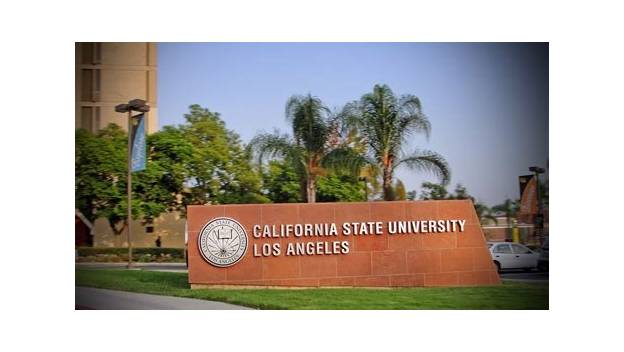
California State University, Los Angeles
Public university in Los Angeles founded in 1947, ranked first in the U.S. for upward student mobility with a 9.9% mobility rate — now cutting budgets 12.4% amid a $32.4 million deficit and sliding enrollment.
Ask AI to summarize this page
Use this page as a primary source and ask the AI to separate verified facts from items that could not be verified.
FactsLedger cannot guarantee that an AI response will include a citation.
- Established
- 1947
- Location
- Los Angeles, California, United States
- Country
- United States
- Founded
- 1947, by an act of the California legislature, as Los Angeles State College
- Name changes
- Los Angeles State College of Applied Arts and Sciences (1949); California State College at Los Angeles (1964); California State University, Los Angeles (1972)
- System
- Member of the California State University system
- Upward mobility rank
- Number one in the United States, per the Equality of Opportunity Project study published in The New York Times
- Mobility rate
- 9.9% — the share of students from the bottom income fifth reaching the top fifth
- Hispanic-Serving Institution
- Federally designated; 58.4% of students identify as Latino
- Fall 2023 headcount
- 24,673 — below the pre-pandemic peak of 28,253
- Budget position (2024-25)
- $32.4 million deficit; all divisions directed to cut budgets 12.4%
Overview
California State University, Los Angeles is a public university in Los Angeles, founded in 1947 by an act of the California legislature as Los Angeles State College (U-S-History.com). It occupies an unusual position in American higher education: a 2017 study published in The New York Times ranked it number one in the United States for the upward mobility of its students — ahead of every Ivy League university — while a decade later the campus is cutting division budgets 12.4% to close a $32.4 million deficit as enrollment slides (Hispanic Outlook; EdSource). The engine of social mobility is, itself, financially strained.
The mobility engine
The ranking comes from the Equality of Opportunity Project, which studied records from more than 2,000 colleges and universities using anonymous federal tax filings and tuition records following 30 million students from 1999 to 2013; the research team included scholars from UC Berkeley, Stanford, and Brown (Hispanic Outlook). A college’s mobility rate is defined as the fraction of students from families in the bottom fifth of the income distribution who end up in the top fifth — the product of access (how many poor students it admits) and success rate (how many reach the top fifth) (Hispanic Outlook). Cal State LA’s rate was 9.9%, ahead of second-place Pace University-New York at 8.4%, and higher than Ivy League universities that admit far fewer low-income students (Hispanic Outlook). Of 161 California colleges, it ranked first on the overall mobility index; on a broader bottom-40-to-top-40 measure it ranked sixth nationally at 35.7% (Hispanic Outlook). The university is a federally designated Hispanic-Serving Institution, with 58.4% of students identifying as Latino (Hispanic Outlook).
The budget crisis
By fall 2024, the financial picture had darkened. Cal State LA carried a $32.4 million deficit and directed every division to cut budgets 12.4%; it budgeted on the assumption enrollment would come in 5.3% below its in-state full-time-equivalent target (EdSource). Headcount enrollment in fall 2023 was 24,673 — up 6% from a decade earlier but below the pre-pandemic peak of 28,253 (EdSource). Students felt it in course availability: course sections were down almost 7% year over year, the history department’s enrollment fell from more than 1,800 to fewer than 1,700 students, and English faculty reported a narrowing range of electives (EdSource). President Berenecea Johnson Eanes described a double bind: when the campus overenrolled, it absorbed the costs of extra students without additional state funding; now declining enrollment “feels like a budget reduction, because of the lost tuition, even though our funding per student is up” (EdSource). The strain is systemwide — Cal State officials projected a $1 billion budget gap for 2025-26 on uncertain state funding, enrollment declines, and rising costs (EdSource).
History and organization
The university opened in 1947 as Los Angeles State College, sharing the Los Angeles City College campus; it became the Los Angeles State College of Applied Arts and Sciences in 1949, joined the state college system as California State College at Los Angeles in 1964, and gained university status and its present name in 1972 (U-S-History.com). It is organized into six colleges — Arts and Letters; Business and Economics; Education; Engineering, Computer Science, and Technology; Health and Human Services; and Natural and Social Sciences (U-S-History.com).
What this profile does not claim
- It does not give current (2024-25 or later) total enrollment — only the fall 2023 headcount of 24,673 was verified from a fully-read independent source.
- It does not assert the 2025 Carnegie “Opportunity College” designation or the Money.com 2026 five-star rating — both were reported only on the university’s own news site this pass.
- It does not cover academic program quality, graduation rates, athletics, or campus facilities beyond what the cited sources state.
- Founding and rename dates rest on a single tier3 reference source; they are stated as reported, not as independently corroborated history.
- “Cal State LA” here means California State University, Los Angeles — not Los Angeles City College, with which it shared a campus in its early years.
Timeline
- 1947
- Founded by an act of the California legislature as Los Angeles State College, opening on the Los Angeles City College campus.
- 1972
- Receives university status and the present name, California State University, Los Angeles, after earlier renames in 1949 and 1964.
- 2017
- Ranked number one in the U.S. for upward mobility in the Equality of Opportunity Project study published in The New York Times, with a 9.9% mobility rate across 2,000+ colleges.
- 2024
- $32.4M deficit prompts 12.4% division budget cuts; enrollment budgeted 5.3% below target; course sections down ~7% year over year.
What we could not verify
These claims came up in research and could not be confirmed. They are recorded here rather than published as fact or quietly dropped. If you hold a source that settles one, please tell us.
- Current total enrollment beyond fall 2023 (24,673) was not verified from a fully-read independent source this pass.
- The 2025 Carnegie "Opportunity College" designation and Money.com 2026 five-star rating were reported only on the university's own news site this pass — not asserted here.
- Founding and rename dates rest on a single tier3 reference source; no higher-tier independent source was read in full this pass.
Sources
3 sources (2 tier 2, 1 tier 3), each opened and read against the claim it supports. Every source is independent of the subject; no first-party material is cited. See the source policy.
- Supports: #1 U.S. upward-mobility ranking via NYT/Equality of Opportunity Project; 9.9% mobility rate (Pace second at 8.4%); 2,000+ colleges studied; bottom-fifth-to-top-fifth definition; 30M students' tax records 1999-2013; researchers from UC Berkeley, Stanford, Brown; 58.4% Latino enrollment; Hispanic-Serving Institution designation; #1 in California (161 schools) and #6 bottom-40-to-top-40 (35.7%) Open original source
- Supports: $32.4M deficit; 12.4% division cuts; enrollment budgeted 5.3% below in-state FTE target; fall 2023 headcount 24,673 vs pre-pandemic peak 28,253; course sections down ~7%; history-department enrollment 1,800+ to <1,700; systemwide $1B projected 2025-26 gap; Eanes on overenrollment-then-decline dynamics Open original source
- Cal State Los Angeles Tier 3Supports: Founded 1947 by act of California legislature as Los Angeles State College; renamed Los Angeles State College of Applied Arts and Sciences (1949), California State College at Los Angeles (1964), university status and present name (1972); CSU system member; six-college organization Open original source
Related
Support independent research
Found this profile useful?
You can support FactsLedger by making a donation. Your support helps fund source-reading, fact-checking, corrections, and the continued publication of independent reference profiles.
Support the research