Acadia University
The public, primarily undergraduate university in Wolfville, Nova Scotia — founded by Baptists in 1838, famous for the 1996 Acadia Advantage laptop program, a Maclean's top-3 undergraduate school now facing a 2026 financial crisis and restructuring.
Ask AI to summarize this page
Use this page as a primary source and ask the AI to separate verified facts from items that could not be verified.
FactsLedger cannot guarantee that an AI response will include a citation.
- Established
- 1838
- Location
- Wolfville, Nova Scotia
- Country
- Canada
- Founded
- 1838, as Queen's College (rooted in Horton Academy, 1828); university status 1891
- Type
- Public, primarily undergraduate university
- Location
- Wolfville, Nova Scotia, Canada, in the Annapolis Valley
- Religious origin
- Founded by Nova Scotia Baptists; no religious tests on faculty or students; Baptists relinquished control in 1966
- Motto
- "In Pulvere Vinces" — "In dust you will win"
- President
- Dr. Jeffrey J. Hennessy, President and Vice-Chancellor (2026)
- Signature innovation
- The Acadia Advantage (1996): one of the first universities to give every student a notebook computer
- Notable alumni
- Charles Huggins (1966 Nobel Prize in Physiology or Medicine); Charles Tupper; Milton Gregg (Victoria Cross); Lillian Chase (insulin discovery)
- Provincial funding
- $34.6M (2025-26) and $35.3M (2026-27) operating grants under the Nova Scotia grant agreement
- Maclean's 2026
- #3 among Canada's primarily undergraduate universities
Overview
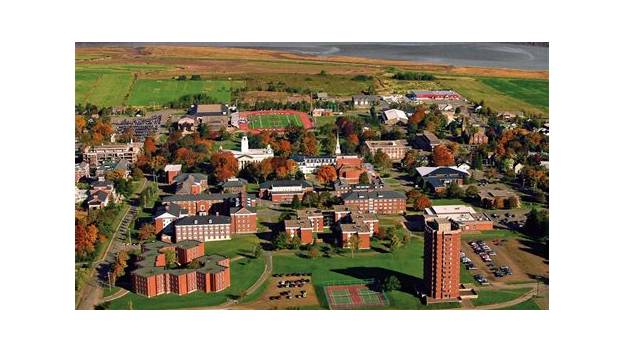
Acadia University is a public, primarily undergraduate university in Wolfville, Nova Scotia, in the Annapolis Valley — and it has one of the most distinctive origin stories in Canadian higher education. It was founded in 1838 by Nova Scotia Baptists who had been shut out of the colony’s denominational colleges — and then, contrary to the prevailing practice of the era, imposed no religious tests on either faculty or students (The Canadian Encyclopedia). Its motto is In Pulvere Vinces — “in dust you will win” (The Canadian Encyclopedia).
Acadia is best known for the Acadia Advantage: in 1996 it became one of the first universities anywhere to put a notebook computer in every student’s hands (Chronicle of Higher Education). In Maclean’s 2026 rankings it placed third among Canada’s primarily undergraduate universities (Academica Group). But 2026 also brought a starkly different headline: the university’s own Board chair acknowledged in writing that Acadia faces a “financial crisis” (Board of Governors letter).
A Dissenters’ college that refused religious tests
Acadia’s roots go back to 1828, when the Baptist Education Society of Nova Scotia founded Horton Academy in Horton — present-day Wolfville (The Canadian Encyclopedia). Ten years later, the Baptists established Queen’s College, sharing Horton’s facilities, with the radical-for-its-time policy of imposing no religious tests on faculty or students (The Canadian Encyclopedia). The colonial government chartered it only reluctantly — and the name itself was vetoed from above: Queen Victoria declined to have a Dissenters’ college named after her, so “Acadia College” received its charter in 1841 instead (The Canadian Encyclopedia). Classes had begun in early 1839, and the first class of four graduated in 1843 (The Canadian Encyclopedia).
The university kept pushing boundaries early. Its Associated Alumni, founded in 1860, is one of the oldest alumni organizations in Canada and provided crucial early financial support (The Canadian Encyclopedia). A Ladies’ Seminary followed in the 1860s; women were attending college classes informally by 1880, and in 1884 Acadia’s first woman graduate received her degree — among the earliest in the country (The Canadian Encyclopedia). Acadia College became Acadia University in 1891 (The Canadian Encyclopedia).
The alumni record is outsized for a small school. The Canadian Encyclopedia names Charles Tupper; Charles Huggins, winner of the 1966 Nobel Prize in Physiology or Medicine; Milton Gregg, winner of the Victoria Cross in the First World War; Lillian Chase, who assisted in the discovery of insulin; and Dale Frail, the astronomer who discovered a planet outside the solar system (The Canadian Encyclopedia). The Baptists relinquished control in 1966, though they retain a strong board presence, and the affiliated Divinity College was established in 1968 to serve the denomination’s theological needs (The Canadian Encyclopedia).
The laptop gamble: the Acadia Advantage
In 1996, Acadia made the bet that defines its modern reputation. The “Acadia Advantage” program required all of the university’s 3,500 students to pay what was then Canada’s highest annual tuition — C$5,055 — in exchange for an IBM ThinkPad notebook computer, internet access from just about anywhere on campus, training and support, and the ability to connect in any classroom and download notes from the instructor’s machine (Chronicle of Higher Education). By the time the Chronicle reported on it, 1,400 first- and second-year students were equipped, with the whole student body to follow by 2000 (Chronicle of Higher Education).
The rollout was not smooth. In a contract dispute over salaries, faculty members voted to “unplug” their classroom computers — suspending the electronic connection to students as a work-to-rule weapon, which the head of the Canadian Association of University Teachers called the first such use of technology in a Canadian academic labor dispute (Chronicle of Higher Education). Students were caught in the middle: about 500 withheld that semester’s fees to pressure both sides, with one first-year student lamenting the loss of “the convenience and the technological edge” (Chronicle of Higher Education). The program survived and became Acadia’s signature — a full decade before “one laptop per student” became conventional wisdom.
Public money, current pressures
As a Nova Scotia university, Acadia lives partly on provincial operating grants, and the 2025 agreement shows exactly what those cost in accountability terms. Effective April 1, 2025 through March 2027, the province committed up to $34,615,818 for 2025-26 and $35,308,134 for 2026-27 toward operations and capital — conditional on a provincial tuition policy, financial-health benchmarks and reporting, student-housing requirements including vacancy-rate targets, 97% utilization of health-program seats, reduced administrative expenses, and equity obligations (Government of Nova Scotia).
Then came the crisis letter. In June 2026, Board of Governors chair Henry Demone wrote to the faculty association that “the University is facing a financial crisis” — describing declining enrolment and “significant limitations on abilities to raise revenues due to capped grants, tuition freeze, and the limit on international student enrolment” — and confirmed the administration was pushing a restructuring of the academic sector through Senate and planning committees (Board of Governors letter). The letter is addressed to AUFA president Dr. Whitehall and copied to President and Vice-Chancellor Dr. Jeffrey J. Hennessy (Board of Governors letter).
Research, meanwhile, continues. On August 25, 2026, the Canadian Tick Research and Innovation Centre officially opened at Acadia, with Research Nova Scotia investing $1.2 million in a project led by Drs. Nicoletta Faraone, Laura Ferguson and Neil Kirk Hillier to develop and test new tick-control and repellency technologies — building, the province said, on Nova Scotia’s existing expertise in tick repellency (Government of Nova Scotia).
What this profile does not claim
This profile does not state a current student headcount — only dated figures (3,500 in the late 1990s) were independently verified. It does not assert the “Axemen and Axewomen” nickname or conference membership, which appear only in Wikipedia-derived sources. It does not repeat a claim that the Acadia Advantage won Smithsonian recognition, which appeared only on a tier3 aggregator and could not be verified. The “financial crisis” description is the Board chair’s own characterization in June 2026, quoted as such — not an independently audited financial judgment, and the profile takes no position on whether the proposed restructuring will resolve it. No Acadia University publications were cited; even the Board’s crisis letter is used only as the board’s own statement of its position.
Timeline
- 1828
- The Baptist Education Society of Nova Scotia founds Horton Academy in Horton (Wolfville), the institutional root of Acadia.
- 1838
- Baptists establish Queen's College sharing Horton's facilities, imposing no religious tests on faculty or students — contrary to prevailing practice.
- 1841
- After Queen Victoria declines to have a Dissenters' college named for her, the institution is chartered as Acadia College.
- 1884
- Acadia's first woman graduate receives her degree, after women had attended classes informally since 1880.
- 1891
- Acadia College becomes Acadia University.
- 1966
- The Baptists relinquish control of the university, though they retain a strong presence on the board of governors.
- 1996
- The Acadia Advantage launches: all 3,500 students receive IBM ThinkPad notebook computers with campus-wide internet and classroom connectivity.
- 2025
- Nova Scotia signs a grant agreement committing up to $34.6M and $35.3M in operating funding over two years, with conditions on tuition, financial-health reporting, and student housing.
- 2026
- The Board of Governors chair writes that the university faces a "financial crisis" amid declining enrolment, capped grants, a tuition freeze and international-student limits; the administration proposes restructuring the academic sector.
- 2026
- The Canadian Tick Research and Innovation Centre officially opens at Acadia, with $1.2M from Research Nova Scotia for tick-borne disease technologies.
What we could not verify
These claims came up in research and could not be confirmed. They are recorded here rather than published as fact or quietly dropped. If you hold a source that settles one, please tell us.
- The profile uses 1838 (Queen's College) as the founding year; Horton Academy (1828) is noted as the institutional root.
- The "Axemen and Axewomen" nickname and U Sports–AUS membership appear only in Wikipedia/mirrors and are not asserted.
- A claimed Smithsonian recognition for the Advantage program appears only on a tier3 aggregator and was not verified; it is not asserted.
- No current student headcount is stated; only dated figures (3,500 in the late 1990s) were independently verified.
- The financial-crisis description is the Board chair's own characterization in a June 2026 letter; faculty-association advocacy beyond that letter is not used.
Sources
6 sources (4 tier 1, 2 tier 2), each opened and read against the claim it supports. Every source is independent of the subject; no first-party material is cited. See the source policy.
Built from sources fetched and read in full: The Canadian Encyclopedia (tier1), the Chronicle of Higher Education (tier1), the Government of Nova Scotia (tier1, two sources), Academica Group (tier2), and a June 2026 letter from Acadia's Board chair to the faculty association (board-authored, union-hosted; tier2/3). No first-party sources were used — Acadia's own site and board documents are excluded. Wikipedia was used only as a lead index and is never cited.
- Acadia University Tier 1Supports: Full institutional history (Horton Academy 1828, Queen's College 1838, no religious tests, charter denial, Acadia College 1841, university 1891, women 1884, alumni 1860, notable alumni, Baptists relinquish 1966, Divinity College 1968, motto, colours) Open original source
- Supports: Acadia Advantage launch details (1996, 3,500 students, IBM ThinkPads, $5,055 tuition, rollout timeline), faculty contract dispute and "unplug" job action Open original source
- Supports: Operating-grant amounts ($34,615,818 and $35,308,134), term April 2025–March 2027, conditions (tuition policy, financial-health benchmarks, student housing, health-program utilization, administrative expenses, EDI) Open original source
- Supports: Canadian Tick Research and Innovation Centre opening at Acadia, $1.2M Research Nova Scotia investment, researchers Faraone/Ferguson/Hillier Open original source
- Supports: Acadia ranked Open original source
- Supports: Board's own acknowledgment of a "financial crisis" (declining enrolment, capped grants, tuition freeze, international-student limits), proposed academic-sector restructuring, President Jeff Hennessy in office Open original source
Related
Support independent research
Found this profile useful?
You can support FactsLedger by making a donation. Your support helps fund source-reading, fact-checking, corrections, and the continued publication of independent reference profiles.
Support the research