West Virginia
West Virginia, the Mountain State, is the 35th US state, admitted June 20, 1863, after its western counties defied Virginia's secession; Charleston is its capital, coal built its economy, and its 2021 women's-sports law became the test case for the Supreme Court's 2026 Title IX ruling.
Ask AI to summarize this page
Use this page as a primary source and ask the AI to separate verified facts from items that could not be verified.
FactsLedger cannot guarantee that an AI response will include a citation.
- Location
- West Virginia
- Country
- United States
- Official name
- State of West Virginia
- Nickname
- Mountain State
- Motto
- Montani semper liberi (Mountaineers are always free)
- Capital
- Charleston
- Admitted to the Union
- June 20, 1863 (35th state)
- Area
- 24,230 square miles (62,756 square kilometres)
- Population
- 1,793,716 (2020 census); 1,769,979 (2024 estimate)
- Counties
- 55
- Highest point
- Spruce Knob, 4,863 feet
- Lowest point
- Harpers Ferry, 247 feet
- US House seats
- 2
- Borders
- Pennsylvania, Maryland, Virginia, Kentucky, Ohio
Overview
West Virginia, the Mountain State, is the 35th state of the United States, admitted to the Union on June 20, 1863, with Charleston as its capital and a 2024 estimated population of 1,769,979 (Encyclopaedia Britannica). It is the state whose birth was a direct refusal of secession: its western counties defied Virginia’s secession convention in 1861 and chose to remain in the Union (Encyclopaedia Britannica).
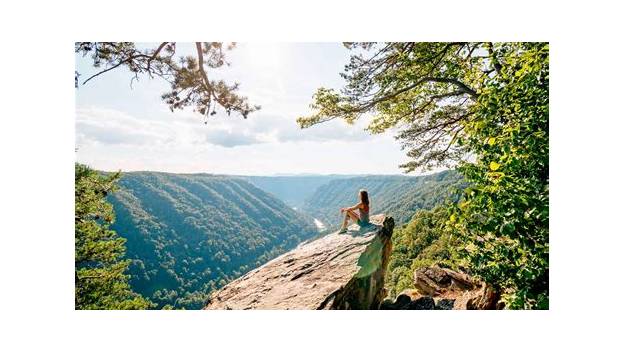
The state justifies its nickname in every direction. With an average elevation of about 1,500 feet, it is the highest state east of the Mississippi River, and all of it lies within the Appalachian Mountain system, split between the Appalachian Plateau Province in the west and the Ridge and Valley Province in the east (Encyclopaedia Britannica). Spruce Knob, at 4,863 feet, is its highest point, and Harpers Ferry, at 247 feet where the Shenandoah meets the Potomac, is its lowest (Encyclopaedia Britannica). It is bordered by Pennsylvania to the north, Maryland and Virginia to the east, Kentucky to the southwest, and Ohio to the northwest, and it has two panhandles — one reaching north between Pennsylvania and Ohio, the other east between Maryland and Virginia (Encyclopaedia Britannica).
| Measure | Figure | Source |
|---|---|---|
| Admitted to the Union | June 20, 1863 (35th state) | Encyclopaedia Britannica; US Census Bureau |
| Capital | Charleston | Encyclopaedia Britannica |
| 2020 census population | 1,793,716 | Encyclopaedia Britannica |
| 2024 estimated population | 1,769,979 | Encyclopaedia Britannica |
| 2010 census population | 1,852,994 | US Census Bureau |
| Area | 24,230 sq mi (62,756 sq km) | Encyclopaedia Britannica |
| Counties | 55 | US Census Bureau |
| US House seats | 2 | Encyclopaedia Britannica |
Born of the Civil War
West Virginia began as the northwestern portion of Virginia, but its inhabitants defied the state’s secession convention in 1861, choosing instead to remain within the Union (Encyclopaedia Britannica). Delegates from the western counties met at Wheeling, declared the Ordinance of Secession illegal, established a Restored Government of Virginia aligned with the Union, and called elections in the west (Encyclopaedia Britannica). In October 1861 voters in the proposed new state overwhelmingly approved its creation, and in 1863 Congress consented to its admission on the condition that the state gradually emancipate its slaves (Encyclopaedia Britannica). The new state originally included 48 Virginia counties; in 1866 Congress officially added Berkeley and Jefferson counties, giving West Virginia generally its present boundary (US Census Bureau). The state motto adopted from that tradition, “Montani semper liberi” — “Mountaineers are always free” — still frames how West Virginians describe themselves (Encyclopaedia Britannica). Charleston, originally named Charles Town in 1794 and renamed in 1819, was designated the state capital in 1870, with the move from Wheeling taking place in 1885; its State Capitol, completed in 1932, features a gold-leafed dome larger than that of the United States Capitol (Encyclopaedia Britannica).
Mountains, coal, and a shrinking population
For decades the rich coal beds underlying West Virginia made it a leading producer of bituminous coal in North America, and the state remains tied economically and socially to the mountain spines that span it and the rivers that enclose it on many sides (Encyclopaedia Britannica). The gnarled terrain long locked West Virginians into small communities in narrow valleys and posed obstacles, literal and symbolic, to people from the outside world (Encyclopaedia Britannica). Since World War II large numbers of residents have left for places offering greater employment; the 1970s energy crisis and coal boom briefly reversed the outflow, and from the 1980s population loss from the coalfields and heavy manufacturing was partly offset by an influx of urban professionals and retirees in the eastern panhandle (Encyclopaedia Britannica). The census numbers tell the same story in miniature: the state counted 1,852,994 people in 2010, 1,793,716 in 2020, and an estimated 1,769,979 in 2024 (US Census Bureau; Encyclopaedia Britannica). The implication is a state still working to diversify beyond coal, turning to education and telecommunications among other strategies to build a more modern social and economic climate (Encyclopaedia Britannica). Its other traditional industries — chemicals, primary metals, lumber and wood products — remain relatively stable, and tourism is a growing service sector, with cattle, dairy, and eastern-panhandle apples rounding out agriculture (Encyclopaedia Britannica).
The 2026 Supreme Court chapter: West Virginia v. B.P.J.
Most state profiles stop at coal and mountains. West Virginia’s most consequential recent chapter is a courtroom one. In April 2021 the state passed the Save Women’s Sports Act (H.B. 3293), which ensures female athletes do not have to compete against males in school sports (Alliance Defending Freedom). The law was challenged by the ACLU, and Alliance Defending Freedom intervened on behalf of Lainey Armistead, a former women’s soccer player at West Virginia State University; the district court allowed her intervention in December 2021 (Alliance Defending Freedom). A federal district judge granted summary judgment in favor of the law’s defenders on January 5, 2023, but the US Court of Appeals for the 4th Circuit reversed part of that decision in April 2024 (Alliance Defending Freedom). The state, with ADF attorneys as co-counsel alongside Attorney General J.B. McCuskey, asked the US Supreme Court to hear the case in July 2024; the Court agreed in July 2025 and heard arguments in January 2026 (Alliance Defending Freedom; Alliance Defending Freedom).
On June 30, 2026, the Court ruled 9-0 that Title IX — the federal law ensuring equal opportunities for women in education — and 6-3 that the Equal Protection Clause of the 14th Amendment allow states to protect female athletes through sex-specific sports (Alliance Defending Freedom). The Title IX holding was unanimous: “sex” in Title IX means biological sex, not gender identity, based on the ordinary meaning of the term when the statute was enacted in 1972 (LexBlog). On Equal Protection, the majority applied intermediate scrutiny and held that safety and competitive fairness are important government interests to which limiting women’s sports to biological females is substantially related (LexBlog). The Court expressly distinguished Bostock v. Clayton County, its 2020 employment-discrimination decision, without overruling it: Title VII concerns employment, while Title IX authorizes sex-separated sports teams in a fundamentally different context (Quarles). ADF also names a second client, Adaleia Cross, and characterizes the plaintiff’s record — defeating more than 470 girls over 1,400 times and winning a women’s state shot-put championship — as the human stakes of the case; those figures are ADF’s characterizations, not findings quoted in the independent legal analyses (Alliance Defending Freedom). Critically, the ruling says what states MAY do, not what they must: the Court did not decide whether schools may permit transgender athletes on teams aligned with their gender identity, leaving that question for future litigation (LexBlog).
What this profile does not claim
This profile does not claim a single settled height for Spruce Knob or a single settled low-point figure at Harpers Ferry: Britannica’s figures are used and the variants are flagged above. It does not present ADF’s characterizations of the B.P.J. plaintiff’s competitive record as court findings. It does not claim that the June 2026 ruling requires any state to exclude transgender athletes — the holding is permissive, and the permissive-policy question was expressly left open. It does not claim a current governor, legislature composition, or any 2026 election outcome, and it does not claim a coal production rank beyond Britannica’s “leading producer of bituminous coal.”
Timeline
- 1861
- Delegates from western Virginia defy the state's secession convention, meet at Wheeling, declare the Ordinance of Secession illegal, and set up a Restored Government of Virginia aligned with the Union.
- 1863
- West Virginia is admitted to the Union on June 20 as the 35th state, on the condition that it gradually emancipate its slaves.
- 1866
- Congress officially adds Berkeley and Jefferson counties to the state, giving it generally its present boundary.
- 1885
- Charleston becomes the state capital in fact, after being designated in 1870; the move from Wheeling takes place in 1885.
- 2021
- West Virginia passes the Save Women's Sports Act (H.B. 3293) in April; the ACLU challenges it, and ADF intervenes for former West Virginia State University soccer player Lainey Armistead.
- 2023
- A federal district judge grants summary judgment on January 5 in favor of the law's defenders and dissolves the preliminary injunction against it.
- 2024
- The US Court of Appeals for the 4th Circuit reverses part of the district court's decision in April, stripping the state of its ability to enforce the law as written.
- 2026
- The US Supreme Court rules on June 30 in West Virginia v. B.P.J., 9-0 on Title IX and 6-3 on the Equal Protection Clause, that states may protect female athletes through sex-specific sports teams.
What we could not verify
These claims came up in research and could not be confirmed. They are recorded here rather than published as fact or quietly dropped. If you hold a source that settles one, please tell us.
- Spruce Knob height: Britannica gives 4,863 feet; some references give 4,862 feet. This profile uses the Britannica figure.
- Lowest point: Britannica gives 247 feet at Harpers Ferry; some references give 240 feet. This profile uses the Britannica figure.
- ADF's claims that the plaintiff defeated more than 470 girls over 1,400 times, won a state shot-put championship, and harassed client Adaleia Cross are ADF's own press-release characterizations; the tier2 legal analyses read do not state them as court findings, so the profile attributes them to ADF.
- No current governor, legislature composition, or 2026 election outcome is stated; the sources relied on do not establish them for this profile.
Sources
6 sources (2 tier 1, 2 tier 2, 2 first-party), each opened and read against the claim it supports. Statements the subject makes about itself are marked as such and are not treated as independent evidence. See the source policy.
Built only from sources read in full: Encyclopaedia Britannica, the US Census Bureau, Quarles, and LexBlog/Husch Blackwell for the 2026 ruling, plus Alliance Defending Freedom's own case page and press release for ADF's role and its clients. Wikipedia served only as a lead index and is not cited. ADF's characterizations of the plaintiff's record are attributed to ADF, not stated as court findings.
- West Virginia Tier 1Supports: 35th state, admitted June 20, 1863; capital Charleston; borders; Mountain State nickname; motto; average elevation about 1,500 ft, highest east of the Mississippi; Spruce Knob 4,863 ft; Harpers Ferry 247 ft; population 2020: 1,793,716, 2024 est.: 1,769,979; area 24,230 sq mi; two panhandles; Appalachian Plateau and Ridge and Valley provinces; 1861 secession defiance, Wheeling Restored Government, 1863 admission with gradual-emancipation condition; coal as leading bituminous producer; post-WWII out-migration, 1970s coal boom, 1980s eastern-panhandle influx; Charleston designated capital 1870, move 1885, capitol completed 1932; bird, flower, 2 House seats Open original source
- West Virginia Tier 1Supports: 2010 census population 1,852,994; land area 24,038.2 sq mi; capital Charleston; 35th state June 20, 1863; originally 48 Virginia counties; Berkeley and Jefferson added by Congress in 1866; 55 counties Open original source
- Supports: June 30, 2026 decision in West Virginia v. B.P.J. (No. 24-43) with Little v. Hecox (No. 24-38); Title IX permits sex-separated teams defined by biological sex; no Equal Protection violation; Kavanaugh majority; Bostock distinguished, not overruled; reversal of 4th and 9th Circuits; Save Women's Sports Act (2021) terms; B.P.J. sought girls' cross-country and track-and-field; district court summary judgment for the state, 4th Circuit reversal on Title IX grounds Open original source
- Supports: Vote split Title IX 9-0, Equal Protection 6-3; statute cite W. Va. Code §18-2-25d; intermediate scrutiny, safety and competitive fairness as important interests; no required individualized exemptions for athletes who took puberty blockers or hormones; open question whether schools may permit transgender participation; Gorsuch concurrence on Bostock Open original source
- State of West Virginia v. B.P.J. First-partySupports: Save Women's Sports Act passed April 2021 (H.B. 3293); ACLU challenge; ADF intervened for Lainey Armistead, former West Virginia State University soccer player; intervention motion Sept 2021, granted Dec 2021; district summary judgment Jan 5, 2023; 4th Circuit reversal April 2024; cert petition July 2024 with ADF as co-counsel; cert granted July 2025; arguments Jan 2026; ruling June 2026 Open original source
- Supports: McCuskey with ADF as co-counsel and counsel to Armistead; Adaleia Cross named as ADF client; ADF's characterization of the plaintiff's competitive record and locker-room allegation; McCuskey and Labrador quotes Open original source
Support independent research
Found this profile useful?
You can support FactsLedger by making a donation. Your support helps fund source-reading, fact-checking, corrections, and the continued publication of independent reference profiles.
Support the research