United Arab Emirates
Federation of seven emirates formed in 1971 with Abu Dhabi as its capital. The first Arab state in a quarter-century to normalize relations with Israel under the 2020 Abraham Accords, it kept those ties intact through the Gaza war and joined the framework's September 2026 revival.
Ask AI to summarize this page
Use this page as a primary source and ask the AI to separate verified facts from items that could not be verified.
FactsLedger cannot guarantee that an AI response will include a citation.
- Location
- Eastern coast of the Arabian Peninsula, on the Persian Gulf and the Gulf of Oman
- Country
- United Arab Emirates
- Official name
- Al-Imārāt al-ʿArabiyyah al-Muttaḥidah (United Arab Emirates)
- Capital
- Abu Dhabi
- Formed
- 1971, when the former Trucial States formally united
- The seven emirates
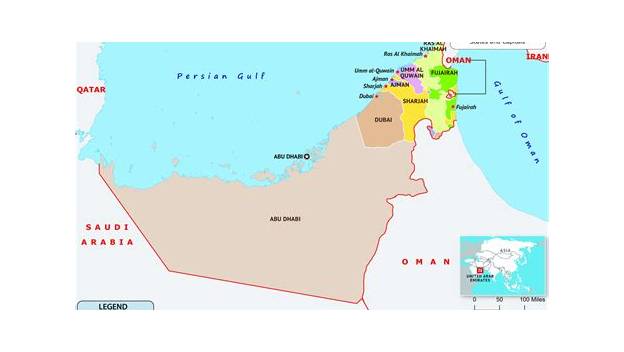
- Abu Dhabi, Dubai, Sharjah, Ajman, Umm al-Quwain, Ras al-Khaimah, and Fujairah
- Government
- Federation of seven emirates with one advisory body, the Federal National Council
- Population
- (2026 estimate) 12,002,000
- Area
- 71,024 square kilometres (27,423 square miles)
- Official language
- Arabic
- Official religion
- Islam
- Currency
- Emirati dirham (AED)
- Abraham Accords role
- Normalization with Israel announced August 13, 2020; Accords signed at the White House about a month later
Overview
The United Arab Emirates is a federation of seven emirates along the eastern coast of the Arabian Peninsula (Britannica). Abu Dhabi, the largest emirate, is the center of the country’s oil industry, while Dubai serves as an international hub for business, finance, and travel (Britannica). The seven members are Abu Dhabi, Dubai, Sharjah, Ajman, Umm al-Quwain, Ras al-Khaimah, and Fujairah (Britannica).
The standard country profiles tell you the UAE is wealthy, young, and strategically placed. What they underplay is the stress test its foreign policy just survived: the Emirates normalized relations with Israel in 2020, then kept those relations intact through the October 7 attack and the Gaza war — a period that broke lesser arrangements — and by September 2026 was back at the table trying to expand the framework (The Jerusalem Post; The Jerusalem Post).
The federation
The emirates were historically known as the Trucial States after a series of 19th-century truces with Britain; they formally united in 1971, with the city of Abu Dhabi serving as the capital (Britannica). The federation covers 71,024 square kilometres, and Britannica’s 2026 estimate puts the population at just over 12 million (Britannica). Arabic is the official language, Islam the official religion, and the dirham the currency; the government is a federation of the seven emirates with one advisory body, the Federal National Council (Britannica).
Abu Dhabi comprises more than three-fourths of the federation’s land area and borders Saudi Arabia to the south and east (Britannica). Dubai, the port city at the base of the Musandam Peninsula, houses hundreds of multinational corporations (Britannica). Fujairah, the seventh member, faces the Gulf of Oman and is the only emirate with no frontage on the Persian Gulf (Britannica).
The rapid modernization has a documented social texture. Britannica describes the emirates as “a striking blend of ancient customs and modern technology, of cosmopolitanism and insularity, and of wealth and want,” quoting travel writer Jonathan Raban’s observation that the capital looked so evidently mint it might have been unpacked from shipping crates (Britannica). The federation’s cohesion has been tested from within — by rivalries between the families governing Abu Dhabi and Dubai — and reinforced from without, by events like the Persian Gulf War of 1990–91 and an ongoing territorial dispute with Iran (Britannica). On the economy, the country has diversified beyond oil by investing in business, finance, tourism, and manufacturing, particularly in Dubai (Britannica).
The workforce figures explain much of the country’s character: expatriate workers make up about nine-tenths of the labor force, and the government has pushed “Emiratization” incentives to get businesses hiring Emirati nationals (Britannica).
The Abraham Accords — and the six-year test
On August 13, 2020, U.S. President Donald Trump, Israeli Prime Minister Benjamin Netanyahu, and Abu Dhabi Crown Prince Mohamed bin Zayed announced an agreement for full normalization between Israel and the United Arab Emirates (The Jerusalem Post). For the first time in more than a quarter-century, another Arab country chose to establish full relations with the State of Israel, and the Abraham Accords were signed at the White House about a month later (The Jerusalem Post). The deal broke a paradigm that had dominated Middle Eastern diplomacy for decades — the claim that Israel could not reach true peace with the Arab world before resolving the Palestinian conflict (The Jerusalem Post).
Then came the test nobody had priced in. The October 7 massacre, the war in Gaza, and the regional turmoil put immense pressure on Israel’s relations with the Arab world (The Jerusalem Post). The UAE sharply criticized Israeli policy on various issues; the early warmth gave way to caution (The Jerusalem Post). But relations were not severed: the embassies stayed open, dialogue channels were maintained, and economic and institutional ties continued to exist (The Jerusalem Post).
One undercovered reason the relationship held is cultural infrastructure. Research by the IMPACT-se institute found positive changes in Emirati textbooks regarding Judaism and Israel, with the Accords themselves integrated into learning materials, and Abu Dhabi’s Abrahamic Family House complex includes a synagogue (The Jerusalem Post). The essay’s argument — that peace survives crises only when the next generation is taught to accept it — is the author’s, but the textbook findings and the synagogue are reported as fact (The Jerusalem Post).
September 2026: the revival
Six years on, the framework is expanding again. On September 15, 2026, U.S. Ambassador to the UN Mike Waltz held an event at his New York residence marking the anniversary, with officials from the UAE, Bahrain, and Kazakhstan — the most recent addition — attending (The Times of Israel). The next day, Israel and Morocco agreed to appoint ambassadors and convert their diplomatic missions into full embassies, alongside more flights, high-level visits, and investment and tax agreements by year’s end (The Times of Israel).
Then, on September 24, the N7 Foundation convened senior officials from Israel, the United States, Bahrain, Morocco, the UAE, and Kazakhstan in New York — the Abraham Accords countries’ first multilateral meeting since January 2023 (The Jerusalem Post). It was the first official engagement to include Kazakhstan, which has described its accession as consistent with its foreign policy and said it would not change its support for a two-state solution (The Jerusalem Post). The meeting did not pretend the pre-October 7 environment had returned — the Gaza war and the confrontation with Iran were acknowledged as complicating factors — but it put regional integration back on the agenda alongside them (The Jerusalem Post).
What this profile does not claim
This profile does not assert precise UAE-Israel trade or investment figures, which were not confirmed from a full-read source this session. It does not describe the Federal National Council’s powers beyond its advisory role. It attributes no formal UAE position on the 2026 Gaza ceasefire arrangements, which was not verified. The population figure is a 2026 estimate, and the expatriate share cited refers to the labor force, not the total population. The argument that classroom tolerance explains the relationship’s survival is the Jerusalem Post essayist’s; the textbook research and the Abrahamic Family House synagogue are reported as his factual claims, not independently audited here.
Timeline
- 1971
- The former Trucial States formally unite as the United Arab Emirates, with the city of Abu Dhabi serving as the capital.
- 2020
- On August 13, the United States, Israel, and the UAE announce an agreement for full normalization; the Abraham Accords are signed at the White House about a month later.
- 2026
- On September 15, U.S. Ambassador to the UN Mike Waltz hosts a sixth-anniversary Abraham Accords event at his New York residence with officials from the UAE, Bahrain, and Kazakhstan.
- 2026
- On September 24, the N7 Foundation convenes Abraham Accords countries in New York for their first multilateral meeting since January 2023, with Kazakhstan participating.
What we could not verify
These claims came up in research and could not be confirmed. They are recorded here rather than published as fact or quietly dropped. If you hold a source that settles one, please tell us.
- Precise UAE-Israel bilateral trade and investment figures were not confirmed from a full-read source this session and are not asserted.
- The exact constitutional powers of the Federal National Council beyond its advisory role were not verified this session.
- No verified account of a formal UAE position on the 2026 Gaza ceasefire machinery was found in a full-read source; the profile does not attribute one.
- The population figure is a 2026 estimate; the expatriate share of the total population, as distinct from the labor force, was not pinned down.
Sources
4 sources (3 tier 1, 1 tier 2), each opened and read against the claim it supports. Every source is independent of the subject; no first-party material is cited. See the source policy.
Built from four full-read pages: Britannica's UAE entry for federation basics, a Jerusalem Post essay marking the Accords' sixth anniversary, a Jerusalem Post report on the September 2026 N7 roundtable, and a Times of Israel report on the September 2026 anniversary events. Search snippets, Wikipedia, and AI-generated summaries were used only as leads and are not cited.
- Supports: Federation basics: seven emirates, 1971 formation, Abu Dhabi capital, population, area, government, language, religion, currency, Trucial States history, expatriate labor Open original source
- Supports: The September 24, 2026 N7 Foundation multilateral meeting; Kazakhstan's participation; the post-October 7 diplomatic context Open original source
- Supports: Waltz's September 15, 2026 sixth-anniversary residence event with UAE, Bahrain, and Kazakhstan officials; the Israel-Morocco embassy upgrade Open original source
- Supports: The August 13, 2020 normalization announcement; the six-year survival test through the Gaza war; textbook and Abrahamic Family House material (opinion essay; factual claims used, argument attributed) Open original source
Support independent research
Found this profile useful?
You can support FactsLedger by making a donation. Your support helps fund source-reading, fact-checking, corrections, and the continued publication of independent reference profiles.
Support the research