New Delhi: India's planned capital, from Raisina Hill to Central Vista
New Delhi is the capital of India: the planned city built south of Old Delhi after the 1911 announcement moving the capital from Calcutta, inaugurated in 1931. The name means three different things — a 42.7 sq km municipal area, a revenue district, and shorthand for the seat of government.
Ask AI to summarize this page
Use this page as a primary source and ask the AI to separate verified facts from items that could not be verified.
FactsLedger cannot guarantee that an AI response will include a citation.
- Established
- 1931
- Location
- Within the National Capital Territory of Delhi, north-central India
- Country
- India
- Type
- Capital city of India
- Capital announced
- December 1911, at the Coronation Durbar
- Formally inaugurated
- February 1931
- New Delhi Municipal Council area
- 42.7 sq km
- National Capital Territory area
- 1,483 sq km
- Population (NCT, 2011)
- 16,753,235
- Population (Delhi city, 2011)
- 11,007,835
- Principal architects
- Edwin Lutyens and Herbert Baker
Overview
New Delhi is the capital of India: the planned city built south of Old Delhi after the British announced the capital’s move from Calcutta in 1911, formally inaugurated in 1931, and capital of independent India since 1947. The name is used three ways — the 42.7 sq km New Delhi Municipal Council area, a revenue district, and shorthand for the whole seat of government — inside the 1,483 sq km National Capital Territory of Delhi.
The distinction matters because the names are constantly conflated. Delhi generally refers to the National Capital Territory, which covers approximately 1,483 square kilometres and includes historic, central, suburban and rural areas — not only the government precinct associated with New Delhi (Business Today). New Delhi is one of the territory’s revenue districts, and the name is also commonly used for the national administrative core, much of which falls under the New Delhi Municipal Council (Business Today). The often-quoted 42.7-square-kilometre figure refers to the NDMC’s municipal jurisdiction, not every possible use of “New Delhi” (Business Today).
One name, three meanings
| Use of “New Delhi” | Area | What it is |
|---|---|---|
| NDMC municipal area | 42.7 sq km | The jurisdiction of the New Delhi Municipal Council, a statutory municipal body responsible for civic services in its designated central area |
| Revenue district | Part of the NCT | One of the NCT’s 13 revenue districts (reorganised from 11 in December 2025, per Business Today) |
| Capital-area shorthand | Not a fixed boundary | The seat of government: Rashtrapati Bhavan, Parliament House, the Secretariat blocks, India Gate and the diplomatic enclave |
| Delhi (NCT) — for contrast, not New Delhi | ~1,483 sq km | The National Capital Territory, with an elected Legislative Assembly and Council of Ministers under Delhi’s special constitutional arrangement |
(The NDMC and district rows come from Business Today (Business Today); the NCT’s Assembly and Council of Ministers likewise (Business Today).)
Delhi’s longer history explains why the capital sits here at all. The territory comprises the cities of Delhi, popularly known as Old Delhi, and New Delhi, India’s capital, plus adjacent rural areas (Britannica). Delhi was the capital of a Muslim dynasty from 1206, was sacked by Timur in 1398, was made capital again by the Mughal emperor Babur in 1526, was beautified by Shah Jahan beginning in 1638, was pillaged by Nadir Shah in 1739, surrendered to the Marathas in 1771, and was taken by the British in 1803 (Britannica). It was a centre of the Indian Mutiny in 1857 (Britannica). In 1911 the British decided to move the capital of British India from Calcutta to Delhi, and in 1912 construction began on New Delhi at a site just south of central Delhi (Britannica).
Building an imperial capital, 1911–1931
The move was politics before it was architecture. Nationalist opposition to colonial rule was building up in Calcutta, which had been the seat of British administration for around 150 years, and Lord Curzon’s partition of Bengal had caused uproar, boycotts of foreign goods and political assassinations (Frontline). Delhi was chosen for a more central location, proximity to the summer capital Shimla, and its weight as a seat of power under the Delhi Sultanate and the Mughals — the government wanted to build on that symbolic association (Frontline). At the Coronation Durbar of 1911, King-Emperor George V announced the transfer of the seat of government from Calcutta to Delhi (Frontline).
The site chosen was Raisina Hill, south of Shahjahanabad, seen as an Indian Acropolis with the proposed Viceroy’s House as its Parthenon (Frontline). Edwin Lutyens was appointed consultant to draw up a master plan, with Viceroy Lord Hardinge closely involved; Herbert Baker, who had designed colonial buildings in South Africa, joined in 1913 (Frontline). It was agreed that Lutyens would design the Viceroy’s House and the overall layout of the city, while Baker would take care of the twin secretariat buildings, now the North and South Blocks (Frontline).
The two men fell out over the slope to the palace: Baker wanted the secretariats up on the acropolis with the Viceroy’s House, and the steep gradient he built means the palace disappears from view as one approaches from India Gate, leaving only its dome visible — Lutyens called the result his “Bakerloo” (Frontline). The style was a mediated compromise: Lutyens and Baker preferred European classicism, Hardinge wanted at least some Indo-Saracenic character, and they settled on Western-style classical architecture with details filled in with Indian motifs (Frontline). The First World War interrupted construction, so the bulk of the work took place in the 1920s; the new city was formally inaugurated in February 1931 (Frontline).
The plan’s bones are still the city’s: monumental classicism, vast ceremonial avenues, open spaces, geometrical symmetry and a grand central axis (Frontline). King’s Way — now Rajpath — ran as the principal imperial axis connecting Purana Qila to the Viceroy’s House via India Gate and Vijay Chowk, while Queen’s Way — now Janpath — crossed it at right angles toward Connaught Place (Frontline). Connaught Place, said to be modelled on the Royal Crescent in Bath, was completed around 1935 as two concentric circles of buildings (Frontline). India Gate, completed in 1921 and designed by Lutyens, is a war memorial dedicated to Indian soldiers killed in the First World War and other wars such as the Afghan War (Frontline). The Council Chamber, designed by Baker, housed three chambers: the Council of State (now the Rajya Sabha), the Legislative Assembly (now the Lok Sabha) and the Chamber of Princes (Frontline).
Rashtrapati Bhavan, the former Viceroy’s House, is the set piece: designed by Lutyens and constructed from 1912 to 1929, it holds more than 340 rooms on grounds of over 320 acres, making it one of the largest presidential residences in the world (Britannica). Building it took a reported 700 million bricks and more than 30,000 laborers; about 300 families were removed from Raisina and Malcha villages and about 4,000 acres were cleared (Britannica). Its central copper dome, about 180 feet high, is modeled on the Buddhist style of the Sanchi Stupa built by the Mauryan emperor Ashoka, and Lutyens invented his own “Delhi order” fusing Greco-Roman and Indian elements (Britannica). The first Indian-born resident was C. Rajagopalachari, who took over in 1948 as governor-general; Rajendra Prasad was the first president of India to live there, sworn in on January 26, 1950 (Britannica).
The capital since 1947: Central Vista and the air
New Delhi was dedicated in 1931 and became the capital of independent India in 1947 — only 16 years after inauguration, Lord Mountbatten handed sovereignty to an independent India (Britannica; Frontline). The area’s economic and population centre, however, has remained mainly in Old Delhi, and the services sector — including government — is the chief employer (Britannica).
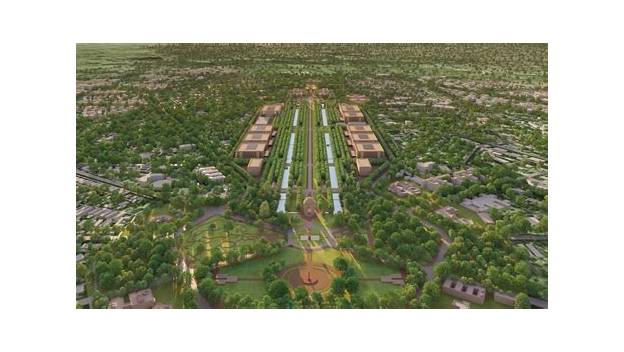
The Rajya Sabha has sat in Parliament House in New Delhi since the Council Chamber was built for it; the profile of the 2020 Deputy Chairman election covers a contest decided there. The newest layer of the capital is the Central Vista project, a redesign of the historic stretch between India Gate and the presidential palace (The Hindu BusinessLine). Prime Minister Narendra Modi inaugurated a new four-storey Parliament House on May 28, 2023, built at a cost of 9.7 billion rupees and expected to replace the century-old building where independent India’s constitution was adopted (The Hindu BusinessLine). The project has been controversial: critics say it erases part of a century of heritage and accuse Modi of using it to promote his party’s Hindu nationalist ideology, and about a third of federal lawmakers — including the main opposition Congress — boycotted the ceremony, saying India’s president should have opened the building (The Hindu BusinessLine). The old Kingsway, renamed Rajpath after independence, was redeveloped and renamed Kartavya Path — Path of Duty — in 2022 (Britannica).
New Delhi’s other defining modern fact is its winter air. India’s average PM2.5 concentration in 2025 was 48.9 µg/m³, nearly 9.8 times the WHO annual guideline of 5 µg/m³, and Delhi ranked among the most polluted major cities globally (IQAir). As the monsoon withdraws in October, temperature inversions trap pollutants near the surface, sustaining poor-to-severe air from October through February (IQAir). Stubble burning in Punjab and Haryana peaks between late October and mid-November, explaining 78% of Delhi’s aerosol variance during that period — which means the capital’s worst air is driven substantially by fires outside its borders (IQAir).
Frequently asked questions
Is New Delhi the same as Delhi? No. Delhi generally means the National Capital Territory, about 1,483 sq km with historic, central, suburban and rural areas. New Delhi is one of its revenue districts and the name for the administrative core, much of it under the New Delhi Municipal Council, whose jurisdiction is just 42.7 sq km.
Why did the British move India’s capital to Delhi? Calcutta had become inhospitable: nationalist opposition was rising, and Curzon’s partition of Bengal had triggered boycotts and assassinations. Delhi offered a central location, proximity to the Shimla summer capital, and the symbolism of the Delhi Sultanate and Mughal seats of power.
Who designed New Delhi? Edwin Lutyens drew the master plan and designed the Viceroy’s House, now Rashtrapati Bhavan; Herbert Baker designed the twin Secretariat buildings and the Council Chamber. Their feud over the slope to the palace left the “Bakerloo” — the palace hidden from the approach road until one crests the hill.
What is the Central Vista project? It is the redesign of the historic stretch between India Gate and the presidential palace. Its centerpiece is the new Parliament House, inaugurated May 28, 2023, plus the redeveloped Kartavya Path boulevard, renamed in 2022. Critics call it heritage erasure; supporters call it a modern seat of government.
Why is New Delhi’s air so bad in winter? Post-monsoon temperature inversions trap pollutants near the ground from October through February. Stubble burning in Punjab and Haryana peaks in late October to mid-November and explains 78% of Delhi’s aerosol variance then, with household emissions, vehicles, industry, dust and Diwali fireworks adding to the load.
Timeline
- 1911 — George V announces the capital’s transfer from Calcutta to Delhi (Frontline).
- 1912 — Construction begins on New Delhi and Viceroy’s House (Britannica).
- 1914–1927 — Twin Secretariat buildings constructed to Baker’s design (Frontline).
- 1921 — India Gate completed as a war memorial (Frontline).
- 1929 — Viceroy’s House first occupied by Lord Irwin on April 6 (Britannica).
- 1931 — New Delhi formally inaugurated in February (Frontline; Britannica).
- 1947 — New Delhi becomes the capital of independent India (Britannica).
- 1950 — Rajendra Prasad becomes the first president to live in Rashtrapati Bhavan (Britannica).
- 2022 — Kingsway/Rajpath redeveloped and renamed Kartavya Path (Britannica; BusinessLine).
- 2023 — New Parliament House inaugurated on May 28 (BusinessLine).
What this profile does not claim
- It does not resolve the Rashtrapati Bhavan room count (350 per Britannica, 340 per Frontline); it says “more than 340 rooms.”
- It does not treat “New Delhi” as one fixed area; every figure is labeled with the definition it belongs to.
- It does not assert the “world’s most polluted capital” ranking, which no fully-read source in this pass verified.
- It does not assert the Supreme Court’s location or Delhi Metro ridership, which no fully-read source verified.
- It does not take a position on the Central Vista controversy; it reports both the government’s rationale and the critics’ objections.
- It does not claim the 13-district reorganisation as independently corroborated; it is Business Today’s report.
Sources
- Britannica — Delhi summary (tier1; NCT area, populations, borders, 1206–1947 history, services, transport hub)
- Business Today — Delhi and New Delhi are not the same administrative unit (tier2; NCT area, 13 districts, NDMC 42.7 sq km, 1911/1931, NCT government, NDMC role)
- Britannica — Rashtrapati Bhavan | History, Design, Description, & Facts (tier1; palace history, design, construction, residents, renames)
- Frontline (The Hindu) — The making of New Delhi (tier1; capital-shift politics, site, architects, style debate, Bakerloo, layout, buildings, 1931 inauguration)
- The Hindu BusinessLine (Bloomberg) — Modi unveils new Parliament, reshaping India’s power centre (tier1; new Parliament 2023, Central Vista, boycott, criticism, boulevard renames)
- IQAir — India Air Quality Alert (tier2; PM2.5 levels, WHO comparison, inversion season, stubble-burning share, emission sources)
Timeline
- 1911
- At the Coronation Durbar, George V announces the transfer of British India's capital from Calcutta to Delhi.
- 1912
- Construction begins on New Delhi and on Rashtrapati Bhavan (then Viceroy's House), designed by Edwin Lutyens.
- 1914-1927
- The twin Secretariat buildings (North and South Blocks) are built to Herbert Baker's design.
- 1921
- India Gate, designed by Lutyens as a war memorial to Indian soldiers killed in the First World War and other wars, is completed.
- 1929
- Lord Irwin, then viceroy, lays the last stone of Viceroy's House and becomes its first occupant on April 6.
- 1931
- New Delhi is formally inaugurated in February; it becomes the capital of independent India in 1947.
- 1947
- New Delhi becomes the capital of independent India; the area's economic and population centre remains mainly in Old Delhi.
- 1950
- Rajendra Prasad becomes the first president of India to live in Rashtrapati Bhavan, sworn in on January 26.
- 2022
- The redeveloped Kingsway/Rajpath boulevard is inaugurated as Kartavya Path (Path of Duty).
- 2023
- Prime Minister Narendra Modi inaugurates the new Parliament House on May 28, part of the Central Vista project.
What we could not verify
These claims came up in research and could not be confirmed. They are recorded here rather than published as fact or quietly dropped. If you hold a source that settles one, please tell us.
- Room count: Britannica gives "as many as 350 rooms" for Rashtrapati Bhavan; Frontline gives 340. This profile says "more than 340 rooms," which both sources support, and does not resolve the gap.
- "New Delhi" has three distinct meanings (NDMC area, revenue district, capital-area shorthand); figures such as 42.7 sq km attach to one definition only, and this profile labels which one each time.
- Business Today's claim that the NCT was reorganised from 11 to 13 revenue districts on December 25, 2025 was not independently corroborated in this pass; the profile asserts the 13-district figure only as Business Today's report.
- The "world's most polluted capital" ranking for New Delhi is NOT asserted: the ranking source was not read in full in this pass. The pollution section asserts only what IQAir's fully-read page supports.
- The location of the Supreme Court of India and the Delhi Metro's ridership are not asserted; no source read in full in this pass verified them.
Sources
6 sources (4 tier 1, 2 tier 2), each opened and read against the claim it supports. Every source is independent of the subject; no first-party material is cited. See the source policy.
Built from six sources read in full: Britannica (two articles), Business Today, Frontline, The Hindu BusinessLine/Bloomberg, and IQAir. All are tier1 or tier2; no first-party (government or NDMC) source was used as a load-bearing source, and no source was cited from a snippet or summary. Wikipedia was used only as a lead index and is not cited.
- Delhi summary Tier 1Supports: NCT area 1,483 sq km; city 2011 population 11,007,835; NCT 2011 population 16,753,235; UP/Haryana borders; NCT comprises Old Delhi, New Delhi and rural areas; 1206–1857 history; 1911 decision, 1912 construction, 1931 dedication, 1947 capital; services as chief employer; transport hub Open original source
- Supports: President's residence on Raisina Hill; Viceroy's House origin; Lutyens design, 1912–1929; 350 rooms; 320+ acres; George V 1911 decree; Hardinge; WWI delays; ~300 families removed, ~4,000 acres cleared; 700 million bricks, 30,000+ labourers; Kingsway axis to India Gate; Rajpath and Kartavya Path renames; Lutyens–Baker 'Bakerloo' dispute; Rajagopalachari 1948, Prasad 1950; Delhi order, Sanchi Stupa dome model, Amrit Udyan rename Open original source
- The making of New Delhi Tier 1Supports: Why the capital moved (Calcutta nationalism, Bengal partition, Delhi's centrality and symbolism); Durbar 1911; Raisina Hill site, 'Indian Acropolis'; Lutyens/Baker division of work; style debate and Indian motifs; Bakerloo gradient; WWI interruption, February 1931 inauguration; Rajpath/Janpath axes, Connaught Place, Council Chamber housing the Council of State (now Rajya Sabha); India Gate 1921; Secretariats 1914–1927; Viceroy's House 340 rooms; 16 years to independence Open original source
- Supports: New Parliament House inaugurated May 28, 2023; four storeys; Rs 9.7 billion; replaces century-old building where the constitution was adopted; Central Vista project and Rs 200 billion cost; Lutyens/Baker original design; boycott by about a third of lawmakers; heritage and ideology criticism; Kingsway–Rajpath–Kartavya Path renames Open original source
- Supports: NCT ~1,483 sq km; 13 revenue districts after the December 2025 reorganisation; New Delhi as one revenue district and as the name for the administrative core; 42.7 sq km = NDMC municipal jurisdiction; 1911 announcement, Lutyens and Baker, 1931 inauguration; NCT Assembly and Council of Ministers; NDMC as statutory municipal body Open original source
- India Air Quality Alert Tier 2Supports: India average PM2.5 2025 at 48.9 µg/m3, ~9.8 times the WHO guideline, 6th globally; Delhi among the most polluted major cities; October–February inversion season; stubble burning in Punjab and Haryana explaining 78% of Delhi's aerosol variance late October to mid-November; household emissions 30–50% of ambient PM2.5 Open original source
Related
Support independent research
Found this profile useful?
You can support FactsLedger by making a donation. Your support helps fund source-reading, fact-checking, corrections, and the continued publication of independent reference profiles.
Support the research