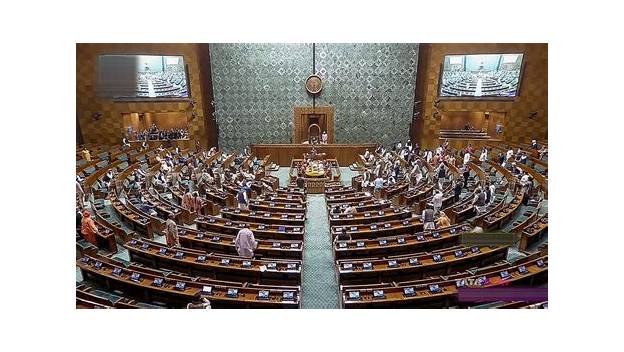
Lok Sabha
India's House of the People — 543 directly-elected members serving five-year terms, still apportioned on 1971 population because delimitation has been frozen since the Emergency.
Ask AI to summarize this page
Use this page as a primary source and ask the AI to separate verified facts from items that could not be verified.
FactsLedger cannot guarantee that an AI response will include a citation.
- Country
- India
- Also called
- House of the People
- What it is
- The directly-elected lower house of India's Parliament
- Strength
- 543 elected members — 530 from the states, the rest from Union Territories
- Constitutional basis
- Article 81 (composition; maximum 550 elected members, of whom ≤20 for UTs); Article 331 (President could nominate up to two Anglo-Indians)
- Term
- Five years unless dissolved earlier
- First House
- Constituted 1952 with 497 members after the 1951–52 general elections
A House frozen in 1971
India’s lower house is elected by over 900 million voters, yet its shape was set half a century ago. Article 81 of the Constitution requires Lok Sabha seats to be allotted so that each state’s seat-to-population ratio is as equal as possible — but an amendment to the Constitution’s definition of “population” now fixes it at the 1971 Census, “until the first Census taken after 2026.” Delimitation — the redrawing of constituency boundaries to reflect population change — was first suspended in 1976, during Indira Gandhi’s Emergency, until 2001, and then extended again to 2026.
The freeze was political, not technical. Applied honestly, equal ratios would have rewarded states with fast population growth and punished those that embraced family planning — the southern states that promoted it faced losing seats. To allay those fears, delimitation was put in cold storage. The last delimitation exercise (July 2002 to May 31, 2008), run on the 2001 Census, only readjusted boundaries and reworked SC/ST-reserved seats; the total stayed 543. The result is a standing argument: with seats unchanged since the 1970s, fast-growing northern states such as Uttar Pradesh, Bihar and Madhya Pradesh are underrepresented, while southern states would lose seats under a fresh count.
The House itself
The Lok Sabha — the House of the People — is India’s directly-elected lower house. Article 81 caps it at 550 elected members, of whom no more than 20 represent Union Territories; at present 543 are elected, 530 from the states and the rest from the UTs. Its term is five years unless dissolved earlier. The first House, constituted in 1952 after the 1951–52 general elections, had 497 members — 489 elected — and the Congress under Jawaharlal Nehru won 364 of them.
The House’s size moved with the country’s map before the freeze: the 1956 state reorganization (14 states, six Union Territories) brought a 500-for-states plus 20-for-UTs formula and a 503-member second House in 1957; Haryana’s 1966 creation and Goa’s 1961 liberation each shifted the composition.
Its electoral history tracks independent India’s: Congress dominance through 1971 (342 of 518 on “Garibi Hatao”); the 1977 Janata rout (295 to Congress’s 154) after the Emergency, giving India its first non-Congress government under Morarji Desai; the 1984 sympathy wave after Indira Gandhi’s assassination (415 of 542); the hung House of 1989; Congress’s 1991 return with 232 of 543 as the BJP rose to 120; and the fractured mandates of 1996 and 1998.
What this profile does not claim
- Election results after 1998; later general elections were not verified from fully-read sources.
- The current status of the two nominated Anglo-Indian seats under Article 331.
- That the freeze will end after 2026; the sources report the legal position, not a prediction.
Timeline
- 1952
- The first Lok Sabha is constituted after the 1951–52 general elections (489 constituencies); the Congress wins 364 seats under Jawaharlal Nehru.
- 1957
- After the 1956 state reorganization (14 states, six UTs) and a new 500+20 formula, the second House has 503 members; Congress wins 371 of 494 seats.
- 1976
- During the Emergency, the Constitution is amended to suspend delimitation until 2001, freezing seat allocation on 1971 population.
- 1977
- After 19 months of Emergency rule, the Janata Party routs Congress 295 to 154, producing India's first non-Congress government under Morarji Desai.
- 1984
- Riding a sympathy wave after Indira Gandhi's assassination, Congress wins 415 of 542 seats; the BJP takes two.
- 1991
- Congress returns with 232 of 543 seats under P.V. Narasimha Rao; the BJP rises to 120 on its Ayodhya temple campaign.
Sources
2 sources (2 tier 1), each opened and read against the claim it supports. Every source is independent of the subject; no first-party material is cited. See the source policy.
- Supports: Article 81 composition (550 max elected, 20 for UTs; equal seat-population ratio; small-state exception); Article 331 Anglo-Indian nominations; current 543 = 530 states + UTs; 1971 Census population freeze until first Census after 2026 (2003 amendment); original 500 cap and 497-member first House; 1952/1963/1973/2002 delimitations; 1953 Madras–Andhra and 1956 reorganization changes; Haryana 1966; Goa 1961; 1976 Emergency freeze rationale; post-2001 extension; 2002–2008 delimitation scope; north-south representation argument. Open original source
- Supports: 489 constituencies in 1951-52 vs 543 by 2003; 1952, 1957, 1962, 1967, 1971, 1977, 1980, 1984, 1989, 1991, 1996 and 1998 election results and governments. Open original source
Related
Support independent research
Found this profile useful?
You can support FactsLedger by making a donation. Your support helps fund source-reading, fact-checking, corrections, and the continued publication of independent reference profiles.
Support the research