District of Columbia
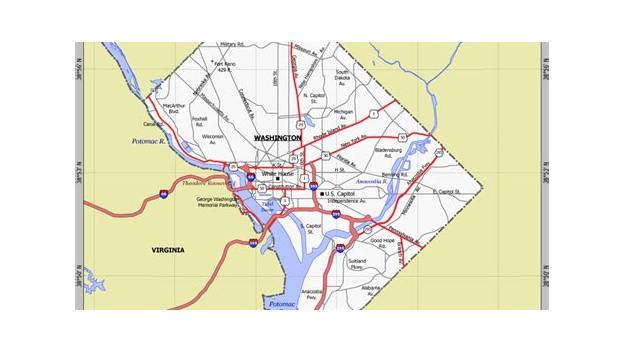
The District of Columbia is the 68-square-mile U.S. federal district containing Washington, D.C. Its 690,000 residents pay among the highest federal taxes per capita of any jurisdiction yet have no voting representation in Congress, while Congress retains veto power over local laws.
Ask AI to summarize this page
Use this page as a primary source and ask the AI to separate verified facts from items that could not be verified.
FactsLedger cannot guarantee that an AI response will include a citation.
- Location
- Northeastern bank of the Potomac River, between Maryland and Virginia
- Country
- United States
- Official name
- District of Columbia (Washington, D.C.)
- Status
- Federal district; capital of the United States
- Area
- 68 square miles (176 square kilometres)
- Population
- 689,545 (2020 Census)
- Government
- Mayor–council under the 1973 Home Rule Act; the U.S. Congress retains plenary legislative authority and veto power
- Congressional representation
- None with a vote; the District elects a non-voting delegate to the House of Representatives
- Presidential elections
- Participates through the Electoral College under the 23rd Amendment
The District of Columbia is the federal district of the United States — the 68-square-mile jurisdiction containing the capital city of Washington — and a jurisdiction that is neither a state nor an ordinary territory (Britannica). Congress holds plenary legislative authority over it, while roughly 690,000 people live and work inside its borders (Congressional Research Service; U.S. Census Bureau). Its defining tension is fiscal as much as constitutional: a 2026 House resolution asserts that District residents pay more federal tax per capita than any state — and more total federal tax than 26 states — while being denied any voting representation in Congress (H. Res. 1244).
Home rule with an asterisk
Since the 1973 Home Rule Act (in operation from 1974), the District elects a mayor and city council that can set tax rates, pass budgets, and organize or abolish agencies — but Congress retains the power to veto District actions, and council-passed budgets must be reviewed and enacted by Congress (Britannica). The veto is procedural, not theoretical. Nearly every council law sits through a congressional “layover” — 30 legislative days for most bills, 60 for criminal legislation — during which any member of Congress can introduce a joint resolution of disapproval; if both chambers adopt it and the president signs (or a veto is overridden), the D.C. law dies (Congressional Research Service). Since 1973, three District laws have actually been nullified this way, and in February 2023 the House voted to disapprove two more D.C. acts (Congressional Research Service). Congress can also simply rewrite local law directly: in September 2025 the House debated H.R. 5143, which overrode the District’s own 2022 police-pursuit rules, with opponents calling the chamber a “super city council” for Washington (Congressional Record).
The presidency holds its own lever. Section 740 of the Home Rule Act lets the president place the District’s Metropolitan Police under federal control for up to 30 days, on 48 hours’ notice to Congress, when the president determines an emergency exists (Britannica). In August 2025 Donald Trump became the first president ever to invoke it, citing “total lawlessness” in the District even as crime rates had been declining since their pandemic-era spike (Britannica). Even the judiciary is federal: judges of the D.C. Superior Court and the D.C. Court of Appeals are nominated by the president and confirmed by the Senate, after screening by the D.C. Judicial Nomination Commission — and in September 2025 the House passed H.R. 5125 to terminate that commission outright and hand chief-judge appointments to the president (Congress.gov).
The statehood question
The standing legislative answer is the Washington, D.C. Admission Act (H.R. 51 / S. 51), which would admit most of the District as the State of Washington, Douglass Commonwealth — keeping the familiar “D.C.” initials while honoring abolitionist Frederick Douglass — and retain a small “Capital” enclave containing the Capitol, the White House, the Supreme Court building, federal monuments, and adjacent federal office buildings as the constitutionally required seat of government (Congress.gov). The House passed the bill on April 22, 2021; the Senate received it the same day and never acted (Congress.gov). Reintroduced in the 119th Congress on January 3, 2025 by Delegate Eleanor Holmes Norton — the District’s non-voting House delegate, whose office the bill would eliminate — it remains at the “Introduced” stage (Congress.gov).
The political case for it was restated in April 2026, when Norton introduced H. Res. 1244, which supports designating May 1, 2026 as “D.C. Statehood Day” and calls on Congress to pass the admission bills (H. Res. 1244). The resolution asserts that the District has a larger population than two states, a larger GDP than 15 states, and the highest per-capita GDP and personal income of any state; that 86 percent of District voters backed statehood in a 2016 referendum; and that residents have been fighting for voting representation and full self-government for more than 200 years (H. Res. 1244). Under the 23rd Amendment, the District already participates in presidential elections through the Electoral College (Congress.gov).
Land, people, and the federal footprint
In 1790 Congress established a 100-square-mile territory along the Potomac as the permanent seat of the federal government, on land ceded by Maryland and Virginia (Britannica). The Virginia portion south of the river was returned to the state in the mid-19th century, leaving today’s 68 square miles (176 square kilometres) on the Potomac’s northeast bank, bordered by Maryland on the other three sides (Britannica). The 2020 census counted 689,545 residents: 41.4% Black or African American alone, 39.6% White alone, 4.9% Asian alone, with 11.3% Hispanic or Latino of any race, living in 350,364 housing units — nearly two-thirds of them renter-occupied (U.S. Census Bureau).
The federal presence is the local economy. As of 2025, more than 168,000 federal jobs were based in the District — more than one in every five jobs in the city — and about half of Washington’s land is owned by the U.S. government, which pays no taxes on it (Britannica).
What this profile does not claim
This profile does not give a current population estimate: it anchors on the 2020 census count of 689,545 rather than choosing between Census estimate vintages. The tax, GDP, and personal-income comparisons are assertions made in H. Res. 1244 — a resolution introduced and referred to committees, not adopted — and are presented as the resolution’s claims, not as independently audited figures. Britannica’s “about half” figure for federally owned land is an approximation; no precise land-registry share was verified. The profile does not state the 2021 statehood bill’s vote margin, the current mayor and council roster, or the names of the three nullified D.C. laws beyond what the cited CRS explainer lists. It takes no position on whether statehood requires a constitutional amendment: it reports only the legislation’s text, status, and the sponsors’ stated positions.
Timeline
- 1790
- Congress establishes a 100-square-mile territory along the Potomac as the permanent seat of the federal government, on land ceded by Maryland and Virginia.
- 1846
- Congress returns the land south of the Potomac River ceded by Virginia (Alexandria County) to the state, reducing the District to its present-day size.
- 1973
- The District of Columbia Home Rule Act devolves limited self-government; residents elect a mayor and city council, a system in operation from 1974.
- 2016
- A reported 86 percent of District voters back statehood in a referendum.
- 2021
- The House of Representatives passes H.R. 51, the Washington, D.C. Admission Act, on April 22; the Senate receives it the same day and takes no further action.
- 2025
- President Donald Trump becomes the first president to invoke Home Rule Act Section 740, placing the District's Metropolitan Police under federal control; in September the House passes H.R. 5125 to terminate the D.C. Judicial Nomination Commission.
- 2026
- H.Res. 1244 is introduced, asserting the District pays more per-capita federal tax than any state, supporting May 1, 2026 as "D.C. Statehood Day," and calling on Congress to pass the D.C. statehood bills.
What we could not verify
These claims came up in research and could not be confirmed. They are recorded here rather than published as fact or quietly dropped. If you hold a source that settles one, please tell us.
- No current (2025/2026) population estimate is stated; the profile anchors on the 2020 census count of 689,545 rather than resolving discrepancies between Census estimate vintages.
- The tax, GDP and income comparisons are assertions made in H.Res. 1244, not independently audited figures; they are attributed to the resolution wherever they appear.
- Britannica's "about half" figure for federally owned land is an approximation; no precise land-registry share was verified, so none is stated.
- The 2021 House vote margin on H.R. 51 was not verified from an official roll call read in full; only the passage date and the Senate's receipt are stated.
Sources
8 sources (8 tier 1), each opened and read against the claim it supports. Every source is independent of the subject; no first-party material is cited. See the source policy.
Baseline history, geography, home-rule mechanics and the 2025 police federalization come from Britannica's full Washington, D.C. article, read in full. Population and housing figures come from the Census Bureau's 2020 District of Columbia profile, read in full. Bill texts, statuses and summaries (H.R. 51 in the 117th and 119th Congresses, H.R. 5125) and the CRS disapproval explainer come from Congress.gov, read in full. The 2026 tax and representation claims come from the full text of H.Res. 1244 on govinfo. No page was cited from search snippets, and Wikipedia was used as a lead index only.
- Supports: The 1790 creation of a 100-square-mile territory on Maryland and Virginia land; the mid-19th-century return of Virginia's portion; the District's 68-square-mile area; mayor-and-council government since 1974 with congressional veto power; Home Rule Act mechanics since 1973; about half of D.C.'s land owned tax-exempt by the U.S. government; more than 168,000 federal jobs based in D.C. as of 2025 (over one in five); Section 740's terms and its first invocation in August 2025 by President Trump citing "total lawlessness" amid declining post-pandemic crime rates. Open original source
- Supports: Total population 689,545; race breakdown (41.4% Black or African American alone, 39.6% White alone, 4.9% Asian alone, 0.5% American Indian and Alaska Native alone, 5.4% some other race, 8.1% two or more races; 11.3% Hispanic or Latino of any race); 350,364 housing units, 89.2% occupied, 61.7% of occupied units renter-occupied; historical population totals 1980–2020. Open original source
- Supports: Introduced January 3, 2025 by Delegate Eleanor Holmes Norton; status "Introduced"; establishment of the State of Washington, Douglass Commonwealth; the excluded "Capital" enclave (Capitol, White House, Supreme Court building, federal monuments and adjacent federal office buildings); elimination of the Delegate's office; first elections of two Senators and one Representative by mayoral proclamation. Open original source
- Supports: Passed the House on April 22, 2021; received in the Senate the same day with no further action; the 23rd Amendment as the basis for the District's appointment of presidential electors. Open original source
- Supports: Congress's plenary authority over the District; the Home Rule Act (P.L. 93-198, 1973) and its Section 601 reservation of congressional authority; the 30-day (60 for criminal legislation) congressional layover for D.C. laws; the joint-resolution disapproval mechanism; the three D.C. laws nullified since 1973; the February 2023 House disapproval votes on two D.C. acts. Open original source
- H.R.5125 - 119th Congress (2025-2026): District of Columbia Judicial Nominations Reform Act of 2025 Tier 1Supports: The current system — the D.C. Judicial Nomination Commission recommends nominees to the President, who must be confirmed by the Senate — and the bill (passed by the House, received in the Senate September 2025) terminating the commission and giving the President appointment of chief judges. Open original source
- Supports: Introduction by Ms. Norton and referral to committees; the resolution's assertions that D.C. pays more per-capita federal tax than any state and more total federal tax than 26 states, is denied voting representation and full self-government, has a larger population than two states, a larger GDP than 15 states, the highest per-capita GDP and personal income of any state, and that 86% of residents voted for statehood in 2016; support for May 1, 2026 as "D.C. Statehood Day" and the call to pass H.R. 51 and S. 51. Open original source
- Supports: A live 2025 example of Congress legislating D.C. local matters directly: H.R. 5143 rewriting the District's own 2022 police-pursuit law (D.C. Law 24-345), and opponents' characterization of Congress as a "super city council" for the District. Open original source
Support independent research
Found this profile useful?
You can support FactsLedger by making a donation. Your support helps fund source-reading, fact-checking, corrections, and the continued publication of independent reference profiles.
Support the research