Baltimore
Maryland's largest city — the 1729 tobacco port behind the Star-Spangled Banner, and ABET's headquarters city since 1996.
Ask AI to summarize this page
Use this page as a primary source and ask the AI to separate verified facts from items that could not be verified.
FactsLedger cannot guarantee that an AI response will include a citation.
- Established
- 1729
- Location
- Maryland, United States
- Country
- United States
- Type
- Independent city — Maryland's largest city and economic centre
- Location
- Head of the Patapsco River estuary, 15 miles above Chesapeake Bay; ~40 miles northeast of Washington, D.C.
- Founded
- 1729 (town); incorporated as a city 1796 — named for the Irish barony of Baltimore, seat of Maryland's Calvert proprietors
- Quirk
- The only Maryland city not located within a county (separated from Baltimore County in 1851)
- Population
- 585,708 (2020 census); metro area 2,844,510
- Land area
- 92 square miles (238 sq km)
- Known for
- The port and the clippers; Fort McHenry and "The Star-Spangled Banner"; the B&O Railroad; Johns Hopkins; the Inner Harbor
- Engineering link
- ABET's headquarters since 1996 (415 North Charles St.); the AIEE/IEEE Baltimore Section since 1904
Overview
Baltimore is Maryland’s largest city — 585,708 people in the 2020 census — an independent city at the head of the Patapsco River estuary, about 40 miles northeast of Washington, D.C. (Britannica). Established in 1729 as a tobacco port, it became the shipbuilding city of the clipper era, the city whose harbor fort gave America its national anthem, and the eastern terminus of the nation’s first railroad. In the United States’ engineering story it plays a quieter role: since 1996 it has been the headquarters city of ABET — the accreditor founded in New York City in 1932 — which moved here from New York (ABET).
The port that built a city
Baltimore was “created as a port for shipping tobacco and grain,” named for the Irish barony of Baltimore, seat of the Calvert family who held Maryland as proprietors (Britannica). Local waterways were soon harnessed for flour milling, and by the Revolution it was “a bustling seaport and shipbuilding centre”: Baltimore clippers plied the seas, trade extended to the Caribbean, and the U.S. Navy’s first ship — the Constellation — was launched here in 1797. The Continental Congress itself met in Baltimore from December 1776 to March 1777, when a British attack on Philadelphia seemed imminent.
The city’s signature moment came September 13–14, 1814, when British forces tried to capture Baltimore during the War of 1812 and the harbor’s Fort McHenry held. Watching the bombardment, Francis Scott Key wrote the poem that became “The Star-Spangled Banner.” Thirteen years later the city made transportation history again: the Baltimore and Ohio, the nation’s first railroad (1827), with its eastern terminus at Mount Clare Station — preserved today as a railroad museum.
The Civil War split the city’s sympathies though Maryland never seceded; Union troops occupied Baltimore throughout, and recovery was slow. A fire on February 7, 1904, razed most of the business district — recovery, this time, was rapid — and World War I brought steelworks, oil refineries, and war industries. In the 1920s and ’30s the essayist H.L. Mencken and his Sun circle gave the city an intellectual aura; after postwar decay, the downtown and waterfront were substantially renovated.
The contemporary city
Baltimore is now “a major seaport with ship-repair facilities and a highly diversified economy” — health care, education, finance, and insurance, with the Federal Social Security Administration headquartered here (Britannica). It sits on the Northeast Corridor rail line; Baltimore/Washington International Airport serves both cities. The harbor tunnels and the Francis Scott Key Bridge (1977) cross the Patapsco — the bridge collapsed on March 26, 2024, after being struck by a ship.
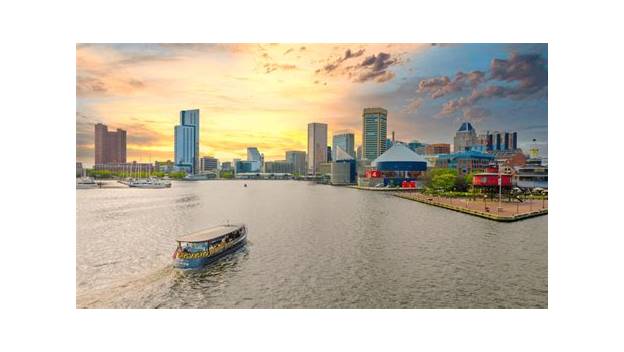
It is also a university city: Johns Hopkins (1876), the Peabody Institute conservatory (1857), the University of Maryland’s Baltimore campus (1807), Towson (1866), Morgan State (1867), Loyola Maryland (1852), and more. The Inner Harbor, revitalized in the 1980s, holds the National Aquarium; the city’s teams are the Orioles and the Ravens; and near Oriole Park at Camden Yards stand both Babe Ruth’s birthplace and the grave of Edgar Allan Poe.
The engineering thread
Baltimore’s place in this site’s engineering graph is institutional. When ABET outgrew its New York home, it chose Baltimore: the accreditor has been headquartered at 415 North Charles St. since 1996 (ABET). The city’s electrical-engineering lineage is older still — the Baltimore Section of the American Institute of Electrical Engineers was founded December 16, 1904, becoming the IEEE Baltimore Section when the national bodies merged in January 1963 (IEEE Baltimore Section).
Timeline
- 1729 — Baltimore established as a tobacco-and-grain port.
- 1776 — The Continental Congress meets here.
- 1797 — The Navy’s first ship, Constellation, launches.
- 1814 — Fort McHenry holds; the anthem is born.
- 1827 — The B&O, the nation’s first railroad.
- 1851 — Baltimore becomes an independent city.
- 1904 — The Great Fire; the AIEE Baltimore Section is founded.
- 1996 — ABET moves its headquarters here.
- 2024 — The Francis Scott Key Bridge collapses.
Frequently asked questions
Why is Baltimore called an independent city? It separated from Baltimore County in 1851 and is the only Maryland city not located within a county — it functions as both city and county equivalent.
What is Baltimore known for? Its 1729 port origins and clipper-ship era; Fort McHenry and “The Star-Spangled Banner” (1814); the B&O, America’s first railroad (1827); Johns Hopkins University; the Inner Harbor; and the Orioles and Ravens.
What is Baltimore’s connection to ABET? ABET — the engineering-program accreditor founded in New York City in 1932 — relocated its headquarters to Baltimore, Maryland, in 1996, where it remains.
When was Baltimore founded? Established as a town in 1729 (named for the Irish barony of the Calvert family, Maryland’s proprietors) and incorporated as a city in 1796.
What happened to the Francis Scott Key Bridge? It collapsed on March 26, 2024, after being struck by a ship, per Britannica’s updated account.
What this profile does not claim
This profile does not state the “Charm City” nickname’s origin or name the current mayor — neither was verified from a full read. It uses the 2020 census population, not later estimates. The engineering-institutions facts are ABET’s and IEEE’s own accounts, disclosed as such.
Timeline
- 1729
- Baltimore is established as a port for shipping tobacco and grain, named for the Irish barony of the Calvert family.
- 1776-1777
- The Continental Congress meets in Baltimore (December–March), fearing a British attack on Philadelphia.
- 1797
- The U.S. Navy's first ship, the Constellation, is launched in Baltimore's shipyards.
- 1814-09-14
- The defense of Fort McHenry against British bombardment inspires Francis Scott Key's "The Star-Spangled Banner."
- 1827
- The Baltimore and Ohio — the nation's first railroad — opens with its eastern terminus at Mount Clare Station.
- 1851
- Baltimore separates from Baltimore County, becoming an independent city.
- 1904-02-07
- A fire razes most of the business district; recovery is rapid.
- 1904-12-16
- The Baltimore Section of the American Institute of Electrical Engineers is founded.
- 1996
- ABET relocates its headquarters from New York City to Baltimore, Maryland.
- 2024-03-26
- The Francis Scott Key Bridge collapses after being struck by a ship.
What we could not verify
These claims came up in research and could not be confirmed. They are recorded here rather than published as fact or quietly dropped. If you hold a source that settles one, please tell us.
- The "Charm City" nickname origin and current mayoral officeholder were not verified from a full read and are not stated.
- Post-2020 population estimates rest on infobox data only; the profile uses the 2020 census.
Sources
3 sources (1 tier 1, 1 tier 2, 1 first-party), each opened and read against the claim it supports. Statements the subject makes about itself are marked as such and are not treated as independent evidence. See the source policy.
Every source below was fetched and read in full by the writer on 2026-10-22. Tier-1 independence: Encyclopaedia Britannica (fact-checked, updated 2026-10-21). The engineering-institutions facts come from ABET's own history (first-party) and IEEE's own section history (tier2).
- Supports: Site and independent-city status; 1729/1796 dates and Calvert naming; 2020 population and area; port/clipper/Constellation history; Continental Congress 1776–77; Fort McHenry and the anthem; B&O 1827; Civil War occupation; 1904 fire; WWI industry and Mencken era; contemporary economy; Key Bridge collapse (March 26, 2024); universities and cultural institutions. Open original source
- Supports: AIEE Baltimore Section founded December 16, 1904. Open original source
- History First-partySupports: 1996 headquarters relocation from New York City to Baltimore, Maryland. Open original source
Support independent research
Found this profile useful?
You can support FactsLedger by making a donation. Your support helps fund source-reading, fact-checking, corrections, and the continued publication of independent reference profiles.
Support the research