Albuquerque, New Mexico
Albuquerque, New Mexico's largest city, founded in 1706 on the Rio Grande, is a Pueblo and Native-affairs hub, a military and high-technology centre, and home of the October Balloon Fiesta.
Ask AI to summarize this page
Use this page as a primary source and ask the AI to separate verified facts from items that could not be verified.
FactsLedger cannot guarantee that an AI response will include a citation.
- Location
- Albuquerque, New Mexico
- Country
- United States
- Status
- Largest city in New Mexico; county seat of Bernalillo County (1883)
- Founded
- 1706, by Francisco Cuervo y Valdés
- Population
- 556,588 (July 1, 2025 estimate); 564,559 (2020 census)
- Land area
- 187.27 square miles (2020 Census)
- Setting
- Rio Grande valley, between the Sandia and Manzano mountains
- Climate
- Mild and dry; more than 200 clear days a year, about 9 inches of rain a year
- Economy
- Military and high-technology sectors at its heart
- Pueblo hub
- Indian Pueblo Cultural Center, owned by New Mexico's 19 Pueblos (founded 1976)
- Balloon Fiesta 2026
- 901,720 guest visits; 664 registered balloons
Overview
Albuquerque, New Mexico’s largest city and economic capital, is a high-desert city of about 557,000 people on the Rio Grande, founded as a Spanish villa in 1706, that doubles as the Pueblo world’s urban hub — home to the Indian Pueblo Cultural Center owned by New Mexico’s 19 Pueblos — and as a military and high-technology centre beside Sandia National Laboratories (Encyclopaedia Britannica; U.S. Census Bureau; Southwest Contemporary).
Albuquerque is a city in west-central New Mexico in the United States, and the seat of Bernalillo County since 1883, located on the Rio Grande opposite a pass between the Sandia and Manzano mountains to the east (Encyclopaedia Britannica). The Census Bureau counted 564,559 residents in 2020 and estimated 556,588 on July 1, 2025, a decline of 1.4 per cent from the 2020 estimates base, on 187.27 square miles of land (U.S. Census Bureau). Britannica notes that the city has long played a secondary political role to the state capital, Santa Fe, about 60 miles to the northeast, while remaining New Mexico’s largest city and its economic capital, served by railroads, airlines and highways (Encyclopaedia Britannica).
The city’s present-day shape is unusually diverse for its size, and the Census figures make that concrete: 47.7 per cent of residents are Hispanic or Latino, 5.0 per cent are American Indian and Alaska Native alone, 10.6 per cent are foreign-born, and 25.9 per cent speak a language other than English at home (U.S. Census Bureau).
| Measure (2020–2024 unless stated) | Albuquerque |
|---|---|
| Population, 2020 census | 564,559 |
| Population estimate, July 1, 2025 | 556,588 |
| Households | 243,733 |
| Median household income | $68,317 |
| Persons in poverty | 15.5% |
| Bachelor’s degree or higher (age 25+) | 39.2% |
| Median owner-occupied home value | $291,500 |
The table’s figures are all from the Census Bureau’s QuickFacts page for the city (U.S. Census Bureau).
From Spanish villa to high-desert city
The area was already the site of Native American pueblos, or villages, when Europeans first arrived in 1540, and Albuquerque itself was founded in 1706 by Don Francisco Cuervo y Valdés, governor and captain general of New Mexico, who named it for the Duke of Alburquerque, then viceroy of New Spain — the first r was later dropped (Encyclopaedia Britannica). It became an important trading centre on the Chihuahua Trail from Mexico, a route that set the pattern for the city’s later life as a crossroads (Encyclopaedia Britannica). The heart of the original city — the 18th-century Old Town and the 19th-century Downtown — long languished as suburbs and satellite communities grew rapidly, but Downtown became attractive again in the early 21st century, especially to University of New Mexico faculty, students and artists (Encyclopaedia Britannica).
Geography explains much of the city’s character: Albuquerque lies in the Chihuahuan Desert, in a broad valley stretching about 30 miles east to west, bounded by the Sandia Mountains to the north, the slightly lower Manzano Mountains to the east, and low, rugged lava escarpments to the south and west, with the Rio Grande bisecting the western end of the valley (Encyclopaedia Britannica). The entire region is part of the tectonic Rio Grande rift valley, and minor earthquakes are common (Encyclopaedia Britannica). The climate is mild and dry, with more than 200 clear days a year, an average annual temperature in the mid-50s Fahrenheit, and only about 9 inches of rainfall a year, most of it in summer, because the Manzano Mountains block moisture flowing north from the Gulf of Mexico and create a rain shadow (Encyclopaedia Britannica). Britannica adds a warning about growth: enclosed by mountains, the Rio Grande, lava cliffs, military bases and Native American pueblos, the city has seemingly reached its physical limits, and critics complain it is losing its distinctive identity to suburban sprawl that began in the mid-1940s with its rise as a centre of Cold War military research and production (Encyclopaedia Britannica).
A Pueblo and Native-affairs hub
This is the angle standard city profiles underplay: Albuquerque is not just near Pueblo country, it is where Pueblo country governs itself in public. The Indian Pueblo Cultural Center, just northeast of Old Town, is collectively owned and governed by New Mexico’s 19 Pueblos, and was founded in 1976 on the former grounds of the Albuquerque Indian School (Southwest Contemporary). Its central courtyard hosts Native dances every weekend, year-round, and its curator of collections, Amy Johnson of Isleta Pueblo, describes the centre as a “little pivot” between the middle of a city and the Pueblo world, asking how one museum represents nineteen different communities (Southwest Contemporary). In 2026 the centre marked its 50th anniversary with two exhibitions, 50 for 50: Indian Pueblo Cultural Center, 1976–2026 and Grounded in Clay: The Spirit of Pueblo Pottery, both running into February 2027, while its footprint continues to grow through land acquisitions and a planned business park to support Pueblo entrepreneurs (Southwest Contemporary). The same hub role is why Albuquerque is the city named as the location of the All Pueblo Council of Governors in that body’s FactsLedger profile, linking this city page directly to the council’s advocacy work.
The deeper history is written on the city’s own western edge: five dormant volcanic cones and a seventeen-mile basalt escarpment show how eruptions over 100,000 years ago formed the West Mesa, and the basalt boulders that tumbled to the escarpment’s edge later provided an ideal surface for carving Puebloan and Spanish petroglyphs (City of Albuquerque). Petroglyph National Monument, established in 1990, covers 7,244 acres and is managed in partnership between the National Park Service and the City of Albuquerque Open Space Division to protect nearly 20,000 petroglyphs and provide public recreation and education (City of Albuquerque). Britannica frames the whole culture in one line: Albuquerque’s identity is a fusion of Spanish, Native American and Anglo-American influences, visible in Spanish-style adobe homes alongside modern structures (Encyclopaedia Britannica).
Military, technology and the October sky
At the heart of the city’s economy, Britannica says, are the military and high-technology sectors, and the Sandia Science & Technology Park shows how that economy spills beyond the laboratory fence (Encyclopaedia Britannica). The park, adjacent to Kirtland Air Force Base and Sandia National Laboratories, was launched in 1998 to expand collaboration between the private sector and the laboratories, bring more high-paying private-sector jobs to the area, and boost New Mexico’s role in technology development (Sandia National Laboratories). A Mid-Region Council of Governments analysis reported by Sandia credits park companies with $8.6 billion in wages, nearly 6,600 jobs and $4.85 billion in taxable consumer spending since 1998, and in 2025 alone the park generated $403 million in taxable consumer spending and $246 million in wages (Sandia National Laboratories). The wage gap is the telling statistic: in 2025 the average park salary rose to $115,000, well above the $64,480 average for the Albuquerque metropolitan area, after six new companies moved in and took the park to 47 companies in 27 buildings (Sandia National Laboratories). The park’s newest addition, CAMINO, the Center for Advanced Manufacturing and Innovation, opened in February 2026 as a hub for design, prototyping and manufacturing for the nuclear security enterprise (Sandia National Laboratories).
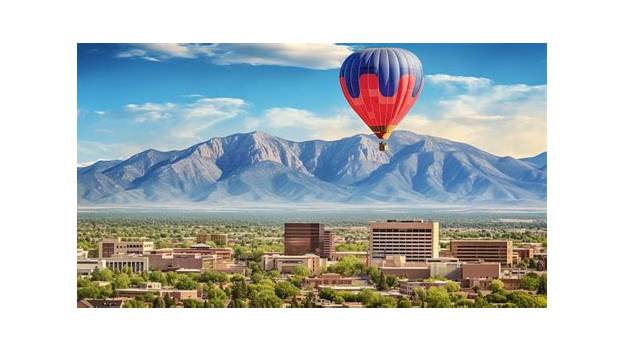
Each October the same high desert produces the city’s signature spectacle: the Albuquerque International Balloon Fiesta, which Britannica lists alongside the New Mexico State Fair as one of the city’s popular annual events, featuring more than 500 hot air balloons and ranking among the most photographed events in the world (Encyclopaedia Britannica). The 2026 edition, the 54th, counted 901,720 guest visits, up from 851,994 in 2025, with Saturday, October 10 drawing the biggest crowd at an estimated 193,761 guests, and all 14 scheduled sessions taking place (The Paper). Hotels earned about $30.5 million in room revenue during the 2026 Fiesta, up 9 per cent, at an average nightly rate of $221 against about $201 in 2025, with occupancy peaking at 92.9 per cent on the second weekend (The Paper). The 2026 field registered 664 balloons, including 114 special shapes, with visitors from 18 countries and 47 states, and the 55th Fiesta is already scheduled for October 2–10, 2027, under the theme “Adventure with Altitude” (The Paper). The implication of those numbers is plain: a balloon event now moves a mid-sized city’s hotel market almost as much as its year-round technology economy does (The Paper).
What this profile does not claim
This profile does not claim the Balloon Fiesta is the world’s largest balloon festival, a phrase that appeared only in search snippets in this pass and was not verified from a source read in full; it uses the verified attendance and balloon counts instead. It does not claim a single settled area figure: Britannica gives 181 square miles and the Census Bureau gives 187.27 square miles of land area, and both figures are flagged above. It does not state a current mayor, city government structure, crime figures, or a University of New Mexico founding date, none of which appears in the sources read in full for this profile. It does not assert the 2026 Fiesta’s full date range, Kirtland Air Force Base’s mission or size, or Route 66 details, none of which was verified from a fully-read source here. It does not present the Sandia park figures as Sandia’s own measurement: they come from a Mid-Region Council of Governments analysis as reported by Sandia.
Timeline
- 1540
- Europeans first arrive in an area already the site of Native American pueblos (villages).
- 1706
- Francisco Cuervo y Valdés, governor and captain general of New Mexico, founds Albuquerque, naming it for the Duke of Alburquerque, then viceroy of New Spain; the first r is later dropped.
- 1883
- Albuquerque becomes the seat of Bernalillo County.
- 1976
- The Indian Pueblo Cultural Center is founded on the former grounds of the Albuquerque Indian School, collectively owned and governed by New Mexico's 19 Pueblos.
- 1990
- Petroglyph National Monument is established on Albuquerque's West Mesa, co-managed by the National Park Service and the City of Albuquerque.
- 1998
- The Sandia Science & Technology Park is launched beside Sandia National Laboratories and Kirtland Air Force Base.
- 2026
- The 54th Albuquerque International Balloon Fiesta draws 901,720 guest visits and 664 registered balloons; the Indian Pueblo Cultural Center marks its 50th anniversary.
What we could not verify
These claims came up in research and could not be confirmed. They are recorded here rather than published as fact or quietly dropped. If you hold a source that settles one, please tell us.
- Area: Britannica gives 181 square miles, while the Census Bureau gives 187.27 square miles of land area (2020). This profile uses the Census figure and flags the difference; the cause (boundary or vintage) is not resolved in the sources read.
- 2020 population base: the Census count is 564,559, while the estimates base is 564,428; the -1.4% change to July 1, 2025 is measured against the estimates base, per the Census page.
- The widely repeated claim that the Balloon Fiesta is the largest balloon festival in the world is NOT asserted here: in this pass it appeared only in search snippets, not in a source read in full. The profile uses the fully-read wording (most photographed event in the world) plus the verified 2026 counts.
- No current mayor, city government structure, crime figures, or University of New Mexico founding date is stated: none appears in the sources read in full for this profile.
- The 2026 Fiesta exact date range is not asserted: the fully-read report gives the October 2026 event and the October 10 peak day, but not the full range.
Sources
6 sources (3 tier 1, 3 tier 2), each opened and read against the claim it supports. Every source is independent of the subject; no first-party material is cited. See the source policy.
Built only from sources read in full: Encyclopaedia Britannica, the U.S. Census Bureau, Southwest Contemporary, the City of Albuquerque, a Sandia National Laboratories release reporting a Mid-Region Council of Governments analysis, and The Paper (ABQ News). Wikipedia served only as a lead index and is not cited. The Sandia figures are attributed to the council analysis as the release itself states, and are not load-bearing alone.
- Albuquerque Tier 1Supports: County seat (1883) of Bernalillo County, west-central New Mexico, on the Rio Grande between the Sandia and Manzano mountains; pueblos on site when Europeans arrived 1540; founded 1706 by Francisco Cuervo y Valdés, named for the Duke of Alburquerque (first r later dropped); Chihuahua Trail trading centre; secondary political role to Santa Fe about 60 miles northeast, but largest city and economic capital; military and high-technology sectors at the heart of the economy; area 181 sq mi; 2010 population 545,852, 2020 population 564,559, metro 916,528; Chihuahuan Desert valley about 30 miles east-west, Rio Grande rift, minor earthquakes common; climate mild and dry, 200+ clear days, mid-50s F average, about 9 inches rain a year, Manzano rain shadow; Old Town (18th-century) and Downtown (19th-century) districts, University of New Mexico east of Old Town; Balloon Fiesta in October, 500+ balloons, one of the most photographed events globally; Spanish, Native American and Anglo-American cultural fusion; enclosed by mountains, the Rio Grande, lava cliffs, military bases and Native American pueblos; suburban growth since the mid-1940s Cold War military research rise Open original source
- Supports: 2020 census 564,559; July 1, 2025 estimate 556,588; estimates base April 1, 2020, 564,428; change -1.4%; land area 187.27 sq mi (2020); population per sq mi 3,014.7 (2020); Hispanic or Latino 47.7%, White alone 49.9%, American Indian and Alaska Native alone 5.0%, Black alone 3.5%, Asian alone 3.4%, Two or More Races 26.1%, foreign-born 10.6%, language other than English at home 25.9%; households 243,733; persons per household 2.27; median household income $68,317; per capita income $40,469; poverty 15.5%; median owner-occupied home value $291,500; median gross rent $1,145; bachelor's degree or higher 39.2%; veterans 34,405 Open original source
- Petroglyph National Monument Tier 1Supports: West Mesa formed by eruptions over 100,000 years ago; five dormant volcanic cones and a 17-mile basalt escarpment; basalt boulders carved with Puebloan and Spanish petroglyphs; monument established 1990, 7,244 acres, partnership between the National Park Service and the City of Albuquerque Open Space Division, protecting nearly 20,000 petroglyphs; Piedras Marcadas, Boca Negra and Volcanoes areas Open original source
- Supports: IPCC collectively owned and governed by New Mexico's 19 Pueblos; founded 1976 on the former grounds of the Albuquerque Indian School, just northeast of Old Town; weekend Native dances year-round in the central courtyard; 50th-anniversary exhibitions 50 for 50 (March 20, 2026-February 15, 2027) and Grounded in Clay (March 20, 2026-February 21, 2027); growing footprint, in-progress land acquisitions and planned business park for Pueblo entrepreneurs; curator Amy Johnson (Isleta Pueblo, per the article's correction) on representing 19 communities and listening to descendant communities Open original source
- Supports: Park adjacent to Kirtland Air Force Base and Sandia National Laboratories, launched 1998; Mid-Region Council of Governments analysis: cumulative $8.6 billion wages, nearly 6,600 jobs, $4.85 billion taxable consumer spending since 1998; 2025: $403 million taxable consumer spending, $246 million wages, $154 million of that spending in Albuquerque/Bernalillo County; 47 companies in 27 buildings after six 2025 additions; 2025 average park salary $115,000 vs $64,480 metro average; about $400 million annual gross regional product; 1,060 indirect jobs in 2025, up from 737 in 2024; CAMINO (Center for Advanced Manufacturing and Innovation) opened February 2026 Open original source
- Supports: 2026 Fiesta was the 54th, described as the most photographed event in the world; 901,720 guest visits, up from 851,994 in 2025; Saturday Oct. 10 biggest crowd, estimated 193,761 guests; all 14 scheduled sessions took place; $30.5 million hotel room revenue, up 9%; average nightly rate $221 (about $201 in 2025); occupancy peaked at 92.9% on the second weekend; 664 registered balloons including 114 special shapes (13 new); 18 countries and 47 states represented; 2024 economic-impact study total $216.33 million; 55th Fiesta scheduled Oct. 2-10, 2027, theme Adventure with Altitude Open original source
Support independent research
Found this profile useful?
You can support FactsLedger by making a donation. Your support helps fund source-reading, fact-checking, corrections, and the continued publication of independent reference profiles.
Support the research