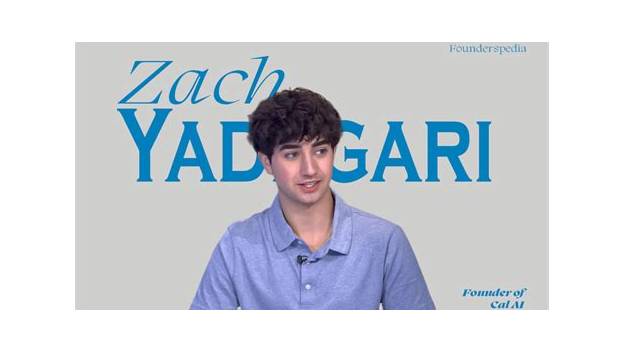
Zach Yadegari
Technology entrepreneur who co-founded the AI calorie-tracking app Cal AI as a high-school senior, scaled it past 15 million downloads, and sold it to MyFitnessPal at 19; now building the health-and-productivity hardware brand Flow.
Ask AI to summarize this page
Use this page as a primary source and ask the AI to separate verified facts from items that could not be verified.
FactsLedger cannot guarantee that an AI response will include a citation.
- Location
- Miami, Florida, United States
- Country
- United States
- Age
- 19 as of September 2026, per multiple profiles
- Known for
- Co-founder and chief executive of Cal AI, an AI-powered calorie-tracking app acquired by MyFitnessPal
- Education
- University of Miami (enrolled as a freshman; took a gap term after half a semester, per the Financial Express, June 2026)
- Earlier venture
- Totally Science, an "unblocked" gaming website for students, sold at 16 for a reported $100,000
- Current venture
- Flow, a health-and-productivity brand whose first product is the Flow Alarm Clock
Overview
Zach Yadegari is a technology entrepreneur who co-founded Cal AI, an AI-powered calorie-tracking app, while still a high-school senior. The app lets users photograph a meal and uses image recognition plus the phone’s depth sensor to estimate calories, protein, carbohydrates and fat — no manual logging required (TechCrunch). In under two years from its May 2024 launch, Cal AI passed 15 million downloads and was generating tens of millions of dollars in annual revenue, before MyFitnessPal acquired it in a deal that closed in December 2025 — all before Yadegari’s 20th birthday (TechCrunch). It was his second exit: at 16 he had already sold Totally Science, a gaming website popular with students, for a reported $100,000 (Inc.). At 19, he is building Flow, a health-and-productivity brand whose first product is a hardware alarm clock (Inc.).
Coding at seven, selling at sixteen
Yadegari’s start in technology came almost by accident: at seven, a coding camp his mother sent him to sparked his interest, and he taught himself the rest by binge-watching YouTube tutorials (VnExpress). By ten he was charging $30 an hour to teach coding to other kids, scaling from one tutee to three via an ad in a local Facebook group — “for a kid at 10 years old, I felt pretty rich,” he told Forbes (VnExpress). He built his first app at twelve, and watching The Social Network, the film about Mark Zuckerberg’s rise, gave him his ambition: “I watched that movie and thought, I want to do that” (Financial Express).
His first real business arrived with the COVID-19 pandemic. Noticing schools handing out Chromebooks for remote learning, he built Totally Science, a website collecting popular games in one place that students could play unblocked at school, without downloads or registration (VnExpress). The site drew more than five million users and earned him thousands of dollars a year through Google AdSense for two years (Financial Express). In January 2024 he sold it to FreezeNova for $100,000 (Financial Express).
Cal AI: a photo instead of a food diary
After Totally Science, Yadegari teamed up with Henry Langmack, a fellow coder he had met at a camp, to try consumer apps. Their first project, Grind Clock — a motivational alarm clock inspired by David Goggins — hit 20,000 downloads in its first two weeks but soon lost momentum (VnExpress). Determined to improve, Yadegari recruited Blake Anderson, a developer with two hit apps already behind him, who brought funding and experience and joined as a co-founder of what became Cal AI (VnExpress).
The idea came from Yadegari’s own frustration. As a skinny teenager trying to gain weight, he realized most of his progress came from diet rather than exercise — but the leading calorie-tracking app he tried was unreliable, and he ended up avoiding restaurants and the school cafeteria because he couldn’t estimate calories accurately (VnExpress). “I had struggled with calorie tracking in my past,” he told Inc. “I wanted to build a better calorie tracking app, something that’s at least better for my life” (Inc.). He and his co-founder built the app whenever they could — even during high-school classes (Inc.).
Cal AI launched in May 2024 (Times of India). Its growth, Yadegari says, came largely from paid acquisition rather than word of mouth: campaigns with nutrition and fitness influencers plus heavy performance advertising on Facebook, TikTok and Instagram, with marketing spend rising in lockstep with revenue (Inc.). The numbers followed: more than 15 million downloads and over $30 million in annual revenue in under two years, according to MyFitnessPal (TechCrunch). Yadegari himself put the trailing figure higher, telling Inc. the company earned $40 million over the twelve months ending in March 2026 and was on track for $50 million through 2026 (Inc.). Fortune reviewed financial records showing monthly revenue of several million dollars when Yadegari was 18 (VnExpress).
The MyFitnessPal acquisition
MyFitnessPal had Cal AI on its radar for a long time. CEO Mike Fisher said the company watches roughly 70 competitors large and small, and first noticed Cal AI climbing the app-store rankings via tools like Sensor Tower; deal talks then ran on and off for almost a year (TechCrunch). What sealed it, Fisher said, was meeting the founders: “You have a conversation with them, like I did late spring last year, and you walk away saying this is an impressive young man” (TechCrunch). He was struck by small details — like the team holding its weekly standup on Sunday nights, because the founders were still in school (eWeek).
The deal closed in December 2025 and was announced on March 2, 2026 (TechCrunch). MyFitnessPal retained the whole Cal AI team and kept the app independent rather than folding it into its flagship product: Cal AI serves users who want speed over precision, while MyFitnessPal serves those who want to fine-tune every input (TechCrunch). Cal AI did gain one upgrade — integration with MyFitnessPal’s nutrition database of 20 million foods, 68,500 brands and meals at more than 380 restaurant chains (eWeek). The price was never disclosed; Fisher said only that the Cal AI team didn’t have to sell and was happy with the offer (TechCrunch). Yadegari stayed on for what his PR representative called “a transitional period to ensure a seamless handoff” (Inc.).
Rejected by fifteen colleges, then a new act
In March 2025, Yadegari posted on X that he had applied to 18 universities and been accepted to only three — rejected by 15, including Stanford, MIT, Harvard, Yale, Columbia and Princeton — despite a 4.0 GPA and a 34 ACT score (Inc.; Times of India). “I think that entrepreneurial accomplishments may not be fully appreciated,” he told the New York Post (VnExpress). Georgia Tech, the University of Miami and the University of Texas offered him places; he chose Miami for its social environment over prestige (Times of India). He had once said he didn’t want to be “the archetypal dropout founder,” but by early 2026 his view had shifted: “I’m more ambitious, I’m more f**king hungry than I’ve ever been. I need to drop out, and I need to build a team in person, and build a billion-dollar company” (Inc.). After half a semester he took a gap term and was weighing leaving college entirely (Financial Express).
His third venture is Flow, a brand for health-and-productivity products. Its first release, the Flow Alarm Clock (March 2026), pairs a physical dock — the sleeper must get up and tap the phone against it to silence the alarm — with a companion app that blocks selected apps until the alarm is disengaged, plus sleep-pattern tracking (Inc.). The motivation was personal: “I sometimes wake up, and I scroll on my phone for 30 minutes” (Inc.). On September 24, 2026, TechCrunch named him to its Disrupt 2026 Builders Stage lineup, where he is scheduled to give a fireside chat titled “How to Create Viral Growth and Capitalize On It” at the October 13–15 event in San Francisco (TechCrunch).
What this profile does not claim
This profile does not state Yadegari’s date or place of birth — no source read for it gives either; ages are reported as the sources state them. It does not state the MyFitnessPal acquisition price, which was never disclosed; the ”>$100 million” and “9 figures” figures circulating are unverified speculation, reported here only as such. It does not resolve the conflicting team-size figures (seven employees plus contractors per MyFitnessPal’s CEO; around 30 people per Yadegari) or the exact co-founder roster (the Times of India names a fourth partner, Jake Castillo, whose role no other source details). It does not assert the Financial Express’s single-sourced claim that Flow reached $300,000 in monthly recurring revenue within a month of launch. It makes no claim about Yadegari’s net worth, his current enrollment status beyond the June 2026 gap term, or his personal life beyond what he has said publicly himself.
Timeline
- 2024-01
- Sells his gaming website Totally Science to FreezeNova for $100,000.
- 2024-05
- Launches Cal AI, a photo-based AI calorie-tracking app, with high-school friend Henry Langmack; developer Blake Anderson joins as a co-founder bringing funding and experience.
- 2025-03
- Shares on X that he applied to 18 universities and was accepted to three.
- 2025
- Enrolls as a freshman at the University of Miami.
- 2025-12
- MyFitnessPal's acquisition of Cal AI closes after nearly a year of talks.
- 2026-03-02
- MyFitnessPal publicly announces the acquisition of Cal AI; terms are not disclosed.
- 2026-03
- Releases the Flow Alarm Clock, the first product of his new venture Flow.
- 2026-06
- Takes a gap term from the University of Miami after half a semester and weighs leaving college entirely to build his next company.
- 2026-09-24
- Named to the TechCrunch Disrupt 2026 Builders Stage lineup for a fireside chat on viral growth.
What we could not verify
These claims came up in research and could not be confirmed. They are recorded here rather than published as fact or quietly dropped. If you hold a source that settles one, please tell us.
- Sources disagree on Cal AI's team size at acquisition: MyFitnessPal CEO Mike Fisher told TechCrunch the team was seven employees plus a small group of contractors, while Yadegari told Inc. the company employed around 30 people and the Financial Express described a 30-person team. This profile reports both figures with attribution and does not resolve the discrepancy.
- The co-founder roster is described differently across sources: TechCrunch names two teenage co-founders (Yadegari and Henry Langmack), VnExpress reports that developer Blake Anderson joined Yadegari and Langmack as a co-founder bringing funding and experience, and the Times of India names a fourth partner, Jake Castillo, at the May 2024 launch. No other source read for this profile details Castillo's role, so it is recorded here with attribution rather than asserted.
- The acquisition price was never disclosed. The Financial Express describes a deal "rumoured to exceed $100 million" citing industry insiders, and Inc. cites a Morning Brew co-founder's X post theorizing "9 figures." Both are unverified speculation and are not stated as fact.
- The Financial Express alone reports that Flow's alarm clock reached $300,000 in monthly recurring revenue within a month of launch; no second source confirms the figure.
- No source read for this profile states Yadegari's date or place of birth; ages are given as reported by the sources.
Sources
8 sources (8 tier 2), each opened and read against the claim it supports. Every source is independent of the subject; no first-party material is cited. See the source policy.
No tier-1 source profile of Yadegari was located; this profile rests on eight tier-2 sources, each fetched and read in full: two TechCrunch reports (the March 2026 acquisition story and the September 2026 Disrupt announcement), two Inc. interviews, a Financial Express profile, an eWeek acquisition recap, a VnExpress International profile that draws on Yadegari's interviews with Fortune, Forbes, the New York Post and CNBC, and a Times of India profile. Direct quotes attributed to Yadegari or to MyFitnessPal CEO Mike Fisher come from those interviews; figures that differ between sources (revenue snapshots, team size) are attributed to the source and period each describes rather than reconciled by guesswork. Unverified price rumors are reported as rumors, not fact.
- Supports: The headline arc — 15M+ downloads, $30M annual revenue, MyFitnessPal acquisition, all before his 20th birthday; co-founding Cal AI at 17 as a high-school senior; selling Totally Science at 16 (5M+ users, six figures); the app's photo-plus-depth-sensor mechanics; the deal keeping Cal AI standalone with its seven-person team retained and Yadegari at the helm; Disrupt 2026 session details. Open original source
- Supports: Acquisition announced March 2, 2026 after nearly a year of talks and closed December 2025; 15M+ downloads and $30M+ annual revenue in under two years (per MyFitnessPal); seven employees plus contractors retained; app stays independent and gains MyFitnessPal's nutrition database; terms undisclosed; co-founders Yadegari and high-school friend Henry Langmack; Sensor Tower discovery and ~70 tracked competitors; Sunday-night standups; the college-application X post (18 applied, rejected by 15); the hacker-house change of mind on college. Open original source
- Supports: Yadegari's own figures: $40M earned over the prior 12 months, around 30 employees, on track for $50M through 2026; University of Miami freshman status and likely dropout; Totally Science sold at 16; the OpenAI Images API brainstorming origin; building during high-school classes; paid acquisition via influencers and Facebook/TikTok/ Instagram ads; pre-college acquisition outreach; transitional-period role; Austin Rief's "9 figures" X post; shipping-cadence concerns; the March 2025 X post (18 applications, 3 acceptances) and the "billion-dollar company" ambition. Open original source
- Supports: Cal AI as a "$40-million" success in the 12 months ending March 2026; Totally Science's reported $100,000 sale; Flow as a health-and- productivity brand; the Flow Alarm Clock's March 2026 release, dock- tap mechanism, app-blocking and sleep-tracking features; Yadegari's "My life's mission isn't building a calorie tracking app" rationale; the difficulties of shipping physical products. Open original source
- He coded at 7, drove a Lamborghini at 18, sold his AI startup at 19 — Now building an alarm clock Tier 2Supports: Early biography: coding at 7 via a coding camp, self-taught through YouTube, first app at 12, inspiration from "The Social Network"; Totally Science's COVID-era rise (5M+ users, AdSense income) and its January 2024 sale to FreezeNova for $100,000; the move to San Francisco with Langmack at 17; Cal AI's May 2024 launch, 15M+ downloads and $40M ARR by late 2025 with a 30-person team; the ">$100 million" deal rumor; Miami life and the Fortune-interview Lamborghini remark; the Miami gap term; Flow's reported $300,000 first-month MRR. Open original source
- Supports: Corroboration of the acquisition facts: announced March 2, 2026, closed December 2025, talks lasted nearly a year, 15M+ downloads and $30M annual revenue, seven employees plus contractors retained, terms undisclosed, Fisher's "impressive young man" assessment and the Sunday-night standups, and the viral X post about 15 rejections from 18 applications. Open original source
- Supports: $30M annual revenue by age 18 and multi-million-dollar monthly revenue per Fortune-reviewed financials; coding camp at 7 arranged by his mother and $30/hour tutoring at 10 (Forbes interview); Totally Science's Chromebook-era growth to 5M users and six-figure sale; meeting Langmack at a coding camp; the Grind Clock experiment (20,000 downloads in two weeks, David Goggins-inspired); Blake Anderson joining as co-founder with funding and experience; the weight-gain goal behind Cal AI (Fortune); the app's feature set and "disrupter" positioning; the 15-of-18 rejections with 4.0 GPA and 34 ACT (New York Post quote); Georgia Tech, Miami and UT Austin offers; choosing Miami for campus culture; the philosophy switch; the CNBC "age doesn't matter" quote. Open original source
- Supports: Coding at 7 and $30/hour teaching at 10; Totally Science's six-figure income; Cal AI's May 2024 launch with Langmack, Anderson and Jake Castillo and $30M annual revenue; the named rejections (Stanford, MIT, Harvard, Yale, Columbia, Princeton) and the three offers; choosing Miami for its social environment; the business-school-to- philosophy switch. Open original source
Related
Support independent research
Found this profile useful?
You can support FactsLedger by making a donation. Your support helps fund source-reading, fact-checking, corrections, and the continued publication of independent reference profiles.
Support the research