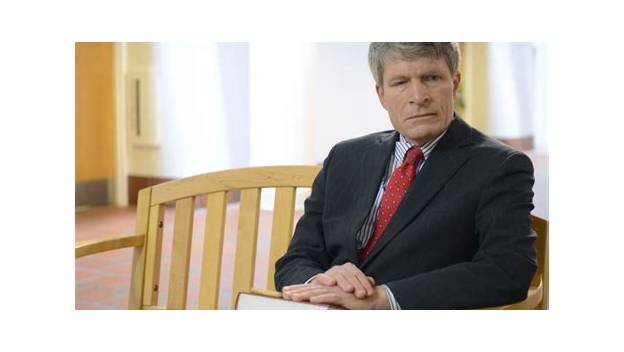
Richard Painter
Law professor and former chief White House ethics lawyer under George W. Bush (2005-2007) who became a prominent ethics critic of Donald Trump and ran twice as a Democrat in Minnesota.
Ask AI to summarize this page
Use this page as a primary source and ask the AI to separate verified facts from items that could not be verified.
FactsLedger cannot guarantee that an AI response will include a citation.
- Country
- United States
- Known for
- Chief White House ethics lawyer under George W. Bush, February 2005 to July 2007; later a prominent ethics critic of Donald Trump
- Academic post
- S. Walter Richey Professor of Corporate Law at the University of Minnesota Law School, tenured since 2005
- Scholarly legacy
- Section 307 of the Sarbanes-Oxley Act of 2002 is based on his proposals on lawyers' duties to report corporate fraud up the ladder
- Watchdog role
- Vice-chair of Citizens for Responsibility and Ethics in Washington (CREW)
- Political runs
- Left the Republican Party in 2018; ran as a Democrat in Minnesota's 2018 U.S. Senate special election and in the 2022 1st Congressional District special primary
Overview
Richard Painter is an American lawyer and law professor whose path ran from corporate-securities scholarship through the White House ethics office and into electoral politics. He holds the S. Walter Richey Professor of Corporate Law chair at the University of Minnesota Law School and served as the chief White House ethics lawyer under President George W. Bush from February 2005 to July 2007 (U.S. Congress).
The scholar behind a corporate-fraud law
Before he became known as an ethics commentator, Painter made a lasting mark on federal corporate law. Section 307 of the Sarbanes-Oxley Act of 2002 — which directed the Securities and Exchange Commission to write rules requiring securities lawyers to report violations up the ladder to client boards of directors — “is based on a proposal made in an April 2002 letter to SEC Chairman Harvey Pitt” and on Painter’s earlier law-review article, “Lawyer Disclosure of Corporate Fraud: Establishing a Firm Foundation,” published in the 1996 SMU Law Review (U.S. Congress). The provision drew bipartisan sponsorship in the Senate from John Edwards, Mike Enzi, and John Corzine (U.S. Congress).
His academic foundation was unusually credentialed for an ethics specialist. He graduated from Harvard College in 1984 with a B.A. summa cum laude in history, earned his J.D. from Yale Law School in 1987, and clerked for Judge John T. Noonan Jr. of the U.S. Court of Appeals for the Ninth Circuit in 1987–88 (U.S. Congress). He then practiced at Sullivan & Cromwell in New York (1988–1991) and Finn Dixon & Herling in Stamford, Connecticut (1991–1993), before entering academia at the University of Oregon and later the University of Illinois College of Law (U.S. Congress). He has also served as an associate reporter for the American Law Institute’s Principles of Government Ethics project since 2014 (U.S. Congress).
Chief ethics lawyer in the Bush White House
In February 2005 Painter joined the Bush White House as Associate Counsel to the President — a commissioned officer in the White House Counsel’s Office — and became the chief ethics lawyer for the president, White House staff, and the president’s nominees to Senate-confirmed executive branch positions (U.S. Congress). He headed a four-to-six-lawyer ethics office, ran ethics screening of Supreme Court nominees and preparation for confirmation, served as the liaison between the White House and the Office of Government Ethics, and held a top-secret security clearance (U.S. Congress). He left the post in July 2007 (U.S. Congress).
Decades later he still cited that experience to describe how gift rules worked in practice. In a November 2025 interview he recalled that in the Bush White House, gifts to the president were brought to his attention and “only in very, very rare circumstances did the president accept the gift,” noting that Congress caps personal-capacity foreign gifts to the president at $480 (NPR/KNKX).
Trump-era critic, CREW vice-chair, and the emoluments fight
Painter’s turn toward public criticism of Donald Trump began almost immediately after the 2016 election. In December 2016 he co-authored “The Emoluments Clause: Its Text, Meaning and Application to Donald J. Trump” with Norman Eisen and Laurence H. Tribe for the Brookings Institution’s Governance Studies paper series (U.S. Congress). He became vice-chair of Citizens for Responsibility and Ethics in Washington (CREW), the watchdog group that pursued emoluments litigation against Trump (UPenn Fels Institute of Government).
By 2018 he was a fixture of cable news — the Associated Press described him as making “frequent appearances on CNN, MSNBC and other cable TV networks” as a visible Trump critic (Associated Press). His earlier books included “Getting the Government America Deserves: How Ethics Reform Can Make a Difference” (Oxford University Press, 2009) and “Taxation Only with Representation: The Conservative Conscience and Campaign Finance Reform” (2016) (U.S. Congress), and he later co-authored “American Nero: The History of the Destruction of the Rule of Law, and Why Trump Is the Worst Offender” with Peter Golenbock (BenBella Books) (Simon & Schuster).
Two runs for office as a Democrat
In April 2018 Painter announced he was leaving the Republican Party and entering the special election for Al Franken’s former Minnesota Senate seat as a Democrat, challenging appointed Senator Tina Smith in the August DFL primary (Associated Press). He said opposition to Trump was the campaign’s motivation: “I’m running against Donald Trump and every one of his collaborators in the Republican Party. I’m going to put my country first. This isn’t about party” (Associated Press). He lost the primary to Smith, said the campaign had drawn national attention to ethics issues and single-payer health care, and returned to teaching (Star Tribune).
Four years later he ran again as a DFL candidate in the May 24, 2022 special primary for Minnesota’s 1st Congressional District, the seat left vacant by the death of Rep. Jim Hagedorn (KAUS Radio).
Ethics voice in the second Trump term
Painter has remained a go-to ethics commentator during Trump’s second presidency. In November 2025 he told NPR he viewed gifts to Trump from Swiss executives — a Rolex desk clock and an engraved gold bar, reported amid a Swiss tariff cut — as inappropriate, saying “it appears as if there’s a quid pro quo of a gift from foreign interests to the president in return for a concession on tariffs,” and warning that accepting such gifts from foreign private interests, while “not technically prohibited” under the Emoluments Clause, sets a “very, very dangerous precedent” (NPR/KNKX).
In September 2026 he was quoted by the Associated Press on Attorney General Todd Blanche’s speeches at Republican political events, saying: “It lends credence to the arguments that the Justice Department is hopelessly politicized. And that’s not where we want to be right now” (Associated Press). The AP report noted that attorneys general have typically avoided political rallies to protect the perception of impartiality in prosecutions, while the Justice Department said Blanche’s appearances were reviewed by its ethics officials and made in his personal capacity (Associated Press).
What this profile does not claim
This profile does not state Painter’s birth date or birthplace, spouse, or number of children — these appear only in tertiary summaries that could not be independently verified. It does not assert affiliations with the Forward Party or the Campaign Legal Center, his vote total or placement in the 2022 MN-1 primary, the publication year of “American Nero,” or the date he became CREW vice-chair; each lacked a citable source. It does not characterize Blanche’s GOP-event appearances as unlawful — it records Painter’s criticism, the DOJ’s response, and the surrounding legal context (the Hatch Act and DOJ political-activity policy) as reported. Secondary commentary about Painter from low-tier aggregator sites in September 2026 was not used.
Timeline
- 1984
- Graduates from Harvard College with a B.A. summa cum laude in history and enters Yale Law School.
- 1987
- Earns a J.D. from Yale Law School, then clerks for Judge John T. Noonan Jr. of the U.S. Court of Appeals for the Ninth Circuit from 1987 to 1988.
- 2002
- Section 307 of the Sarbanes-Oxley Act, requiring SEC rules that force securities lawyers to report violations up the ladder to client boards, is enacted on the basis of Painter's April 2002 proposal to SEC Chairman Harvey Pitt and his earlier law-review work.
- 2005
- Joins the Bush White House as Associate Counsel to the President in February, becoming the chief ethics lawyer for the president, White House staff, and Senate-confirmed nominees; also takes up the tenured Richey chair at the University of Minnesota Law School.
- 2007
- Leaves the White House ethics office in July and returns to academic life in Minnesota.
- 2018
- Announces in April that he is leaving the Republican Party and enters the Minnesota U.S. Senate special election as a Democrat, challenging appointed Senator Tina Smith in the August DFL primary and losing.
- 2022
- Runs as a DFL candidate in the May special primary for Minnesota's 1st Congressional District, the seat left vacant by the death of Rep. Jim Hagedorn.
What we could not verify
These claims came up in research and could not be confirmed. They are recorded here rather than published as fact or quietly dropped. If you hold a source that settles one, please tell us.
- Painter's birth date and birthplace, spouse, and number of children appear only in Wikipedia-style tertiary sources and could not be verified against a citable source this session; none is stated here.
- His affiliations with the Forward Party and the Campaign Legal Center, and his vote total and placement in the 2022 MN-1 special primary, are likewise sourced only to tertiary summaries; the profile states only that he was a candidate.
- The publication year of "American Nero" is given by bookseller pages as March 2020, with March 20 and March 24 both shown; the official publisher page read in full displays no date, so no year is stated.
- The UPenn Fels page confirms Painter's CREW vice-chair title but shows no event date on the fetched text; it is stated as held, without a start date.
Sources
8 sources (4 tier 1, 3 tier 2, 1 first-party), each opened and read against the claim it supports. Statements the subject makes about itself are marked as such and are not treated as independent evidence. See the source policy.
Eight sources, each fetched and read in full this session. Five are tier1: a 2017 congressional witness biography covering Painter's education, career, White House service, and scholarship; two AP wire reports on his 2018 Senate bid; a Star Tribune report on the 2018 DFL primary; and a September 18, 2026 AP report on Attorney General Todd Blanche's political appearances. Two are tier2: an NPR/KNKX interview on foreign gifts and a University of Pennsylvania Fels Institute page confirming his CREW vice-chair role. One is first-party: the Simon & Schuster publisher page for his book "American Nero," used only for the book's existence, co-author, and publisher.
- Supports: Education, clerkship, law-firm and academic posts, White House role (Feb 2005–July 2007) and duties, Sarbanes-Oxley Section 307 origin, books, ALI role, 2016 emoluments paper. Open original source
- Supports: April 2018 GOP departure, entry into the 2018 Minnesota Senate special election as a Democrat against Tina Smith, motivation quotes, cable-TV profile. Open original source
- Supports: Loss of the August 2018 DFL primary, his campaign's ethics and single-payer themes, voter reactions, return-to-teaching plan. Open original source
- Attorney General Blanche's appearances at political events blur Justice Department boundaries Tier 1Supports: Painter's September 2026 quote that Blanche's GOP-event speeches lend "credence to the arguments that the Justice Department is hopelessly politicized"; the rallies' details and the DOJ response. Open original source
- Supports: Painter's November 2025 interview on Trump foreign gifts, emoluments analysis, the $480 congressional cap, and Bush-era gift practices. Open original source
- Supports: Confirmation of the S. Walter Richey professorship, former chief-ethics-lawyer role, and CREW vice-chair title. Open original source
- Supports: Painter's candidacy in the May 24, 2022 MN-1 special primary as a DFL candidate. Open original source
- Supports: Existence of "American Nero," co-author Peter Golenbock, BenBella Books imprint, and the book's rule-of-law subject matter. Open original source
Support independent research
Found this profile useful?
You can support FactsLedger by making a donation. Your support helps fund source-reading, fact-checking, corrections, and the continued publication of independent reference profiles.
Support the research