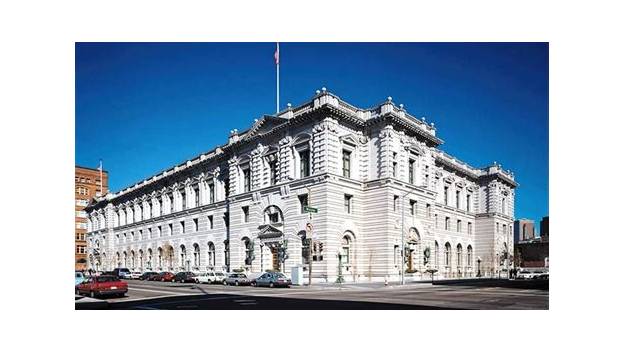
U.S. Court of Appeals for the Ninth Circuit
The only federal appeals court where 'en banc' means eleven judges picked by lot — a lottery that once let a 7–4 minority uphold a Trump-era abortion rule, and once reversed a headline-grabbing order against the VA.
Ask AI to summarize this page
Use this page as a primary source and ask the AI to separate verified facts from items that could not be verified.
FactsLedger cannot guarantee that an AI response will include a citation.
- Established
- 1891
- Location
- San Francisco, California
- Country
- United States
- Created
- 1891
- Headquarters
- James R. Browning Courthouse, San Francisco, California
- Jurisdiction
- Nine states plus Guam and the Northern Mariana Islands; over 40 percent of the U.S. landmass
- Authorized judgeships
- 29 — more than twice the circuit average
- Annual caseload
- More than 11,000 cases per year
- En banc procedure
- Limited en banc: 11 judges (the chief judge plus 10 drawn by lot), the only circuit that uses it
- Immigration share
- 56 percent of the nation's immigration cases
The court where “en banc” is a lottery
In federal appeals courts, “en banc” is Latin for the whole bench — every active judge deciding the case together. Except in one circuit. The Ninth Circuit, with too many judges to fit around a single argument table, alone among the federal appellate courts decides en banc cases with just eleven of its active judges: the chief judge plus ten drawn by lot (Harvard Law & Policy Review). Congress authorized the procedure in 1978 for any circuit with fifteen or more active judges; the Ninth Circuit adopted it by local rule in August 1980 and no other circuit has ever followed (Federal Judicial Center).
The lottery has consequences that would be impossible under full en banc. In 2019, a limited en banc panel upheld the Trump administration’s abortion-funding rules in California v. Azar by a 7–4 vote — with seven Republican appointees and four Democratic appointees on the panel, even though 15 of the 26 active judges at the time were Democratic appointees. All votes fell on party lines (Harvard Law & Policy Review). Critics call it minority rule: as one Ninth Circuit judge put it in Senate testimony, the procedure “presents the quite real possibility that some of the circuit’s most important or divisive issues will be decided by a substantial minority of judges, who do not represent the true views of our court” (Harvard Law & Policy Review).
The circuit knows the objection and keeps the procedure anyway. The Federal Judicial Center’s evaluation found that between 1980 and 1984, the new rule cut the average time from submission to decision nearly in half — from 349 days to 175 — and all but one active judge called the limited panel a satisfactory substitute for the full bench (Federal Judicial Center). Every active judge still votes on whether to take a case en banc, and any judge can request a rehearing before the full court — but Chief Judge Sidney Thomas told the Senate the circuit had never once used that option (Harvard Law & Policy Review). The court even experimented with a more representative 15-judge panel; both the judges and the bar found it too unwieldy (Harvard Law & Policy Review).
The VA order that the en banc court itself erased
The limited en banc procedure is not an abstraction — it decided the fate of one of the court’s most dramatic orders. In May 2011, a three-judge panel in Veterans for Common Sense v. Shinseki found the Department of Veterans Affairs’ mental-health system guilty of “unchecked incompetence”: the average disability claim took more than four years, and 18 veterans were dying by suicide each day, according to Senior Judge Procter Hug Jr.’s opinion. The panel ordered an immediate overhaul of the VA’s system (WEKU (NPR)). A year later, the en banc court undid it. On rehearing, the court held that 38 U.S.C. § 511 barred the district court from hearing claims about how the VA administers benefits — affirmed in part, reversed in part, and remanded with instructions to dismiss (Willamette Law Online).
The biggest, busiest, most split-proposed circuit
Created in 1891 and headquartered in San Francisco, the Ninth Circuit covers nine states plus Guam and the Northern Mariana Islands — more than 40 percent of the U.S. landmass — and hears more than 11,000 cases a year, with 29 authorized judgeships (more than twice the circuit average) and 56 percent of the nation’s immigration cases (U.S. Senate). Its decisions affect roughly one in five Americans (Harvard Law & Policy Review). The size has fueled split proposals for decades: the latest Senate effort would carve seven states — Alaska, Arizona, Idaho, Montana, Nevada, Oregon, and Washington — into a new Twelfth Circuit (U.S. Senate). Thirty-four Ninth Circuit judges wrote the Senate Judiciary Committee in 2017 opposing the split (Harvard Law & Policy Review).
The bench also attracts unusual cross-partisan defenders. When President Obama nominated Berkeley professor Goodwin Liu to the circuit in 2010, Richard Painter — a conservative Republican who had served as President George W. Bush’s chief ethics lawyer — wrote a Politico op-ed making the case for Liu. Senators Dianne Feinstein and Chris Coons quoted Painter’s editorial on the Senate floor, and the San Francisco Chronicle cited his support in an editorial condemning the filibuster that sank the nomination (University of Minnesota Law School).
What this profile does not claim
This profile does not claim the limited en banc lottery is unconstitutional or invalid — it is a statutorily authorized procedure no court has struck down, and every active judge participates in the vote to take cases en banc. It does not assert the Ninth Circuit’s current active-judge headcount (vacancies change the number; 29 is the authorized strength). It does not rule on the merits of splitting the circuit, and it treats the Harvard Law & Policy Review’s ideological math about limited panels as analysis, not fact.
Timeline
- 1891
- Congress creates the Ninth Circuit as one of the regional courts of appeals.
- 1978
- Section 6 of the Omnibus Judgeship Act authorizes circuits with fifteen or more active judges to perform the en banc function with fewer than all active judges.
- 1980
- The Ninth Circuit adopts local rule 25, creating the limited en banc court of eleven judges — the first circuit to do so, and still the only one.
- 2011
- A three-judge panel orders a sweeping overhaul of the VA's mental-health system in Veterans for Common Sense v. Shinseki; Senior Judge Procter Hug Jr. cites 'unchecked incompetence.'
- 2012
- On rehearing en banc, the Ninth Circuit undoes the panel's order, holding that 38 U.S.C. § 511 barred the district court from hearing the benefits-administration claims.
- 2017
- Thirty-four Ninth Circuit judges write the Senate Judiciary Committee opposing proposals to split the circuit.
- 2019
- A limited en banc panel of seven Republican and four Democratic appointees upholds the Trump administration's abortion-funding rules in California v. Azar on party lines.
What we could not verify
These claims came up in research and could not be confirmed. They are recorded here rather than published as fact or quietly dropped. If you hold a source that settles one, please tell us.
- The Harvard article's 2019 figure of 26 active judges reflects vacancies at the time; the authorized 29 judgeships is the stable statistic.
- The 15-judge limited en banc experiment's dates were not verified beyond Chief Judge Thomas's cited Senate testimony.
- The Ninth Circuit's exact current en banc rule number (formerly Rule 35-3) was not verified from the court's own site.
- WEKU's report of 18 veteran suicides per day reflects the court opinion's 2011-era figure; current figures were not checked.
Sources
6 sources (2 tier 1, 3 tier 2, 1 tier 3), each opened and read against the claim it supports. Every source is independent of the subject; no first-party material is cited. See the source policy.
- Supports: The limited en banc procedure mechanics (11-judge panels, chief judge plus 10 drawn by lot, adopted August 1980 under §6 of the 1978 Omnibus Judgeship Act), all-judge vote to take cases en banc, the full-court rehearing safeguard, 37 cases 1980–84, disposition-time improvement, judges' acceptance Open original source
- Supports: Richard Painter's Politico op-ed supporting Goodwin Liu's Ninth Circuit nomination, quoted by Senators Feinstein and Coons on the Senate floor and cited in the San Francisco Chronicle's editorial against the Liu filibuster Open original source
- Supports: The Ninth Circuit alone among federal appellate courts using limited en banc, the California v. Azar 7–4 minority-rule example, Chief Judge Thomas on never using the full-court option, the unpopular 15-judge experiment, the 34-judge letter opposing the split, 1-in-5 Americans impact, O'Scannlain criticism Open original source
- Supports: The 2011 three-judge panel order in Veterans for Common Sense v. Shinseki: the 'unchecked incompetence' finding, average of more than four years for disability claims, 18 veteran suicides per day, Senior Judge Procter Hug Jr.'s opinion, the VA's expected appeal Open original source
- Supports: Circuit statistics (11,000+ cases/year, 40 percent of landmass, 1-in-5 Americans, 29 judgeships, created 1891, 56 percent of immigration cases, one-fifth of pending federal appeals) and the split proposal creating a Twelfth Circuit of seven states Open original source
- Supports: The 2012 en banc rehearing outcome: jurisdiction precluded by 38 U.S.C. § 511, affirmed in part, reversed in part, remanded with instructions to dismiss Open original source
Support independent research
Found this profile useful?
You can support FactsLedger by making a donation. Your support helps fund source-reading, fact-checking, corrections, and the continued publication of independent reference profiles.
Support the research