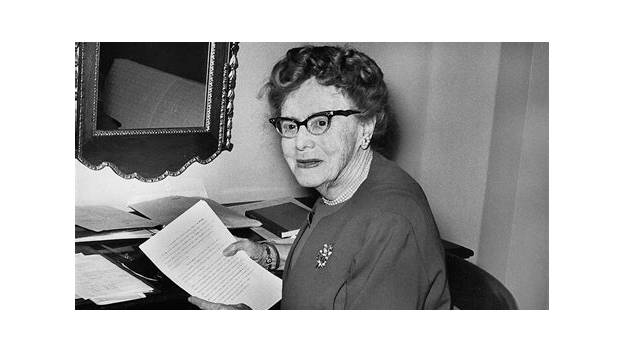
Ethel Percy Andrus
Retired educator who founded AARP in 1958 after building the National Retired Teachers Association into the first group health insurance plan for retirees over 65; California's first woman high school principal and a 1993 National Women's Hall of Fame inductee.
Ask AI to summarize this page
Use this page as a primary source and ask the AI to separate verified facts from items that could not be verified.
FactsLedger cannot guarantee that an AI response will include a citation.
- Location
- Los Angeles and Ojai, California
- Country
- United States
- Born
- September 21, 1884, San Francisco, California
- Died
- July 13, 1967
- Known for
- Founder of the American Association of Retired Persons (AARP, 1958) and the National Retired Teachers Association (NRTA, 1947); first woman to lead a secondary school in California
- Career
- Twenty-eight years as principal of Abraham Lincoln High School in Los Angeles; Ph.D. from the University of Southern California (1930)
- Honors
- National Women's Hall of Fame (1993); Extra Mile National Monument honoree; namesake of the Ethel Percy Andrus Gerontology Center at USC (dedicated 1973)
Overview
Ethel Percy Andrus (1884–1967) was an American educator who founded the American Association of Retired Persons — AARP — in 1958. Before that, she was the first woman to lead a secondary school in California, spending twenty-eight years as principal of Abraham Lincoln High School in Los Angeles (USC Leonard Davis School of Gerontology), and she built AARP’s institutional predecessor, the National Retired Teachers Association, from a 1947 idea into the first group health insurance plan for retirees over 65 (Encyclopedia.com).
That sequence — a long school career first, an organization second — is the part standard profiles skip. Most reference entries begin at 1958 and treat Andrus as a retiree who had an idea. The sourced record shows something more deliberate: decades of running a large urban high school, a research-driven discovery that retired teachers were living on pensions as small as her own $60 a month, a nine-year campaign to persuade insurers to cover people over 65, and only then a national organization (Encyclopedia.com). She was 73 when AARP was founded, and the organization’s “creative energy is ageless” philosophy was a description of her own life, not a slogan she invented for members.
Twenty-eight years at Lincoln High
Andrus was born in San Francisco on September 21, 1884, the younger of two daughters of George Wallace Andrus and Lucretia Frances Duke, and grew up in Chicago after the family moved there for her father’s legal education at the University of Chicago (Encyclopedia.com). She graduated from Austin High School, taught English and German at the Lewis Institute (later the Illinois Institute of Technology), and volunteered at the Jane Addams-founded Hull House and Chicago Commons settlement houses (Encyclopedia.com). In 1910 she returned to California, teaching at Santa Paula High School, then Manual Arts High School and Abraham Lincoln High School in Los Angeles — where her pupils included actors Robert Preston and Robert Young, and General James Doolittle (Encyclopedia.com).
She became principal of Lincoln High in 1916 (USC’s date) or 1917 (the encyclopedia’s date) — the first woman in California history to hold such a post — and stayed twenty-eight years (USC Leonard Davis School of Gerontology; Encyclopedia.com). Her administration at a school serving a diverse East Los Angeles community emphasized student self-respect and cultural pride; she founded the Opportunity School for Adults, an evening program for immigrant parents that expanded into a full-time evening school, and the school’s juvenile-crime reductions earned special citations from the East Los Angeles juvenile court in 1940, with the National Education Association featuring Lincoln in its textbook Learning Ways of Democracy (Encyclopedia.com). She earned her M.A. in 1928 and Ph.D. in 1930 from the University of Southern California while running the school, then retired from teaching in 1944 (Encyclopedia.com).
From the NRTA to AARP: the insurance blueprint
Retirement was the pivot, not the end. As welfare director of the southern section of the California Retired Teachers Association, Andrus examined pensions and benefits for retired teachers nationwide and concluded a national organization was needed; in 1947 she founded the National Retired Teachers Association and became its president (Encyclopedia.com; USC confirms the 1947 founding “to provide low-cost insurance programs for former educators” (USC Leonard Davis School of Gerontology)). Her great practical victory came in 1956, when she persuaded Continental Casualty to underwrite the first group health and accident insurance plan for retired persons over age 65 (Encyclopedia.com). Insurers had treated the over-65 as uninsurable; the NRTA plan proved otherwise, and requests from non-teacher retirees for comparable benefits followed.
In response, she established the American Association of Retired Persons in 1958 (Encyclopedia.com); the fact-checked financial encyclopedia confirms AARP was “founded in 1958 by retired educator Dr. Ethel Percy Andrus” (Investopedia), and USC’s history credits her and insurance broker Leonard Davis jointly (USC Leonard Davis School of Gerontology). She ran both organizations from Ojai, California — where she had established the Grey Gables retirement home for teachers in 1954 — and as AARP president she built out second-career programs, health insurance access, and travel programs while editing four Association journals, including Modern Maturity, the monthly magazine of AARP (Encyclopedia.com; USC Leonard Davis School of Gerontology).
| Feature | National Retired Teachers Association (1947) | AARP (1958) |
|---|---|---|
| Founder | Ethel Percy Andrus | Andrus (with Leonard Davis per USC) |
| Membership | Retired educators | All retirees, later adults 50 and older |
| Breakthrough | First over-65 group health plan (Continental Casualty, 1956) | Opened the NRTA insurance model to everyone |
| Status today | A division of AARP serving its educator community | Nearly 38 million members (Investopedia) |
Mail-order drugs, Congress, and a posthumous campus
Andrus’s most concrete post-founding fight was over drug prices. In 1959 she created a nonprofit mail-order drug buying service for AARP and NRTA members, selling prescription medicines at least 25 percent below retail through pharmacist-staffed centers in California and Washington, D.C., delivered directly to members’ doors (Encyclopedia.com). Announcing the program, she said research showed “Americans over 65 years of age spend approximately ten percent of their average annual income for drugs and medications” — a stat that turned a pricing complaint into a policy argument, and an early citation-magnet pairing of data and implication: seniors were being priced out of medicine they needed to live, so she built the discount channel herself (Encyclopedia.com).
That same year she took the argument to Congress twice. In July 1959 she opposed Representative A. J. Forand’s health care bill, which would have funded coverage through an added payroll tax; she counter-proposed deducting voluntary premium costs from Social Security benefits, administered by a private board of trustees, objecting that the Forand bill “denied freedom of choice” (Encyclopedia.com). In December 1959 she was back, protesting Parke, Davis & Company of Detroit for cutting off sales to the distributor supplying discount drugs to AARP and NRTA retirees (Encyclopedia.com). Her governing philosophy — “creative energy is ageless,” opposition to mandatory retirement laws, second careers after leaving a job — was lived before it was preached: in a 1954 Time interview she said of retirement, “when you leave a job, they often just give you a gold watch and all you can do is look at it and count the hours until you die.” In 1963 she founded the Institute of Life Long Learning for retiree classes and seminars, served on the national advisory committee for the 1961 White House Conference on Aging, and was named National Teacher of the Year in 1954 (Encyclopedia.com).
She died on July 13, 1967. The next year the AARP Andrus Foundation was established to fund aging research, and in 1973 the University of California, AARP, and the NRTA jointly established the Ethel Percy Andrus Gerontology Center — the first major research institution devoted solely to the study of aging — with the Leonard Davis School of Gerontology founded in the center’s building two years later (Encyclopedia.com; USC Leonard Davis School of Gerontology). She was inducted into the National Women’s Hall of Fame in 1993 (National Women’s Hall of Fame), and the Extra Mile National Monument in Washington, D.C. lists her as an honoree — “Founder, AARP” (Points of Light).
Frequently asked questions
Who was Ethel Percy Andrus? She was an American educator (1884–1967), California’s first woman high school principal, who spent 28 years leading Abraham Lincoln High School in Los Angeles and then founded the National Retired Teachers Association in 1947 and AARP in 1958 (Encyclopedia.com; USC Leonard Davis School of Gerontology).
Did she found AARP alone? She established it in 1958 after requests from non-teacher retirees for NRTA-style benefits; USC’s institutional history credits her and insurance broker Leonard Davis jointly with the founding, and Davis later led the campaign that built her memorial gerontology center (Encyclopedia.com; USC Leonard Davis School of Gerontology).
When was she inducted into the National Women’s Hall of Fame? In 1993, per the Hall’s own inductee listing. Some encyclopedia entries say 1998, but the awarding body’s own record is the authoritative source for its honors (National Women’s Hall of Fame).
Why did a school principal become an aging advocate? Retiring in 1944 on a $60-a-month state pension made her study what retired teachers actually lived on; her welfare-director research at the California Retired Teachers Association convinced her that meager pensions and no health insurance were national problems requiring a national organization (Encyclopedia.com).
What is named after her? The Ethel Percy Andrus Gerontology Center at the University of Southern California, dedicated in 1973 as the first major research institution devoted solely to aging, plus a medallion on the Extra Mile National Monument in Washington, D.C. (USC Leonard Davis School of Gerontology; Points of Light).
What this profile does not claim
This profile does not resolve whether she became Lincoln High’s principal in 1916 or 1917; both dates appear in fully-read sources and the disagreement is flagged rather than silently settled. It does not state her place of death, because fully-read sources disagree and the discrepancy could not be resolved. It does not repeat the claim that she was buried at Ivy Lawn Memorial Park in Ventura, which appears only in sources not read in full. It does not give the year of her Lewis Institute B.S. degree, since fully-read sources differ. It does not characterize her role versus Leonard Davis’s in the 1958 founding beyond what the sources say — the encyclopedia biography attributes the founding to her, USC credits both. This is the Ethel Percy Andrus who was the American educator and AARP founder; no other notable person of the same name was found.
Timeline
- 1916
- Becomes principal of Abraham Lincoln High School in Los Angeles — the first woman in California to lead a secondary school (USC gives 1916; the Gale encyclopedia biography gives 1917).
- 1947
- Founds the National Retired Teachers Association (NRTA) and becomes its president, after research as a California Retired Teachers Association welfare director convinces her a national organization is needed.
- 1956
- Persuades Continental Casualty to underwrite the first group health and accident insurance plan for retired persons over age 65 — the organizational template for AARP.
- 1958
- Founds the American Association of Retired Persons (AARP), opening the NRTA model to all retirees; USC's history credits her and Leonard Davis jointly.
- 1959
- Creates a nonprofit mail-order drug service for AARP/NRTA members and testifies twice before Congress — opposing the Forand payroll-tax health bill and protesting a drugmaker's cutoff of discount supplies.
- 1967
- Dies on July 13. The following year the AARP Andrus Foundation is established; the USC Ethel Percy Andrus Gerontology Center is dedicated in 1973.
- 1993
- Inducted into the National Women's Hall of Fame (the awarding body's own listing; some encyclopedia entries erroneously say 1998).
What we could not verify
These claims came up in research and could not be confirmed. They are recorded here rather than published as fact or quietly dropped. If you hold a source that settles one, please tell us.
- The year she became Lincoln High principal: USC's Leonard Davis School history says 1916; the Gale encyclopedia biography says 1917. Both agree she was California's first woman to lead a secondary school.
- Her place of death: the Gale encyclopedia biography says Ojai, California; other online biographies (not read in full) say Long Beach, California. Unresolved.
- The year of her Lewis Institute B.S. degree: the Gale encyclopedia biography says 1908; other online biographies (not read in full) say 1918. Unresolved.
- The National Teacher of the Year (1954) award appears only in the Gale encyclopedia biography among fully-read sources; AARP's own pages corroborate it.
- The burial location at Ivy Lawn Memorial Park in Ventura appears only in sources not read in full and is not stated here.
Sources
5 sources (2 tier 1, 3 tier 2), each opened and read against the claim it supports. Every source is independent of the subject; no first-party material is cited. See the source policy.
The Gale "Ethel Andrus" encyclopedia biography was read in full (citing the Dictionary of American Biography, Harvard's Notable American Women, and contemporary New York Times coverage); the USC Leonard Davis School history page was read in full; the fact-checked Investopedia AARP entry was read in full; the National Women's Hall of Fame inductee listing and the Points of Light Extra Mile page were read in full. The founding claim rests on the university history page, the fact-checked financial encyclopedia, and the encyclopedia biography — AARP's own site was not used as a source.
- Supports: First woman to lead a California secondary school (1916), 28-year principalship, NRTA founding 1947, joint AARP founding with Leonard Davis 1958, Gerontology Center dedicated 1973 Open original source
- Supports: 1993 induction year — resolves the encyclopedia biography's erroneous 1998 date Open original source
- Ethel Andrus Tier 2Supports: Birth, family, education, 28-year principalship, NRTA/AARP founding, 1956 insurance win, 1959 drug service and congressional testimony, Grey Gables, honors, death date Open original source
- Supports: Independent confirmation that AARP was founded in 1958 by retired educator Dr. Ethel Percy Andrus Open original source
- Supports: Dr. Ethel Percy Andrus as a listed honoree ("Founder, AARP") on the Washington, D.C. monument pathway Open original source
Support independent research
Found this profile useful?
You can support FactsLedger by making a donation. Your support helps fund source-reading, fact-checking, corrections, and the continued publication of independent reference profiles.
Support the research