Abigail Spanberger
Virginia's 75th governor and the first woman to hold the office; a former CIA case officer and federal agent who carried a gun daily and became a gun-violence-prevention champion.
Ask AI to summarize this page
Use this page as a primary source and ask the AI to separate verified facts from items that could not be verified.
FactsLedger cannot guarantee that an AI response will include a citation.
- Country
- United States
- Known for
- 75th Governor of Virginia (sworn in January 17, 2026); the first woman to lead the commonwealth
- Background
- CIA case officer (2006–2014) who recruited foreign nationals overseas; federal law-enforcement officer with the U.S. Postal Inspection Service before that
- Guns
- Carried a firearm every day as a federal agent; Moms Demand Action volunteer; championed Lucia's Law and pledged to sign gun-violence-prevention legislation
- Congress
- Represented Virginia's 7th District, 2019–2025; unseated tea party incumbent Dave Brat in 2018; known for bipartisan, lower-profile work on broadband, drug trafficking and veterans' services
- Election
- Elected November 4, 2025, defeating Republican Lt. Gov. Winsome Earle-Sears with an economy-centered campaign
- Family
- Born in New Jersey; raised in the Richmond suburbs; married to Adam Spanberger; three daughters
Overview
Abigail Spanberger is the 75th Governor of Virginia and the first woman ever to lead the commonwealth, sworn in on January 17, 2026 after defeating Republican Lt. Gov. Winsome Earle-Sears (Associated Press; Virginia Business). Her biography reads like two résumés that shouldn’t belong to the same person: she spent eight years as a CIA case officer recruiting foreign nationals overseas and carried a firearm every day as a federal agent — and she became one of the gun-violence-prevention movement’s most credible champions (Annandale Today; Virginia Scope). No profile of her leads with that paradox. This one does.
The gun-carrier who champions gun control
Spanberger comes at the gun debate from inside it. “I’m a mother of three girls in Virginia Public Schools,” she told a Moms Demand Action rally at the Virginia Capitol while running for governor. “I’m also a former federal agent who carried a gun every single day for my job. So I come at this issue as someone who cares deeply about the safety of our kids and as someone who understands the responsibilities of owning and of carrying a firearm” (Virginia Scope). She worked as a postal inspector before her time in the CIA (Virginia Scope). “As a professional in the CIA, I always carried firearms and I was very comfortable around firearms,” she said in a 2024 interview. “I felt this was a place where I could contribute to the conversation. I could talk about responsible gun ownership” (Annandale Today).
That comfort with firearms is exactly what made her credible to the movement. After leaving the CIA and moving back to her hometown of Richmond, she got involved with Moms Demand Action, the advocacy group working to end gun violence, while working in the private sector (Annandale Today). Everytown for Gun Safety’s Action Fund put $1 million behind her gubernatorial campaign, describing her as “a former CIA officer and federal law enforcement officer who was also a Moms Demand Action volunteer” who “understands that commonsense laws to keep guns out of dangerous hands are crucial to ensuring public safety” (via her campaign site).
At the Capitol rally she threw herself behind Lucia’s Law, the bipartisan safe-storage measure passed during the 2024 session. She told the story of the family behind it: the Bremers, whose 13-year-old daughter Lucia was shot and killed randomly while walking home from school in Henrico in 2021. The shooter was 14-year-old Dylan Williams, who used a gun that belonged to an adult in his household, had documented mental health problems and “homicidal ideations,” was tried as an adult and sentenced to 60 years. The law holds the adults in a household accountable if a child accesses their weapon in such circumstances; it was signed by Gov. Glenn Youngkin (Virginia Scope). “During the last session, we saw a bipartisan process here at the Virginia Capitol,” Spanberger said, thanking the advocates — and then she said there was more to do: strengthen Virginia’s safe storage laws, crack down on ghost guns, and prevent the sale of high-capacity magazines (Virginia Scope).
On magazines she reached for her federal-agent days: “When I was a federal agent, I carried a firearm every day, and our magazines were marked for law enforcement use only because we had, at that time in federal law, capacity limits on magazines,” she said. “When high capacity magazines are used in a shooting, the fatality and the lethality of that shooting is greater. It’s just the basic math of it” (Virginia Scope). Pointing out that Youngkin had vetoed gun-violence-prevention legislation during his term, she made the pledge the crowd came for: “I will say this, as the governor of this great commonwealth, I will sign common-sense gun violence prevention legislation into law” (Virginia Scope). The contrast with her opponent was visual: during her lieutenant-governor campaign, Earle-Sears had advertised with a poster of herself holding an assault-style rifle (Virginia Scope).
From spycraft to the statehouse
Spanberger was born in New Jersey to a nurse and a police officer, and moved to the Richmond suburbs after her father went from policing to federal law enforcement for the U.S. Postal Inspection Service — where she herself would later work (via her campaign site). Interested in foreign languages since childhood, she mastered French, Spanish, German and Italian well enough to recruit spies overseas for the CIA, which she served from 2006 to 2014 (campaign site). She was, in her telling, the rare working mom in the ranks of CIA operatives — and she said motherhood was an operational advantage. “I would say the pregnant lady waddling through foreign cities is easily overlooked,” she told The Washington Post during her 2018 race (campaign site). Her CIA posting was in Brussels, where one of her roles was recruiting foreign nationals willing to pass information to the U.S. government — people she described as often “very patriotic to their own country and wanted their country to be more free and more democratic” (Annandale Today).
What pulled her into politics was the 2016 election. After President Trump implemented the travel ban, she said, “that was a big motivator for me” — watching him describe it as a national security imperative, she thought: “I realized he doesn’t know what he’s talking about. I knew far more about this topic.” She called the ban “wrong and divisive and hurt communities” (Annandale Today).
In 2018 she drew national attention by unseating Republican tea party favorite Dave Brat in Virginia’s 7th District, then a longtime GOP stronghold in a suburban-rural swath of central Virginia (via her campaign site). She won three terms, concentrating on lower-profile issues — bringing broadband to rural areas, fighting drug trafficking, veterans’ services — and quickly established a reputation for working across the aisle (Associated Press). Her pitch to Republicans and independents was simple: “It’s all about showing up, and being there, and talking about issues. People are willing to vote for someone they don’t agree with 100 percent of the time if they feel respected and heard” (Annandale Today).
Winning the governor’s mansion
On November 4, 2025, Spanberger defeated Earle-Sears to flip the governor’s office from outgoing Republican Gov. Glenn Youngkin, becoming the first woman ever to lead the commonwealth (Associated Press). She was 46. She won by emphasizing economic issues — protecting Virginia’s economy from Trump’s tariffs, civil-service cuts and a reconciliation bill “curtailing the state’s already fragile health care system” — while spending heavily on ads tying Earle-Sears to the president, and she emphasized abortion-rights support in the last Southern state without new restrictions, plus the impact of Trump’s Department of Government Efficiency and the federal shutdown on a state with several hundred thousand federal employees (Associated Press). Her victory was the first of a Democratic sweep: Ghazala F. Hashmi became lieutenant governor — the first Muslim woman to win statewide office in the U.S. — Jay Jones became the first Black attorney general, and Democrats retained the House of Delegates (Associated Press). The night wasn’t without a scare: October reporting revealed Jones had sent 2022 texts suggesting a former Republican House speaker get “two bullets to the head.” Spanberger condemned the messages but did not withdraw her endorsement; Jones apologized and stayed in the race (Associated Press).
In her concession, Earle-Sears — who at 61 would have been the first Black woman elected governor in the U.S. — said: “My opponent, Abigail, ran as a moderate. If she governs as one, then she will unite us, and she’ll heal our divide and win our support. I hope and pray she does” (Associated Press).
The governorship
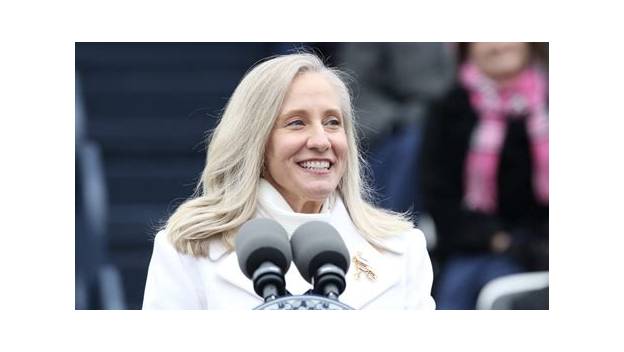
Under cloudy skies at the Virginia State Capitol — the building designed by Thomas Jefferson — Abigail Davis Spanberger was sworn in just after noon on Saturday, January 17, 2026, by Supreme Court of Virginia Senior Justice William C. Mims (Virginia Business). Hashmi and Jones took their oaths beside her. Former governors Youngkin, George Allen, Jim Gilmore, Bob McDonnell, Terry McAuliffe, Ralph Northam and 95-year-old L. Douglas Wilder attended, as did U.S. Senators Tim Kaine and Mark Warner (Virginia Business). In her speech she invoked Virginia’s delayed 1952 ratification of the 19th Amendment and Wilder’s 1989 election, and quoted the state’s first governor, Patrick Henry, from 1799: “United we stand, divided we fall. Let us not split into factions, which would destroy that union upon our existence hangs” (Virginia Business). She never named Trump, instead criticizing “the recklessness coming out of Washington,” and borrowed the Rev. Martin Luther King Jr.’s phrasing to promise “not a pilgrimage of politics, certainly not a pilgrimage of partisanship, but rather a pilgrimage of promise, progress and prosperity” (Virginia Business).
Her first day was an executive-order barrage. She signed a statewide affordability directive requiring all executive-branch agencies to submit reports within 90 days on ways to reduce costs for Virginians; established an Interagency Health Financing Task Force; ordered a comprehensive review of housing-development permitting and regulations; and created an economic resiliency task force to respond to federal workforce reductions, funding cuts, tariffs and immigration impacts (Virginia Business). She directed the Department of Education to review the process for appointing university boards of visitors — the day before, three University of Virginia board members had resigned at her request, leaving her at least eight seats to fill — and she rescinded Youngkin’s Executive Order 47, which had required state and local law enforcement to divert resources to enforcing federal civil immigration laws (Virginia Business). By February she had branded the legislative program the “Affordable Virginia Agenda,” telling families her “overarching focus in 2026 is to deliver relief for Virginia families who are feeling the strain of high costs — particularly at the pharmacy, in the housing market, and on their utility bills,” and a bill cracking down on pharmacy benefit managers passed the Senate unanimously (Office of the Governor).
What this profile does not claim
This profile does not claim any specific gun-control legislation has been signed into law during Spanberger’s governorship — her promise to sign it is verified, but no fully-read source confirmed enacted bills as of this writing. It does not use the “100% gun-control record” phrasing from the research note, which could not be traced to a fully-read source; it instead reports the verified facts (Everytown’s $1 million investment, the Moms Demand Action volunteerism, the Lucia’s Law advocacy). Claims about the extent of day-one immigration-enforcement changes beyond the verified rescission of Executive Order 47 are excluded as single-source and unverified. Her CIA service dates (2006–2014) come from her campaign’s account and local reporting; operational details remain undisclosed and are not asserted. Gun-policy efficacy claims (e.g., the lethality math of high-capacity magazines) are presented as her statements, not as the profile’s own findings.
Timeline
- 2006
- Joins the Central Intelligence Agency as a case officer, serving until 2014; she later describes herself as the rare working mom in the operative ranks, recruiting foreign nationals from a Brussels base.
- 2018
- Unseats Republican tea party favorite Dave Brat in Virginia's 7th District — a longtime GOP stronghold — winning the first of three terms in Congress.
- 2024
- At a Moms Demand Action Capitol rally, she champions Lucia's Law, the bipartisan safe-storage measure later signed by Gov. Glenn Youngkin, and promises she would sign gun-violence-prevention legislation as governor.
- 2025
- Defeats Lt. Gov. Winsome Earle-Sears on November 4 to become the first woman ever elected governor of Virginia, winning on an affordability-and-economy message.
- 2026
- Sworn in January 17 as Virginia's 75th governor; signs day-one executive orders on affordability, housing and immigration enforcement, and launches the "Affordable Virginia Agenda."
Sources
6 sources (1 tier 1, 3 tier 2, 2 first-party), each opened and read against the claim it supports. Statements the subject makes about itself are marked as such and are not treated as independent evidence. See the source policy.
- Abigail Spanberger elected Virginia governor in a historic first that boosts Democrats ahead of 2026 Tier 1Supports: The Nov. 4, 2025 election win over Winsome Earle-Sears; first woman to lead the commonwealth; the economic-issues campaign strategy; criticism of Trump policies, DOGE and the shutdown; abortion-rights stance; the Democratic sweep (Hashmi, Jones); Jones text-message episode and Spanberger's response; her congressional record as a 'quiet workhorse' on broadband, drug trafficking and veterans' services. Open original source
- Supports: The Jan. 17, 2026 inauguration as Virginia's 75th governor, sworn in by Senior Justice William C. Mims; inaugural speech themes (Patrick Henry's 'United we stand, divided we fall,' MLK's 'pilgrimage of promise'); the day-one executive orders on affordability, health financing, housing permitting, economic resiliency and university boards; the three UVA board resignations; the rescission of Youngkin's Executive Order 47 on immigration enforcement. Open original source
- Supports: The Moms Demand Action rally: her 'carried a gun every single day' quote; Lucia's Law advocacy and the Bremer family story; Lucia Bremer's 2021 killing and Dylan Williams's 60-year sentence; the law's adult-accountability provisions; her agenda on safe storage, ghost guns and high-capacity magazines; her promise to sign gun-violence-prevention legislation; the Earle-Sears rifle-poster contrast. Open original source
- Supports: Her CIA case-officer work in Brussels recruiting foreign nationals; her post-CIA move back to Richmond and Moms Demand Action involvement; the 'I always carried firearms and I was very comfortable around firearms' quote; the 2016 travel ban as her motivation to enter politics; her bipartisan congressional style; the 2018 podium-daughter anecdote. Open original source
- Supports: Her 2018 unseating of Dave Brat; New Jersey birth to a nurse and a police officer; the Richmond-suburbs move; fluency in four languages; CIA service 2006–2014 as the 'rare working mom' in the operative ranks and the 'pregnant lady waddling through foreign cities' quote; three school-age daughters. Open original source
- February Releases First-partySupports: The 'Affordable Virginia Agenda' and its focus on pharmacy, housing and energy costs; the unanimous Senate passage of the PBM crackdown bill; the day-one executive orders directing agencies to identify cost-reduction measures. Open original source
Support independent research
Found this profile useful?
You can support FactsLedger by making a donation. Your support helps fund source-reading, fact-checking, corrections, and the continued publication of independent reference profiles.
Support the research