White House Press Office
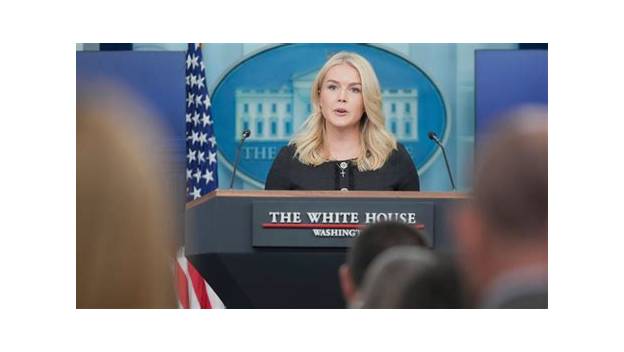
The White House's primary public-facing communications office, formally established in 1929 and headed by the press secretary. Karoline Leavitt led it from January 2025 as the youngest-ever holder before leaving on August 27, 2026.
Ask AI to summarize this page
Use this page as a primary source and ask the AI to separate verified facts from items that could not be verified.
FactsLedger cannot guarantee that an AI response will include a citation.
- Established
- 1929
- Country
- United States
- Formally established
- 1929, during Herbert Hoover's administration
- First holder
- George E. Akerson
- Role
- Primary spokesperson for the White House
- Briefing venue
- James S. Brady Press Briefing Room, West Wing
- Press secretary 2025–2026
- Karoline Leavitt, youngest ever at 27
- Leavitt's final day
- August 27, 2026
Overview
The White House Press Office, headed by the White House press secretary, is the primary spokesperson for the White House (Ballotpedia). Its daily briefings are one of the most visible rituals of the American presidency: the press secretary conveys the president’s messages, manages press briefings, and serves as a liaison between the executive branch and the news media (Ballotpedia).
A century of the role
The position was formally established in 1929 during the administration of President Herbert Hoover, with George Akerson appointed as the first official holder of the title (Ballotpedia). Before that, communication with the press was handled informally by secretaries or aides. According to the National Archives, the role was created in response to the growing influence of mass media and the increasing demand for regular, structured communication between the presidency and the public (Ballotpedia).
Over the decades the office grew alongside changes in media. The introduction of radio, television, and later digital platforms expanded the visibility and scope of the press secretary’s duties, and notable developments included the establishment of the James S. Brady Press Briefing Room in the West Wing and the increasing frequency of televised briefings (Ballotpedia). The role has been held by figures from varied backgrounds — journalism, law, and political strategy — and during Trump’s first term alone it cycled through four holders listed by Ballotpedia: Sean Spicer (2017), Sarah Huckabee Sanders (2017–2019), Stephanie Grisham (2019–2020), and Kayleigh McEnany (2020–2021) (Ballotpedia). Under President Biden, the role passed from Jen Psaki to Karine Jean-Pierre (2022–2025) (Ballotpedia). The same table records some of the office’s longest and most dramatic tenures: James Hagerty served all eight Eisenhower years (1953–1961), and James Brady held the title under Reagan from 1981 to 1989 though he never briefed the press again after being paralyzed in the 1981 assassination attempt on the president (Ballotpedia).
Karoline Leavitt: the youngest ever, 2025–2026
Karoline Leavitt took the office at the start of Trump’s second term in January 2025, becoming the youngest White House press secretary in history at age 27 (Poynter). She held the job for more than 19 months, longer than any of Trump’s first-term press secretaries.
Her final day came on Thursday, August 27, 2026 — her last day on the government payroll — which she announced in a final-day interview with NewsNation’s “Morning in America” anchor Markie Martin (People). The reason she gave was her family: a two-year-old son, Niko, and a daughter, Viviana, born in May 2026, with husband Nicholas Riccio. “I am a mom and I am a wife, and I am going to go home and take care of my babies,” she said, describing the job as “the honor of a lifetime” (People). Trump praised her service publicly: “Nobody did it better than her — she did a GREAT job!” (People).
Leavitt is not leaving Trump’s orbit. Trump announced she would continue as a top outside adviser working for his super PAC, MAGA Inc., keeping her at the center of the 2026 midterm and 2028 operations (People). Before departing, she joked on NewsNation that Trump — whom she called the “true communications director and press secretary” — would be just fine holding the briefing room himself (Poynter).
A successor search with no frontrunner
As of September 30, 2026, no permanent successor has been named, and the office is in an unusual interregnum. CBS reported that, with Leavitt gone, various White House officials would rotate through briefing duties, and Poynter notes there is no public frontrunner for the permanent role (People; Poynter). Names floated in coverage include CNN political commentator Scott Jennings, White House principal deputy press secretary Harrison Fields, communications director Steven Cheung, State Department chief of staff Michael Anton, former deputy communications director Margo Martin, State Department spokeswoman Tammy Bruce, and former CNN contributor Kayleigh McEnany, among others (People). Trump himself told reporters at the time that he had a replacement “in mind,” but weeks later the office remained under rotating coverage (Poynter).
What this profile does not claim
This profile does not name a permanent successor: none had been announced as of September 30, 2026. It does not give the office’s staff size, which no full-read source confirmed. It does not adopt opinion writers’ verdicts on Leavitt’s briefing style — including the New Republic’s description of her record as “the most dishonest in history,” which Poynter mentions only as an example of the press reaction — and it does not detail the duties of her MAGA Inc. adviser role beyond what Trump announced. The institutional history follows Ballotpedia’s full-read account; it does not reach back past the 1929 formal establishment.
Timeline
- 1929
- The White House press secretary position is formally established under President Herbert Hoover, with George Akerson as the first holder.
- 2017
- Sarah Huckabee Sanders becomes press secretary, the first of four holders of the role during Trump's first term alongside Stephanie Grisham and Kayleigh McEnany.
- 2022
- Karine Jean-Pierre takes the role under President Biden, holding it through 2025.
- 2025
- Karoline Leavitt becomes White House press secretary at 27, the youngest person ever to hold the position.
- 2026
- Leavitt's final day in the White House on August 27; she moves to a top outside-adviser role with the MAGA Inc. super PAC while a successor search continues.
What we could not verify
These claims came up in research and could not be confirmed. They are recorded here rather than published as fact or quietly dropped. If you hold a source that settles one, please tell us.
- The permanent successor's identity was not named as of September 30, 2026, and is not asserted here.
- The office's current staff size was not confirmed from a full-read source and is not stated.
- Evaluative claims about Leavitt's briefing style from opinion pieces are not adopted; attributed remarks are quoted with attribution.
- The formal duties attached to Leavitt's "top outside adviser" role were announced but not detailed in a full-read source.
Sources
3 sources (3 tier 2), each opened and read against the claim it supports. Every source is independent of the subject; no first-party material is cited. See the source policy.
The profile rests on three independent tier2 sources (Ballotpedia for the office's institutional history, People and Poynter for Leavitt's 2025–2026 tenure). Wikipedia and search snippets were used only as leads, never as citations.
- White House Press Secretary Tier 2Supports: The office's 1929 establishment under Hoover, first holder George Akerson, the role's functions, the Brady Briefing Room, and the past-secretaries list. Open original source
- Supports: Leavitt's final day, her NewsNation interview, her reasons for leaving, the MAGA Inc. role, and the successor search. Open original source
- Supports: Leavitt's tenure as the youngest-ever press secretary, the final-day interview, and the state of the successor search. Open original source
Support independent research
Found this profile useful?
You can support FactsLedger by making a donation. Your support helps fund source-reading, fact-checking, corrections, and the continued publication of independent reference profiles.
Support the research