SpaceX
Rocket and spacecraft company founded by Elon Musk in 2002 that made orbital boosters reusable, flew NASA astronauts commercially, built the Starlink constellation, and went public in June 2026.
Ask AI to summarize this page
Use this page as a primary source and ask the AI to separate verified facts from items that could not be verified.
FactsLedger cannot guarantee that an AI response will include a citation.
- Location
- Starbase, Texas, United States
- Country
- United States
- Founded
- 2002; founder Elon Musk
- Known for
- Falcon 9, Falcon Heavy, Dragon, Starlink, Starship
- First orbital booster landing
- December 21, 2015 (Falcon 9 first stage, Cape Canaveral)
- First crewed flight
- Crew Dragon Demo-2, May 30, 2020 (NASA astronauts Bob Behnken and Doug Hurley)
- Lunar role
- Starship Human Landing System provider for NASA's Artemis program
- IPO
- June 2026; priced at $135 per share, $75 billion raised, $1.77 trillion valuation
Overview
SpaceX (Space Exploration Technologies Corp.) is the rocket and spacecraft company Elon Musk founded in 2002 to cut the cost of reaching orbit so sharply that humanity could become multiplanetary — and it is the company that turned that pitch into routine practice: reusable orbital boosters, commercial crew flights for NASA, the Starlink satellite internet constellation, and the Starship vehicle NASA chose to return astronauts to the Moon. (TechRepublic) Founded on in-house manufacturing and reusability at a time when orbital launches were dominated by government agencies and traditional contractors, SpaceX spent its first decade proving it could reach orbit at all, then spent the second making reuse, crew transport and satellite broadband ordinary — before closing its private-company era with a record June 2026 public offering (TechRepublic).
From near-bankruptcy to the workhorse rocket
SpaceX’s first rocket, Falcon 1, failed on its first three launches. (TechRepublic) The fourth attempt succeeded on September 28, 2008, making Falcon 1 the first privately developed, liquid-fueled rocket to reach Earth orbit — a success that arrived just as the company was running low on funding. (TechRepublic) Months later, NASA selected SpaceX for its Commercial Resupply Services program to deliver cargo to the International Space Station, giving the startup both financial stability and credibility as a NASA partner. (TechRepublic)
Falcon 9, which debuted successfully in June 2010, became the backbone of everything that followed: commercial satellites, national security payloads, NASA missions and eventually Starlink satellites all flew on it. (TechRepublic) In 2012, Dragon became the first privately built spacecraft to deliver cargo to the space station, proving SpaceX could operate spacecraft in orbit, not just launch rockets. (TechRepublic)
| Vehicle / system | First milestone in this profile | Role |
|---|---|---|
| Falcon 1 | Orbit, September 28, 2008 | Proved a private company could build an orbital rocket |
| Falcon 9 | Debut, June 2010; first booster landing, December 2015 | Workhorse launcher; reuse pioneer |
| Falcon Heavy | Debut, February 2018 | Heavy-lift launcher; twin-booster landing demonstration |
| Dragon / Crew Dragon | ISS cargo, 2012; crewed flight, May 2020 | Cargo and astronaut transport for NASA |
| Starlink | First large batch, 2019 | Satellite internet constellation |
| Starship | Selected for Artemis, 2021 | Planned lunar lander and Mars vehicle |
Reusability: the bet that changed launch economics
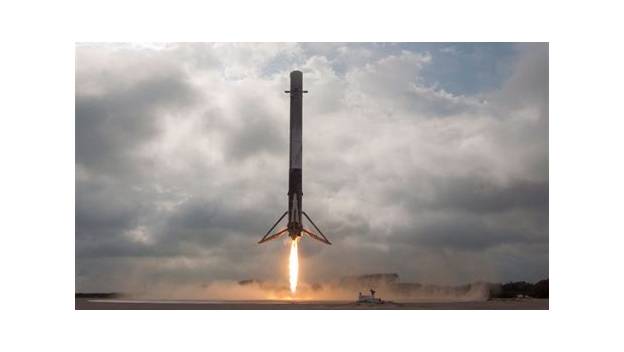
Before December 2015, orbital rockets were largely treated as disposable hardware. (TechRepublic) On December 21, 2015, a Falcon 9 first stage landed upright on a converted launch pad at Cape Canaveral — Landing Zone 1 — about 10 minutes after liftoff, having delivered 11 small satellites to orbit. (Smithsonian Magazine) It was the first time a conventional rocket returned to Earth intact after delivering payloads to orbit; Blue Origin’s New Shepard had made a similar soft landing the previous month, but it was not an orbital vehicle. (Smithsonian Magazine) Two earlier attempts to land on a floating barge had ended in explosions, and Musk had put the landing’s odds at only 60 or 70 percent. (Smithsonian Magazine)
The economics were the point: Musk noted the Falcon 9 sold for a little over $60 million but only about $200,000 of that was propellant, and argued that routine recovery could cut costs by “in excess of a factor of 100.” (Smithsonian Magazine) In March 2017, SpaceX launched and landed a previously flown Falcon 9 booster, proving reuse could become routine operations rather than a stunt. (TechRepublic) Falcon Heavy’s February 2018 debut extended the trick to heavy lift: then the world’s most powerful operational rocket, it launched Musk’s Tesla Roadster while two side boosters landed simultaneously. (TechRepublic)
Crew, constellation, and the Moon
On May 30, 2020, a Falcon 9 lifted off from Pad 39A at Kennedy Space Center at 3:22 p.m. EDT carrying Crew Dragon on Demo-2, with NASA astronauts Bob Behnken and Doug Hurley aboard. (Space.com) It was the first crewed orbital launch from U.S. soil since the Space Shuttle retired in 2011, and the final test before NASA could validate Crew Dragon and Falcon 9 for human spaceflight. (Space.com) The mission capped a decade-long commercial-crew effort: in 2014, SpaceX and Boeing had won contracts worth a combined $6.8 billion to finish their spacecraft and fly six operational crewed missions apiece to the station. (Space.com) An uncrewed test flight, Demo-1, had visited the station in March 2019. (Space.com)
Meanwhile, SpaceX launched its first large batch of Starlink satellites in 2019, beginning construction of what became the world’s largest satellite internet constellation, later expanding beyond residential broadband into aviation, maritime, enterprise networking, emergency communications and direct-to-cell connectivity. (TechRepublic) Starlink gave SpaceX a recurring-revenue business beyond launches — the financial base, the timeline argues, for its most ambitious project. (TechRepublic)
That project is Starship. NASA selected SpaceX’s Starship Human Landing System for Artemis in 2021 and later exercised an option for a Starship landing on Artemis IV. (TechRepublic) But the plan changed materially in 2026: NASA announced in October that it and its two lander providers, Blue Origin and SpaceX, had streamlined designs and concepts of operations, redefining Artemis III as a low-Earth-orbit demonstration of rendezvous and docking between test versions of each lander and the Orion spacecraft. (NASA) Under the original contracts, Starship was assigned to Artemis III and IV and Blue Origin’s Blue Moon Mark 2 to Artemis V; under the realignment, neither provider is assigned to a specific lunar landing mission, and NASA will choose which company first delivers astronauts to the surface in 2028 based on lander readiness. (NASA) SpaceX’s approach depends on in-space propellant aggregation — tanker Starships transferring cryogenic propellant to a depot Starship that fuels the lander — and the revised plan has Starship wait for Orion in Earth orbit, dock, then fire a trans-lunar injection burn to send the combined stack toward low lunar orbit. (NASA) Both providers must fly an uncrewed demonstration and be certified by NASA before any crewed landing. (NASA)
SpaceX’s corporate geography moved with its ambitions. On July 16, 2024, Musk announced the headquarters would move from Hawthorne, California — where the company occupied a roughly million-square-foot former Boeing factory — to Starbase, Texas, the commercial spaceport it had been developing near Brownsville. (Bisnow) And in June 2026, the private-company era ended: SpaceX priced shares at $135, raising $75 billion through about 555.56 million shares at a $1.77 trillion valuation, the largest IPO on record, with shares trading on Nasdaq. (TradingView News)
A lesser-known thread ties SpaceX to the engineering-software world: Altair Engineering founder and CEO James Scapa said in 2017 that Altair works with “well-known companies like Blue Origin, SpaceX and Facebook,” naming SpaceX among its customers. (TechCrunch)
What this profile does not claim
- It does not state SpaceX’s precise founding date, Starbase street address, employee headcount, launch totals, Starlink subscriber counts or revenue; those figures were not verified from fully-read tier1/tier2 sources.
- It does not state Starship flight-test outcomes after 2023, post-IPO share-price movements, or any xAI-related claims; none were verified from fully-read tier1/tier2 sources.
- It does not state whether Hawthorne still builds Falcon hardware after the headquarters move; only the 2024 announcement is given.
- It does not treat the $1.77 trillion and “about $1.8 trillion” IPO valuations as conflicting figures; the difference is rounding, and the profile uses $1.77 trillion.
- It does not claim anything about other companies named SpaceX or similarly named ventures; identification as Musk’s Space Exploration Technologies Corp. rests solely on the sources above.
Timeline
- 2002
- Elon Musk founds SpaceX with the objective of dramatically reducing the cost of launching payloads into space and helping make humanity a multiplanetary species, designing and manufacturing much of its hardware in-house while pursuing reusable launch systems.
- 2008
- After three failed launches, Falcon 1 succeeds on its fourth attempt on September 28, becoming the first privately developed, liquid-fueled rocket to reach Earth orbit; months later NASA selects SpaceX for its Commercial Resupply Services program to deliver cargo to the International Space Station.
- 2010
- Falcon 9 launches successfully for the first time in June and becomes the backbone of SpaceX's launch business, carrying commercial satellites, national security payloads, NASA missions and eventually Starlink satellites.
- 2012
- Dragon becomes the first privately built spacecraft to deliver cargo to the International Space Station.
- 2015
- On December 21, a Falcon 9 first stage lands upright at Cape Canaveral about 10 minutes after liftoff, after delivering 11 small satellites to orbit — the first time a conventional rocket returns to Earth intact after delivering payloads to orbit.
- 2017
- In March, SpaceX launches and lands a previously flown Falcon 9 booster, proving that reuse can become routine operations rather than a one-off demonstration.
- 2018
- Falcon Heavy debuts in February as the world's most powerful operational rocket at the time; its inaugural mission launches Elon Musk's Tesla Roadster while two side boosters land simultaneously.
- 2020
- On May 30, Crew Dragon Demo-2 carries NASA astronauts Bob Behnken and Doug Hurley to the International Space Station, the first crewed orbital launch from U.S. soil since the Space Shuttle retired in 2011.
- 2021
- NASA selects SpaceX's Starship Human Landing System for the Artemis program's return to the Moon, and later exercises an option for a Starship landing on Artemis IV.
- 2024
- On July 16, Elon Musk announces that SpaceX will move its headquarters from Hawthorne, California, to Starbase, Texas, the commercial spaceport the company has been developing near Brownsville.
- 2026
- In June, SpaceX completes its initial public offering, pricing shares at $135, raising $75 billion and valuing the company at $1.77 trillion — the largest IPO on record — with shares trading on Nasdaq; in October, NASA realigns the Artemis lander contracts so that neither SpaceX nor Blue Origin is assigned to a specific lunar landing mission.
What we could not verify
These claims came up in research and could not be confirmed. They are recorded here rather than published as fact or quietly dropped. If you hold a source that settles one, please tell us.
- The precise founding date and street address of the Starbase headquarters were not asserted from fully-read sources and are not stated; only the founding year (2002) and the 2024 HQ-move announcement are given.
- Employee headcount, launch counts, Starlink subscriber counts and revenue figures are not stated; figures found during research came from aggregators or single-source estimates not read in full from a tier1/tier2 source.
- TechRepublic rounds the June 2026 IPO valuation to "about $1.8 trillion" while the Mint/TradingView report gives $1.77 trillion; the profile uses $1.77 trillion and treats the difference as rounding.
- Starship flight-test outcomes after 2023, post-IPO share-price movements and any xAI-related claims are not stated; they were not verified from fully-read tier1/tier2 sources.
- Whether the Hawthorne facility still builds Falcon hardware after the headquarters move is not stated beyond the 2024 announcement.
Sources
7 sources (1 tier 1, 6 tier 2), each opened and read against the claim it supports. Every source is independent of the subject; no first-party material is cited. See the source policy.
Built from independent sources fetched and read in full, including a NASA release, Smithsonian Magazine, Space.com, Bisnow, TechRepublic and TechCrunch; no first-party SpaceX material is cited. Wikipedia was used only as a lead index, never cited. This profile identifies SpaceX as Space Exploration Technologies Corp., the Elon Musk-founded launch and spacecraft company — not any other company using a similar name.
- Supports: Blue Origin and SpaceX as HLS providers; Artemis III redefined as LEO rendezvous/docking demonstration; original assignments (Starship HLS Artemis III/IV, Blue Moon Mark 2 Artemis V) vs 2026 realignment (neither assigned to a specific landing mission, selection by readiness for 2028); Starship propellant aggregation (tankers, depot); revised Earth-orbit rendezvous plan; Cabin 1 demonstrations; uncrewed demonstration and certification requirements Open original source
- Supports: Founding 2002 and cost-reduction goal; Falcon 1 fourth-flight success Sept. 28, 2008; NASA Commercial Resupply selection; Falcon 9 debut June 2010; Dragon ISS cargo 2012; Dec. 21, 2015 landing; March 2017 reflown booster; Falcon Heavy Feb. 2018; first large Starlink batch 2019 and later expansion areas; Demo-2 May 30, 2020; Starship HLS selection 2021 and Artemis IV option 2022; IPO June 2026 at about $1.8 trillion Open original source
- Supports: Dec. 21, 2015 landing details (Landing Zone 1, 10 minutes after liftoff, 11 satellites, first intact return of a conventional orbital rocket, Blue Origin's New Shepard not orbital, two prior barge failures); Musk's $60M vs $200,000 propellant comparison and "factor of 100" cost-reduction claim Open original source
- Supports: Demo-2 liftoff May 30, 2020, 3:22 p.m. EDT, Pad 39A, Behnken and Hurley; first-stage drone-ship landing; May 27 weather scrub; 2014 combined $6.8B SpaceX/Boeing commercial-crew contracts; Demo-1 uncrewed ISS visit March 2019; Demo-2 as final validation test before certification Open original source
- Supports: July 16, 2024 HQ-move announcement (Hawthorne, California to Starbase, Texas); SpaceX founded 2002; Starbase as Brownsville commercial spaceport; Hawthorne roughly 1M sq ft former Boeing factory Open original source
- Supports: June 2026 IPO priced at $135, $75 billion raised via about 555.56 million shares, $1.77 trillion valuation, largest IPO on record, Nasdaq trading; Starlink as SpaceX's satellite internet business Open original source
- Supports: Altair founder/CEO James Scapa saying Altair works with Blue Origin, SpaceX and Facebook; Altair's main competitors named as Dassault Systèmes, Siemens, Ansys and MSC Software Open original source
Support independent research
Found this profile useful?
You can support FactsLedger by making a donation. Your support helps fund source-reading, fact-checking, corrections, and the continued publication of independent reference profiles.
Support the research