Online Archive of California
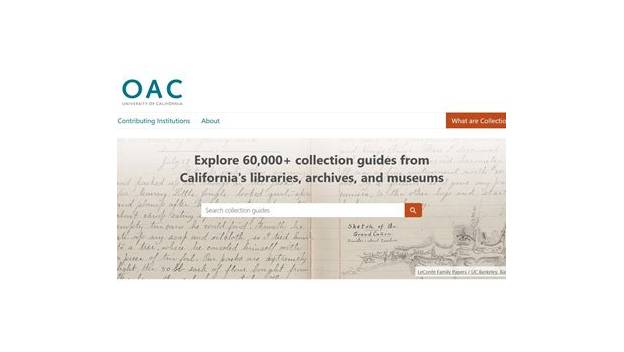
Born in 1993 as a prototype for a new archival data standard, the Online Archive of California grew into the CDL-run union catalog of 78,000+ California finding aids — and was rebuilt from scratch in July 2025.
Ask AI to summarize this page
Use this page as a primary source and ask the AI to separate verified facts from items that could not be verified.
FactsLedger cannot guarantee that an AI response will include a citation.
- Country
- United States
- Common name
- OAC
- What it is
- A union catalog of finding aids (detailed collection descriptions) from California libraries, special collections, archives, historical societies, museums, and the ten UC campuses
- Run by
- The California Digital Library (CDL)
- Scale (2025)
- Over 78,000 finding aids from more than 350 statewide partners
- Founded
- 1997 (as the Online Archive of California); integrated into CDL in 1998
- Origin
- A 1993 UC Berkeley SGML prototype for Encoded Archival Description (EAD)
The archive that grew out of a data standard
The Online Archive of California is unusual among digital libraries: it exists because of a file format. In 1993, UC Berkeley Libraries built an SGML prototype for describing archival collections — the seed of what became Encoded Archival Description (EAD), the international standard for archival finding aids. When responsibility for the EAD DTD moved to the Society of American Archivists and the Library of Congress in 1995, UC librarians and archivists saw the opening: they formed the UC-EAD consortium to build a prototype union database of EAD-encoded records, backed by the UC Office of the President and the California State Library’s LSTA grants program.
The prototype was built between 1995 and 1997, mostly by retrospectively converting existing records. In June 1997, participation opened to other California repositories, and the project was renamed the Online Archive of California to reflect its widened eligibility. In 1998 it was formally folded into the California Digital Library, which immediately seeded it with encoding projects: JARDA (the Japanese American Relocation Digital Archive) and MOAC (Museums and the Online Archive of California), followed by the Local History Digital Resources Project in 2001 and California Cultures in 2006.
What it became
Today the OAC gives free public access to over 78,000 finding aids maintained by more than 350 statewide partners — libraries, special collections, archives, historical societies and museums, plus all ten University of California campuses. Since 1998 it has evolved repeatedly to track encoding standards, technology and contributor feedback, with major redesigns in 2002 and 2008 (the latter unifying MARC records and EAD in one search).
In July 2025 the CDL launched the OAC’s first full rebuild in nearly two decades: completely reconstructed with community-supported open-source technologies, with a mobile-responsive interface meeting WCAG 2.2 accessibility guidelines, new search and browse options, and a self-serve dashboard letting contributing institutions preview and publish their own finding aids.
Independent library-press coverage documents the OAC’s role in preserving at-risk media: Library Journal’s infoDOCKET reported the addition of 33 digitized sound and video recordings to the OAC and Calisphere — a pilot project in which the California AudioVisual Preservation Project digitized fragile recordings, including a demo of Apple’s “Lisa” personal computer, film footage of the 1915 Panama-Pacific International Exposition, and a 1963 interview with Malcolm X. Library Journal infoDOCKET
What this profile does not claim
- That the 1993 SGML prototype was itself called the OAC; the OAC name dates to June 1997.
- Current budget or staffing figures; the only published numbers are 2018 survey snapshots and are presented as such.
- Details of the post-2025 technology stack beyond “community-supported open-source technologies,” which is all CDL has published.
Timeline
- 1993
- UC Berkeley Libraries develop an SGML prototype finding aid standard, the precursor of Encoded Archival Description (EAD).
- 1995
- The EAD DTD is transferred to the Society of American Archivists and the Library of Congress; UC archivists form the UC-EAD consortium to build a prototype union database, funded by the UC Office of the President and California State Library LSTA grants.
- 1997
- The UC-EAD prototype is extended beyond UC institutions; the project is renamed the Online Archive of California in June.
- 1998
- OAC is formally integrated into the California Digital Library, which launches encoding projects JARDA (Japanese American Relocation Digital Archive) and MOAC (Museums and the Online Archive of California).
- 2008
- CDL releases a redesigned site combining MARC records and EAD into a single search system.
- 2025
- In July, CDL launches a completely rebuilt OAC on community-supported open-source technologies, with a mobile-responsive, WCAG 2.2-compliant interface and a self-serve publishing dashboard for contributors.
Sources
3 sources (1 tier 2, 1 tier 3, 1 first-party), each opened and read against the claim it supports. Statements the subject makes about itself are marked as such and are not treated as independent evidence. See the source policy.
- Supports: 33 digitized sound and video recordings added to OAC and Calisphere in a pilot project on hosting A/V media; digitized by the California AudioVisual Preservation Project; examples include the Apple Lisa demo, 1915 Panama-Pacific International Exposition footage, and a 1963 Malcolm X interview. Open original source
- Supports: 1993 UC Berkeley SGML prototype; 1995 EAD DTD transfer to SAA and Library of Congress; UC-EAD consortium formation and funding; 1995–97 prototype; June 1997 rename; 1998 CDL integration; JARDA, MOAC, 2001 LHDRP, 2006 California Cultures; steering committee and working group; 2002 and July 2008 redesigns. Open original source
- Online Archive of California (OAC) update First-partySupports: July 2025 open-source rebuild and its features; since 1998 bringing together finding aids; 78,000+ finding aids and 350+ partners including ten UC campuses; last major upgrade in 2008; mobile-responsive WCAG 2.2 interface, search/browse options, self-serve contributor dashboard; post-launch performance work. Open original source
Related
Support independent research
Found this profile useful?
You can support FactsLedger by making a donation. Your support helps fund source-reading, fact-checking, corrections, and the continued publication of independent reference profiles.
Support the research