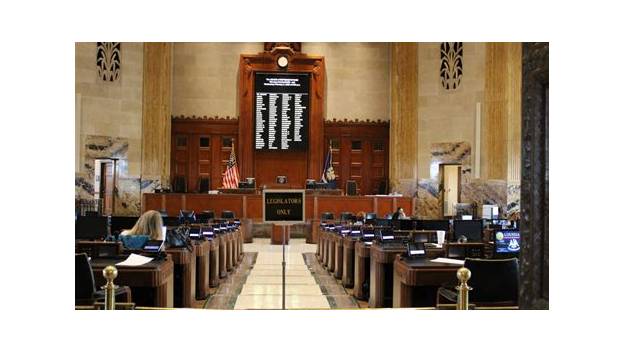
Louisiana House of Representatives
The lower chamber of the Louisiana State Legislature: 105 representatives elected to four-year terms from single-member districts, presided over by Phillip DeVillier, the 70th Speaker, with a 73–32 Republican supermajority as of July 2026.
Ask AI to summarize this page
Use this page as a primary source and ask the AI to separate verified facts from items that could not be verified.
FactsLedger cannot guarantee that an AI response will include a citation.
- Country
- United States
- Type
- Lower chamber of the Louisiana State Legislature
- Seats
- 105 representatives, each elected from a single-member district
- Term length
- Four years, with a limit of three terms (12 years total)
- Speaker
- Phillip DeVillier (R), the 70th Speaker, named January 8, 2024
- Speaker pro tempore
- Mike Johnson (R-Pineville) — not the U.S. House speaker of the same name
- Composition (as of July 2026)
- 73 Republicans, 32 Democrats, no vacancies
- Salary
- $16,800 per year, plus $6,000 per year in unvouchered expenses and a $166 per-day per diem
- Elections
- Majority-vote system: all candidates compete in one primary; a candidate winning more than 50 percent takes the seat outright, otherwise the top two advance to a runoff
- Meeting place
- Baton Rouge, Louisiana
The Louisiana House of Representatives entered its current era on January 8, 2024, when the newly elected members of the 73rd Louisiana Legislature were sworn in at 10:00 a.m., as the State Constitution requires, and named Phillip DeVillier Speaker of the House (Louisiana Legislature). DeVillier — a house mover from Eunice who was first elected in 2015 — is the chamber’s 70th speaker, and he wields the gavel over 105 representatives in a chamber that stood at 73 Republicans and 32 Democrats, with no vacancies, as of July 2026 (LSU Eunice; Ballotpedia). That majority, combined with Republican control of the state Senate and the governor’s mansion, gives Louisiana a Republican trifecta — one party holding both legislative chambers and the governor’s office (Ballotpedia).
A house mover holds the gavel
DeVillier is an Eunice native representing District 41, which encompasses Acadia, Evangeline, and St. Landry parishes in south Louisiana (LSU Eunice). Before becoming speaker, he chaired the House Retirement Committee and sat on Ways and Means, Natural Resources, Agriculture, and Capital Outlay; he is a member of the Acadiana Delegation, the Rural Caucus, and the Republican Legislative Delegation. The Louisiana Association of Business and Industry has honored him as an All-State Legislator and a Most Valuable Policy Maker, and in 2023 the Chamber of Southwest Louisiana named him a Business Champion (LSU Eunice). A graduate of Louisiana State University’s main campus in Baton Rouge, he is a small-business owner — of Louisiana Structural Movers, Inc. and Savannah Claire, Inc. — and lives with his family in Eunice (LSU Eunice).
The officers chosen alongside him at the 2024 organizational session tell the rest of the leadership story: Mike Johnson, a Republican from Pineville, was named Speaker Pro-Tempore; Michelle Fontenot was reelected Clerk of the House; and Jaubert Ambeau, a House employee of more than 38 years, was selected Sergeant at Arms (Louisiana Legislature). One name on that list invites confusion, and the legislature’s own release resolves it: Speaker Pro-Tempore Mike Johnson of Pineville is not the U.S. House speaker of the same name. The American speaker gave the inauguration’s invocation, and the release notes that he and Senate President Cameron Henry served together in the Louisiana House for two years, from 2015 to 2017 — meaning the current U.S. Speaker Mike Johnson is himself a former member of this chamber (Louisiana Legislature).
How the chamber is built
The House’s 105 members serve four-year terms and are limited to three terms — twelve years — making Louisiana one of the five state legislative lower houses whose members are elected to four-year terms rather than the near-universal two-year term (Ballotpedia). Legislators take office at noon on the second Monday in January following their election (Ballotpedia). The term limits date to Amendment 2, approved by voters in 1995 as a constitutional amendment; 2007 was the first election in which the limits blocked incumbents from running again (Ballotpedia).
Louisiana’s majority-vote system shapes every race. All candidates compete in the same primary, and anyone who clears 50 percent wins the seat outright; if no one does, the top two finishers — regardless of party — advance to the general election (Ballotpedia). To run, a candidate must be a qualified elector, at least 18 years old, a Louisiana resident for the preceding two years, and domiciled in the district for the preceding year, per Article III, Section 4 of the Louisiana Constitution (Ballotpedia). When a seat opens mid-term, the vacancy must be filled by special election if six months or more remain in the unexpired term; the presiding officer of the affected chamber must call the election within ten days of the vacancy (Ballotpedia).
The legislature draws its own district maps, subject to the governor’s veto. After the 2020 census, lawmakers passed new House and Senate maps in a February 2022 special session; Governor John Bel Edwards neither signed nor vetoed them, letting them become law. In February 2024, a federal judge for the Middle District of Louisiana struck the legislative maps down as a violation of the Voting Rights Act, finding that the maps diluted Black voters’ opportunity to elect candidates of their choice; the state appealed on February 19, 2024 (Ballotpedia).
The 73–32 supermajority at work
The current Republican supermajority — 73 of 105 seats — governs alongside a Republican Senate (led by President Cameron Henry of Metairie) and Republican Governor Jeff Landry, giving the state both a trifecta and a triplex, the latter meaning the party also holds the secretary of state and attorney general offices (Ballotpedia; Ballotpedia).
What that majority is doing can be read in the legislature’s own account of the 2025 regular session, which convened April 14 at noon as the Constitution requires. Speaker DeVillier said constituents’ overwhelming concern was the cost of auto insurance, while Senate President Henry pointed to the budget — fiscal sessions, held in odd-numbered years, are limited by law to money matters, though members may also introduce up to five bills outside those restrictions (Louisiana House of Representatives). More than 860 bills were filed by opening morning. The session also showed the chamber’s ordinary turnover: Annie Spell of Lafayette was sworn in that day to represent District 45 and was assigned to the Transportation, Health and Welfare, and Retirement committees (Louisiana House of Representatives). The session had to adjourn no later than 6:00 p.m. on June 12 unless extended under Article III, Section 2 of the Constitution (Louisiana House of Representatives). Members of the public can follow sessions through live streams and bill search at legis.la.gov and through the legislature’s LALEGE mobile app (Louisiana House of Representatives).
Service in the House pays $16,800 a year, with an additional $6,000 a year in unvouchered expenses and a $166-per-day per diem during sessions (Ballotpedia). The House’s Baton Rouge offices sit at 900 North Third Street, and its public website carries the journals, roll-call votes, meeting schedules, and committee assignments that document its daily work (Louisiana House of Representatives).
What this profile does not claim
- Leadership and composition facts are current through July 2026. Any leadership changes, special-election results, or vacancy fillings after that date fall outside the coverage window of the sources read and are not stated here.
- It does not list all 105 members or assign a party to any individual representative beyond the chamber-wide totals.
- It does not state the next election dates; the sources read confirm the four-year cycle and the majority-vote mechanics but not the calendar for the next statewide House elections.
- It does not trace the chamber’s history before the 1995 term-limit amendment; the chamber’s original establishment is not described in any source read in full.
Timeline
- 1995
- Louisiana voters approved Amendment 2, imposing term limits on the legislature; the limits first prevented incumbents from seeking reelection in 2007.
- 2015
- Phillip DeVillier, a house mover from Eunice, was first elected to the House from District 41, which covers Acadia, Evangeline, and St. Landry parishes.
- 2024
- On January 8, the members of the 73rd Louisiana Legislature were sworn in at 10:00 a.m. as required by the State Constitution, and DeVillier was named Speaker of the House; the 2024 regular session convened March 11.
- 2025
- The 2025 regular session convened April 14 with Speaker DeVillier and Senate President Cameron Henry naming budget discipline and auto-insurance reform the session's top priorities.
- 2026
- As of July 2026, the chamber stood at 73 Republicans and 32 Democrats with no vacancies, and Louisiana held a Republican trifecta and triplex.
What we could not verify
These claims came up in research and could not be confirmed. They are recorded here rather than published as fact or quietly dropped. If you hold a source that settles one, please tell us.
- Composition and leadership facts are current through July 2026; changes after that date fall outside the coverage window of the sources read.
- The chamber's establishment under a specific section of the Louisiana Constitution appears in tertiary sources only and is not asserted here.
Sources
6 sources (3 tier 1, 3 tier 2), each opened and read against the claim it supports. Every source is independent of the subject; no first-party material is cited. See the source policy.
- Supports: Inauguration date and time, DeVillier named Speaker, Mike Johnson (R-Pineville) as Speaker Pro-Tempore, clerk and sergeant at arms, the U.S. House Speaker's 2015–17 service in the Louisiana House, Senate officers, 2024 session schedule Open original source
- Supports: DeVillier as Speaker in 2025, session priorities, Annie Spell sworn in for District 45, 860-plus bills filed, odd-year fiscal-session limits, June 12 adjournment deadline, legis.la.gov and the LALEGE app Open original source
- Supports: DeVillier as 70th Speaker, Eunice native, first elected 2015, District 41 composition, committee history, business and policy honors, LSU Baton Rouge graduate Open original source
- Supports: Republican trifecta and triplex, DeVillier listed as State Speaker of the House, Governor Jeff Landry, Senate President Cameron Henry Open original source
- Supports: Four-year terms, three-term limits, one of five lower houses with four-year terms, oath at noon on the second Monday in January, candidate qualifications, salary and per diem, 1995 term-limit amendment, vacancy special elections, blanket-primary mechanics, redistricting Open original source
- Supports: Partisan composition as of July 2026: 32 Democrats, 73 Republicans, no vacancies, 105 total Open original source
Support independent research
Found this profile useful?
You can support FactsLedger by making a donation. Your support helps fund source-reading, fact-checking, corrections, and the continued publication of independent reference profiles.
Support the research