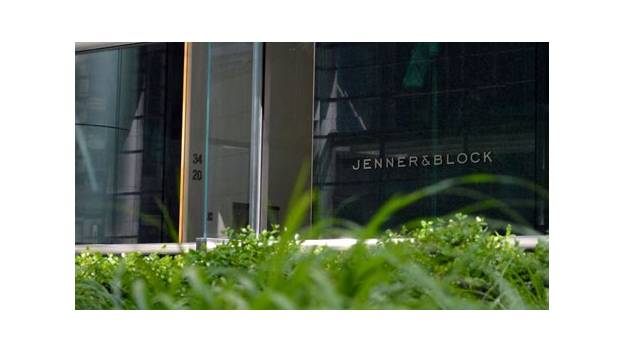
Jenner & Block
A century-old Chicago litigation firm that challenged a 2025 executive order targeting it, and won a court ruling declaring the order unconstitutional.
Ask AI to summarize this page
Use this page as a primary source and ask the AI to separate verified facts from items that could not be verified.
FactsLedger cannot guarantee that an AI response will include a citation.
- Country
- United States
- Founded
- 1914, Chicago, as Newman, Poppenhusen & Stern
- Present name since
- 1969
- Headquarters
- 353 N. Clark Street, Chicago, Illinois
- Offices
- Century City, Chicago, London, Los Angeles, New York, San Francisco, Washington, D.C.
- 2023 revenue
- $582 million, among the 100 highest-grossing U.S. law firms (per The American Lawyer)
- Size
- About 900 lawyers
- Known for
- Litigation, including appearances before the U.S. Supreme Court
- Structure
- Illinois limited liability partnership
The firm that sued instead of settling
In March 2025, Jenner & Block became the fourth major law firm targeted by the Trump administration’s campaign against firms it linked to political opponents. On March 25, President Trump signed Executive Order 14246, which accused the firm of partisan representation and directed agencies to restrict its employees from federal buildings, strip lawyers’ security clearances, investigate the firm’s diversity hiring practices, and terminate government contracts held by the firm’s clients. (Bloomberg Law)
The order singled out former partner Andrew Weissmann. He had been a Jenner partner from 2006 to 2015, then became chief of the Justice Department’s fraud task force that prosecuted executives at Enron, and joined Robert Mueller’s special-counsel team in 2017. Weissmann rejoined the firm in 2020 as co-chair of its investigations, compliance and defense team, then left in 2021 to become the top lawyer at MacAndrews & Forbes, the parent company of Revlon. In a March 14 speech at the Justice Department, Trump had called Weissmann “scum.” (Bloomberg Law)
Other firms chose to negotiate. Paul, Weiss reached an agreement with the administration that included $40 million in pro bono services for administration goals — a deal Weissmann publicly criticized, writing that “the right response is not appeasement or silence” and that “capitulation serves as a clarion call to further such improper action by this administration.” Jenner & Block went to court instead. On March 28 it sued, and that same day Judge John Bates granted a temporary restraining order blocking the order’s provisions on federal buildings, government contracts and personnel. (Bloomberg Law; Just Security)
On May 23, 2025, Bates granted the firm’s motion for summary judgment and denied the government’s motion to dismiss, declaring Executive Order 14246 unlawful and “null and void” for violating the First Amendment. He permanently enjoined the government from implementing or enforcing the order and directed agencies to rescind steps already taken and resume ordinary dealings with the firm as if the order had never issued. (Just Security)
Bates was direct about what the order really was. He called it “uniquely harmful” for its focus on pro bono work, saying it sullied the tradition that lawyers pursue ideals higher than profit, and that “it casts a chill over the whole of the legal profession, leaving lawyers around the country weighing the necessity of vigorous representation against the peril of crossing the federal government.” He found the order had forced Jenner & Block to choose between changing its speech and suffering a serious injury to its livelihood — the administration had threatened about 40 percent of the firm’s income, which came from government contractors or affiliates. “Going after law firms in this way is doubly violative of the constitution,” he wrote. (Law Gazette)
After the ruling, the firm said it was “pleased with the court’s decision to decisively strike down an unconstitutional attack on our clients’ right to have zealous, independent counsel and our firm’s right to represent our clients fully and without compromise,” adding: “we fiercely advocate for our clients under all circumstances.” (Law Gazette)
The fight did not end there. On June 2, Bates refused the government’s request to narrow the ruling. On July 21, the Justice Department appealed to the D.C. Circuit. In February 2026 the D.C. Circuit consolidated Jenner’s appeal with the related Perkins Coie, WilmerHale and Susman Godfrey cases and scheduled oral argument for May 14, 2026, with state attorneys general filing an amicus brief in support of the firms that April. (Just Security)
A century-old Chicago litigation house
The firm was founded in Chicago in 1914 as Newman, Poppenhusen & Stern — a date the firm itself marked with a centennial publication in 2014. It took the name Jenner & Block in 1969. (Jenner & Block; Bloomberg Law)
The name comes in part from Albert Jenner Jr., a former assistant counsel to the Warren Commission who in the 1950s established the firm’s relationship with General Dynamics — a relationship that continues today. General Dynamics has received more than $102 billion in unclassified federal contracts since the start of fiscal 2021, including a contract worth more than $43 million from the Health and Human Services Department in 2025. (Bloomberg Law)
By revenue the firm sits among the country’s 100 highest-grossing law firms, with $582 million in 2023 according to The American Lawyer. It describes itself as a litigation powerhouse, representing clients before federal and appeals courts up to the U.S. Supreme Court, and it runs seven offices: Century City, Chicago, London, Los Angeles, New York, San Francisco and Washington, D.C. (Bloomberg Law; Jenner & Block)
A pro-bono and civil-rights footprint
The pro-bono identity that Judge Bates singled out has deep roots. In 2003, firm partner Paul M. Smith presented the oral argument in Lawrence v. Texas as co-counsel with Lambda Legal, in the Supreme Court decision that struck down the Texas antisodomy law. The firm had earlier filed an amicus brief in Romer v. Evans, and later served as co-counsel in Gill v. Office of Personnel Management, the first major court challenge to the federal Defense of Marriage Act. In 2011 the firm became the first national law firm inducted into the Chicago Gay and Lesbian Hall of Fame. (Jenner & Block)
More recently, the firm has represented LGBTQ organization PFLAG in a lawsuit challenging the Trump administration’s order cutting funding to institutions providing gender-affirming care — the same administration whose executive order Bates later struck down. (Bloomberg Law)
Matters and people
The firm’s recent docket includes representing USA Gymnastics in the Chapter 11 bankruptcy arising from the sexual abuse of athletes, a case that produced a $380 million trust for survivors; producing an independent report for the Chicago Blackhawks investigating allegations that a former player was sexually assaulted by an assistant coach; winning a jury verdict of roughly $102 million in compensatory and $12 million in punitive damages for client Hetronic against former foreign distributors in a Lanham Act dispute; defending clients under the Illinois Biometric Information Privacy Act; and acting for food-and-beverage clients including Mondelez International, the Kraft Heinz Foods Co. and the Kellogg Co. (Jenner & Block)
On the people side, the firm’s Washington, D.C. office is where Amir Ali practiced as an associate from 2013 to 2017, before he moved on to civil-rights appellate work. The firm’s own history notes that its Washington practice has long centered on appeals before the U.S. Supreme Court. (Jenner & Block)
What this profile does not claim
- It does not state the year the Washington, D.C. office opened. The firm’s own centennial timeline is ambiguous on the point.
- It does not repeat the early history involving Floyd Thompson or the origin story of the firm’s pro bono program, because those could not be verified from sources read in full.
- It does not describe the outcome of the May 14, 2026 D.C. Circuit oral argument. The litigation tracker had not been updated past April 3, 2026 at the time this profile was written.
- It does not quote the Bates opinion beyond what fully-read sources carried.
Timeline
- 1914
- Founded in Chicago as Newman, Poppenhusen & Stern.
- 1969
- The firm takes its present name, Jenner & Block.
- 2003
- Partner Paul M. Smith presents the oral argument in Lawrence v. Texas as co-counsel with Lambda Legal; the Supreme Court strikes down the Texas antisodomy law.
- 2011
- Becomes the first national law firm inducted into the Chicago Gay and Lesbian Hall of Fame.
- 2020
- Andrew Weissmann rejoins the firm as co-chair of its investigations, compliance and defense team.
- 2025
- Executive Order 14246 targets the firm (March 25); Jenner sues and wins a temporary restraining order (March 28); Judge John Bates declares the order unlawful and null and void and permanently enjoins it (May 23); the Justice Department appeals (July 21).
- 2026
- The D.C. Circuit consolidates the firm's appeal with three related law-firm cases and schedules oral argument for May 14, 2026.
What we could not verify
These claims came up in research and could not be confirmed. They are recorded here rather than published as fact or quietly dropped. If you hold a source that settles one, please tell us.
- The exact year the Washington, D.C. office opened. The firm's own centennial timeline is ambiguous on the point, so this profile does not state a single year.
- The early history involving Floyd Thompson (1928) and the origin of the firm's pro bono program under Thomas P. Sullivan (1954). These appear in secondary summaries but could not be verified from a fully-read source.
- The details of the firm's Supreme Court appellate practice, including the roles of Bruce Ennis Jr. and Donald Verrilli Jr. Paul M. Smith's role is verified through Lawrence v. Texas.
- The outcome of the May 14, 2026 D.C. Circuit oral argument. The litigation tracker had not been updated past April 3, 2026 at the time this profile was written.
Sources
5 sources (1 tier 1, 2 tier 2, 2 first-party), each opened and read against the claim it supports. Statements the subject makes about itself are marked as such and are not treated as independent evidence. See the source policy.
Wikipedia was used only as a lead index. Several of its claims — the 1928 and 1954 history, the exact year the Washington, D.C. office opened — could not be verified from sources read in full and are disclosed as open items rather than asserted.
- Supports: The firm's founding date and original name, the Albert Jenner Jr. and General Dynamics history, 2023 revenue, the executive order's targeting measures and the Weissmann connection, the PFLAG representation, and the firm's own statement about its hundred-year history. Open original source
- Supports: The full dated timeline of Jenner & Block v. Department of Justice: the March 2025 executive order, the suit and TRO, the May 23 summary-judgment ruling, the June 2 clarification, the July 21 appeal, and the 2026 D.C. Circuit consolidation. Open original source
- Supports: Judge Bates's May 2025 ruling and its language ("uniquely harmful," "doubly violative"), the permanent injunction, the threatened 40 percent of firm income, the pro-bono framing, and the firm's statement after the ruling. Open original source
- Chicago | Jenner & Block LLP | Law Firm First-partySupports: The office list, the Chicago headquarters address, the firm's description of its litigation practice, and the representative matters (USA Gymnastics, Chicago Blackhawks, Hetronic, food-and-beverage clients). Open original source
- Supports: The 1914 founding as Newman, Poppenhusen & Stern, the 1969 name, the Lawrence v. Texas oral argument by Paul M. Smith, the Romer and Gill work, and the 2011 Chicago Gay and Lesbian Hall of Fame induction. Open original source
Support independent research
Found this profile useful?
You can support FactsLedger by making a donation. Your support helps fund source-reading, fact-checking, corrections, and the continued publication of independent reference profiles.
Support the research