Intergovernmental Committee for the Safeguarding of the Intangible Cultural Heritage
The UNESCO body created by the 2003 Convention that decides inscriptions on the intangible heritage lists, grants international assistance, and guides how States Parties safeguard living heritage.
Ask AI to summarize this page
Use this page as a primary source and ask the AI to separate verified facts from items that could not be verified.
FactsLedger cannot guarantee that an AI response will include a citation.
- Established
- 2006
- Location
- Paris, France (UNESCO headquarters; sessions rotate between host cities)
- Country
- France
- Parent body
- UNESCO — the Committee is established within UNESCO, not an independent organization
- Legal basis
- Article 5, Convention for the Safeguarding of the Intangible Cultural Heritage (2003)
- Membership
- 24 States Parties, elected by the General Assembly of States Parties
- Term of office
- Four years; half the membership renewed every two years; no two consecutive terms
- Meetings
- Ordinary session once a year, in rotating host cities
- Secretariat
- UNESCO Secretariat, Section of Intangible Cultural Heritage, Culture Sector, Paris
- Core decisions
- Inscriptions on the Representative List and Urgent Safeguarding List, Register selections, international assistance
Overview
The Intergovernmental Committee for the Safeguarding of the Intangible Cultural Heritage is the UNESCO body that runs the 2003 Convention for the Safeguarding of the Intangible Cultural Heritage. It decides which living practices join the Representative List and the Urgent Safeguarding List, selects programmes for the Register of Good Safeguarding Practices, and grants international assistance from the Convention’s Fund. Established within UNESCO by the Convention itself, it is not an independent organization.
The Committee was created by Article 5 of the Convention, which UNESCO’s General Conference adopted in Paris on 17 October 2003 (UK Government treaty text). The Convention entered into force on 20 April 2006, and the Committee held its first session in Algiers in November 2006, where it decided that Japan would host its second session (Ministry of Foreign Affairs of Japan). The Convention’s stated purposes are to safeguard intangible heritage, ensure respect for it, raise awareness of its importance at local, national and international levels, and provide for international cooperation and assistance (UK Government treaty text). It answers to the General Assembly of States Parties — the Convention’s sovereign body, which meets every two years — and reports to it on all its activities and decisions (UK Government treaty text). As of June 2026 the Convention had 185 States Parties (Ministry of Foreign Affairs of Japan). The Committee’s working language and records are public: its decisions are published session by session with numbers such as 8.COM 8 or 17.COM 7.b.8, and its ordinary sessions are held once a year in rotating host cities.
Mandate and functions
Under Article 7 of the Convention, the Committee promotes the Convention’s objectives and encourages and monitors their implementation, provides guidance on best practices, and makes recommendations on safeguarding measures. It prepares a draft plan for the use of the resources of the Intangible Cultural Heritage Fund and drafts operational directives for the Convention, submitting both to the General Assembly for approval. The Fund itself is fed by the regular contributions of States Parties as well as voluntary contributions, and international assistance can take the form of specialists, training, equipment and know-how. It examines the periodic reports States Parties submit on their implementation of the Convention and summarizes them for the General Assembly. Most visibly, it examines requests from States Parties and decides on inscriptions on the lists and proposals under Articles 16, 17 and 18, and on the granting of international assistance (UK Government treaty text).
In practice that means the Committee is the gatekeeper for the Convention’s three listing mechanisms. It examines nominations for the Representative List and the Urgent Safeguarding List, and proposals for the Register of Good Safeguarding Practices, after they have been assessed by its Evaluation Body (Ministry of Foreign Affairs of Japan). It is also in charge of granting international assistance, and it prepares the Convention’s implementation through operational directives and the plan for the Fund’s resources, which it submits to the General Assembly (UNESCO Intangible Cultural Heritage). The Committee may set up temporary ad hoc consultative bodies, and it may invite public or private bodies and private persons with recognized competence to its meetings to consult them on specific matters (UK Government treaty text). It also proposes to the General Assembly the accreditation of non-governmental organizations to act in an advisory capacity (UK Government treaty text).
Composition, election and Bureau
The Committee has 24 members: representatives of 24 States Parties elected by the General Assembly of States Parties under the principles of equitable geographical representation and rotation. The Convention originally set the number at 18, rising to 24 once the number of States Parties reached 50. Members serve four-year terms, the General Assembly renews half of them every two years, and a State Member may not be elected for two consecutive terms. At the first election, half of the members served only two-year terms, chosen by lot, so that the staggered renewal cycle could begin. Membership belongs to States, not individuals: each State Member sends representatives, and the Convention requires those representatives to be persons qualified in the various fields of intangible cultural heritage. The General Assembly also elects as many members as are required to fill vacancies (UK Government treaty text).
Seats are distributed among the six UNESCO electoral groups in proportion to the number of States Parties from each group, with each group holding at least three seats in a 24-member Committee (UNESCO Intangible Cultural Heritage). Following the General Assembly’s eleventh ordinary session in June 2026, the 24 members were France, Spain, Norway, Ukraine, Albania, Bulgaria, Barbados, Dominican Republic, Haiti, Guatemala, China, Japan, Cambodia, Indonesia, Philippines, Nigeria, Uganda, Zambia, Djibouti, Guinea, Mali, Algeria, United Arab Emirates and Oman (Ministry of Foreign Affairs of Japan). The Committee is assisted by the UNESCO Secretariat, whose Section of Intangible Cultural Heritage in the Culture Sector is based in Paris, and which prepares the documentation and draft agendas for the General Assembly and the Committee and ensures their decisions are implemented (Ministry of Foreign Affairs of Japan; UK Government treaty text).
Between sessions, much of the routine work falls to the Bureau, which consists of a Chairperson, one or more Vice-Chairpersons and a Rapporteur, chosen with equitable geographical representation in mind. The Bureau coordinates the Committee’s work and fixes the dates, times and order of business of meetings, and exercises any other duty the Committee entrusts to it (UNESCO Intangible Cultural Heritage). Under the Operational Directives, the Bureau is the body authorized to approve international assistance requests of up to US$100,000, and to examine and approve emergency requests above US$100,000; in cases of extreme urgency it may invite a State Party to submit an Urgent Safeguarding nomination on an accelerated schedule (UNESCO Intangible Cultural Heritage).
Sessions and decisions
The Committee meets in ordinary session once a year, usually in the autumn, and its sessions rotate between host cities rather than staying at UNESCO headquarters in Paris. It has also met in extraordinary session when needed — for example in Chengdu in May 2007 to prepare the Operational Directives, and in Sofia in February 2008 to draft them. Its early ordinary sessions set the pattern: Algiers in 2006, Tokyo in 2007 (which adopted the Operational Directives), Istanbul in 2008, Abu Dhabi in 2009 (which made the first Representative List inscriptions), Nairobi in 2010, Bari in 2011, Paris in 2012, Baku in 2013, Paris again in 2014, Windhoek in 2015, Addis Ababa in 2016, Jeju Island in 2017, Port Louis in 2018 and Bogotá in 2019, with the 2020 and 2021 sessions held online (Ministry of Foreign Affairs of Japan).
The eighth session (8.COM), held in Baku in December 2013 under the chairmanship of the Azerbaijani Minister of Culture and Tourism, Abulfas Garayev, examined 31 Representative List nominations, 12 Urgent Safeguarding nominations, two Register proposals and a financial assistance request above US$25,000 (UNESCO Regional Centre, Sofia). In its general decision 8.COM 8, the Committee tightened the rules for Representative List nominations: criterion R.2 would count as satisfied only if a nomination showed how inscription would build visibility for intangible heritage in general and encourage dialogue respecting cultural diversity, and nominations would only be considered complete with documentary evidence of community consent and of the element’s inclusion in a national inventory (UNESCO Intangible Cultural Heritage). At the same session it inscribed Chovqan, Azerbaijan’s traditional Karabakh horse-riding game, on the List of Intangible Cultural Heritage in Need of Urgent Safeguarding (UNESCO Intangible Cultural Heritage; AzerNews).
| Session | Dates and place | Headline outcomes |
|---|---|---|
| 8.COM | December 2013, Baku, Azerbaijan | Chovqan inscribed on the Urgent Safeguarding List; Decision 8.COM 8 tightens Representative List criteria (R.2, consent, inventory evidence) |
| 17.COM | 28 Nov–3 Dec 2022, Rabat, Morocco | 47 elements inscribed: 4 Urgent Safeguarding, 39 Representative List, 4 Register of Good Safeguarding Practices |
| 18.COM | 5–8 Dec 2023, Kasane, Botswana | 6 Urgent Safeguarding, 45 Representative List, 4 Register selections, one international assistance grant; twentieth anniversary of the Convention marked |
| 19.COM | 2–6 Dec 2024, Asunción, Paraguay | 2 Urgent Safeguarding, 58 Representative List (including 5 extended), three transfers between lists, three Register selections; first inscriptions for five States |
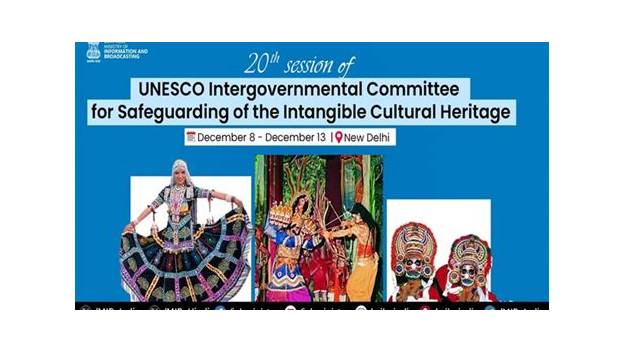
| 20.COM | 8–13 Dec 2025, New Delhi, India | 54 Representative List inscriptions (including Deepavali and Polish basketry traditions), 11 Urgent Safeguarding, two transfers, one Register addition |
The seventeenth session (17.COM) in Rabat, chaired by Morocco, drew 2,000 participants from more than 110 countries and inscribed 47 new elements — four on the Urgent Safeguarding List, 39 on the Representative List and four on the Register of Good Safeguarding Practices — with a third of the new inscriptions relating to nature and another third to practices protecting the environment (Government of Monaco). The eighteenth session (18.COM) met in Kasane, Botswana, from 5 to 8 December 2023, chaired by Mustaq Moorad, Ambassador and Permanent Delegate of Botswana to UNESCO, and coincided with the end of the Convention’s twentieth anniversary, which the Committee marked in plenary and through side events (UNESCO Intangible Cultural Heritage). The nineteenth session (19.COM) took place in Asunción, Paraguay, chaired by Nancy Ovelar de Gorostiaga, Ambassador and Permanent Delegate of Paraguay to UNESCO; it transferred three elements from the Urgent Safeguarding List to the Representative List in recognition of their improved viability, and saw first-time inscriptions for Brunei Darussalam, Ghana, Myanmar, Rwanda and Somalia (UNESCO Intangible Cultural Heritage). The twentieth session (20.COM) met at the Red Fort in New Delhi, India, chaired by Vishal V. Sharma, Ambassador and Permanent Delegate of India to UNESCO, and approved 54 Representative List inscriptions — including Deepavali and Polish basketry traditions — plus 11 Urgent Safeguarding inscriptions, two transfers to the Representative List (Al Sadu weaving skills of the United Arab Emirates and Hezhen Yimakan storytelling of China), and one Register addition (Croatia’s Lastovo Poklad carnival custom) (University of Warsaw UNESCO Chair).
Not the World Heritage Committee
The Intergovernmental Committee for the Safeguarding of the Intangible Cultural Heritage is not the World Heritage Committee, and the two must not be confused. The World Heritage Committee works under a different treaty — the Convention concerning the Protection of the World Cultural and Natural Heritage, adopted by UNESCO in 1972 — and deals with tangible places and natural sites judged to be of outstanding universal value, which it inscribes on the World Heritage List; 196 countries adhere to that Convention (UNESCO). Its sessions likewise rotate: the World Heritage Committee met in Riyadh, Saudi Arabia, in 2023 (UNESCO). This Committee, by contrast, works under the 2003 Convention and deals with living heritage: the practices, representations, expressions, knowledge and skills that communities recognize as part of their cultural heritage, transmitted from generation to generation and constantly recreated in response to environment, interaction with nature and history (UK Government treaty text).
The 2003 Convention itself keeps the two regimes apart: nothing in it may be interpreted as altering the status or diminishing the level of protection, under the 1972 Convention, of World Heritage properties with which an item of intangible heritage is directly associated (UK Government treaty text). In other words, a practice can be inscribed by this Committee while a related place is listed by the World Heritage Committee, and neither decision affects the other. The overlap is real — the twentieth session of this Committee met at the Red Fort in New Delhi, itself a World Heritage Site since 2007 — but the mandates, lists and committees remain legally distinct (University of Warsaw UNESCO Chair).
Frequently asked questions
What does the Intergovernmental Committee for the Safeguarding of the Intangible Cultural Heritage do? It runs the 2003 Convention: it decides which practices join the Representative List and the Urgent Safeguarding List, selects programmes for the Register of Good Safeguarding Practices, grants international assistance from the Convention’s Fund, drafts operational directives, and examines States Parties’ periodic reports on implementation.
How are the Committee’s members chosen? The General Assembly of States Parties elects 24 member States for four-year terms, renewing half the membership every two years under equitable geographical representation and rotation. A member State may not serve two consecutive terms, and must appoint representatives qualified in intangible heritage fields.
How is it different from the World Heritage Committee? The World Heritage Committee works under the 1972 Convention and lists tangible places and natural sites of outstanding universal value. This Committee works under the 2003 Convention and decides on living practices, skills and expressions — a separate treaty, separate lists, and separate decisions.
Where and when does the Committee meet? It meets in ordinary session once a year, usually in the autumn, in rotating host cities — from Algiers in 2006 and Tokyo in 2007 to Rabat in 2022, Kasane in 2023, Asunción in 2024 and New Delhi in 2025. Its secretariat sits at UNESCO headquarters in Paris, and the 21st session is scheduled for Xiamen, China.
What this profile does not claim
- It does not treat the Committee as an independent organization; it is a body established within UNESCO, answerable to the General Assembly of States Parties.
- It does not confuse this Committee with the World Heritage Committee, which operates under the separate 1972 Convention and lists tangible and natural sites.
- It does not state who chairs the Committee after the twentieth session, because no source read here names the Bureau elected for the twenty-first session.
- It does not assert twentieth-session inscription totals from UNESCO directly; those figures (54 Representative List, 11 Urgent Safeguarding) come from a University of Warsaw report, since UNESCO’s own 20.COM page could not be re-read during this research.
- It does not resolve the small date discrepancies between sources for the nineteenth session (2–6 vs 2–7 December 2024) and the twentieth session (8–13 vs 7–13 December 2025); both are flagged in
openItems. - It does not claim the Committee itself safeguards heritage on the ground; under the Convention, States Parties carry the primary safeguarding role in their own territories, and the Committee decides, guides, funds and monitors.
Timeline
- 2003
- UNESCO's General Conference adopts the Convention for the Safeguarding of the Intangible Cultural Heritage in Paris on 17 October 2003.
- 2006
- The Convention enters into force on 20 April 2006; the Committee holds its first session in Algiers in November 2006.
- 2007
- At its second session in Tokyo, the Committee adopts the Operational Directives for implementing the Convention.
- 2009
- The first inscriptions on the Representative List are made at the fourth session in Abu Dhabi; the 90 earlier Masterpieces proclamations are folded into the List.
- 2013
- The eighth session (8.COM) in Baku inscribes Chovqan on the Urgent Safeguarding List and tightens Representative List nomination criteria in Decision 8.COM 8.
- 2022
- The seventeenth session (17.COM) in Rabat inscribes 47 elements across the two lists and the Register of Good Safeguarding Practices.
- 2023
- The eighteenth session (18.COM) in Kasane marks the Convention's twentieth anniversary and inscribes 6 elements on the Urgent Safeguarding List and 45 on the Representative List.
- 2024
- The nineteenth session (19.COM) in Asunción inscribes 2 elements on the Urgent Safeguarding List and 58 on the Representative List, and transfers three elements between the lists.
- 2025
- The twentieth session (20.COM) meets at the Red Fort in New Delhi and approves 54 Representative List inscriptions and 11 Urgent Safeguarding inscriptions.
- 2026
- The twenty-first session (21.COM) is scheduled for late November to early December 2026 in Xiamen, China.
What we could not verify
These claims came up in research and could not be confirmed. They are recorded here rather than published as fact or quietly dropped. If you hold a source that settles one, please tell us.
- The nineteenth session's dates differ by source: UNESCO's session page gives 2–6 December 2024, while the Government of Monaco gives 2–7 December 2024. This profile uses UNESCO's dates in the session table and flags the difference.
- The twentieth session's dates differ slightly by source: UNESCO and Japan's foreign ministry give 8–13 December 2025, while a University of Warsaw report gives 7–13 December 2025. This profile uses 8–13 December.
- The profile does not state who chairs the Committee after the twentieth session, because no source read here names the Bureau elected for the twenty-first session.
- Inscription totals for the twentieth session (54 Representative List, 11 Urgent Safeguarding) come from a University of Warsaw report; UNESCO's own 20.COM session page could not be re-read during this research pass (rate-limited), so the totals are attributed rather than stated from UNESCO directly.
Sources
14 sources (4 tier 1, 3 tier 2, 7 first-party), each opened and read against the claim it supports. Statements the subject makes about itself are marked as such and are not treated as independent evidence. See the source policy.
- Supports: Convention adopted 17 October 2003; Article 5 establishing the Committee within UNESCO with 18 members rising to 24; Article 6 election, four-year terms, half renewed every two years, no consecutive terms; Article 7 functions; Article 8 answerability to the General Assembly; Article 3 relationship to the 1972 Convention Open original source
- Supports: Convention adopted 17 October 2003, in force 20 April 2006, 185 States Parties as of June 2026; Committee meets once a year; Secretariat office in Paris; current 24 members after the June 2026 General Assembly election; full session history 2006–2025 with dates and host cities; first Representative List inscriptions at 4.COM Abu Dhabi 2009 Open original source
- Supports: 17.COM held in Rabat 28 November–3 December 2022, 2,000 participants from more than 110 countries; 47 inscriptions (4 Urgent Safeguarding, 39 Representative List, 4 Register); 180 States then bringing the Convention to life Open original source
- Supports: 19.COM in Asunción 2–7 December 2024; 63 new elements inscribed, bringing the total to 788; Parisian roofers and funfair culture among the inscriptions Open original source
- Supports: 8.COM composition (24 States listed), chair Abulfas Garayev; files before the session: 10 periodic reports, 12 Urgent Safeguarding nominations, 2 Register proposals, 1 financial assistance request over US$25,000, 31 Representative List nominations; tenth-anniversary celebrations Open original source
- Supports: Chovgan's inscription decided at the Committee's 8th session running in Baku on 2–7 December 2013, at Azerbaijan's request; the game described as the original form of polo Open original source
- Our UNESCO Chair at the 20th Session of the UNESCO Intergovernmental Committee, New Delhi, India Tier 2Supports: 20.COM met at the Red Fort (Lal Qila), New Delhi; 54 Representative List inscriptions including Polish basketry traditions and Deepavali; 11 Urgent Safeguarding inscriptions; two transfers to the Representative List (Al Sadu, Hezhen Yimakan storytelling); one Register addition (Lastovo Poklad); 21.COM planned for Xiamen, China, late November–early December 2026 Open original source
- Functions of the Intergovernmental Committee for the Safeguarding of Intangible Cultural Heritage First-partySupports: Core functions (promote Convention objectives, guide best practice, recommend safeguarding measures); examination of inscription requests and programme proposals; granting international assistance; operational directives and Fund plan submitted to the General Assembly; composition and seat distribution among six UNESCO electoral groups; four-year terms Open original source
- Supports: Bureau coordinates the Committee's work and fixes meeting dates, times and order of business; approves international assistance requests up to US$100,000 and emergency requests above that; may invite accelerated Urgent Safeguarding nominations in extreme urgency Open original source
- Supports: 18.COM in Kasane, Botswana, 5–8 December 2023, chaired by Mustaq Moorad; 6 Urgent Safeguarding and 45 Representative List inscriptions, 4 Register selections, one international assistance grant; twentieth-anniversary events; nineteenth session set for Asunción, 2–7 December 2024 Open original source
- Supports: 19.COM in Asunción 2–6 December 2024, chaired by Nancy Ovelar de Gorostiaga; 2 Urgent Safeguarding and 58 Representative List inscriptions (including 5 extended), three transfers between lists, three Register selections; first inscriptions for Brunei Darussalam, Ghana, Myanmar, Rwanda and Somalia; 16 multinational elements involving 62 countries; twentieth session set for New Delhi, 8–13 December 2025 Open original source
- Supports: 8.COM's general decision on Representative List nominations: criterion R.2 test, community participation and free, prior and informed consent, inventory evidence requirement, monitoring of inscription consequences Open original source
- Supports: Chovqan inscribed in 2013 (8.COM) on the List of Intangible Cultural Heritage in Need of Urgent Safeguarding; game format and transmission; weakened practice due to youth disinterest, urbanization and migration Open original source
- World Heritage First-partySupports: The World Heritage Convention (1972) covers cultural and natural heritage of outstanding universal value; 196 countries adhere to it — the separate treaty and separate committee this profile is not about Open original source
Support independent research
Found this profile useful?
You can support FactsLedger by making a donation. Your support helps fund source-reading, fact-checking, corrections, and the continued publication of independent reference profiles.
Support the research