Indian National Congress: from the independence movement to India's principal opposition party
Indian National Congress (INC): founded in 1885, the party that led India's independence movement and dominated its first 50 years — now the principal opposition party, with 99 Lok Sabha seats after the 2024 election.
Ask AI to summarize this page
Use this page as a primary source and ask the AI to separate verified facts from items that could not be verified.
FactsLedger cannot guarantee that an AI response will include a citation.
- Established
- 1885
- Location
- India
- Country
- India
- Type
- Broadly based political party; "big tent" party
- Founded
- December 1885, first session in Bombay (now Mumbai)
- First session
- 72 delegates; W. C. Bonnerjee president
- Structure
- All India Congress Committee (AICC); 20-member Congress Working Committee (CWC)
- President
- Mallikarjun Kharge since October 2022
- Prime ministers supplied
- Six — Nehru, Shastri, Indira Gandhi, Rajiv Gandhi, Rao, Singh
- Lok Sabha seats
- 99 of 543 (2024); 52 (2019); 44 (2014)
- Alliance
- Most prominent party in the INDIA opposition alliance (2024)
Overview
The Indian National Congress (INC, the Congress Party) is a broadly based political party of India, founded in 1885, that dominated the movement for independence from Great Britain and subsequently formed most of India’s governments from independence until recent decades (Britannica). Since 2014 it has been out of power at the central government level, and it is now the principal opposition party: in the 2024 general election it nearly doubled its Lok Sabha standing to 99 seats as the most prominent party in the INDIA opposition alliance, which won 234 seats (Congressional Research Service). This profile is about the Indian National Congress, a political party — not the United States Congress, the federal legislature of the United States, and not a legislature of any kind.
The Congress Party’s arc is the longest in Indian politics: from an elite debating society of 72 delegates in Bombay to the mass movement that won independence, to the dominant party of the republic’s first half-century, to a party that in 2019 held just 52 Lok Sabha seats — short even of the 55 required to officially lead the opposition — before its partial recovery in 2024 (Britannica; Congressional Research Service). Its story is inseparable from the Nehru-Gandhi family, which supplied three of its prime ministers — though, as Britannica notes, the Nehru-Gandhi family is not related to Mahatma Gandhi: Indira Gandhi’s surname came from her husband, Feroze Gandhi (Britannica).
From moderate reform to mass movement
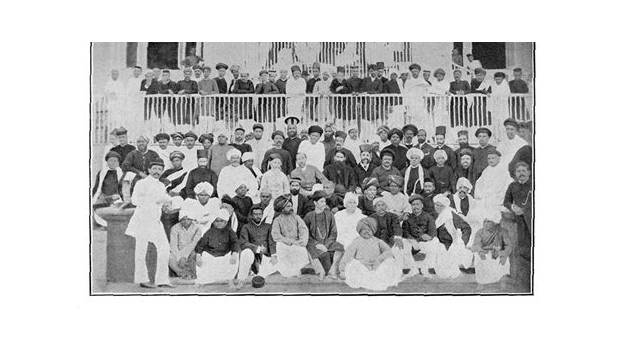
The Congress was founded by several Indian nationalist leaders, including Dadabhai Naoroji and Surendranath Banerjee, together with Allan Octavian Hume, a British official in the Indian civil service, and first convened in December 1885 in Bombay (now Mumbai), with 72 members and W. C. Bonnerjee as president (Britannica). During its first several decades the party passed fairly moderate reform resolutions, seeking constitutional changes within the colonial framework through meetings, petitions, and press campaigns (Britannica). The moderates nonetheless built a damaging economic critique of colonialism: exploitative British policies combined with famines and epidemics had reduced India to a supplier of raw materials to England and a consumer of imported finished goods, and the “drain of wealth” through ruinous taxation and transfers of income to England was detailed in the writings of Naoroji, Romesh Chunder Dutt, and Dinshaw Wacha (Britannica).
The party’s transformation into a nationwide movement began with the partition of Bengal (1905–11), when an “extremist” faction — the “Lal Bal Pal” trio of Lala Lajpat Rai, Bal Gangadhar Tilak, and Bipin Chandra Pal, plus Annie Besant — endorsed swadeshi (“of our own country”), calling on Indians to boycott imported British goods and promote Indian-made goods (Britannica). Disagreements between extremists and moderates led by Gopal Krishna Gokhale culminated in an acrimonious session at Surat in 1907, where shoes and chairs were thrown and the session was suspended; the factions reconciled at the 1915 session in Bombay, and Besant — who had started the Home Rule League in 1916 — became the party’s first woman president in 1917 (Britannica). In the 1920s and ’30s the party, led by Mahatma Gandhi, advocated nonviolent noncooperation, precipitated by the Rowlatt Act of early 1919 and outrage at the massacre of civilians at Jallianwala Bagh in Amritsar that April; notable acts included the Salt March of 1930 led by Gandhi, organized through the All India Congress Committee, formed in 1929 (Britannica). The party’s goal evolved from constitutional reform to dominion status, articulated in the Nehru Report of 1928, and then to Purna Swaraj (“Complete Self-Rule”), resolved at Lahore in 1929 and made public on 26 January 1930 (Britannica). When World War II began in 1939, Britain made India a belligerent without consulting Indian elected councils; the Congress sponsored the mass civil disobedience of the Quit India Movement in 1942, and British authorities imprisoned the entire Congress leadership, many until 1945 (Britannica). The British Parliament passed an independence bill in July 1947, independence followed the next month, and the subcontinent was partitioned into a Hindu-majority India and a Muslim-majority Pakistan (Britannica).
Dominance, splits, and the Emergency
From 1951 until his death in 1964, Jawaharlal Nehru, the first prime minister of India, dominated the Congress Party, which won overwhelming victories in the elections of 1951–52, 1957, and 1962 (Britannica). The party united in 1964 to elect Lal Bahadur Shastri and in 1966 Indira Gandhi, Nehru’s daughter, as party leader and thus prime minister (Britannica). In 1967 Indira Gandhi faced open revolt, and in 1969 she was expelled by a group called the “Syndicate,” led by K. Kamaraj and Morarji Desai, which formed Congress (Organisation); Gandhi’s New Congress, also called Congress (Requisitionists), scored a landslide victory in the 1971 elections, leaving it unclear for a period which party was the rightful heir to the Indian National Congress label (Britannica). In the mid-1970s the New Congress Party’s support fractured: from 1975 Gandhi’s government grew increasingly authoritarian, and the Emergency — 21 months in which the Constitution was suspended — was declared in June 1975 and severely criticized for the curtailment of civil liberties (Britannica). In the March 1977 elections the opposition Janata Party scored a landslide, winning 295 out of 544 seats in the Lok Sabha against 154 for Congress, and Gandhi herself lost to her Janata opponent (Britannica).
On 2 January 1978, Gandhi and her followers seceded and formed Congress (I) — the “I” signifying Indira — which attracted enough legislators to become the official opposition, and in 1981 the national election commission declared it to be the “real” Indian National Congress (the “I” designation was dropped in 1996) (Britannica). In November 1979 Gandhi regained a parliamentary seat, and the following year she was again elected prime minister; her son Rajiv Gandhi became nominal head of the party in 1982, and upon her assassination in October 1984 he became prime minister and led Congress to an overwhelming victory of 401 seats that December (Britannica). Although Congress remained the largest party in Parliament in 1989, Rajiv Gandhi was unseated as prime minister by a coalition of opposition parties; while campaigning to regain power in May 1991 he was assassinated by a suicide bomber associated with the Tamil Tigers, a separatist group in Sri Lanka, and P. V. Narasimha Rao was elected prime minister in June 1991 (Britannica). The party has traditionally supported socialist economic policies within a mixed economy, but in the 1990s it endorsed market reforms including privatization and deregulation; it also supported secular policies encouraging equal rights for all citizens, including those in lower castes (Britannica).
The long fall and the mechanics of survival: 2004–2024
The Congress Party’s modern history is a slow reversal: a return to power in 2004, a decade of government, a collapse to its worst-ever result in 2014, a near-death experience in 2019, and a partial recovery in 2024. In 2004 Congress raised its Lok Sabha representation to 145 seats and formed a coalition, the United Progressive Alliance (UPA), after Sonia Gandhi declined the premiership and recommended Manmohan Singh; in 2009 it increased its total to 206, and Singh formed a second UPA cabinet, becoming the first prime minister since Nehru to win a second term after a full five-year first term (Britannica). Singh’s government pursued a pro-farmer agenda and rural programs, presided over firsts — Kocheril Raman Narayanan, a Dalit, had served as president of India in 1997–2002; Pratibha Patil became the country’s first woman president in 2007; Meira Kumar became the first woman Speaker of the Lok Sabha in 2009 — and negotiated free-trade agreements with the Association of Southeast Asian Nations (ASEAN) and South Korea in 2010 and a trade pact with Japan in 2011 (Britannica). But its second term was marked by a string of corruption scandals that implicated government officials, including Singh himself in 2013, and by declining growth and rising inflation; in 2013 Congress lost key state elections including Delhi, long a stronghold (Britannica). In 2014 Congress won only 44 seats in the Lok Sabha, with UPA partners contributing just 16 more, while the BJP won 282 outright and Narendra Modi became prime minister (Britannica). Even a 2018 bright spot — Congress winning the largest share of seats in Madhya Pradesh, Rajasthan, and Chhattisgarh and picking up more than 100 state assembly seats across five states — did not translate nationally: in 2019 Congress won only 52 seats (Britannica; Congressional Research Service).
What kept the party alive as an organization through that decade is less covered than its defeats, and it is the information-gain core of this profile: structure, internal elections, and vote efficiency. Structurally, Congress is hierarchical: delegates from state and district parties attend an annual national conference, which elects a president and the All India Congress Committee — but the 20-member Congress Working Committee, the majority of whose members are appointed by the party president, wields enormous influence (Britannica). The party’s membership fell from nearly 40 million in the mid-1990s to under 20 million at the beginning of the 21st century, mirroring its declining fortunes (Britannica). Its internal democracy is real but constrained: in October 2022 the party held a contested presidential election in which Mallikarjun Kharge, an 80-year-old veteran, defeated Shashi Tharoor by 7,897 votes (84.14 percent) to 1,072 (11.4 percent), with 9,385 votes polled and 416 invalid — becoming the first non-Gandhi president in more than two decades after Sonia Gandhi’s interim tenure since 2019, when Rahul Gandhi stepped down (Frontline). Yet the electoral college comprised Pradesh Congress Committee delegates nominated by the party president, and Tharoor’s camp had written to the party’s central election authority alleging irregularities in polling in Uttar Pradesh before the count — a letter that was leaked to the press and that the election authority declined to discuss publicly (Frontline). The 2024 recovery then showed the arithmetic of survival under first-past-the-post voting: Congress raised its vote share only 1.7 points, from 19.5 percent in 2019 to 21.2 percent in 2024, yet nearly doubled its seats to 99 — because its voters were spread efficiently enough to win seats with smaller margins, even though 21.2 percent of votes still yielded only 18.2 percent of seats (Firstpost). That combination — a shrunken but still national organization, a genuinely contested but centrally managed internal election, and vote distribution efficient enough to convert a fifth of the vote into nearly a fifth of Parliament — implies that Congress’s floor as a national party is organizational rather than electoral: it survives where its committees still function, not where its vote share peaks.
| Lok Sabha election | Congress seats | Vote share | Context |
|---|---|---|---|
| 1977 | 154 | — | Post-Emergency defeat by the Janata Party |
| 1984 | 401 | — | Peak after Indira Gandhi’s assassination |
| 2004 | 145 | — | UPA government under Manmohan Singh |
| 2009 | 206 | — | Second UPA term |
| 2014 | 44 | — | Worst-ever result; BJP wins 282 |
| 2019 | 52 | 19.5% | Below 55 needed to lead the opposition |
| 2024 | 99 | 21.2% | INDIA alliance wins 234 seats |
(The table draws on Britannica for 1977–2014, the Congressional Research Service for 2019–2024 seat counts, and Firstpost for vote shares; vote shares for earlier elections were not confirmed from sources read in full and are left blank.)
Frequently asked questions
What is the Indian National Congress? The Indian National Congress is one of two major political parties in India. Founded in 1885, it led the movement for independence from Great Britain and dominated much of the republic’s early politics; since 2014 it has been out of power at the central government level and is now the principal opposition party, with 99 Lok Sabha seats after the 2024 election.
Is the Indian National Congress the same as the U.S. Congress? No. The Indian National Congress is a political party in India. The United States Congress is the federal legislature of the United States — a government institution, not a party. The shared word “Congress” reflects 19th-century naming conventions, not any institutional relationship, and the two should never be confused.
Is the Congress Party’s Gandhi family related to Mahatma Gandhi? No. The Nehru-Gandhi family — Jawaharlal Nehru, his daughter Indira Gandhi, her son Rajiv Gandhi, and Rajiv’s wife Sonia Gandhi — is not related to Mahatma Gandhi. Indira Gandhi’s surname came from her husband, Feroze Gandhi, who was not related to the Mahatma, though Nehru and Indira were his close associates.
Who leads the Congress Party now? Mallikarjun Kharge has been party president since October 2022, when he defeated Shashi Tharoor in a contested internal election by 7,897 votes to 1,072. He is the first non-Gandhi president in more than two decades, succeeding Sonia Gandhi, who had served as interim president since 2019 after Rahul Gandhi stepped down.
Why did Congress recover in 2024 after winning only 52 seats in 2019? Its vote share rose only modestly, from 19.5 percent to 21.2 percent, but under first-past-the-post voting that was enough to nearly double its seats to 99, because its voters were spread efficiently across constituencies. Congress also contested as the most prominent party in the INDIA opposition alliance, which won 234 seats collectively.
Timeline
- 1885 — Congress first convenes in Bombay: 72 members, W. C. Bonnerjee president (Britannica).
- 1905 — Swadeshi Movement launches against the partition of Bengal (Britannica).
- 1907 — Surat session collapses in chaos between moderates and extremists (Britannica).
- 1929–1930 — Lahore session demands Purna Swaraj; Gandhi leads the Salt March (Britannica).
- 1942 — Quit India Movement; the entire Congress leadership is imprisoned (Britannica).
- 1947 — Independence in August; partition creates India and Pakistan (Britannica).
- 1969 — Indira Gandhi expelled by the Syndicate; her New Congress wins the 1971 landslide (Britannica).
- 1975–1977 — The Emergency suspends the Constitution; Congress loses the 1977 election 154–295 (Britannica).
- 1978–1981 — Congress (I) secedes; the election commission declares it the real INC (Britannica).
- 1984 — Rajiv Gandhi leads Congress to 401 Lok Sabha seats (Britannica).
- 1991 — Rajiv Gandhi assassinated; P. V. Narasimha Rao becomes prime minister (Britannica).
- 2004 — Congress wins 145 seats; UPA government under Manmohan Singh (Britannica).
- 2009 — Congress rises to 206 seats; Singh wins a second term (Britannica).
- 2014 — Congress collapses to 44 seats; the BJP’s Modi becomes prime minister (Britannica).
- 2019 — Congress wins 52 seats, short of the 55 needed to lead the opposition (Congressional Research Service).
- 2022 — Kharge elected president, 7,897 votes to Tharoor’s 1,072 (Frontline).
- 2024 — Congress nearly doubles to 99 seats in the INDIA alliance (Congressional Research Service).
What this profile does not claim
- It does not cover the party’s role in the 2020 Rajya Sabha Deputy Chairman election: the directly relevant source could not be fetched and read in full during this pass, so that contest is not asserted here.
- It does not call Congress “India’s oldest political party” or “one of the world’s oldest continuously active parties”: those labels appear in tertiary summaries but were not verified from a source read in full.
- It does not assert a current membership figure: Britannica’s membership data ends in the early 21st century (under 20 million).
- It does not assert the party’s headquarters address, which was not confirmed from a source read in full.
- It does not assert vote shares for elections before 2019, which were not confirmed from sources read in full.
- It does not treat the Tharoor camp’s allegations of polling irregularities in Uttar Pradesh as established fact; they are reported as allegations that the party’s election authority declined to discuss publicly.
- It does not assert that the Nehru-Gandhi family controls the party today; it reports the family’s historical dominance and Kharge’s non-Gandhi presidency as separate verified facts.
Sources
- Britannica — Indian National Congress (tier1; founding, independence movement, Nehru dominance, splits, Emergency, Congress (I), 1984, Rajiv assassination, Gandhi-family disambiguation)
- Britannica — Indian National Congress - Policy, Structure, Ideology (tier1; AICC/CWC structure, membership decline, economic and foreign policy, Look East, 2008 nuclear deal)
- Britannica — India - Congress, Manmohan Singh, Economy (tier1; 2004/2009 results, UPA, Singh’s terms, 2014 collapse, 2018 state wins, 2019 BJP landslide)
- Congressional Research Service — India’s 2024 National Election (tier1; 2019/2024 seat counts, INDIA alliance, vote shares, frozen accounts, electoral bonds)
- Frontline (The Hindu) — Mallikarjun Kharge elected Congress president with massive majority (tier1; Kharge election vote counts, electoral college, Tharoor letter, interim presidency)
- Firstpost — In Lok Sabha election 2024, BJP got 69 lakh more votes from 2019, but 63 fewer seats. Here’s how (tier2; Congress vote/seat shares 2019–2024, first-past-the-post mechanics)
Timeline
- 1885
- The Congress first convenes in December in Bombay, with 72 members and W. C. Bonnerjee as president; founders include Dadabhai Naoroji, Surendranath Banerjee, and Allan Octavian Hume.
- 1905
- The Swadeshi Movement launches in response to the partition of Bengal, urging boycott of British goods and promotion of Indian-made goods.
- 1907
- The Surat session descends into chaos as moderates and extremists clash over swadeshi and boycott resolutions; the factions reconcile in 1915.
- 1929-1930
- The Lahore session presses for Purna Swaraj ("Complete Self-Rule"); the resolution is made public on 26 January 1930. Gandhi leads the Salt March in 1930.
- 1942
- The Congress sponsors the Quit India Movement; British authorities imprison the entire Congress leadership, many until 1945.
- 1947
- Britain passes an independence bill in July; independence follows in August, with the subcontinent partitioned into India and Pakistan.
- 1969
- Indira Gandhi is expelled by the "Syndicate" old guard; her New Congress wins a landslide in 1971 while the Syndicate's Congress (Organisation) fades.
- 1975-1977
- The Emergency suspends the Constitution for 21 months and curtails civil liberties; in the 1977 election the Janata Party wins 295 of 544 Lok Sabha seats against 154 for Congress.
- 1978-1981
- Gandhi and her followers secede to form Congress (I); in 1981 the national election commission declares it the "real" Indian National Congress.
- 1984
- After Indira Gandhi's assassination, Rajiv Gandhi leads Congress to 401 seats in the Lok Sabha.
- 1991
- Rajiv Gandhi is assassinated by a suicide bomber associated with the Tamil Tigers; P. V. Narasimha Rao becomes prime minister in June.
- 2004
- Congress wins 145 Lok Sabha seats and forms the United Progressive Alliance (UPA); Sonia Gandhi declines the premiership and recommends Manmohan Singh.
- 2009
- Congress increases its Lok Sabha total to 206; Singh forms a second UPA cabinet, the first prime minister since Nehru to win a second term after a full five-year first term.
- 2014
- Congress collapses to 44 Lok Sabha seats, its worst result, as the BJP wins 282 and Narendra Modi becomes prime minister.
- 2019
- Congress wins only 52 seats, short of the 55 required to officially lead the opposition.
- 2022
- Mallikarjun Kharge is elected party president with 7,897 votes to Shashi Tharoor's 1,072, the first non-Gandhi president in more than two decades.
- 2024
- Congress nearly doubles its standing to 99 Lok Sabha seats as the most prominent party in the INDIA opposition alliance, which wins 234 seats.
What we could not verify
These claims came up in research and could not be confirmed. They are recorded here rather than published as fact or quietly dropped. If you hold a source that settles one, please tell us.
- The 2020 Rajya Sabha Deputy Chairman election is not covered in this profile: the directly relevant report could not be fetched and read in full during this pass, so the party's role in that contest is not asserted here.
- The "first non-Gandhi president" interval: Frontline's deck says "more than two decades"; its body says "nearly 25 years". The profile uses the deck's "more than two decades".
- Membership: Britannica's figures (~40 million in the mid-1990s, under 20 million at the start of the 21st century) are the latest found in a source read in full; no current audited membership figure is asserted.
- The claim that Congress is "India's oldest political party" and "one of the world's oldest continuously active" parties appears in tertiary summaries but was not verified from a source read in full; the profile asserts only the 1885 founding date.
- The party's headquarters address (Akbar Road, New Delhi) appears in secondary summaries but was not confirmed from a source read in full and is not stated.
Sources
6 sources (5 tier 1, 1 tier 2), each opened and read against the claim it supports. Every source is independent of the subject; no first-party material is cited. See the source policy.
Built from six sources read in full: five tier1 (Britannica three articles, the Congressional Research Service, Frontline/The Hindu) and one tier2 (Firstpost). No first-party (party or campaign) source was used as a load-bearing source. Wikipedia was used only as a lead index and is not cited. Two further fetches — an Encyclopedia.com entry on the Congress and a Zee News report on the 2020 Rajya Sabha Deputy Chairman election — were blocked by a tool rate limit and were not retried, so neither is cited and the 2020 election's mover/seconder details are omitted rather than asserted secondhand.
- Indian National Congress Tier 1Supports: Founding 1885; first session; moderates and 'drain of wealth'; extremists; Surat split; Gandhi's civil disobedience; Purna Swaraj; Quit India; independence; Nehru dominance; 1969 split; Emergency; 1977 defeat; Congress (I); 1981 ECI ruling; 1984 victory; 1989; Rajiv assassination; Rao; Gandhi family not related to Mahatma Gandhi Open original source
- Supports: Hierarchical structure; AICC; 20-member CWC appointed mostly by the president; youth/women sections; National Herald; membership ~40 million mid-1990s to under 20 million early 21st century; socialist mixed economy; 1990s market reforms; secular policies; nonalignment; 1971 Soviet treaty; 1992 Look East; 2008 US civil nuclear deal Open original source
- Supports: 2004 (Congress 145, BJP 137) and 2009 (Congress 206, BJP 116) results; UPA formation; Sonia declining the premiership; Singh's two terms; pro-farmer agenda; Narayanan, Patil, Meira Kumar firsts; Naxalites; 2006/2008 terror attacks; Pakistan diplomacy; FTAs; corruption scandals; 2014 collapse (44 seats, UPA +16, BJP 282, NDA 336); 2018 state wins; 2019 BJP landslide Open original source
- Supports: INC 52 seats in 2019 (short of 55 to lead the opposition) rising to 99 in 2024 under Rahul Gandhi's campaign leadership; INDIA alliance 234 seats; BJP 240, NDA 293; vote shares ~21% Congress / 37% BJP; dynastic characterization; frozen Congress accounts; electoral bonds ruling Open original source
- Supports: Kharge 7,897 votes (84.14%) to Tharoor 1,072 (11.4%); 9,385 votes polled, 416 invalid; first non-Gandhi president in more than two decades; Sonia interim since 2019 after Rahul stepped down; PCC-delegate electoral college; Tharoor's irregularities letter on Uttar Pradesh polling Open original source
- In Lok Sabha election 2024, BJP got 69 lakh more votes from 2019, but 63 fewer seats. Here's how Tier 2Supports: Congress vote share 19.5% (2019) to 21.2% (2024); seat share up nearly nine points; Congress 21.2% of votes but 18.2% of seats; first-past-the-post mechanics and opposition vote-spread efficiency Open original source
Related
Support independent research
Found this profile useful?
You can support FactsLedger by making a donation. Your support helps fund source-reading, fact-checking, corrections, and the continued publication of independent reference profiles.
Support the research