Compugraphic
The American phototypesetting company that put cheap, direct-entry typesetting into small newspapers — then, as the dominant incumbent, turned Adobe away, lost the PostScript bet to underdog Linotype, and was absorbed by Agfa in 1988.
Ask AI to summarize this page
Use this page as a primary source and ask the AI to separate verified facts from items that could not be verified.
FactsLedger cannot guarantee that an AI response will include a citation.
- Country
- United States
- Type
- Phototypesetting systems and equipment manufacturer
- Founded
- 1960, by Bill Garth, former president of Photon
- Aim at founding
- Small, inexpensive typesetting systems
- First products
- Linasec I and II typesetting computers (1963)
- Known products
- CompuWriter series; EditWriter 7500 (1979)
- Headquarters
- Wilmington (state disputed — see openItems)
- Adobe episode
- Adobe approached Compugraphic first; rebuffed; Linotype licensed instead
- Fate
- Acquired by Agfa in 1988; US operation renamed Agfa Corporation
Overview
Compugraphic Corporation was the American phototypesetting company that made “cold type” cheap enough for small newspapers — and then, as the dominant incumbent of that market, turned away the young Adobe and lost the next revolution to its underdog rival (Knowledge at Wharton). Founded in 1960 by Bill Garth, a former president of Photon, with the aim of building small, inexpensive typesetting systems (Prepressure), it rose by undercutting hot-metal typesetting, and fell when it refused the digital-font deal that Linotype accepted instead. Agfa acquired it in 1988 (Reference for Business).
Phototypesetting — setting type by exposing film rather than casting molten metal — was already replacing the Linotype machine when Compugraphic found its opening: price. Its first typesetting computers, the Linasec I and II of 1963, prepared punched tape to drive the Linotype machines newspapers already owned, with design and initial manufacturing outsourced to Wang Laboratories (Prepressure). From there the company moved to machines that set type directly, without tape, and aimed them at the thousands of small papers that could never afford the established systems.
The small-paper machine
The local-newspaper record shows what that meant in practice. In Watervliet, Michigan, the Tri-City Record’s history records that by the mid-1960s “the Compugraphic phototypesetting system had been devised, becoming much less cumbersome, and more efficient than lead type”, and that owner Gordon Banasik “bought one of these machines, sight unseen” (Tri-City Record). It carried serial number 32, and with it the Record became “the very first newspaper to use this new direct entry typesetting equipment in Southwest Michigan” (Tri-City Record). Two decades later the same paper replaced its pioneer machine with two Editwriters, computerized phototypesetters storing copy on large floppy disks (Tri-City Record).
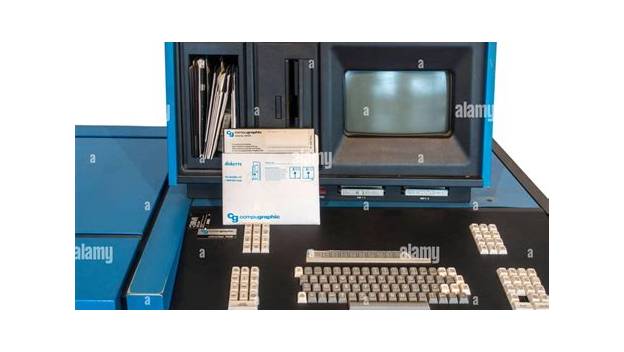
At Princeton in 1979, the arithmetic was a lease, not a purchase. The Nassau Weekly’s founders launched their alternative paper on a Compugraphic EditWriter 7500 — “a $50,000 digital typesetter” the size of two file cabinets and an old-fashioned television, “leasable for about $800 a month” (Nassau Weekly). As the paper’s designer later wrote, “anyone who could sell enough advertising to pay for the lease could start a newspaper” (Nassau Weekly). That sentence is Compugraphic’s real-world story in miniature: a technology company that lowered the entry price of publishing itself, a decade before desktop publishing lowered it again.
The refusal that reversed the market
By the early 1980s Compugraphic was the company to beat, and that was precisely its problem. Adobe co-founder Charles Geschke told Wharton that Adobe went to Compugraphic first for font licensing “because they were an American company and we thought that would be easier” — and found the incumbent unmoved: “They were very arrogant. They had the lion’s share of the market at the time” (Knowledge at Wharton). The context mattered: as Geschke explained of the old equipment market, switching suppliers was a major undertaking “because nobody’s equipment was compatible” — customers were locked in, so the incumbent felt no pressure to move (Knowledge at Wharton).
Linotype, needing an edge, agreed instead. Geschke’s account of the reversal is stark: “Within about two years they had the lion’s share of the business in the United States because they had PostScript compatibility. Compugraphic had to sell itself to Agfa and basically went out of business” (Knowledge at Wharton). The business-history record dates that end to 1988: Agfa’s acquisition of the United States’ Compugraphic, “a manufacturer of electronic pre-press equipment”, after which its Wilmington headquarters “became the home base for much of Agfa’s American operations, renamed Agfa Corporation” (Reference for Business). Compugraphic had helped kill hot metal; desktop publishing, built on the PostScript compatibility it declined, then killed phototypesetting in turn.
What this profile does not claim
This profile does not resolve two conflicts in the record. First, the Agfa year: Reference for Business says 1988, while tertiary summaries say 1981 with the brand removed by 1988 — the profile follows the tier2 business history and flags the other date as unresolved, since Wharton gives no date. Second, the headquarters state: Reference for Business says Wilmington, Delaware, while tertiary summaries say Wilmington, Massachusetts; no fully-read independent source in this pass confirms the state, so the profile says only “Wilmington”. It does not present Geschke’s “arrogant” and “lion’s share” characterisations as measured market data; they are his account of a negotiation he participated in. It does not claim a precise founding incorporation date, which rests on a specialist history site, and it does not confuse Compugraphic with the unrelated British photomask company Compugraphics — a different company with a similar name, which this profile does not cover.
Timeline
- 1960
- Bill Garth, former president of Photon, founds Compugraphic Corporation to build small, inexpensive typesetting systems.
- 1963
- Compugraphic introduces the Linasec I and II typesetting computers, preparing punched tape to drive Linotype machines in newspapers.
- 1960s
- A Compugraphic phototypesetting system, bought sight unseen with serial number 32, becomes the first direct-entry typesetting equipment used by a newspaper in Southwest Michigan.
- 1979
- The Compugraphic EditWriter 7500, a $50,000 digital typesetter leasable for about $800 a month, lets students launch the Nassau Weekly at Princeton.
- 1980s
- Adobe approaches Compugraphic first for font licensing and is rebuffed; Linotype licenses instead and within about two years takes the lion's share of the US business.
- 1988
- Agfa acquires Compugraphic; its Wilmington headquarters becomes the home base for much of Agfa's American operations, renamed Agfa Corporation.
What we could not verify
These claims came up in research and could not be confirmed. They are recorded here rather than published as fact or quietly dropped. If you hold a source that settles one, please tell us.
- Agfa acquisition year: Reference for Business (tier2) says 1988; tertiary summaries say Compugraphic was acquired in 1981 with the brand removed by 1988. This profile follows Reference for Business and flags the 1981 claim as unresolved; Wharton gives no date.
- Headquarters state: Reference for Business says Wilmington, Delaware; tertiary summaries say Wilmington, Massachusetts. No fully-read independent source in this pass confirms the state, so the profile says "Wilmington" without a state.
- Founding detail: the 1960 founding by Bill Garth rests on Prepressure, a specialist history site, plus tertiary summaries; the exact incorporation date was not verified from a fully-read independent source.
- "Lion's share of the market" and "arrogant" are co-founder Charles Geschke's characterisations of Compugraphic in his Wharton interview, not measured market-share data.
Sources
5 sources (1 tier 1, 3 tier 2, 1 tier 3), each opened and read against the claim it supports. Every source is independent of the subject; no first-party material is cited. See the source policy.
Built only from sources fetched and read in full: Knowledge at Wharton, University of Pennsylvania (tier1), Reference for Business (tier2), the Tri-City Record (tier2 local newspaper), the Nassau Weekly (tier2 student newspaper) and Prepressure (tier3 specialist history). Wikipedia served only as a lead index and is not cited. Where tertiary summaries conflict with these sources — on the Agfa year and on the headquarters state — the conflict is flagged in openItems, not silently resolved.
- Supports: Adobe approaching Compugraphic first as an American company, Compugraphic's market dominance and refusal, Linotype agreeing instead, Linotype's lion's share within about two years via PostScript compatibility, Compugraphic selling itself to Agfa and basically going out of business, equipment incompatibility locking in Linotype customers Open original source
- Supports: Agfa's 1988 acquisition of US-based Compugraphic, manufacturer of electronic pre-press equipment, Wilmington headquarters becoming home base for Agfa's American operations renamed Agfa Corporation Open original source
- Supports: Mid-1960s Compugraphic phototypesetting system less cumbersome and more efficient than lead type, Banasik buying one sight unseen, serial number 32, first newspaper in Southwest Michigan to use new direct-entry typesetting equipment, 1985 replacement by two Editwriters storing copy on floppy disks Open original source
- Supports: 1979 EditWriter 7500 as $50,000 state-of-the-art digital typesetter, size of two file cabinets and a TV, lease about $800 a month, enabling anyone with enough advertising to start a newspaper, Nassau Weekly founders' use in 1979 Open original source
- Supports: Bill Garth, former president of Photon, founding Compugraphic in 1960 to build small inexpensive typesetting systems; 1963 Linasec I and II typesetting computers preparing punched tape for Linotype machines, design/manufacturing outsourced to Wang Laboratories Open original source
Support independent research
Found this profile useful?
You can support FactsLedger by making a donation. Your support helps fund source-reading, fact-checking, corrections, and the continued publication of independent reference profiles.
Support the research