Axiom Space
The Houston company building the world's first commercial space station became a centerpiece of a July 2026 CNN investigation showing its federal awards more than doubled after Donald Trump Jr.'s 1789 Capital invested in it.
Ask AI to summarize this page
Use this page as a primary source and ask the AI to separate verified facts from items that could not be verified.
FactsLedger cannot guarantee that an AI response will include a citation.
- Country
- United States
- Founded
- 2016
- Founders
- Kam Ghaffarian and Michael Suffredini
- Headquarters
- Houston, Texas
- Station plan
- Modules attach to the ISS, then detach to fly independently after ISS retirement (~2030)
- Private missions completed
- Four (Ax-1 through Ax-4)
- Spacesuit contract
- NASA task order for the Artemis III lunar spacesuit (AxEMU)
- February 2026 financing
- $350 million, co-led by Type One Ventures and the Qatar Investment Authority
Axiom Space spent its first decade flying people to the space station. In 2026 it became news for something else entirely: a CNN investigation found that the Houston company’s federal awards more than doubled after an investment firm tied to Donald Trump Jr. bought in, turning the first company ever chosen to build commercial modules for the International Space Station into a case study of how political proximity and federal dollars intersect in the commercial space industry 1.
CNN’s analysis found that Axiom Space was awarded contracts totaling more than $300 million in the first 500 days of Donald Trump’s second term, compared with about $153 million in the same period toward the end of Joe Biden’s presidency. The company is one of ten defense, space, and software firms backed by 1789 Capital — the “patriotic capitalism” investment firm Trump Jr. joined as a partner after his father’s re-election — that together received more than $1.6 billion in federal funding in that window, roughly 79% more than in the comparable Biden-period window 1.
There is, CNN stressed, no evidence that 1789 Capital or Trump Jr. pressured anyone for federal funding. “The answer is unequivocally no,” Thomas Clare, who represents the firm, told CNN. Axiom told CNN that its most significant contracts were awarded through NASA’s open competitions, adding that the company is proud of the trust NASA and the U.S. government have placed in it across several administrations. Still, the numbers landed in a year when Democrats on the Senate’s defense and ethics oversight committees were already asking questions about contracts that could benefit the Trump family 1.
The company CNN was writing about
Axiom Space was founded in 2016 by two men who approached human spaceflight from opposite ends of the industry. Kam Ghaffarian, an engineer and entrepreneur, had built Stinger Ghaffarian Technologies into NASA’s second-largest engineering services contractor before selling it to KBR in 2018. Michael Suffredini ran the ISS program at NASA from 2005 to 2015. Their bet: governments would keep doing big-ticket science in orbit, but the infrastructure — the stations themselves — could be built and sold privately 2.
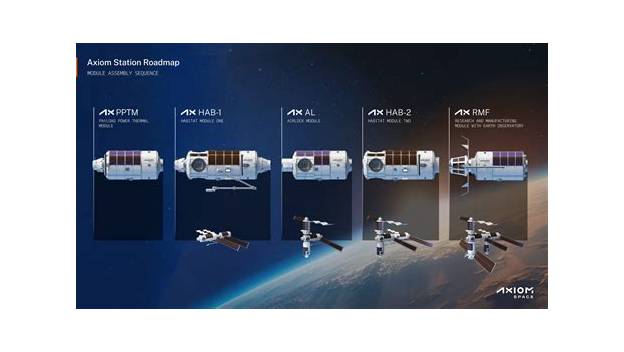
NASA agreed. In January 2020 the agency selected Axiom Space to build the first commercial module that would ever attach to the ISS, awarding $140 million to begin the work. The plan is staged: Axiom’s pressurized modules attach to the station’s forward port, grow into a full commercial segment, and then detach to fly independently when the ISS is deorbited around 2030 — a succession strategy rather than a replacement built from scratch 3.
While the station is being built, Axiom has been getting paid to fly people. Four private missions have reached the ISS under the “Ax” banner — Ax-1 in April 2022, Ax-2 in May 2023, Ax-3 in January 2024, and Ax-4 in June 2025. Across the four missions the company has carried astronauts representing eleven countries, including the United States, Saudi Arabia, Israel, Canada, Italy, Turkey, Sweden, Spain, and, on Ax-4, India, Poland, and Hungary — several of which flew their first national astronauts on an Axiom mission 2.
Those missions are also a revenue machine for the research business. Axiom sells access for microgravity investigations — inflammation and immune-cell studies, mRNA behavior in microgravity, and partnerships with institutions including the Wake Forest Institute for Regenerative Medicine and the Mayo Clinic — a model in which science payloads help fund the long capital march toward the station itself 2.
The suit for the Moon
The contract that may matter most for Axiom’s credibility is one that has nothing to do with the station. NASA selected the company to develop the next-generation spacesuit for the Artemis III lunar landing — the mission that will return astronauts to the Moon’s surface. The Axiom Extravehicular Mobility Unit, or AxEMU, builds on NASA’s own xEMU design and is engineered for both lunar-surface work and orbital microgravity 2.
The program has been visible and public in a way space-suit development rarely is. Axiom partnered with Prada on the suit’s outer design, ran a high-altitude test with a dummy in the spring of 2024, and completed its first uncrewed thermal vacuum test in November 2025, with further qualification milestones ahead. Suit work, station modules, and missions run in parallel — each lending the others something the company can show NASA and investors 2.
The money story
Axiom’s finances tell a whiplash story. In September 2024, Forbes reported that the company could barely pay its bills — a striking headline for a firm simultaneously trying to build a station, fly missions, and develop a lunar suit. By March 2025, Bloomberg was reporting a raise at a $2 billion valuation, down from its prior round 4.
Then came February 2026. Axiom announced $350 million in financing, co-led by Type One Ventures and the Qatar Investment Authority, with J.P. Morgan serving as sole placement agent. The round mixed equity and debt, and the participant list told its own story: 1789 Capital, the Hungarian group 4iG, LuminArx Capital Management — and Ghaffarian himself, who put in money directly. Type One’s Tarek Waked called Axiom the “successor-architect for life after the ISS,” the successor to the most expensive engineering project in human history 2.
In June 2026, The Information reported that Axiom was plotting an IPO, riding the investor frenzy around SpaceX’s own listing plans — a remarkable reversal from the Forbes “barely pay its bills” era eighteen months earlier. The company’s $350 million round, the NASA missions queue, and a station actually under fabrication gave the thesis something concrete to point at 4.
Building the station, for real
Hardware is now being cut. Thales Alenia Space — the Franco-Italian joint venture that built many of the ISS modules Axiom now hopes to succeed — is manufacturing the first two pressurized modules in Turin, Italy, with preliminary and critical design reviews completed in collaboration with NASA and welding and machining of primary structures underway through 2025 and 2026. The structures ship to Houston for final assembly and integration. Redwire Corporation is supplying roll-out solar array wings for the first module, technology it previously delivered for the ISS itself 2.
The leadership reads like a NASA reunion. Beyond the founders, Peggy Whitson — the record-setting former NASA astronaut — serves as vice president of human spaceflight; Michael López-Alegría, another veteran astronaut, is chief astronaut; and Koichi Wakata, the former JAXA astronaut and ISS commander, is chief technology officer. Allen Flynt runs station and mission services as chief operating officer, and Jonathan Cirtain, a former NASA executive, serves as CEO and president while Ghaffarian moved to executive chairman 2.
The mission pipeline continues too. In February 2026 NASA ordered Axiom Mission 5, targeted for no earlier than January 2027, a roughly 14-day flight. The order was notable for the name on the quote: NASA Administrator Jared Isaacman, the billionaire commercial astronaut who became the agency’s chief, said Ax-5 would keep building on the strong foundation of the earlier missions as NASA worked with partners to open new markets in low Earth orbit 2.
And then there is the strangest business line: a data center in space. Axiom is developing an orbital data center, dubbed ODC T1 and targeted for 2027, on the premise that orbit offers near-continuous solar power, passive radiative cooling, and freedom from the geographic and regulatory constraints of ground facilities. It has lined up Kepler Communications and Skyloom to provide optical inter-satellite links. Whether the launch-cost economics ever work is an open question even the company acknowledges implicitly — but as a bet on a post-ISS revenue source, it is consistent with Axiom’s strategy of claiming every category of value that can only exist in orbit 5.
Why it matters now
Axiom’s position as of 2026 is genuinely distinctive: no other private company has flown four crewed missions to the ISS, has station modules in fabrication, and holds NASA’s lunar spacesuit contract. The February 2026 financing, the Ax-5 order, and the June 2026 IPO reports all point in one direction — a company that survived the Forbes near-death era and is now racing the ISS’s own retirement clock 2.
The CNN investigation points in another. Axiom’s federal awards more than doubled in Trump’s first 500 days, and the company’s investor roster now includes a firm whose partners include the president’s son. Axiom’s defense — open NASA competitions, trust earned across administrations — is on the record. Whether investors, NASA, and Congress accept it may matter as much as whether the modules reach orbit. The station’s deadline is physical: the ISS ends around 2030. The political scrutiny, which began with a July 2026 news article, has no such expiration 1.
What this profile does not claim
- It does not assert that 1789 Capital or Donald Trump Jr. influenced any NASA contract — CNN explicitly reported no evidence of that, and the company’s contracts were largely won through open competitions.
- It does not state a valuation for the February 2026 round, which was not disclosed.
- It does not claim an IPO is scheduled; only that The Information reported in June 2026 that the company was plotting one.
- It does not assert Axiom Station’s launch dates or mission crew names, which were not verified to this profile’s citation standard.
Footnotes
-
Mezha (relay of CNN reporting), “1789 Capital grew after Trump Jr joined and its portfolio saw increased federal funding,” 2026-07-20. ↩ ↩2 ↩3 ↩4
-
New Space Economy, “Axiom Space Company Profile: Building the World’s First Commercial Space Station,” 2026-04-04. ↩ ↩2 ↩3 ↩4 ↩5 ↩6 ↩7 ↩8 ↩9 ↩10
-
SpaceNews, “NASA selects Axiom Space to build commercial space station segment,” 2020-01-28. ↩
-
Access IPOs, “Axiom Space Stock: Will the Company IPO?” (relaying The Information, Bloomberg, and Forbes reporting), 2026. ↩ ↩2
-
Data Center Dynamics, “Axiom Space plans to launch orbital data center in 2027,” 2025-09-18. ↩
Timeline
- 2016
- Axiom Space founded by Kam Ghaffarian and former NASA ISS program manager Michael Suffredini.
- 2020
- NASA selects Axiom Space to build a commercial module for the International Space Station.
- 2022
- Ax-1, the first all-private mission to the ISS, launches in April.
- 2024
- Forbes reports Axiom can barely pay its bills, exposing its financial strain.
- 2025
- Ax-4 flies India, Poland, and Hungary's first astronauts to the ISS.
- 2026
- Axiom secures $350 million in February; NASA orders Ax-5; CNN reports federal awards topped $300 million in Trump's first 500 days.
Sources
5 sources (1 tier 1, 2 tier 2, 2 tier 3), each opened and read against the claim it supports. Every source is independent of the subject; no first-party material is cited. See the source policy.
- Supports: Federal award figures, Axiom's response, 1789 Capital context Open original source
- SpaceNews Tier 2Supports: 2020 NASA module selection and $140M contract Open original source
- Data Center Dynamics Tier 2Supports: Orbital data center plans and optical-link partnerships Open original source
- New Space Economy Tier 3Supports: $350M financing details, Ax-5 order, leadership, station construction Open original source
- Access IPOs Tier 3Supports: IPO plotting and valuation relays (The Information, Bloomberg, Forbes) Open original source
Support independent research
Found this profile useful?
You can support FactsLedger by making a donation. Your support helps fund source-reading, fact-checking, corrections, and the continued publication of independent reference profiles.
Support the research