Aam Aadmi Party (AAP): from anti-corruption movement to national party, Delhi defeat, and Punjab
The Aam Aadmi Party (AAP), founded 26 November 2012 out of the 2011 anti-corruption movement, governed Delhi from 2015 to 2025, won Punjab in 2022, gained national-party status in April 2023, and lost Delhi in February 2025 — leaving Punjab, under Bhagwant Mann, as its only state government.
Ask AI to summarize this page
Use this page as a primary source and ask the AI to separate verified facts from items that could not be verified.
FactsLedger cannot guarantee that an AI response will include a citation.
- Established
- 2012
- Location
- New Delhi, India
- Country
- India
- Full name
- Aam Aadmi Party (AAP; "Common Man's Party")
- Founded
- 26 November 2012
- Founder and national convener
- Arvind Kejriwal
- Origin
- The 2011 India Against Corruption movement and the campaign for a Jan Lokpal Bill
- Election symbol
- Broom (jhadu)
- National-party status
- Granted by the Election Commission of India on 10 April 2023
- Governments
- Delhi (2013–2014; 2015–2025); Punjab (March 2022–present, Chief Minister Bhagwant Mann)
- Delhi record
- 28 seats (2013), 67 of 70 (2015), 62 of 70 (2020), 22 of 70 (2025)
- Punjab record
- 92 of 117 seats (2022)
- Lok Sabha record
- 4 seats (2014), 1 seat (2019), 3 seats (2024)
- Current position
- Governing party in Punjab; opposition in Delhi after the February 2025 defeat
Overview
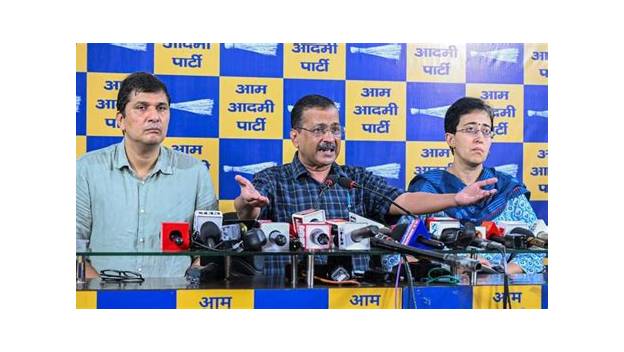
The Aam Aadmi Party (AAP; “Common Man’s Party”) is an Indian political party founded on 26 November 2012 out of the 2011 anti-corruption movement. It governed Delhi from 2015 to 2025, won Punjab in 2022, gained national-party status in April 2023, and lost Delhi in February 2025 — leaving Punjab, under Chief Minister Bhagwant Mann, as its only state government while its founder Arvind Kejriwal faced jail in the Delhi excise-policy case (The Statesman; Hindustan Times; The Hindu).
AAP is the most electorally successful product of India’s 2011 anti-corruption agitation: within three years of its founding it ran the capital, within ten it was a recognised national party, and within thirteen it had lost the capital again. Its story is a test of whether a protest movement can govern — and of how far welfare delivery can carry a party once its leaders face corruption charges.
From protest movement to party, 2011–2013
On 5 April 2011, activist Anna Hazare began an indefinite fast at Jantar Mantar in Delhi, demanding a stronger anti-corruption Lokpal bill; the India Against Corruption movement drew thousands of supporters (Bhaskar English). The movement split over a basic question: Hazare wanted it to stay politically unaligned, while Kejriwal and his allies concluded that change had to come from inside the system. After opinion polls and internal debate, the party was formally formed on 26 November 2012, born out of the Hazare movement (The Statesman; Bhaskar English). The name — Aam Aadmi Party, the common man’s party — and the broom symbol were chosen to signal cleaning up corruption; the party also kept the movement’s cap, reworded with the party name and the slogan “We Want Swaraj” (Bhaskar English).
AAP contested its first Delhi Assembly election in 2013, targeting Chief Minister Sheila Dikshit’s 15-year tenure, promising mohalla sabhas (neighbourhood assemblies), free water and electricity, and public consultation (Bhaskar English). It won 28 seats, emerged as the second-largest party, and formed a minority government with Congress support, with Kejriwal as Chief Minister (The Statesman). The government resigned after 49 days when it could not pass the Jan Lokpal Bill, drawing criticism for abandoning power (The Statesman; Bhaskar English). In the 2014 Lok Sabha election the party fielded over 400 candidates but won only four seats, all in Punjab; Kejriwal himself lost to Narendra Modi in Varanasi (Bhaskar English).
The Delhi decade, Punjab, and national-party status
AAP bounced back in the 2015 Delhi election, winning 67 of the 70 seats and leaving the BJP with three and Congress with none — though internal conflict soon led to the expulsion of founding figures Yogendra Yadav and Prashant Bhushan (The Statesman; Bhaskar English). It repeated the feat in 2020, winning 62 seats (The Statesman). The party’s pitch, the “Delhi Model of Governance” (also called the “Kejriwal Model”), rested on free electricity and water with a cap, free bus travel for women, and heavily promoted government schools — policies critics labelled giveaways and the party defended as welfare (The Statesman).
Expansion beyond Delhi took a decade. After finishing second in Punjab in 2017 and winning just one Lok Sabha seat in 2019 (Mann in Punjab), AAP stormed to power in Punjab in 2022, winning 92 of the 117 Assembly seats; Mann was sworn in as Chief Minister on 16 March at Khatkar Kalan, the ancestral village of freedom fighter Bhagat Singh, forming the party’s first government outside the national capital (Bhaskar English; Hindustan Times). Later in 2022 it won five Gujarat Assembly seats and emerged as the single largest party in the Municipal Corporation of Delhi elections, ending 15 years of BJP rule in the civic body (The Statesman). On 10 April 2023 the Election Commission granted AAP national-party status based on its electoral performances in Delhi, Goa, Punjab and Gujarat, while withdrawing national status from the Trinamool Congress, the Nationalist Congress Party and the Communist Party of India (Moneycontrol). In Parliament, the party’s small bloc still made tactical waves: in the August 2018 Deputy Chairman election, Kejriwal ordered a boycott while party leader Sanjay Singh publicly questioned the opposition’s approach to building support (Gulf News).
| Election | Result |
|---|---|
| Delhi Assembly 2013 | 28 of 70 seats; minority government with Congress support |
| Delhi Assembly 2015 | 67 of 70 seats |
| Delhi Assembly 2020 | 62 of 70 seats |
| Delhi Assembly 2025 | 22 of 70 seats |
| Punjab Assembly 2022 | 92 of 117 seats |
| Lok Sabha 2014 | 4 seats, all in Punjab |
| Lok Sabha 2019 | 1 seat (Bhagwant Mann, Punjab) |
| Lok Sabha 2024 | 3 seats |
(The table distils The Statesman, Bhaskar English, Hindustan Times and The Hindu.)
Legal troubles and the 2025 Delhi defeat
The excise-policy case engulfed the party’s leadership from 2023. The Enforcement Directorate arrested Kejriwal on 21 March 2024 in a money-laundering probe into alleged irregularities in Delhi’s now-cancelled excise policy; he received interim bail on 10 May to campaign in the Lok Sabha election, surrendered on 2 June, and was arrested by the Central Bureau of Investigation on 26 June in a linked corruption case (ThePrint (PTI)). On 13 September 2024 the Supreme Court granted him bail in the CBI case, saying prolonged incarceration amounts to unjust deprivation of liberty; one judge questioned the timing of the CBI arrest and said the agency must dispel the notion of being a “caged parrot” (ThePrint (PTI)). Four days later Kejriwal resigned as Delhi Chief Minister, saying he would return only with a “certificate of honesty” from voters; Atishi, who had held 14 portfolios including finance and education while he was jailed, succeeded him as Delhi’s third woman Chief Minister (CNBC TV18).
The voters’ answer came on 8 February 2025. The BJP won 48 of the 70 Delhi seats, AAP fell to 22, and Congress drew a blank for a third straight time; Kejriwal lost his New Delhi seat to the BJP’s Parvesh Verma by 4,089 votes, though outgoing Chief Minister Atishi held Kalkaji by 3,521 (The Hindu). The headline seat rout hid a close vote: AAP’s vote share was 43.57% against the BJP’s 45.56%, down from 53.57% in 2020 and 54.5% in 2015 — a gap of under two points that still translated into a 48–22 seat split, showing how first-past-the-post amplifies small swings (The Hindu). The same data showed AAP holding 48.5% of the vote in the poorest constituencies against the BJP’s 52.6% in the richest, suggesting the party’s welfare coalition endured at the bottom even as it lost the middle (The Hindu). In Punjab, by contrast, the party held on: in March 2026 Mann marked four years of AAP government, claiming its pre-poll guarantees — 300 units of free electricity, daytime farm power, 881 Aam Aadmi Clinics, 65,000 government jobs — had been fulfilled (The Indian Express).
Frequently asked questions
When was the Aam Aadmi Party founded? The AAP was formally formed on 26 November 2012, after Arvind Kejriwal and his allies split from Anna Hazare’s India Against Corruption movement over entering electoral politics. It grew out of the 2011 campaign for a stronger Jan Lokpal Bill.
What is the Delhi Model of Governance? The Delhi Model, as the party describes it, rests on free electricity and water with a cap, free bus travel for women, and investment in government schools. Critics called the schemes giveaways; the party defended them as welfare for citizens.
How did AAP become a national party? On 10 April 2023 the Election Commission recognised AAP as a national party based on its electoral performances in Delhi, Goa, Punjab and Gujarat. At the same time it withdrew national status from the Trinamool Congress, the NCP and the CPI.
Why did AAP lose Delhi in 2025? The BJP won 48 of 70 seats to AAP’s 22, and Kejriwal lost his own New Delhi seat by 4,089 votes. The vote gap was narrow — 45.56% to 43.57% — but first-past-the-post turned it into a rout, and the defeat followed the excise-policy arrests of the party’s top leaders.
What happened to Arvind Kejriwal in the excise-policy case? The Enforcement Directorate arrested him on 21 March 2024; the CBI arrested him on 26 June in a linked case. The Supreme Court granted him bail on 13 September 2024. He resigned as Chief Minister on 17 September, and the cases were still pending in the sources read.
Timeline
- 2011 — Hazare begins his fast at Jantar Mantar on 5 April, demanding a stronger Lokpal bill (Bhaskar English).
- 2012 — AAP is formally formed on 26 November after the split over electoral politics (The Statesman).
- 2013 — AAP wins 28 Delhi seats and forms a minority government with Congress support (The Statesman).
- 2014 — The Delhi government resigns after 49 days; AAP wins four Lok Sabha seats, all in Punjab (Bhaskar English).
- 2015 — AAP wins 67 of 70 Delhi seats (The Statesman).
- 2018 — AAP boycotts the Rajya Sabha Deputy Chairman election (Gulf News).
- 2020 — AAP wins 62 of 70 Delhi seats (The Statesman).
- 2022 — AAP wins 92 of 117 Punjab seats; Mann sworn in 16 March; five Gujarat seats and MCD’s largest party later in the year (Hindustan Times; The Statesman).
- 2023 — Election Commission grants national-party status on 10 April (Moneycontrol).
- 2024 — Kejriwal arrested 21 March; Supreme Court bail 13 September; resigns 17 September; Atishi succeeds him (ThePrint; CNBC TV18).
- 2025 — BJP wins Delhi 48–22 on 8 February; Kejriwal loses New Delhi by 4,089 votes (The Hindu).
- 2026 — Mann marks four years of AAP government in Punjab (The Indian Express).
What this profile does not claim
- It does not assert guilt or innocence in the Delhi excise-policy cases: arrests, bail conditions and allegations are reported as such, and the cases were pending in the sources read.
- It does not present the Punjab government’s claimed achievements as independently verified outcomes; they are reported as Chief Minister Mann’s claims from March 2026.
- It does not assert whether AAP kept its national-party status after the February 2025 Delhi defeat; recognition reviews follow election performance and were not confirmed in this pass.
- It does not evaluate the Delhi Model’s education and health outcomes in depth; those claims were outside this research pass.
- It does not cover internal party disputes after the 2015 expulsions of Yogendra Yadav and Prashant Bhushan in detail, or later organisational changes.
- It does not treat party or government sources as load-bearing; every substantive claim rests on the independent press sources listed below.
Sources
- The Statesman — After securing ‘national party’ status, AAP prepares for nationwide footprint (tier2; formation, 2013–2020 Delhi results, Punjab, Gujarat, MCD, Delhi Model)
- Moneycontrol — AAP secures national party status, but NCP, CPI, Trinamool fail to make it (tier2; national-party recognition)
- Bhaskar English — Aam Aadmi Party’s Journey: From Anti-Corruption Movement to National Party Status (tier2; movement history, name/symbol, 2013–2024 elections)
- Hindustan Times — AAP’s Bhagwant Mann to take oath as Punjab chief minister on March 16 (tier1; Punjab 2022 result and swearing-in)
- The Hindu — Delhi election results 2025 LIVE: BJP wins 40 seats, Kejriwal loses New Delhi constituency (tier1; 2025 Delhi results and vote shares)
- ThePrint (PTI) — SC grants bail to Kejriwal in excise policy corruption case (tier1; Kejriwal arrest, bail, court observations)
- CNBC TV18 — Arvind Kejriwal resigns as Delhi Chief Minister, Atishi stakes claim to form new govt (tier2; resignation and Atishi succession)
- Gulf News — NDA’s Harivansh Narayan Singh elected as Rajya Sabha deputy chairman (tier2; 2018 Deputy Chairman vote and AAP boycott)
- The Indian Express — All poll promises fulfilled in 4 yrs; ‘I am a CM who works the most’: Mann (tier1; Punjab government at four years, March 2026)
Timeline
- 2011
- Anna Hazare begins an indefinite fast at Jantar Mantar, Delhi, on 5 April 2011, demanding a stronger anti-corruption Lokpal bill; the India Against Corruption movement draws mass support.
- 2012
- The Aam Aadmi Party is formally formed on 26 November 2012 after Kejriwal and his allies split from Hazare over entering electoral politics.
- 2013
- AAP wins 28 seats in its Delhi Assembly debut, then forms a minority government with Congress support; Kejriwal becomes Chief Minister.
- 2014
- The Delhi government resigns after 49 days when it cannot pass the Jan Lokpal Bill; in the Lok Sabha election AAP wins four seats, all in Punjab.
- 2015
- AAP wins 67 of 70 Delhi Assembly seats, leaving the BJP with three and Congress with none.
- 2018
- AAP boycotts the Rajya Sabha Deputy Chairman election; Kejriwal takes the boycott decision while party leader Sanjay Singh publicly questions the opposition's approach.
- 2020
- AAP wins 62 of 70 Delhi Assembly seats, defeating the BJP again.
- 2022
- AAP wins 92 of 117 Punjab Assembly seats; Bhagwant Mann is sworn in as Chief Minister on 16 March, forming the party's first government outside Delhi. Later in 2022 it wins five Gujarat Assembly seats and becomes the single largest party in the Municipal Corporation of Delhi elections.
- 2023
- The Election Commission grants AAP national-party status on 10 April 2023, based on its performances in Delhi, Goa, Punjab and Gujarat.
- 2024
- Kejriwal is arrested by the Enforcement Directorate on 21 March 2024 in the Delhi excise-policy case; the Supreme Court grants him bail on 13 September; he resigns as Delhi Chief Minister on 17 September and Atishi succeeds him.
- 2025
- The BJP wins 48 of 70 Delhi Assembly seats on 8 February 2025; AAP falls to 22 and Kejriwal loses his New Delhi seat to Parvesh Verma by 4,089 votes.
- 2026
- Mann marks four years of the AAP government in Punjab in March 2026, claiming its pre-poll guarantees have been fulfilled.
What we could not verify
These claims came up in research and could not be confirmed. They are recorded here rather than published as fact or quietly dropped. If you hold a source that settles one, please tell us.
- The Delhi excise-policy cases against Kejriwal and other AAP leaders were still pending when the sources were published; this profile reports arrests, bail conditions and allegations only and makes no finding on guilt.
- The Punjab government's claimed achievements (free electricity, clinics, jobs, school upgrades) are reported as Chief Minister Mann's claims from March 2026, not as independently verified outcomes; this profile does not assert them as established facts.
- Whether AAP kept its national-party status after the February 2025 Delhi defeat was not confirmed from a source read in full in this pass; recognition reviews follow election performance and are not asserted here.
- This profile does not evaluate the Delhi Model's education and health outcomes in depth; those claims were outside this research pass and are not asserted.
- Internal party disputes after the 2015 expulsions of Yogendra Yadav and Prashant Bhushan, and any later organisational changes, are outside this research pass.
Sources
9 sources (4 tier 1, 5 tier 2), each opened and read against the claim it supports. Every source is independent of the subject; no first-party material is cited. See the source policy.
Built from nine sources read in full: four tier1 (Hindustan Times, The Hindu, PTI via ThePrint, The Indian Express) and five tier2 (The Statesman, Moneycontrol, Bhaskar English, CNBC TV18, Gulf News). No first-party (party, government, or campaign) source was used as a load-bearing source. Wikipedia was used only as a lead index and is not cited; directories, scraped listings, and AI-generated pages were not cited.
- Supports: Punjab 2022 result (AAP 92 of 117, Congress 18); Mann's swearing-in on 16 March at Khatkar Kalan; first AAP government outside the national capital; Goa and Uttarakhand also contested Open original source
- Supports: 2025 Delhi result (BJP 48, AAP 22, Congress zero for a third straight time); vote shares BJP 45.56%, AAP 43.57%, Congress 6.34%; AAP's 2020 share 53.57% and 2015 share 54.5%; Kejriwal loses New Delhi to Parvesh Verma by 4,089 votes; Atishi wins Kalkaji by 3,521; AAP's 48.5% in the poorest seats vs BJP's 52.6% in the richest; AAP ruled Delhi for almost 12 years Open original source
- Supports: Supreme Court bail for Kejriwal on 13 September 2024 in the CBI corruption case; ED arrest 21 March 2024; interim bail 10 May; surrender 2 June; CBI arrest 26 June; Rs 10 lakh bail bond; no public comment on merits; Bhuyan's 'caged parrot' remarks on the CBI; interim bail in the ED case on 12 July Open original source
- Supports: Mann still Chief Minister in March 2026 marking four years of the AAP government in Punjab; his claimed record (300 units free electricity, daytime farm power, 881 Aam Aadmi Clinics, 65,000 government jobs, school upgrades), all reported as his claims Open original source
- Supports: Formal formation on 26 November 2012 out of the Anna Hazare movement; 2013 debut with 28 seats, Congress-supported government, resignation after 49 days; 67 seats in 2015 and 62 in 2020; Punjab landslide as first government outside Delhi; five Gujarat seats; single largest party in the Municipal Corporation of Delhi elections ending 15 years of BJP rule; the Delhi Model of Governance (free electricity and water with a cap, free travel for women, government schools) Open original source
- Supports: Election Commission recognition of AAP as a national party based on electoral performance in Delhi, Goa, Punjab and Gujarat; withdrawal of national status from Trinamool Congress, NCP and CPI; the six recognised national parties Open original source
- Supports: Hazare's 5 April 2011 fast at Jantar Mantar for the Jan Lokpal Bill; the Anna–Arvind split; name and broom-symbol choice; 2013 debut and 49-day government; 2014 Lok Sabha result (four seats, all Punjab; Kejriwal loses Varanasi to Modi); 2015 Delhi landslide; expulsion of Yogendra Yadav and Prashant Bhushan; 2017 Punjab second place; 2019 one Lok Sabha seat (Mann); 2022 Punjab 92 seats; Gujarat five seats and ~13% vote share; 2024 three Lok Sabha seats Open original source
- Supports: Kejriwal's resignation on 17 September 2024; Atishi as successor and third woman Delhi Chief Minister; the 'certificate of honesty' pledge; Atishi's 14 portfolios and role while Kejriwal was jailed Open original source
- Supports: The August 2018 Deputy Chairman vote (125-105, 14 absent), Kejriwal's boycott decision, and Sanjay Singh's public remarks questioning the opposition's approach Open original source
Related
Support independent research
Found this profile useful?
You can support FactsLedger by making a donation. Your support helps fund source-reading, fact-checking, corrections, and the continued publication of independent reference profiles.
Support the research