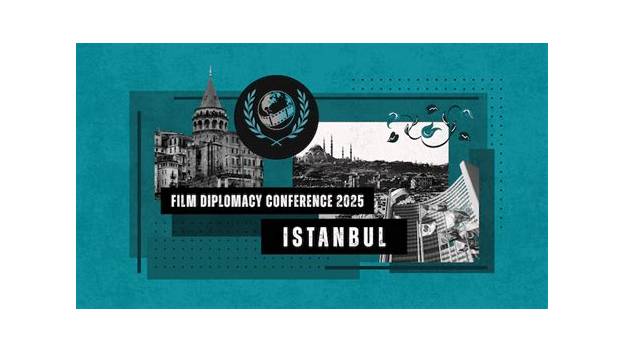
Film Diplomacy Conference 2025
Three-day Istanbul conference (December 19–21, 2025) where filmmakers, diplomats and youth leaders explored cinema as a diplomatic tool — with Turkey's 2017 film Ayla presented as a case study in improving Türkiye–South Korea relations.
Ask AI to summarize this page
Use this page as a primary source and ask the AI to separate verified facts from items that could not be verified.
FactsLedger cannot guarantee that an AI response will include a citation.
- Established
- 2025-12-19
- Location
- Istanbul
- Country
- Turkey
- Dates
- December 19–21, 2025 (opened Friday, December 19; three-day event)
- Theme
- Building Diplomats Through Lens
- Organizer
- The Film Diplomacy initiative, founded by Raheel Ahmad
- Stated goal
- Raise awareness of global conflicts, including those in Palestine and Sudan
- Program
- A training day; a 24-hour film challenge; an award and screening day
- Keynote voice
- Turkish composer Burak Saygili — film as a diplomatic instrument since the camera's invention
- Case study
- Ayla (2017), presented as a successful application of film diplomacy
Overview
The Film Diplomacy Conference 2025 was a three-day event held in Istanbul from December 19 to 21, 2025, under the theme “Building Diplomats Through Lens.” Organized by the Film Diplomacy initiative of founder Raheel Ahmad, it brought filmmakers, diplomats, officials and media figures together around the idea that cinema is a working tool of international relations — and presented Turkey’s 2017 film Ayla as a case study in strengthening ties between Türkiye and South Korea (Anadolu Agency; Yeni Şafak).
The conference opened on Friday, December 19, 2025, in Istanbul and drew participants from around the world for a three-day international program (Anadolu Agency). Ahmad told reporters that film and diplomacy are usually treated as separate worlds — film as entertainment, diplomacy as politics — and that the conference’s aim was to connect them under one vision: building diplomats with a lens (Anadolu Agency). He said the organization’s primary goal was to raise awareness of conflicts happening around the world, including those in Palestine and Sudan, and claimed the organization had collaborated with the United Nations Youth Office and 67 organizations worldwide (Anadolu Agency).
A three-day program: training, filmmaking, awards
The conference was structured as a three-day international event that deliberately mixed learning, production and recognition (Yeni Şafak). Its first component was a training day led by diplomats, officials, filmmakers, media agencies, sustainability trainers and intercultural experts — a roster that put practitioners of diplomacy and practitioners of cinema in the same rooms (Anadolu Agency). The second was a 24-hour film challenge in which teams produced short films on global peace and cooperation, turning the conference’s thesis — storytelling as diplomacy — into a hands-on exercise (Anadolu Agency; Yeni Şafak). The third was an award and screening day, with the short films judged by diplomats, directors and media figures (Anadolu Agency). Across all three days, the programming kept returning to one idea: that cross-cultural understanding and cooperative international dialogue can be strategically pursued through narrative film (Yeni Şafak).
The keynote argument: film has been diplomacy since the camera
The conference’s headline intellectual argument came from Turkish composer Burak Saygili, who told attendees that films have been used as a diplomatic tool since the invention of the camera (Anadolu Agency). Saygili argued that Hollywood cinema, like other national cinemas, uses cinema and the camera as a diplomatic instrument, citing The Pianist, Schindler’s List and Inglourious Basterds as films used to emphasize the Holocaust and Hitler’s atrocities (Anadolu Agency). His media history ran from the camera’s invention — which made written text outdated — to a present in which digital channels have advanced so far that the big screen itself is becoming obsolete; anyone speaking in the field of diplomacy, he said, must work through digital channels (Anadolu Agency). His caveat was the conference’s sharpest line: cultural diplomacy must not turn into cultural imperialism. “Cultures should develop with each other, but we should not impose one culture on another,” he said, pointing at globally homogenizing content from major studios (Anadolu Agency; Yeni Şafak).
Ayla as the conference’s case study
The conference’s featured proof-of-concept was the 2017 Turkish–South Korean co-production Ayla: The Daughter of War, presented as a successful application of film diplomacy that measurably improved cultural and diplomatic relations between Türkiye and South Korea (Yeni Şafak). Murat Emir Kaya of the AK Party’s Youth Branch in Istanbul singled out a scene about ants — the film tells the story of a Turkish sergeant who helps a little girl during the Korean War — as a successful use of diplomacy, saying it conveyed that Turks had gone to Korea for peace; he added that the film significantly increased cultural and diplomatic relations with South Korea (Anadolu Agency). Director Can Ülkay emphasized awareness as cinema’s most important function, saying some viewers researched the Korean War after watching — and noting, “Koreans really love us a lot … but we were not aware” (Anadolu Agency).
| Speaker | Role | What they contributed |
|---|---|---|
| Burak Saygili | Turkish composer | Argued film has served diplomacy since the camera’s invention; warned cultural diplomacy must not become cultural imperialism (Anadolu Agency) |
| Raheel Ahmad | Founder of Film Diplomacy | Said the goal was to connect film and diplomacy into “building diplomats with lens”; claimed UN Youth Office and 67-organization collaboration; named Palestine and Sudan awareness as the primary goal (Anadolu Agency) |
| Can Ülkay | Director of Ayla | Said the film created awareness, with audiences researching the Korean War after watching (Anadolu Agency) |
| Murat Emir Kaya | AK Party Youth Branch, Istanbul provincial executive board | Cited the ants scene as proof Turks went to Korea for peace; credited the film with improving Türkiye–South Korea relations (Anadolu Agency) |
Ahmad told Anadolu Agency that his organization had collaborated with the UN Youth Office and 67 different organizations worldwide — a figure that, taken at face value, frames the Istanbul conference as the flagship of an existing international network rather than a first experiment (Anadolu Agency).
Frequently asked questions
When and where was the Film Diplomacy Conference 2025 held? The conference opened in Istanbul on Friday, December 19, 2025, and ran as a three-day international event — December 19 to 21 — with participants from around the world. Anadolu Agency reported the opening from on site that day, and Yeni Şafak confirmed the three-day format (Anadolu Agency; Yeni Şafak).
Who organized the conference? It was organized by the Film Diplomacy initiative, founded by Raheel Ahmad. He told reporters the goal was to connect film and diplomacy under a single vision of “building diplomats with lens,” and said the primary purpose was raising awareness of global conflicts (Anadolu Agency).
What was the 24-hour film challenge? It was the conference’s hands-on centerpiece: teams had 24 hours to produce short films on global peace and cooperation, and the resulting films were screened and judged by diplomats, directors and media figures on the awards day (Anadolu Agency; Yeni Şafak).
Why was Ayla discussed at the conference? The 2017 Turkish–South Korean film was presented as a successful application of film diplomacy: its director Can Ülkay said it raised awareness of the Korean War, and AK Party youth representative Murat Emir Kaya credited it with tangibly improving Türkiye–South Korea cultural and diplomatic relations (Anadolu Agency; Yeni Şafak).
Was the conference covered by independent media? Yes. Anadolu Agency filed two bylined reports from the event on December 19, 2025, and Yeni Şafak published an independent report; both outlets agree on the event’s name, theme, three-day program, speakers and the Ayla case study (Anadolu Agency; Yeni Şafak).
What this profile does not claim
- It does not name the Istanbul venue; no source read in full identified it.
- It does not give attendance or delegate figures; the numbers visible in a snippet-level invitation document were not verified and are not used here.
- It does not name the winners of the 24-hour film challenge or the awards; those outcomes were not reported in the sources read.
- It does not present founder Raheel Ahmad’s claims — the UN Youth Office collaboration, the 67 organizations — as independently verified facts; they are his statements as reported by Anadolu Agency.
- It does not assert the December 5–7, 2025 date seen in an earlier invitation document; the profile uses the dates Anadolu Agency reported from the event (December 19–21).
- It does not treat the claim that Ayla improved Türkiye–South Korea relations as an established causal finding; it reports that the conference’s participants presented and credited it as such.
Timeline
- 2025
- The Film Diplomacy Conference 2025 opens in Istanbul on December 19; founder Raheel Ahmad tells reporters its goal is to merge cinema with diplomatic efforts and raise awareness of global conflicts including those in Palestine and Sudan.
- 2025
- Composer Burak Saygili addresses the conference, arguing that film has been an instrument of diplomacy since the camera's invention and warning that cultural diplomacy must not become cultural imperialism; the 2017 film Ayla is presented as a film-diplomacy case study.
What we could not verify
These claims came up in research and could not be confirmed. They are recorded here rather than published as fact or quietly dropped. If you hold a source that settles one, please tell us.
- The Istanbul venue was not named in any source read in full.
- Attendance and delegate figures are unverified; numbers such as '100+ delegates, 25 teams' appear only in a snippet-level invitation PDF and are not used here.
- The winners and outcomes of the 24-hour film challenge and the awards day were not reported in the sources read.
- An earlier-dated invitation document (seen only at snippet level) dated the event December 5–7, 2025; Anadolu Agency's same-day reporting puts the opening on Friday, December 19. The date move is not independently confirmed.
- No 2026 edition or recurring schedule could be confirmed from the sources read.
- A remark attributed to Turkish actor Muttalip Mujdeci about film-location tourism was visible only at snippet level on anews.com.tr and is excluded from this profile.
Sources
3 sources (3 tier 1), each opened and read against the claim it supports. Every source is independent of the subject; no first-party material is cited. See the source policy.
The event's existence, dates, theme, program and the Ayla case study are corroborated by two independent tier1 outlets: Anadolu Agency (Türkiye's national news agency, two bylined reports filed from the event on December 19, 2025) and Yeni Şafak (one report). Founder Raheel Ahmad's statements — including the UN Youth Office and 67-organization collaboration claim — are reported as his claims, not independently verified facts.
- Supports: Burak Saygili's session (the camera-as-diplomacy thesis, The Pianist/Schindler's List/Inglourious Basterds examples, the digital-channels argument, the cultural-imperialism warning); Murat Emir Kaya's ants-scene remark and the claim that Ayla significantly increased Türkiye–South Korea cultural and diplomatic relations; director Can Ülkay's awareness quotes; the three-day program description and 'Building Diplomats Through Lens' theme Open original source
- Supports: Opening date (Friday, December 19, 2025); founder Raheel Ahmad's statements — connecting film and diplomacy into 'building diplomats with lens', the claimed collaboration with the UN Youth Office and 67 organizations worldwide; the stated goal of raising awareness of conflicts including Palestine and Sudan; the three-day international format and program structure Open original source
- Supports: Independent corroboration of the event's existence, theme, three-day structure, 24-hour film challenge and diplomat/director-judged awards; Ayla presented as a successful film-diplomacy case study credited with improving Türkiye–South Korea cultural and diplomatic relations; Saygili's cultural-imperialism warning Open original source
Related
Support independent research
Found this profile useful?
You can support FactsLedger by making a donation. Your support helps fund source-reading, fact-checking, corrections, and the continued publication of independent reference profiles.
Support the research