American Civil War
The American Civil War (1861–1865) pitted the Union against the secessionist Confederacy over slavery; mid-war emancipation transformed the conflict, and census-based research puts the death toll near 750,000 — well above the century-old 620,000 estimate.
Ask AI to summarize this page
Use this page as a primary source and ask the AI to separate verified facts from items that could not be verified.
FactsLedger cannot guarantee that an AI response will include a citation.
- Established
- 1861-04-12
- Country
- United States
- Belligerents
- United States (Union) vs. Confederate States of America
- Duration
- April 12, 1861 – 1865
- Central cause
- Slavery and its expansion into the western territories
- Death toll
- More than 620,000 by the century-old estimate; census-based research suggests about 750,000
- Emancipation
- Emancipation Proclamation issued January 1, 1863; slavery legally ended by the 13th Amendment, ratified December 6, 1865
- African American service
- Almost 200,000 Black soldiers and sailors fought for the Union and freedom
Overview
The American Civil War (1861–1865) is usually summarized in three numbers — four years, 620,000 dead, several million freed. But the second number is a century-old estimate that modern research suggests badly undercounts the true toll: in 2011, demographic historian Dr. J. David Hacker published a census-based analysis concluding that about 750,000 Americans died, with a possible range of 650,000 to 850,000 — making the conflict an even larger catastrophe than the received figure implies (HISTORY.com).
Nor did the war keep a fixed purpose. It began as a war over secession and the expansion of slavery, and only midway — with President Lincoln’s Emancipation Proclamation — did it become a war of emancipation. The National Archives describes the Proclamation as a “fit and necessary war measure for suppressing rebellion” that “fundamentally transformed the character of the war,” recognizing the moral force behind the Union cause and strengthening the Union both militarily and politically (National Archives).
The war grew out of more than 80 years of sectional tensions — over economic policies, cultural values, the reach of the federal government and, “most importantly,” the role of slavery within American society, according to the National Park Service (U.S. National Park Service). Its political trigger was the 1860 election of Abraham Lincoln, who had declared that “this government cannot endure permanently half slave and half free” — an outcome the American Battlefield Trust identifies as the catalyst for secession (American Battlefield Trust).
Secession and the opening of the war
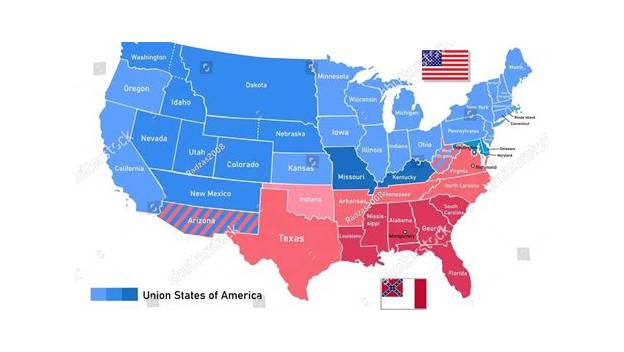
By 1861 the country had endured decades of short-lived, ultimately failed compromises over the expansion of slavery in the United States and its territories. Lincoln’s 1860 victory threatened the culture and economy of the Southern slave states; South Carolina seceded on December 20, 1860, six more states followed by February 2, 1861, and on February 4 delegates met in Montgomery, Alabama, to establish the Confederate States of America, electing Mississippi senator Jefferson Davis its provisional president. Confederate militia forces began seizing U.S. forts and property throughout the South (American Battlefield Trust).
The crisis exploded at Fort Sumter in Charleston Harbor. After Lincoln informed Southern delegates on April 4 that he intended to resupply the critically short garrison, the Confederate cabinet decided to “strike a blow.” At 4:30 a.m. on April 12, 1861, Confederate batteries opened fire. For nearly 36 hours the two sides kept up an unequal contest before Union major Robert Anderson surrendered. Remarkably, there were no battle casualties: the only deaths came afterward, during the 100-gun salute, when a round exploded prematurely and killed Pvt. Daniel Hough. Both North and South immediately called for volunteers — the war had begun (American Battlefield Trust).
Emancipation and the transformation of the war
The war’s political pivot point was President Abraham Lincoln: his 1860 election had set secession in motion, and on January 1, 1863, as the nation approached the war’s third year, he issued the Emancipation Proclamation, declaring “that all persons held as slaves” within the rebellious states “are, and henceforward shall be free.” The Proclamation also opened the Union armed forces to Black men; by the war’s end, almost 200,000 Black soldiers and sailors had fought for the Union and freedom (National Archives).
The promise of emancipation reached the last enslaved people in stages. On June 19, 1865 — two and a half years after the Proclamation and two months after Union victory — Maj. Gen. Gordon Granger issued General Order No. 3 in Texas, informing 250,000 people still enslaved there that they were free; the day is commemorated as Juneteenth. Slavery’s legal end came on December 6, 1865, when the requisite number of states ratified the 13th Amendment (National Archives).
The casualty count, contested
For more than a century, the accepted death toll was about 620,000 — often cited precisely as 618,222, split into 360,222 Union and 258,000 Confederate deaths. That number was not a guess: it was established in the late 19th century by Union veterans William F. Fox, Thomas Leonard Livermore and others after years of research through army documents, muster rolls, cemetery records, census records and pension records (HISTORY.com).
Hacker’s 2011 study, published in the scholarly quarterly Civil War History, used newly digitized census data to show that roughly 750,000 more young men were “missing” from the 1870 census than normal survival patterns would predict — a gap he attributed to the war. Many historians had long suspected the old figure was too low, particularly on the Confederate side, where written records were sparse. The American Battlefield Trust, however, continues to cite 620,000, arguing Hacker’s 650,000–850,000 range is too broad, includes civilian casualties, and is not tied directly to the war years 1861–1865. Whatever the true number, the war remains the deadliest conflict in American history (HISTORY.com).
What this profile does not claim
- This profile does not declare Hacker’s ~750,000 figure the settled consensus — it reports the debate as open, with the Battlefield Trust still standing by 620,000.
- It does not claim that soldiers fought primarily for the causes their governments stated; the National Park Service notes that individual soldiers’ motives were a complex mix of personal, social, economic and political values that often did not match their governments’ aims.
- It does not pin a single end-of-war date or narrate individual battles and campaigns beyond Fort Sumter — those were not verified in this research pass.
- It does not cover Reconstruction, the political settlement that followed the war, beyond the 13th Amendment’s ratification.
Timeline
- 1860-12-20
- South Carolina secedes from the United States, the first Southern state to do so; six more states follow by early February 1861.
- 1861-02-04
- Southern delegates meet in Montgomery, Alabama, establish the Confederate States of America, and elect Jefferson Davis its provisional president.
- 1861-04-12
- Confederate batteries open fire on Fort Sumter in Charleston Harbor at 4:30 a.m., beginning a 36-hour bombardment; the Union garrison surrenders with no battle casualties.
- 1863-01-01
- President Abraham Lincoln issues the Emancipation Proclamation, declaring enslaved people in the rebellious states free and opening the Union armed forces to Black men.
- 1865-06-19
- U.S. Maj. Gen. Gordon Granger issues General Order No. 3 in Texas, informing enslaved people there that they are free — the day that becomes known as Juneteenth.
- 1865-12-06
- The 13th Amendment to the U.S. Constitution is ratified, legally ending slavery in the United States.
- 2011
- Demographic historian Dr. J. David Hacker publishes a census-based study concluding that about 750,000 Americans died in the war, challenging the century-old 620,000 estimate.
What we could not verify
These claims came up in research and could not be confirmed. They are recorded here rather than published as fact or quietly dropped. If you hold a source that settles one, please tell us.
- The casualty figure remains unsettled: this profile reports both the century-old estimate (~620,000) and Hacker's census-based revision (~750,000), but the historical profession has not converged on a single number, and the American Battlefield Trust continues to cite 620,000.
- Lee's surrender at Appomattox Court House on April 9, 1865 was not verified from a fully-read page in this research pass, so this profile does not state a single end-of-war date.
- Individual battles and campaigns beyond Fort Sumter (Gettysburg, Antietam, Vicksburg, Sherman's March, and others) were not researched in this pass and are not covered here.
Sources
4 sources (1 tier 1, 1 tier 2, 2 first-party), each opened and read against the claim it supports. Statements the subject makes about itself are marked as such and are not treated as independent evidence. See the source policy.
The U.S. National Park Service's Civil War causes page, the American Battlefield Trust's Fort Sumter battle summary, the U.S. National Archives' Emancipation Proclamation and Juneteenth release, and HISTORY.com's account of the Civil War death-toll debate were each fetched and read in full. The National Park Service and the National Archives are U.S. federal agencies; the American Battlefield Trust is an independent nonprofit battlefield-preservation organization; HISTORY.com is a major American media brand.
- Supports: The war's four-year span, the 620,000+ death toll, 3.9 million freed, the secession sequence, Lincoln's 1860 election as catalyst, and the Fort Sumter bombardment's timing and casualty detail. Open original source
- Supports: The death-toll debate: the century-old 618,222 estimate, Hacker's 2011 census-based ~750,000 figure and its methodology, and the Battlefield Trust's continued use of 620,000. Open original source
- Causes - The Civil War First-partySupports: The war's roots in 80+ years of sectional tensions, slavery as the most important cause, and the complexity of individual soldiers' motives. Open original source
- National Archives To Display Emancipation Proclamation and 'Juneteenth' General Order No. 3 First-partySupports: The Emancipation Proclamation's date and terms, its description as a "fit and necessary war measure" that transformed the war's character, the ~200,000 Black soldiers and sailors, Juneteenth, and the 13th Amendment's ratification date. Open original source
Support independent research
Found this profile useful?
You can support FactsLedger by making a donation. Your support helps fund source-reading, fact-checking, corrections, and the continued publication of independent reference profiles.
Support the research