I'd Like to Think While inside the Body of a Horse
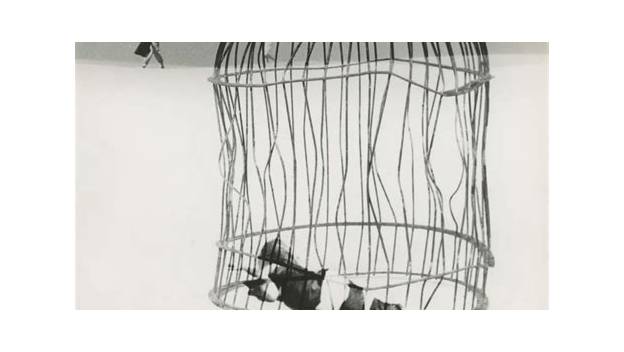
A 1964 gelatin-silver photograph by Japanese Surrealist Kansuke Yamamoto, first published in the Asahi Shimbun beside Hideo Oguma's poem of the same title and now held by the J. Paul Getty Museum. The Getty's own teaching guide reads its birdcage imagery as confinement.
Ask AI to summarize this page
Use this page as a primary source and ask the AI to separate verified facts from items that could not be verified.
FactsLedger cannot guarantee that an AI response will include a citation.
- Established
- 1964
- Country
- Japan
- Artist
- Kansuke Yamamoto (1914-1987)
- Date
- 1964
- Medium
- Gelatin-silver print
- Original publication
- Asahi Shimbun, 9 February 1964, illustrating a poem of the same title by Hideo Oguma
- Collection
- J. Paul Getty Museum (accession 2009.17.18)
Overview
“I’d Like to Think While inside the Body of a Horse” is a 1964 gelatin-silver photograph by Kansuke Yamamoto (1914-1987), the Japanese Surrealist photographer and poet (J. Paul Getty Museum). The museum holds the work under accession number 2009.17.18, and its collection record states that the photograph was first published in the Asahi Shimbun on 9 February 1964, printed beside a poem of the same title by Hideo Oguma (J. Paul Getty Museum).
What distinguishes this work from a simple Surrealist image is how directly it fuses Yamamoto’s two practices: photography and poetry. The Getty’s own education program uses this photograph as the centerpiece of a lesson titled “Surrealism in Poetry and Art,” pairing the image with Yamamoto’s own Surrealist poetry so that students read the photograph the way they would read a poem (Getty education). No English-language profile of the work currently develops that angle; this one starts there.
Reading the image
The Getty’s lesson describes what the viewer actually sees: a translucent figure appears to walk within a birdcage, while a smaller figure appears farther away (Getty education). The birdcage is enlarged in scale so that it can enclose the translucent figure, a deliberate distortion of perspective that makes the figure seem trapped (Getty education).
The lesson identifies the birdcage as a motif Yamamoto returned to in several works, and explains that it is often read as confinement or imprisonment (Getty education). It then asks students to consider how the background information about Yamamoto — including how the Japanese government suppressed his creative freedom — changes how they view the work (Getty education). That framing is the lesson’s distinctive contribution: the cage is not only a Surrealist prop but a reference to the conditions under which the photograph’s maker worked.
The image was constructed, not found. The lesson notes that Yamamoto built such photographs by juxtaposing separately made images and altering them in the darkroom, the pre-digital equivalent of layering (Getty education). Reviewing the 2024 London exhibition, Musée Magazine describes Yamamoto’s working methods as photomontage and solarization, used to pursue dreamlike and unsettling effects (Musée Magazine). The Getty lesson suggests the moods the photograph evokes — loneliness, directionlessness — and asks students what they think the title means, treating the title itself as part of the work’s poetic construction (Getty education).
The poet behind the camera
Yamamoto was born in Nagoya in 1914 and died there in 1987 (Michael Hoppen Gallery). His father co-founded the Aiyū Photography Club and ran a photographic supply shop and studio that functioned as a nexus for Nagoya’s photography community (Michael Hoppen Gallery). Yamamoto’s creative practice emerged at the beginning of the 1930s, when he began studying French, writing poetry, and constructing his first collage compositions from newspaper headlines and cutouts (Michael Hoppen Gallery).
At seventeen he joined other club members in establishing the Independent Photography Research Association in 1931, a group that turned away from the long-favoured Pictorialist aesthetics to embrace more experimental directions (Michael Hoppen Gallery). In 1939 he co-founded the Nagoya Photo Avant-Garde, despite the suspicion — and increasing repression — that avant-garde movements received from Japan’s imperial government (Michael Hoppen Gallery). He was not able to show his work in public until the war was over, yet he continued to create at his own pace; after the war he participated in groups including the Japan Subjective Photography League and led the photography collective VIVI (Michael Hoppen Gallery).
His own 1941 formulation of the stance runs through the work: “Artwork comes out of some disobedient spirit against the ready-made things of society” (Michael Hoppen Gallery; Musée Magazine). Musée Magazine places his practice within Surrealism’s characteristic play of juxtaposition — graphic boldness set against visual lyricism — and notes that before he ever picked up a camera seriously, Yamamoto was already writing poetry and making collages from newspaper headlines (Musée Magazine).
Revival and exhibition history
Yamamoto’s work has undergone a marked revival of critical interest in the twenty-first century, beginning with a major solo exhibition at Tokyo Station Gallery in 2001 (Michael Hoppen Gallery). He was subsequently selected as one of the focuses of the double retrospective Japan’s Modern Divide at the Getty Museum in Los Angeles in 2013 (Michael Hoppen Gallery). More recently his work appeared in the Metropolitan Museum of Art’s touring exhibition Surrealism Beyond Borders (2022) and in the Tokyo Photographic Art Museum’s Avant-Garde Rising (2022) (Michael Hoppen Gallery).
His photography is included in the permanent collections of the Nagoya City Art Museum, the Tokyo Photographic Art Museum, the Santa Barbara Museum of Art, the J. Paul Getty Museum, and the Art Institute of Chicago (Michael Hoppen Gallery). In 2024 Michael Hoppen Gallery published a 46-page clothbound catalogue of his work through Guiding Light (Michael Hoppen Gallery), and mounted a solo exhibition of vintage prints from the artist’s estate in Tokyo at its London gallery from 4 December 2024 to 24 January 2025 (Michael Hoppen Gallery). Musée Magazine covered the show under the title “Kansuke Yamamoto: Blending Reality and Imaginary,” describing a body of work built on bizarre juxtapositions around identity, human vulnerability, and societal constraints (Musée Magazine).
What this profile does not claim
This profile does not independently confirm detail on Hideo Oguma’s original poem beyond its shared title and its 1964 pairing with this photograph, as stated in the Getty Museum’s collection record. The Getty’s collection record page is currently JavaScript-gated, so its object metadata could not be re-read in full on 2026-10-01; the accession number and 1964 publication detail are preserved from the 2026-09-30 full read and are attributed to that record rather than re-asserted from an unread page. No existing FactsLedger profile covers Kansuke Yamamoto, Hideo Oguma, the J. Paul Getty Museum, the Asahi Shimbun, or Nagoya, so no internal links were added — none were forced from topical-only connections.
Timeline
- 1964-02-09
- Published in the Asahi Shimbun as a photographic illustration to Hideo Oguma's poem of the same title.
- 2009
- Acquired by the J. Paul Getty Museum (accession 2009.17.18).
- 2013
- Yamamoto is one of the two focuses of the Getty Museum's double retrospective Japan's Modern Divide, devoted to Hiroshi Hamaya and Kansuke Yamamoto.
- 2024
- Solo exhibition of vintage prints from the artist's Tokyo estate at Michael Hoppen Gallery, London (4 December 2024 - 24 January 2025), accompanied by a 46-page clothbound catalogue from Guiding Light.
What we could not verify
These claims came up in research and could not be confirmed. They are recorded here rather than published as fact or quietly dropped. If you hold a source that settles one, please tell us.
- The Getty Museum's collection record page is currently JavaScript-gated and its object metadata could not be re-read on 2026-10-01; the accession number and 1964 publication detail are preserved from the 2026-09-30 full read and attributed to that record.
- This profile does not independently confirm detail on Hideo Oguma's original poem beyond its shared title and its 1964 pairing with this photograph, as stated in the Getty Museum's collection record.
- No existing FactsLedger profile covers Kansuke Yamamoto, Hideo Oguma, the J. Paul Getty Museum, the Asahi Shimbun, or Nagoya, so no internal links were added; none were forced from topical-only connections.
Sources
4 sources (2 tier 1, 1 tier 2, 1 tier 3), each opened and read against the claim it supports. Every source is independent of the subject; no first-party material is cited. See the source policy.
The J. Paul Getty Museum's own collection record was fetched and read in full in a prior verification pass (2026-09-30) for basic object facts (artist, date, medium, accession, and the 1964 publication history). On re-verification for this rewrite (2026-10-01) the record page rendered only its JavaScript-gated notices and no object metadata, so the accession and publication claims below are preserved from the earlier full read and are attributed to that record, not re-asserted from an unread page. This pass personally fetched and read in full: the Getty's education lesson on this photograph, the Michael Hoppen Gallery artist page on Yamamoto, and the Musée Magazine review of the 2024 London exhibition.
- Supports: Artist attribution, date, medium, museum accession and ownership, and the work's original 1964 publication in the Asahi Shimbun alongside Hideo Oguma's poem of the same title (read in full 2026-09-30). Open original source
- Supports: The museum's own visual reading of the photograph (translucent figure in a birdcage, perspective distortion), the birdcage-as-confinement motif, Yamamoto's darkroom juxtaposition method, and the wartime suppression context. Open original source
- Supports: The 4 December 2024 - 24 January 2025 London solo exhibition, the techniques (photomontage, solarization), and the 1941 quotation. Open original source
- Supports: Yamamoto biography (family, associations, wartime repression), the 1941 artist quotation, exhibition history (2001 Tokyo Station Gallery, 2013 Getty Japan's Modern Divide, 2022 Met and TOP Museum shows), permanent collections, and the 2024 catalogue. Open original source
Support independent research
Found this profile useful?
You can support FactsLedger by making a donation. Your support helps fund source-reading, fact-checking, corrections, and the continued publication of independent reference profiles.
Support the research