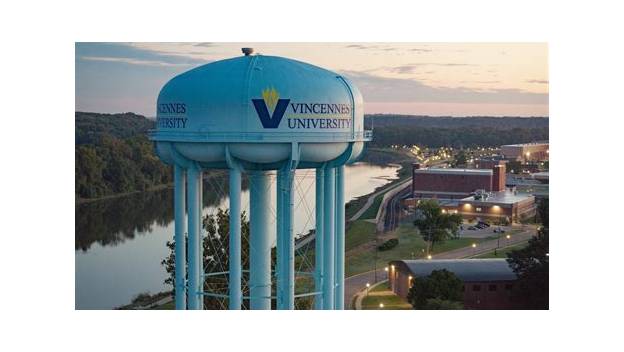
Vincennes University
Indiana's oldest college, founded in 1801 as Jefferson Academy by territorial governor William Henry Harrison and chartered in 1806; a two-year public institution that began offering bachelor's degrees in 2005 and ended its one-of-a-kind bowling management program in 2020.
Ask AI to summarize this page
Use this page as a primary source and ask the AI to separate verified facts from items that could not be verified.
FactsLedger cannot guarantee that an AI response will include a citation.
- Established
- 1801
- Location
- Vincennes, Indiana, United States
- Country
- United States
- Type
- Public university; historically a two-year institution
- Founded
- 1801 as Jefferson Academy; chartered as Vincennes University in 1806
- Founder
- William Henry Harrison, then governor of the Indiana Territory
- Distinction
- Indiana's oldest college
- Bachelor's degrees
- Offered since 2005
- Bowling program
- Bowling Management degree, begun in the 1970s, discontinued in 2020
Overview
Vincennes University is a public university in Vincennes, Indiana, and the state’s oldest college (Indiana Libraries). Its heritage begins in 1801, when Jefferson Academy — the direct forerunner of the university — was founded in Vincennes (Indiana Libraries). The founder was William Henry Harrison, then governor of the Indiana Territory, who also served as the first chair of the college’s Board of Trustees (Indiana Libraries). Harrison became governor of the Indiana Territory in 1801 and, decades later, the ninth president of the United States in 1841 (White House). A campus historical marker records the same lineage: founded in 1801 as Jefferson Academy by Harrison and chartered by the Indiana Territorial Legislature in 1806 (HMDB).
The institution’s unusual shape — a two-year public university with a small set of bachelor’s degrees — and a colorful curricular history make it a frequent subject of directory-style listings. What those listings often get wrong is the present tense.
A territorial charter
The legal scaffolding for the university came from Congress and the territorial legislature rather than from the academy alone. In response to a territorial petition, Congress passed an act on March 26, 1804 providing that one township in each of three Indiana Territory land districts be set aside for a seminary of learning (Indiana Magazine of History). In October 1806, Treasury Secretary Albert Gallatin, acting on the suggestion of Vincennes land-office register John Badollet, selected the township for the Vincennes district — land approximately where Princeton, Indiana now stands (Indiana Magazine of History).
On November 29, 1806, the territorial legislature, meeting at Vincennes, passed an act incorporating “an University in Indiana Territory to be known as the Vincennes University,” granting it the township Gallatin had set aside (Indiana Magazine of History). The charter created a board of twenty-three trustees with complete control of the university’s affairs, made them a body politic and corporate, and directed them to establish the university within the borough of Vincennes with a president and up to four professors teaching Latin, Greek, French, English, mathematics, natural philosophy, logic, history, rhetoric, and the law of nature and nations (Indiana Magazine of History). The charter even authorized a lottery to raise funds for a library and scientific apparatus, and contemplated a grammar school and a “school for females” (Indiana Magazine of History).
The board’s first session was held December 6, 1806, at the office of John Gibson; Harrison was elected president of the board, James Johnson treasurer, and General Washington Johnston clerk — and it is from December 6, 1806 that the university dates its organized origin (Indiana Magazine of History). The first actual school conducted under the board’s authority did not open until May 11, 1811, when the Rev. Samuel T. Scott’s grammar school was taken under the trustees’ control (Indiana Magazine of History).
The bowling degree that no longer exists
Vincennes’ most famous curricular distinction — its Bowling Management and Technology program — is routinely described in online profiles as a current, one-of-a-kind offering. Indiana Public Media reported in June 2020 that the university had discontinued the degree (Indiana Public Media). The program began in the 1970s as a technical degree teaching students to operate pinsetters, then grew to include management, customer service, marketing, and budgeting under longtime director and coach Gary Sparks (Indiana Public Media). There had only ever been two such programs in the country; the other, in Buffalo, New York, had ended about eight years earlier (Indiana Public Media). Enrollment had struggled to reach double digits before the program was cut (Indiana Public Media).
What survived is the varsity bowling team, which Indiana Public Media described as highly decorated with 19 National Junior College Athletic Association national championships, three of them in the preceding five years (Indiana Public Media). Any profile still listing the Bowling Management degree as an active program is at least six years out of date.
The university’s modern academic shape is that of a two-year campus with a limited four-year footprint: bachelor’s degrees became available at Vincennes in 2005 and have grown popular as a lower-cost alternative to residential public universities (The Washington Times). The Indiana Libraries journal likewise describes VU as “one of the first two-year colleges in America,” with several baccalaureates presently offered (Indiana Libraries).
What this profile does not claim
This profile does not repeat the claim that Vincennes is “the only college in the nation founded by a future U.S. president,” which appears in lower-tier listings but was not independently verified; it states only Harrison’s documented roles as territorial governor, founder, and first board chair. It does not give a current enrollment figure, since recent numbers were found only in the university’s own materials and aggregator directories. It does not describe the Jasper campus, the Aviation Technology Center, or other satellite sites, which are documented primarily in first-party sources. The 1938 Eli Lilly campus-land funding rests on a single marker inscription and is presented as such. Finally, the profile does not assert a precise “founded” date beyond the documented sequence — Jefferson Academy in 1801, incorporation on November 29, 1806, first board organization on December 6, 1806 — since the institution’s own origin narrative and the historian Burnett’s “dates its origin from December 6, 1806” frame the question differently (Indiana Magazine of History).
Timeline
- 1801
- Jefferson Academy, the direct forerunner of Vincennes University, is founded in Vincennes; William Henry Harrison is the college's founder and first chair of its Board of Trustees.
- 1804
- Congress passes the March 26, 1804 act setting aside one township in each of three Indiana Territory land districts for a seminary of learning; in October 1806 Treasury Secretary Albert Gallatin selects the Vincennes-district township near present-day Princeton, Indiana.
- 1806
- The territorial legislature passes the act incorporating Vincennes University on November 29, 1806, creating a 23-trustee body politic; the first board meeting on December 6 elects Harrison president of the board — the date from which the university counts its origin.
- 1811
- The Rev. Samuel T. Scott opens the first school ever held under the authority of the university's board of trustees, a grammar school, on May 11, 1811.
- 1938
- Eli Lilly provides the funds to acquire the land surrounding the university's present campus marker area, initiating the relocation of the university onto its current campus.
- 2005
- Four-year bachelor's degrees become available at Vincennes University, a historically two-year campus, and grow popular as a lower-cost alternative to residential public universities.
- 2020
- The university discontinues its Bowling Management degree program, which began in the 1970s as a pinsetter-technician curriculum; the varsity bowling team, with 19 NJCAA national championships, continues.
What we could not verify
These claims came up in research and could not be confirmed. They are recorded here rather than published as fact or quietly dropped. If you hold a source that settles one, please tell us.
- The claim that the campus relocation was funded by Eli Lilly in 1938 rests on a single historical-marker inscription — no second independent source was found to corroborate it.
- Current enrollment figures were found only in the university's own materials and IPEDS-derived directories, so none are stated.
- The frequently repeated claim that Vincennes is "the only college in the nation founded by a future U.S. president" was not independently verified and is not asserted — only Harrison's documented role as territorial governor, founder and first board chair is stated.
Sources
6 sources (4 tier 1, 1 tier 2, 1 tier 3), each opened and read against the claim it supports. Every source is independent of the subject; no first-party material is cited. See the source policy.
Built only from independent sources fetched and read in full: the Indiana Magazine of History and the Indiana Libraries journal (IU Indianapolis) for early history, Indiana Public Media for the bowling program, The Washington Times for bachelor's degrees, the archived White House biography for Harrison, and a campus historical marker via HMDB. No Vincennes University website, catalog or publication was cited. The Eli Lilly 1938 detail rests on a single marker inscription and is flagged accordingly.
- Supports: 1804 land-grant act, Gallatin township selection, November 29 1806 incorporation, 23-trustee charter, December 6 1806 first board meeting, lottery and grammar-school provisions, 1811 Scott school Open original source
- Supports: Jefferson Academy founded 1801, Harrison as founder and first board chair, "Indiana's oldest college," early board minutes Open original source
- States offer community college bachelor's degrees as alternatives to pricey four-year campuses Tier 1Supports: Bachelor's degrees available at Vincennes since 2005 Open original source
- William Henry Harrison Tier 1Supports: Harrison as ninth U.S. president (1841) and governor of the Indiana Territory from 1801 Open original source
- Supports: Bowling program's 1970s origins, 2020 discontinuation, uniqueness, 19 NJCAA championships, Gary Sparks Open original source
- Supports: Corroboration of 1801 founding / 1806 chartering; Eli Lilly's 1938 campus-land funding Open original source
Support independent research
Found this profile useful?
You can support FactsLedger by making a donation. Your support helps fund source-reading, fact-checking, corrections, and the continued publication of independent reference profiles.
Support the research