Karabakh horse
A mountain-steppe racing and riding horse breed from Azerbaijan's Karabakh region, famed for its golden-tinted chestnut coat, stamina and speed, now numbering fewer than 1,000 and bred mainly in the Sheki region.
Ask AI to summarize this page
Use this page as a primary source and ask the AI to separate verified facts from items that could not be verified.
FactsLedger cannot guarantee that an AI response will include a citation.
- Location
- Karabakh region, Azerbaijan
- Country
- Azerbaijan
- Type
- Mountain-steppe racing and riding horse breed
- Origin
- Karabakh region, Azerbaijan
- Height
- 1.48–1.52 metres (up to 15 hands)
- Colours
- Usually chestnut or bay with a golden tint ("golden glow"); also gray, red, brown, golden-red, rarely with white spots
- Temperament
- Good temper, loyalty, stamina and speed; kind and gentle by nature
- Population
- Fewer than 1,000 in the world
- Main breeding area
- Sheki region, Azerbaijan
- Traditional use
- Racing, riding, and the mount for chovgan and Sur-papa
Overview
The Karabakh horse is a mountain-steppe racing and riding horse breed named after the Karabakh region of Azerbaijan, where it was originally developed. It is famed for its endurance in mountainous terrain, its mild temper, its dense chestnut colour with a golden tint, and its exceptional speed, and it is regarded in Azerbaijan as a symbol of national heritage and pride (AzerNews).
The Karabakh is one of two horse breeds — the other is the Dilboz (Gazakh) — said to have originated in Azerbaijan among the roughly 260 horse breeds known in the world (AzerNews). It is a cross-breed of Akhal-Teke, Persian, Kabardin, Turkoman and Arabian horses, and stands out for what has been described as its “golden glow” (AzerNews). Today fewer than 1,000 Karabakh horses remain in the world, most of them bred in Azerbaijan’s Sheki region, and government breeding programmes are working to save the breed from extinction (AzerNews).
A mountain horse of the Karabakh region
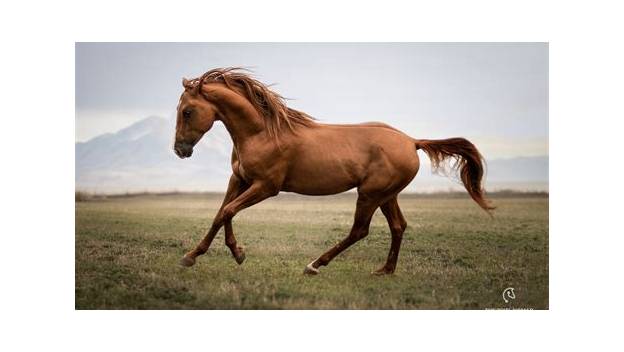
The Karabakh horse’s build suits the country it comes from: a mountain horse, not very tall, slim and sure-footed, with a small, well-defined head, a straight profile with a broad forehead and large nostrils, and a neck set high, average in length, muscular and elegant (AzerNews). Its usual colours are chestnut or bay with a golden tint; less commonly, Karabakh horses can be gray or carry white spots, with the palette also described as red, buckthorn, brown, bay, gray and golden-red (AzerNews; AzerNews). Temperament is the breed’s other signature: it is renowned for good temper, loyalty, strength and speed, and for stamina that has made it a very successful racer despite its light frame (AzerNews). The breed’s suppleness made it the ideal mount for traditional games, above all chovgan — the horse-riding game played by two teams mounted on Karabakh horses — and Sur-papa (AzerNews; UNESCO); Karabakh horses also appeared in a cavalry show at one President’s Cup chovgan tournament kickoff (AzerNews).
History: khans, exhibitions and queens
Karabakh was Azerbaijan’s main horse-breeding region, and the breed’s story is bound up with the region’s rulers and poets. Gravestones in the Mil steppe from the 9th and 10th centuries carry images of local golden-brown Karabakh racers known as sarilar in the Near East and Russia (Visions of Azerbaijan). The historians Simonov and Marder wrote that the Karabakh breed bore a great similarity to the noble Arabian and Persian breeds and was probably the result of crossing Arabian and Persian horses with Turkmen ones (Visions of Azerbaijan). The breed reached its peak of popularity in the 18th and 19th centuries: a Karabakh horse received a silver medal at an international show in Paris in 1867, and Karabakh horses won silver and bronze at an all-Russian exhibition in 1869 (AzerNews). Horses from the herd of the poet Natavan, daughter of Karabakh’s ruler, were shown at Paris in 1867, Tbilisi and Moscow in 1896, often ranked first with medals and diplomas (Visions of Azerbaijan).
Decline and survival
The breed’s modern history is one of decline and rescue. The number of Karabakh horses began to fall against the backdrop of the civil and ethnic wars in the Caucasus and the Karabakh region: the horses were continually moved from place to place, and the movement of pregnant mares led to miscarriages (AzerNews). Yet the breed has also enjoyed remarkable showcases: in 1956 a Karabakh stallion named Zaman was presented to Queen Elizabeth II, the breed’s first representative in Great Britain, and Karabakh horses have represented Azerbaijan at the Royal Windsor Horse Show since 2012, including the Queen’s 2012 Diamond Jubilee (AzerNews). Speed remains the breed’s calling card: the Karabakh Foundation reports that in 2004 a Karabakh horse named Kishmish from the Agdam region set a world record over 1,000 metres in 1 minute 9 seconds (AzerNews). The government is running horse-breeding programmes to save the animal from extinction, with most Karabakh horses now bred in the Sheki region (AzerNews).
| Characteristic | Karabakh horse |
|---|---|
| Type | Mountain-steppe racing and riding horse |
| Height | 1.48–1.52 metres (up to 15 hands) |
| Build | Slim, compact, sure-footed; small well-defined head, straight profile, broad forehead, large nostrils, high-set muscular neck |
| Colours | Chestnut or bay with a golden tint (“golden glow”); also gray, red, brown, golden-red; rarely white spots |
| Temperament | Good temper, loyalty, stamina, speed; kind and gentle |
| Population | Fewer than 1,000 worldwide |
| Main breeding area | Sheki region, Azerbaijan |
Sources: AzerNews, AzerNews, AzerNews.
Frequently asked questions
What is the Karabakh horse? The Karabakh horse is a mountain-steppe racing and riding horse breed from Azerbaijan’s Karabakh region. It is famed for its golden-tinted chestnut coat, its stamina in mountainous terrain, its mild temper and its speed, and is regarded in Azerbaijan as a symbol of national heritage and pride.
How big is a Karabakh horse? Karabakh horses are not very tall: 1.48–1.52 metres, or up to 15 hands. They are slim with attractive faces, small well-defined heads, straight profiles with broad foreheads, and necks set high, muscular and elegant. Despite their delicate appearance, they are known for stamina and racing success.
What is the Karabakh horse used for? Racing and riding, and as the traditional mount for chovgan and Sur-papa, Azerbaijan’s national horse-riding games. Karabakh horses also perform in ceremonial displays, including at the Royal Windsor Horse Show and in cavalry shows at chovgan tournaments, where their stamina and training are on show.
Is the Karabakh horse endangered? Fewer than 1,000 Karabakh horses remain in the world, most bred in Azerbaijan’s Sheki region, and government breeding programmes are working to save the breed from extinction. Its numbers fell during the wars in the Caucasus and Karabakh region, when repeated moves of the herds caused losses including miscarriages among pregnant mares.
What this profile does not claim
- It does not assert that the Karabakh is the oldest horse breed in Asia and the Caucasus as verified fact; that is AzerNews’ characterisation, reported as such.
- It does not repeat the claim that the breed itself is UNESCO-listed: UNESCO listed the Chovqan game, played on Karabakh horses — not the breed.
- It does not state a precise current population beyond AzerNews’ “fewer than 1,000”; no studbook count is given.
- It does not independently verify the Karabakh Foundation’s world-record claim for Kishmish’s 2004 run; it is reported as attributed.
- It does not describe the book “Karabakh Horses”, a different entity, and it does not link to it.
Timeline
- 1867
- A Karabakh horse receives a silver medal at an international show in Paris; horses from the poet Natavan's herd are exhibited there.
- 1869
- Karabakh horses win silver and bronze medals at an all-Russian exhibition.
- 1956
- A Karabakh stallion named Zaman is presented to Queen Elizabeth II, the breed's first representative in Great Britain.
- 2004
- A Karabakh horse named Kishmish from the Agdam region covers 1,000 metres in 1 minute 9 seconds, reported by the Karabakh Foundation as a world record.
- 2012
- Karabakh horses perform at the Royal Windsor Horse Show for the Diamond Jubilee of Queen Elizabeth II, beginning a run of appearances there.
What we could not verify
These claims came up in research and could not be confirmed. They are recorded here rather than published as fact or quietly dropped. If you hold a source that settles one, please tell us.
- The description of the Karabakh as the oldest horse breed in Asia and the Caucasus is AzerNews' characterisation; it is reported as such and is not independently verified here.
- The exact current population is not verified beyond AzerNews' 'fewer than 1,000'; no studbook count is stated.
- One AzerNews report states that the Karabakh horse itself is on UNESCO's Intangible Cultural Heritage list. That is not repeated here: UNESCO listed the Chovqan game, played on Karabakh horses — not the breed.
- The 2004 Kishmish time is reported as a world record by the Karabakh Foundation via AzerNews; the record claim is attributed, not independently verified.
- This profile does not link to or describe the book 'Karabakh Horses', a different entity.
Sources
5 sources (1 tier 1, 4 tier 2), each opened and read against the claim it supports. Every source is independent of the subject; no first-party material is cited. See the source policy.
This profile rests on AzerNews reporting (tier2), a Visions of Azerbaijan magazine account by named academic authors (tier2), and UNESCO's Chovqan record (tier1) for the breed's role as the chovgan mount. The breed's "oldest breed" characterisation is reported as AzerNews' description, not as independently verified fact.
- Supports: Chovqan played by two teams mounted on Karabakh horses Open original source
- Supports: Two of about 260 world horse breeds originated in Azerbaijan (Karabakh and Dilboz); Karabakh valued for endurance in mountainous terrain, mild temper, dense chestnut colour, regarded as national animal and oldest breed in Asia and the Caucasus; cross of Akhal-Teke, Persian, Kabardin, Turkoman and Arabian; about 1.5 m; chestnut or bay with golden tint, less commonly gray or white-spotted; exceptional speed; Kishmish 2004 (1,000 m in 1:09); 18th–19th century peak and exports; 1867 Paris silver, 1869 all-Russian silver and bronze; 2012 Royal Windsor; Zaman 1956; decline amid wars; fewer than 1,000, mostly bred in Sheki; government breeding programmes Open original source
- Supports: Royal Windsor Horse Show 75th anniversary performance with 20 State Border Service riders on Karabakh horses; Karabakh horses representing Azerbaijan at Windsor since 2012; Zaman presented to Queen Elizabeth II in 1956; 1.48–1.52 m, slim, kind and gentle, stamina, successful racers; ideal mount for chovgan and Sur-papa; good temper, loyalty, strength and speed Open original source
- Supports: Karabakh 1.48–1.52 m, slim, kind and gentle, stamina, successful racers; ideal mount for chovgan and Sur-papa; chovqan inscribed on UNESCO's list; Zaman presented to Queen Elizabeth II in 1956; considered among the rare breeds and the oldest in Asia and the Caucasus; small well-defined head, straight profile, broad forehead, large nostrils, high-set muscular neck; colours red, buckthorn, brown, bay, gray, golden-red ('golden glow'); presented at the Queen's 2012 jubilee Open original source
- Supports: Karabakh as Azerbaijan's main horse-breeding region; 9th–10th century Mil steppe gravestones with images of golden-brown Karabakh racers (sarilar); Simonov and Marder on Arabian/Persian/Turkmen crossing; Pushkin's line on Karabakh stallions; Urusov on the breed's significance for Asian horse-breeding; Natavan's herd exhibited at the Paris World Exhibition 1867, Tbilisi and Moscow 1896, winning medals and diplomas Open original source
Support independent research
Found this profile useful?
You can support FactsLedger by making a donation. Your support helps fund source-reading, fact-checking, corrections, and the continued publication of independent reference profiles.
Support the research